
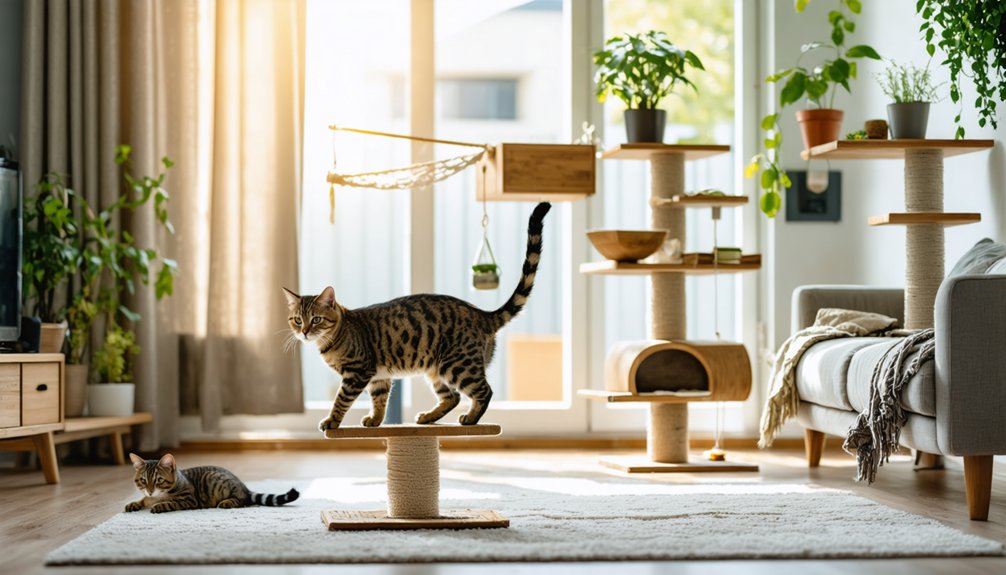

Indoor cat owners are improving sleep, play, and health with smarter enhancement. Popular upgrades include LED chase toys, rotating teasers, and puzzle feeders that slow eating, aid digestion, and burn energy. Cat trees, shelves, and window perches add climbing, observation, and stress relief. Quiet retreat zones, separate bedding, and well-placed scratchers support rest and reduce conflict. Predictable play routines and sensory rotation help prevent boredom, nighttime activity, and behavior problems. More practical upgrades follow.
Highlights
- Owners are upgrading to motion toys, teaser wands, and rotating play schedules to keep indoor cats active and prevent boredom.
- Puzzle feeders, lick mats, and treat-dispensing toys turn meals into enrichment while slowing eating and supporting digestion and weight control.
- Cat trees, wall shelves, and window perches create vertical territory that boosts exercise, confidence, and stress relief.
- Quiet rest zones with soft bedding, privacy, and comfortable temperatures help indoor cats sleep better and feel secure.
- Scratchers, hideaways, scent rotation, and predictable play routines reduce stress, protect furniture, and encourage calmer behavior.
Upgrade Cat Play for Better Night Sleep
Upgrade evening play to help an indoor cat settle more easily at night. Evidence suggests visually engaging, low-noise toys can channel predatory energy before bedtime without disrupting the household.
LED light-up balls create glowing targets that remain visible in dim rooms, encouraging repeated chasing and pouncing. Glowing teaser wands add guided movement that supports leaping, stretching, and prey-style stalking in a way many cats readily join. Many motion toys use auto-shutoff features to preserve battery life after a set activity period. Short play sessions several times a day can also improve health and mental stimulation for indoor cats.
Silent foam balls are especially useful in shared homes. Their soft, lightweight design rolls quietly, avoids loud impacts, and still supports batting, carrying, and tossing. For cats needing extra visual stimulation, a Nighttime laser can prompt short bursts of movement in darker spaces. A battery-powered laser toy with 360° rotation can add unpredictable movement that keeps a cat alert and active before bed.
Durable glowing toys, bright colors, and quiet materials help families build a calming, cat-inclusive evening routine before lights-out.
Use Smart Cat Toys to Burn Energy
Beyond evening play, smart cat toys add another effective way to help indoor cats burn excess energy throughout the day.
A well-chosen Smart Toy uses motion, speed changes, and unpredictable pauses to mimic prey, sustaining attention longer than static options.
This richer Interactive Play helps reduce boredom, stress, weight gain, and destructive behavior while supporting sharper mental focus. Toys that mimic prey behavior provide a safe outlet for natural hunting instincts while improving agility and coordination.
Automatic rolling balls, mimic mice, smart teasers, and mini robots encourage chasing, stalking, pouncing, and bunny kicking without constant human operation.
For households wanting cats to feel engaged and included in daily routines, rotating toys helps prevent Burnout and maintains interest. Puzzle toys also add problem-solving stimulation that helps deter boredom-driven mischief.
Evidence suggests regular active sessions lower obesity risk and improve overall health.
Models such as Wicked Ball or Wicked Mouse PLUS can extend independent activity and promote consistent Energy release indoors.
Add Puzzle Feeders for Play and Digestion
Add puzzle feeders to turn mealtime into structured enhancement that supports both play and digestion. This form of enrichment feeding mimics hunting, provides mental stimulation, and helps indoor cats stay engaged when people are busy.
Evidence links puzzle feeding with fewer boredom behaviors, less stress, and better confidence, including in seniors and cats with disabilities. A clear feeder with wide openings makes easy access more obvious at first, helping cats learn through sight, scent, and sound.
Puzzle feeders also slow fast eaters, encouraging smaller mouthfuls that improve digestion and reduce regurgitation in scarf-and-barf cats. They support portion control, daily movement, and healthier weight management through pawing, chasing, and rolling. They can also replace a standard bowl with work-for-food feeding that taps natural instincts.
Brain feeding can use dry or wet food, and many cats can receive their full ration this way. Lickimats are a wet-food option that let cats lick wet food or palatable pastes for added enrichment.
Starting with simple tubes or balls, then increasing challenge gradually, helps households create a routine cats can succeed in confidently every day.
Build Vertical Spaces Indoor Cats Actually Use
Food enhancement works best when the rest of the home also supports natural feline behavior, and vertical space is one of the most effective upgrades for indoor cats. Research in the Journal of Feline Medicine and Surgery found raised territory lowers stress by supporting climbing, observation, and retreat. This preference is rooted in ambush-predator instinct, which drives cats to seek elevated places for safety and surveillance.
Indoor cats use vertical areas most when climbing pathways feel stable, reachable, and integrated into shared rooms. Thoughtful perch placement helps cats monitor activity, avoid dogs or children, and remain part of the household without feeling exposed. Window perches can add changing sensory stimuli through sunlight, outdoor views, and neighborhood sounds. Placing perches in front of windows is especially effective because sunlit viewing spots are a natural favorite for many cats.
In multi-cat homes, height also reduces conflict by creating separate territory without using more floor space. Cat trees, anchored shelves, and wide platforms at varied heights encourage movement, support healthy weight, and build confidence. Well-designed vertical territory helps cats feel secure, capable, and at home.
Set Up Window Perches for Daily Stimulation
Why do window perches matter so much for indoor cats? A well-placed window perch supports daily stimulation by giving cats elevated observation of birds, weather, and neighborhood movement. This visual access aligns with feline surveillance instincts, reduces boredom, and can lessen behavior problems linked to under-stimulation. It also creates safe outdoor viewing without exposure to traffic, predators, or disease. Many cat owners choose a perch with a secure, sun-filled seat to make daily viewing even more appealing.
Selection should match window type, cat size, and expected use. PetSmart carries several window-perch options, including single-level, double-level, and even multi-level designs for multiple cats. The K&H EZ Mount Window Kitty Sill Double Stack offers a double-level perch option at a current price of $46.98. Suction cup models suit renters and simple installation, while bracket-mounted designs offer greater long-term stability. Adjustable frames, padded surfaces, and hammock-style construction improve comfort and weight distribution. Machine-washable covers simplify upkeep. For stronger cat, households often choose windows with frequent activity and sunlight, ensuring panoramic views, warmth, and enough space for stretching or multiple cats.
Create Quiet Rest Zones for Indoor Cats
Alongside visual stimulation from window perches, indoor cats also benefit from protected areas dedicated to uninterrupted rest. Effective zones are placed in bedrooms, guest rooms, or back rooms away from kitchens, televisions, and appliances. Keeping ambient noise below 55 decibels can lower stress hormones by 20 percent, supporting calmer sleep and steadier behavior.
Comfort improves when each cat has a separate bed, mat, or enclosed hideaway lined with fleece, felt, faux fur, or Aromatic bedding carrying familiar scent. Ambient soundscapes may soften unpredictable household noise when kept gentle. Rest areas work best at 68 to 72 degrees Fahrenheit, near windows for quiet observation yet apart from food and litter. Curtain dividers, shelves, cubes, or closable doors help create privacy and exclusive retreat status from dogs, children, and other cats. In multi-cat homes, providing multiple resting areas helps prevent territorial disputes and allows each cat to relax without competition.
Rotate Cat Toys to Prevent Boredom
Because indoor environments offer limited novelty, rotating toys on a set schedule helps preserve interest and reduces the boredom that often leads to furniture scratching, item knocking, and other destructive behaviors.
This approach supports stalking, chasing, and pouncing instincts while improving mental stimulation and overall well-being.
A practical system begins with taking inventory, dividing toys into groups, and storing unused items out of sight.
Many households use a weekly A-B-C pattern, though some cats benefit from faster changes.
Reintroduced toys often feel new again, especially when rotational variety includes feather wands, puzzle feeders, motion-activated mice, and treat-dispensing options.
Periodic additions of new textures or movement patterns further strengthen engagement.
Scentcycling, such as invigorating toys with catnip, silvervine, or grass, can also renew curiosity without increasing clutter or expense.
Support Senior Indoor Cats With Gentle Enrichment
Toy rotation remains useful in later life, but senior indoor cats often benefit most from enhancement that protects comfort while still engaging natural instincts. Easy puzzle feeders, snuffle mats, and simple foraging games support problem solving without overexertion, while treats should stay within 5 to 10 percent of daily calories.
Short wand sessions, ball track toys, and brief clicker practice help maintain muscle tone and joint mobility at a manageable pace. Window perches, sunny sills, and secure acrylic hammocks provide visual enrichment and restful basking. Mobility friendly ramps and step-equipped cat trees let older cats reach favored views with less strain. New blankets, cat grass, and occasional gentle massage can add sensory comfort, helping senior cats stay active, settled, and included in the household routine as needs change.
Add Scratching, Scents, and Hiding Spots
Why do many indoor cats ignore a new scratcher while returning to the sofa corner? Research points to material, stability, and placement. Cats prefer sisal, wood, rough fabric, or cardboard, offered in both vertical and horizontal forms. Posts placed near windows, nap areas, and daily pathways are used far more often than those tucked away. Multiple sturdy options also reduce conflict and furniture damage.
Scent cues and refuge complete the upgrade. Scented scratching with catnip, silver vine, or Feliscratch helps communicate where claws belong; rotating herbs biweekly helps maintain interest, and praise reinforces use. Hidden retreats such as closets, crates, high shelves, or under‑bed spaces support security, especially in multi‑cat homes. Scratchers with built‑in hideaways save space while reducing stress‑related behaviors and promoting household harmony.
Fix Boredom Behaviors With Cat Enrichment
When indoor cats lack outlets for stalking, chasing, foraging, and problem-solving, boredom often appears as nighttime activity, overgrooming, pestering, or destructive habits.
Effective interactive enhancement addresses those needs through daily wand or string play, toy rotation, and sessions that end with a successful “catch,” which research links to fewer nighttime disturbances.
Puzzle feeders, treat toys, and hidden kibble turn meals into foraging work that is more engaging than free feeding while slowing intake.
Short clicker sessions and simple tricks add cognitive challenge, often leading to calm naps afterward.
Sensory variety matters too: window bird viewing, calming music, new textures, rotated scents, and scent puzzles support curiosity without overwhelm.
A predictable routine with morning play and evening play-plus-meal helps many indoor cats feel secure, included, and settled.
References
- https://cheerble.com/blogs/cheerble-blog/keep-your-indoor-cat-happy-and-healthy
- https://mtairyvets.com/2025/11/15/enrichment-ideas-to-keep-indoor-cats-engaged/
- https://www.dakinhumane.org/blog-full/unlocking-a-better-life-for-your-indoor-cat-the-power-of-enrichment
- https://www.morningsideveterinary.com/keeping-indoor-cat-happy/
- https://bestfriends.org/pet-care-resources/best-indoor-cat-enrichment-ideas-toys-puzzles-and-more
- https://pmc.ncbi.nlm.nih.gov/articles/PMC3922041/
- https://vcahospitals.com/know-your-pet/cat-behavior-and-training—enrichment-for-indoor-cats
- https://www.lovingcareanimalhospital.net/indoor-enrichment-ideas-for-cats/
- https://www.jacksongalaxy.com/blogs/news/resolutions-for-a-healthy-cat-play-therapy
- https://www.animalhumanesociety.org/resource/seven-enrichment-ideas-keep-your-indoor-cat-entertained