
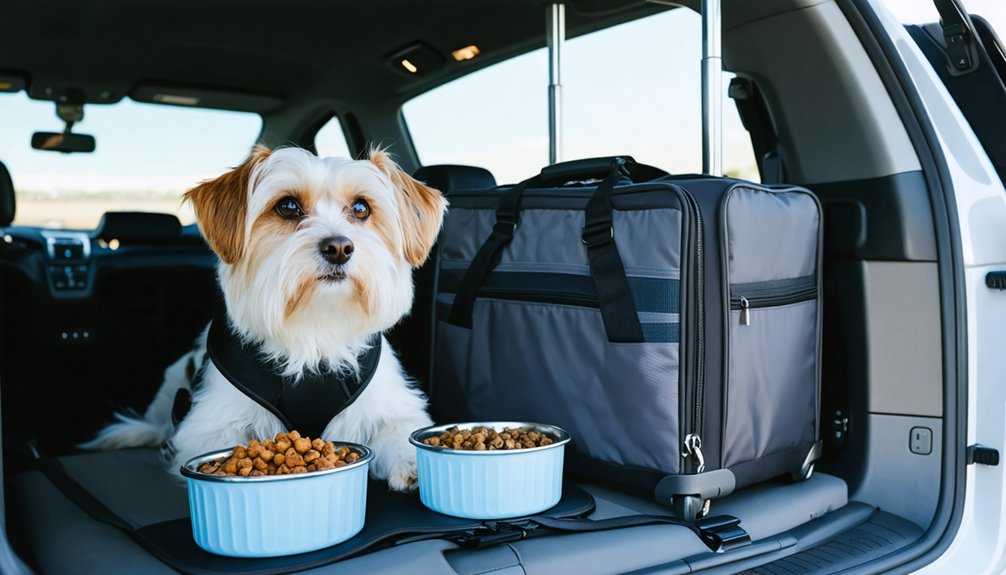

Tested travel pet products offer the best protection when they pair crash-certified restraints, secure carriers, and spill-resistant bowls. Top car harnesses include Sleepypod Clickit, Ruffwear Load Up, EzyDog Drive, and ZuGoPet, all evaluated with FMVSS 213-style crash methods or CPS certification. Hard-sided crates generally protect better in serious collisions, while airline-friendly soft carriers must fit under seats and vent on three sides. Portable silicone bowls with non-slip, leak-resistant designs simplify safer road trips. More specifics follow.
Highlights
- Crash-tested car restraints like Sleepypod Clickit, Ruffwear Load Up, and EzyDog Drive improve containment and reduce injury risk in 30 mph simulations.
- Prioritize CPS certification or FMVSS 213 testing, which measures forward excursion, rotation, stitching strength, buckle security, and tether integrity.
- Hard-sided crates offer better impact protection, rollover containment, and emergency evacuation outcomes than soft carriers during vehicle travel.
- Airline-friendly carriers should fit under seats, provide mesh ventilation on three sides, and let pets stand, turn, and lie down.
- Portable travel bowls work best when collapsible, food-grade silicone, dishwasher-safe, and designed to reduce spills during driving or rest stops.
What Travel Pet Products Passed Testing?
Which travel pet products actually passed testing? Verified options are limited, but several standouts give safety‑minded pet families confidence.
Among car leashes, the Sleepypod Clickit earned CPS 5‑star certification, while the Clickit Sport was crash‑tested for dogs 18 to 90 pounds. The Clickit Sport also uses dual seatbelt loops to help dogs sit, lie down, and shift more comfortably while restrained. Because there are no federal standards for pet harness crash testing, independently certified options carry added credibility. Only CPS certification confirms a product has met rigorous independent crash‑testing standards. EzyDog Drive was crash‑tested in Australia for 15 to 75 pounds, and Ruffwear Load Up used strength‑rated hardware.
For small dogs, the ZuGoPet Rocketeer Pack passed CPS under 25 pounds. Shoppers seeking budget leashes should note that lower price alone does not signal proven performance.
Crates also showed clear results: the Gunner G1 led CPS testing, and Cabelas Gun Dog Kennel stood out as a budget pick. Sleepypod carriers were consistently certified. No CPS‑approved boosters were identified, despite frequent marketing claims.
How Dog Car Harness Testing Really Works
Although marketing often makes dog car leash sound interchangeable, real testing follows a defined crash protocol rather than assumption. No official standard in North America defines “crash tested” for dog harnesses on its own.
Across North America, FMVSS 213 guides a 30 mph frontal simulation on a standardized rear-seat bench using weighted dog dummies secured to seatbelts. One example, the Ruffwear Load Up Harness, was dynamically tested at MGA Research under FMVSS 213 with 25‑lb, 45‑lb, and 75‑lb dog mannequins.
Independent facilities such as MGA Research and the Center for Pet Safety document crash movement with high-speed cameras and sensors.
They measure forward excursion, rotation, containment, and whether stitching, buckles, hardware, and other tethering materials stay intact under load.
Setup follows manufacturer instructions to mirror everyday use, while multiple dummy sizes reveal size-specific performance.
This process evaluates the full restraint system, not just the vest portion.
It verifies anchor points, tether connections, and seat interaction, giving pet-travel communities evidence beyond advertising claims. The Center for Pet Safety also supports consumer education initiatives that help families understand what verified testing means.
Some protocols also impose stricter excursion limits.
Which Dog Car Harnesses Rated Best?
Several dog car harnesses consistently rank above the rest when independent crash data, certification status, construction quality, and fit range are compared side by side.
Sleepypod Clickit Terrain and Clickit Sport lead for CPS certification, secure Infinity Loop engineering, and broad sizing. Many experts still note that properly secured crates remain the safest option for dog travel overall.
Whole Dog Journal also favored Ruffwear Load Up for strength-rated hardware and straightforward seat belt integration. It also features a universal seat-belt loop that attaches to existing vehicle belts.
Kurgo Impact and EzyDog Drive stand out under safety standards tied to FMVSS 213 testing, while Kurgo Enhanced Strength Tru-Fit remains notable for university crash results, all-steel hardware, and wide weight coverage. Kurgo Impact also uses four adjustment points to help create a near-perfect fit across many dog shapes.
Across these leading models, material durability matters as much as certification: reinforced webbing, padded vests, stress-tested buckles, and escape-resistant construction help families choose protection that feels trusted, inclusive, and suitable for many dog shapes.
When a Travel Crate Is Safer
When crash protection and containment take priority, a hard‑sided travel crate is often the safer choice than a strap or soft carrier. Crash simulations consistently show rigid crates deliver better impact resistance, reducing injury risk and preventing ejection more effectively than deformable designs. Veterinary guidance also favors crates, citing markedly lower spinal injury rates and better protection from debris during collisions. For air travel, travelers should also verify airline pet policies early and reserve in advance because airline requirements and in-cabin pet fees can vary by species and carrier type.
Structural performance explains the difference. Rigid frames resist compression, secure latches improve rollover containment, and balanced weight distribution lowers tip‑over risk in abrupt turns. Strong bolted joints withstand substantial force, while ventilation panels preserve airflow without weakening protection. Many pet travelers still consider airline-approved certifications and breathable mesh panels when comparing carriers for comfort and compliance. For many travelers who want safety standards they can trust, crate durability matters as much as convenience. Real‑world data also links crates with higher survival rates, fewer injuries, and faster emergency evacuation. Some travelers still choose soft-sided carriers for in-cabin flights when airline compliance and portability are the main priorities.
Which Carriers Work for Small Pets?
For small pets traveling in cabins or on short car trips, the best carriers balance fit, ventilation, and enough structure to keep the animal stable without sacrificing under-seat compatibility. Pet size should be matched to airline limits, which commonly top out near 18 x 12 x 12 inches, with some stricter dimensions on major carriers. On many airlines, carrier limits are around 18 x 11 x 11 inches, though JetBlue allows 17 x 12.5 x 8.5 inches and Southwest allows 18.5 x 13.5 x 8.5 inches.
Among tested options, the Sleepypod Air stands out because it compresses to fit seats as narrow as 16 inches, offers strong ventilation, and adds plush bedding. It also has crash-test certification and a lifetime replacement guarantee if damaged in an auto accident. Its Carrier material and structure also support stability. PETSFIT also offers several airline-approved carriers, including expandable models and a wheeled version for small pets.
Frisco’s Premium Quilted Carrier is a budget-friendly choice with cozy construction and airline compliance, though its softer frame reduces carry comfort over time.
Mr. Peanut’s soft-sided series and Monterey backpack also suit small pets needing flexible, under-seat friendly travel options.
How to Install Pet Car Restraints Correctly
Proper installation determines whether a pet car restraint limits movement safely or fails under force. Before travel, the strap is placed on the ground, paws guided into loops, then centered on the chest with straps behind the shoulders. Buckles should be fastened snugly, allowing two fingers under each strap. Only the reinforced back attachment point should be used.
For seat-belt securing, the belt is pulled out, buckled, and locked by fully extending the shoulder strap. A carabiner connects the lap and shoulder portions, or the belt threads through strap loops if designed for that method. After connection, a firm tug serves as a safety‑check.
Correct installation timing includes short parked-car sessions first, then brief drives. Slack should allow sitting or lying down, never access forward.
What to Look for in Portable Pet Bowls
Which features matter most in a portable pet bowl depends on how it will be used, but material safety and spill control are the primary benchmarks. Food-grade silicone remains the preferred choice because it combines flexibility, compact storage, and material durability, especially when labeled BPA and PVC‑free. Water‑resistant fabric bowls can reduce weight, but food‑safe construction remains essential.
Capacity should reflect the pet’s hydration needs without sacrificing portability, making size scalability a practical consideration. Options span roughly 10 to 64 ounces, with 24 ounces suiting many pets and larger formats serving bigger dogs. Non‑slip bases, tapered edges, high sides, and leak‑resistant designs help limit mess. Collapsible forms, carabiner clips, and carrying handles improve convenience, while dishwasher‑safe, quick‑drying materials support hygiene and repeated use for every travel group.
Which Portable Bowls Travel Best by Car?
Car travel places different demands on a portable pet bowl than trail use or quick rest stops, with stability and splash control becoming the deciding factors.
Among tested options, the Kurgo Splash-Free Wander Bowl stands out for Spill containment, using a tapered edge and wedge shape that stays level on seats. Its Bowl material, food-grade silicone, is lightweight and top-rack dishwasher safe.
For longer drives, the Lixit Waterboy offers the strongest leakproof performance, making in-car hydration practical without backseat flooding.
The Winsee Double Bowl suits larger dogs through a non-slip silicone base and raised edges that resist tipping.
The Dexas Popware Elevated Feeder adds stable posture and dependable spill prevention, while the MuttRuk RollOut Travel Bowl works best as a compact backup for shared road-trip kits and emergency stops.
How to Pick an Airline-Friendly Pet Carrier
Although airline pet policies differ, the right in-cabin carrier is usually a soft-sided model that fits under the seat, meets the airline’s published size limit, and provides mesh ventilation on at least three sides.
Most airlines require under-seat placement, so flexible carriers are favored because they compress more easily than hard-sided designs while still maintaining structure and comfort.
Selection should center on Carrier ventilation, dimensional compliance, and pet safety.
Published examples, such as 18 x 11 x 11 inches on some carriers, show why travelers should verify measurements directly with the airline before booking.
Weight limits also matter: the combined pet-and-carrier total must meet airline rules.
A leak-proof base, secure latches, and sturdy fabric improve reliability.
For comfort, the carrier should allow the pet to stand, turn, and lie down safely.
Which Travel Pet Products Fit Your Trip?
Choosing travel pet products by trip type improves both safety and practicality, because the demands of a short errand differ substantially from those of a cross-country drive or an outdoor excursion.
For short day trips, adjustable leashes, durable nylon tethers, seat barriers, booster seats, and portable bowls balance comfort with budget friendly safety.
For longer drives, evidence favors crash-tested leashes such as Sleepypod Clickit Sport, reinforced anchor systems, hammock covers, spill-proof bowls, or CPS-rated crates like Gunner G1. Extended voyages may also benefit from enclosed kennels and console carriers that reduce distraction.
Outdoor travel calls for heavy-duty leashes, collapsible bowls, hammock protectors, and versatile carriers built for vehicle-to-trail use.
Family vacations often require coordinated kits, including restraints, crates, barriers, and window screens, with eco friendly gear appealing to shared values.
References
- https://www.caranddriver.com/car-accessories/g60191102/best-dog-car-seats-restraints-tested/
- https://sleepypod.com/products/sport-bundle
- https://www.thule.com/en-us/dog-products/dog-car-harnesses
- https://ruffwear.com/products/load-up-dog-car-harness
- https://companyofanimals.com/us/brand/carsafe/
- https://www.chewy.com/b/dog-car-harness-11554
- https://www.consumerreports.org/home-garden/pets/best-dog-harnesses-and-carriers-for-travel-a1803562066/
- https://www.kurgo.com/car-safety-harnesses
- https://centerforpetsafety.org/cps-certified/
- https://www.gopetfriendly.com/blog/crash-tested-dog-harnesses/