Start with a crate that’s independently crash-tested by groups like the Center for Pet Safety—not vague marketing labels. Choose rotomolded HDPE or aluminum, since wire crates can collapse and eject your dog. Size it so your dog stands, turns, and lies fully extended. Anchor all four corners to rated tie-downs, never trim or bed rails. Skip stretchy bungees that turn hooks into projectiles. Below, you’ll find the details that keep your dog safe.
TLDR Key Takeaways
- Verify true crash performance with independent third-party testing from sources like the Center for Pet Safety, demanding published speed, weight, and pass/fail criteria.
- Choose rotomolded HDPE or aluminum crates with reinforced corners, welded door frames, and multi-point latches that resist impact and prevent ejection.
- Size the crate by adding 2–4 inches to your dog’s body length and standing height, avoiding oversized or too-small enclosures.
- Anchor all four corners to factory-rated tie-downs or aftermarket anchors with published working-load limits, avoiding sheet metal, trim, or unrated bed rails.
- Place the crate tight against the cab wall on non-slip mats, using rated hooks instead of bungees to prevent dangerous rebound and projectiles.
Why Most ‘Crash-Tested’ Crate Claims Fail
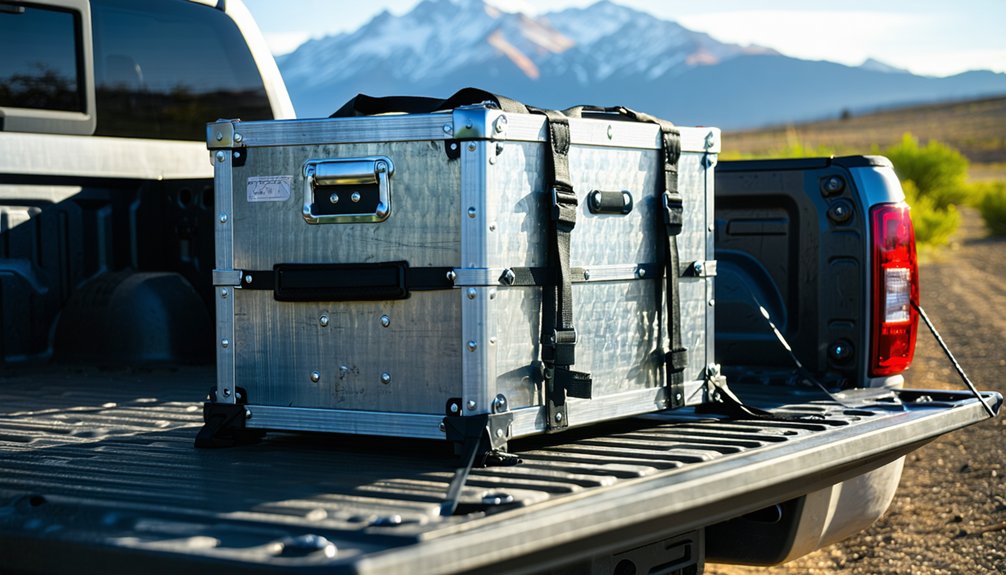
When you see “crash-tested” on a pet crate, you’d reasonably assume the label means something—but in the U.S., it usually doesn’t.
There’s no federal performance standard for pet crates, and the Consumer Product Safety Commission doesn’t even classify them as consumer products.
That regulatory gap creates Marketing Loopholes manufacturers exploit freely.
These Misleading Labels often mean a product underwent some test—not that it passed any pass/fail threshold.
With Nonstandard Testing, brands write their own protocols, making cross-brand comparisons impossible.
One carrier advertised as “crash-tested up to 30 lb, 30 mph” failed at 20 lb, stitching tearing apart.
This Unverified Compliance leaves you guessing.
If you care about your dog’s safety on the road, demand independent certification and published protocols, not vague claims.
Pick a Crash-Rated Crate That Holds Up
Because marketing claims won’t protect your dog, you need to verify true crash performance before you buy. Demand independent testing from third parties like the Center for Pet Safety, not in-house demos. Require published results showing test speed, dummy weight, and pass/fail criteria under certified protocols—30–35 mph frontal sled tests count, generic “crash tested” labels don’t. Prioritize dog mass matching: the crate’s tested weight range must equal or exceed your dog’s actual weight, since crash forces scale with mass.
| Selection Factor | What to Verify | Red Flag |
|---|---|---|
| Testing Source | Independent lab | In-house claim |
| Protocol | CPS or equivalent | Vague language |
| Weight Class | Matches your dog | Smaller-dog only |
| Documentation | Published results | No report |
Choose crates engineers in our community trust.
Choose Rotomolded or Aluminum Over Wire
Why do wire crates keep failing in truck-bed crashes? They collapse, burst open, and eject dogs because thin steel wire and light latches can’t handle variable impact forces. That’s why serious overlanders choose rotomolded HDPE or heavy aluminum instead.
Rotomolded shells distribute impact through thick, flexible walls, resisting crack propagation. Aluminum extrusions resist deformation through high stiffness. Both categories add reinforced corners and welded or cast door frames—real Reinforcement Integrity that wire simply lacks. Their Locking Mechanisms use multi-point latches with stainless or coated hardware built for road grit, vibration, and salty winter spray.
Wire rarely carries any crash rating. If you’re traveling year-round with working dogs, you belong with crates that protect them. Pick rotomolded or aluminum, and leave wire behind.
Size the Crate Right for Your Dog
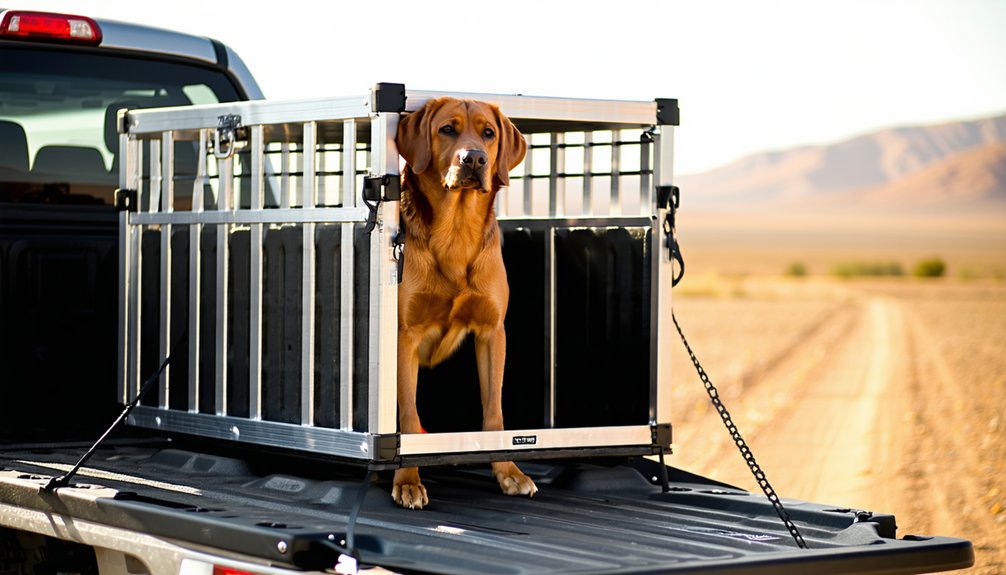
A crate that’s too big is just as dangerous as one that’s too small. Oversized space lets your dog build momentum during sudden braking or impacts, risking orthopedic injury, while cramped quarters force unhealthy curling.
To get it right, measure your dog’s body length from nose to tail base and standing height to the top of the head or ears, then add 2–4 inches to each. Trust measurements over breed or weight alone.
Your dog should enter easily, stand, turn, and lie fully on one side with limbs extended.
For growing pups, use divider adjustment to shrink the interior now and expand it later.
Measure repeatedly as adults gain or lose weight, rechecking fit before every multi-day trip.
We size for safety together.
Anchor All Four Corners to Rated Tie-Downs
Once you’ve sized the crate correctly, you need to lock it down to anchor points that can actually hold it.
Secure all four corners to factory-rated tie-downs or aftermarket anchors with published working-load limits—never to sheet metal, trim, or unrated bed rails. Four-corner anchoring distributes restraint forces, controlling forward, rearward, lateral, and rotational movement during braking and cornering.
Position anchors so straps pull the crate down and inward, avoiding steep angles that weaken holding force. Low-profile retractable anchors, cleats, and L-track systems give you direct strap paths and a square, balanced load.
Smart L track compatibility planning matches hardware to your bed’s mounting points.
When you tackle rated anchor installation, use the full assembly—bolts, rings, cleats—chosen for your truck’s construction. That’s how serious overlanders keep their dogs safe.
Why Bungees and Plastic Hooks Fail in Crashes
Bungee cords betray you exactly when you need them most. When a crate slams forward in a 30 mph crash, your bungees stretch 100–200% of their length, letting kinetic energy build before the cord ever tightens.
That elastic stretch means inconsistent restraint—low force during the critical first moments, then violent rebound that turns crates and hooks into projectiles.
The hook material is the weakest link: light-gauge metal or molded plastic, not rated for crash-level loads. Termination pull-through is a documented impact failure, and abrupt angle changes let hooks detach and fly, causing lacerations.
You belong with overlanders who trust rigid restraint, not springs. Choose non-elastic web straps, chains, or rated hardware. Your gear—and everyone riding with you—deserves restraint that locks down and holds.
Place the Crate Against the Cab Wall
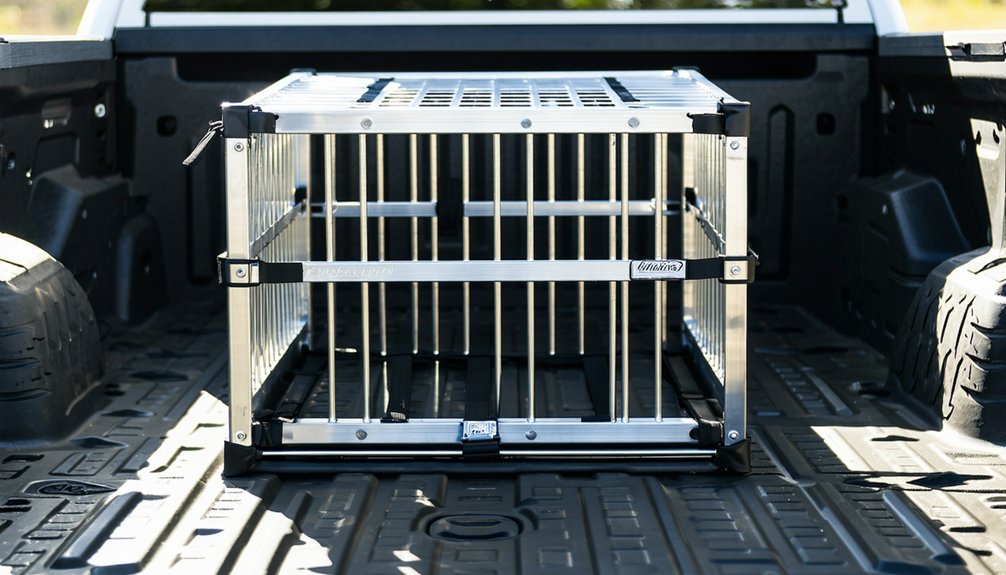
Because empty bed space gives a crate room to build momentum, you should slide it tight against the cab wall before you anchor anything. This placement limits rearward acceleration during braking or impact, and it cuts wind exposure in an open bed.
Crash-safety-oriented retailers recommend it explicitly, and it’s why so many overlanders trust it as part of their anti-movement strategy.
Treat cab-wall placement as one layer, not a standalone restraint. Pair it with four-corner strap anchoring and non slip liners to reduce minor sliding and even out tension. Keep ventilation openings clear, and never block emergency door access—you’ll need it for loading and unloading too.
Once positioned, run a shake test and short drive check to confirm everything stays aligned.
Stop Sliding With Non-Slip Mats and Liners
When your crate sits flush against the cab wall, the next job is killing the friction gap that lets it slide on a steel bed. You’ll want heavy-duty vulcanized rubber, 3/8–1/2 in. thick, cut edge-to-edge so the crate’s feet sit fully on non-slip surface. Mat quality matters: weighty, textured mats (60–100+ lb) won’t shift under lateral forces, and raised tread beats slick plastic in traction testing.
| Material | Texture | Why It Grips |
|---|---|---|
| Vulcanized rubber | Checkerplate | High friction, impact absorption |
| TPE/TPR | Raised tread | All-weather flexibility |
| Drop-in plastic | Smooth | Avoid—low grip |
Skip loose fabric or cardboard underneath; it compresses and shifts. Choose underside channels for drainage, clean grit regularly, and you’ll keep your rig’s load stable like the rest of us do.
Keep Your Dog Cool in an Exposed Truck Bed
Out in an exposed truck bed, heat’s your biggest enemy, and fresh air exchange is your first line of defense. Mount window fans to enhance circulation inside your cap, and run them off a separate power source so you’re not draining the truck battery.
Block the sunny side with reflective foil and an aluminum tarp, and lay light-colored carpeting over the bed to cut surface heat.
Lean on evaporative cooling: drape a wet towel over one side of the crate, letting towel moisture do the work. Damp wood shavings extend that effect for hours.
Keep cool water flowing, pack ice, and stop frequently in shade.
Don’t guess—install heat monitoring with digital sensors inside the crate. Like the handlers you trust, you’ll keep your dog safe.
Stay Warm and Dry on Cold Overland Routes
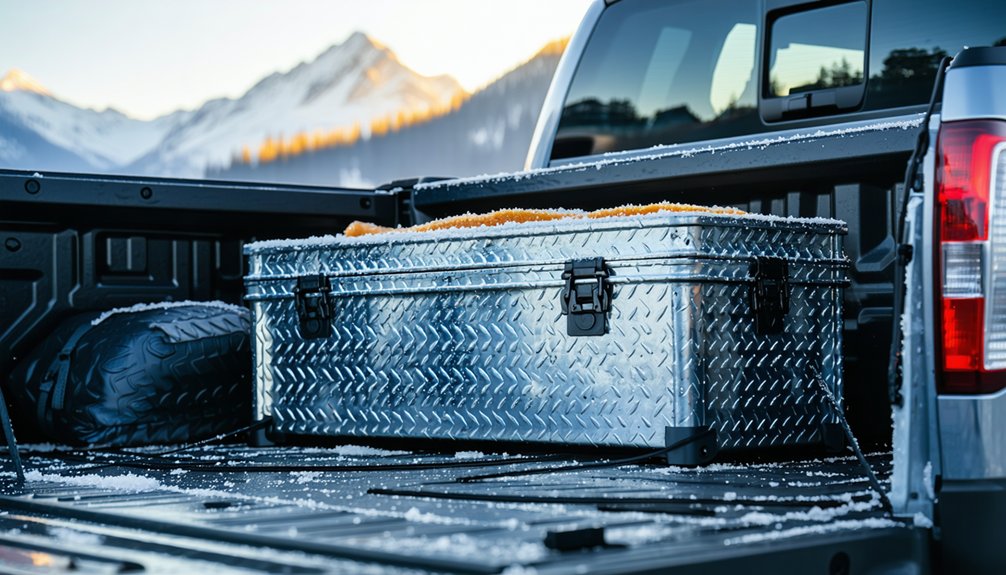
While heat threatens your dog in summer, cold steals body warmth fast on winter routes, and your first defense is the crate itself.
Choose a double-wall or rotomolded crate, add foam-board panels for R-value, and rise the floor on rubber mats or rigid foam so cold metal can’t pull heat away.
Build a layered bed: closed-cell foam pad, wool or synthetic blanket, then a moisture-wicking cover that keeps your dog dry.
Orient the door toward the cab, fit a weather-resistant cover, and route Ventilation Routing so vents face away from wind and road spray.
Watch for Gaps Condensation; small openings let dampness collect, so air bedding during stops.
Skip propane heaters entirely—use a fused 12V heated mat with overheat protection when temperatures truly demand it.
What the Law Says About Dogs in Truck Beds
Before you load your dog for a long haul, know that the law varies sharply by state, and a setup that’s legal in one place can earn you a fine in the next.
Only a handful of states—California, Connecticut, Maine, Massachusetts, New Hampshire, and Rhode Island—have explicit statutes, while others rely on cruelty laws.
These state by state restrictions matter: California’s Vehicle Code §23117 demands 46-inch side racks, two-point cross-tethering, or a secured container on highways.
Washington’s RCW 46.61.660 requires animals harnessed, caged, or in a tied-down enclosure.
Texas has no statewide rule, but cities like Dallas and Houston impose Class C misdemeanors with fines up to $2,000.
Watch for highway enforcement differences, since high-speed roads often trigger stricter requirements.
A crash-tested, anchored crate keeps you compliant everywhere.
Inspect Truck-Bed Straps After Rough Terrain
After you’ve cleared a rough stretch—washboard gravel, deep ruts, or a hard pothole hit—stop and inspect every truck-bed strap before you continue.
Walk around the bed, scanning for slack, shifted crates, or missing tie-downs.
Push and pluck each strap to confirm equal tension at every ratchet and cam buckle.
Tug each anchor, D-ring, and cleat to catch loosening or cracked welds.
Run your hands along the full webbing length, feeling for cuts, fraying, melted fibers, or stiffness.
Inspecting strap stitching around hooks and ratchet bars reveals broken or pulled threads.
Operate each ratchet, checking hardware corrosion on springs, pawls, and axles after water crossings or salt.
Confirm hooks fully engage with latches closed.
This shared discipline keeps your rig—and everyone counting on it—safe.
Frequently Asked Questions
How Much Does a Quality Crash-Tested Dog Crate Typically Cost?
You’ll typically spend $500–$900+ on a quality crash-tested crate. Budget considerations rise with weight rating and safety compliance; larger XL setups hit $1,200–$1,500. Factor in installation guidance and mounting kits, adding $50–$200 to your total.
Can My Dog Stay Crated Overnight During Multi-Day Trips?
Yes, your dog can stay crated overnight if you’ve done it right. Train crate etiquette beforehand, make sure nighttime ventilation, anchor securely, and provide breaks. Like fellow overlanders, you’ll keep your companion calm, safe, and comfortably alongside you.
Should I Acclimate My Dog to the Crate Beforehand?
Yes, you should. Desensitize through treats, short crate sessions at home before any trip. Start with the door open, then build brief closed-door periods. You’ll help your dog feel calm, secure, and ready to travel alongside you.
How Do I Clean Rotomolded or Aluminum Crates After Expeditions?
Strip bedding, rinse off debris, then scrub with mild soap. For deep cleaning, hit corners and seams. Disinfect for 10 minutes, rinse, and dry completely—that’s your rust prevention. We all keep our gear trail-ready together.
Are Tonneau Covers Compatible With Truck-Bed Crate Setups?
Yes, many work—but do your compatibility review first. You’ll want retractable T-slot covers for serious crate setups. Installation considerations matter: check whether your cover occupies stake pockets your rack needs. Pick smart, and you’ll fit right in.
Conclusion
You’ve now got the blueprint for a crate setup that actually protects your dog. Don’t trust marketing labels—demand real crash-test data, choose rotomolded or aluminum over flimsy wire, and size it correctly. Anchor all four corners to rated tie-downs, manage temperature in that exposed bed, and know your local laws. After every rough stretch, inspect your straps. Do this right, and your dog rides safe through whatever the trail throws at you.
References
- https://gunner.com/blogs/pack/real-life-dog-crate-crash-test-lab-survives-a-truck-rollover
- https://pet-academy.org/best-dog-crates-for-truck-beds/
- https://www.youtube.com/watch?v=RyrCwcg-4ng
- https://carinterior.alibaba.com/buyingguides/truck-bed-dog-crates-safety-vs.-durability
- https://rockcreekcrates.com/blogs/news/dog-crates-for-pickup-trucks-legal-rules-tie-down-tips-and-top-safety-features
- https://www.youtube.com/watch?v=OEkFkt8igCs
- https://www.youtube.com/watch?v=sMa1zKQDTKo
- https://www.facebook.com/groups/1729655510653295/posts/4314287232190097/
- https://www.inceptionaiapp.com/en-US/pet-supplies/dogs/dog-crates-and-carriers/dog-vehicle-restraints/in-vehicle-crate-restraint-systems
- https://www.germanshepherds.com/threads/safe-crates-for-truck-bed.770893/