Only three states—New Jersey, Hawaii, and Rhode Island—legally require you to restrain your dog while driving, with fines ranging from $50 to $1,000. The other 47 states don’t have specific seatbelt laws, but you’re not off the hook: cops can still cite you for distracted driving, animal cruelty, or unsafe loads if your dog’s loose. Stick around, and you’ll see exactly what each state expects from you.
TLDR Key Takeaways
- Only New Jersey, Hawaii, and Rhode Island have explicit dog-restraint laws requiring carriers, crates, or seatbelts.
- Most states lack pet-specific statutes, but drivers can still be cited under distracted-driving or animal-cruelty laws.
- Fines for violating dog-restraint laws range from $50 to $1,000, depending on the state and severity.
- California, Connecticut, and Maine regulate open truck beds, requiring tethers, crates, or secure sides.
- Unrestrained dogs risk severe injury, with 87% suffering skeletal harm in vehicle crashes.
Do You Legally Need a Dog Seatbelt in Your State?
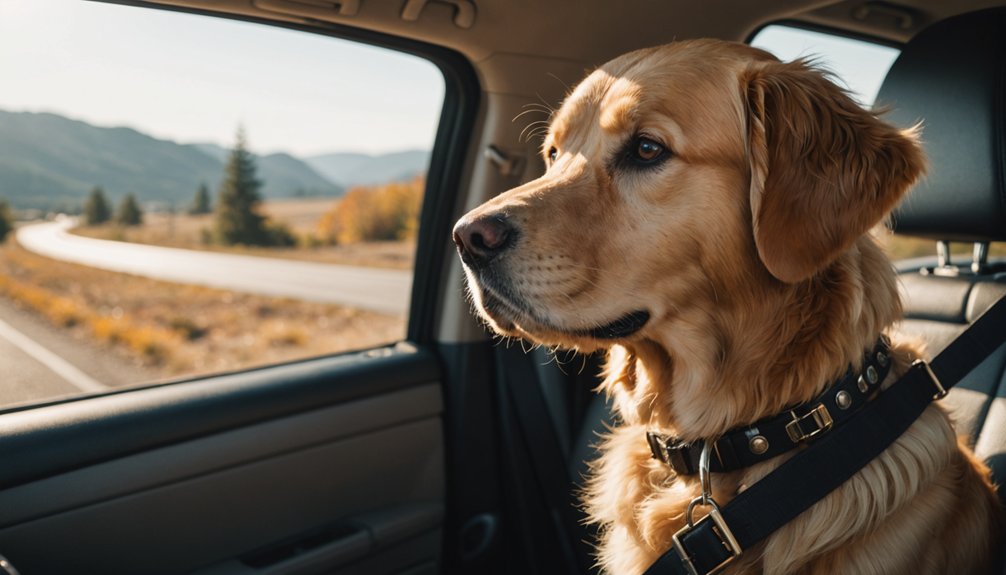
No federal law requires you to buckle up your dog, and most states don’t have one either. Alabama, Arkansas, Missouri, New York, Indiana, Iowa, and many others skip pet-specific restraint statutes entirely.
That doesn’t mean you’re free and clear, though. Cops can still cite you under distracted-driving, animal-cruelty, or unsafe-load rules if your dog creates driving hazards or rides unsecured in a truck bed. Arizona, Hawaii, and Connecticut may even charge drivers under distracted driving laws for having a dog sitting in their lap while driving.
Only three states—New Jersey, Hawaii, and Rhode Island—have explicit dog-restraint laws on the books. New Jersey’s statute is the strictest, imposing fines of $250 to $1000 on drivers who fail to secure their pets properly. Everywhere else, officers rely on general traffic and welfare codes to address pet safety concerns. Studies show that unrestrained pets in accidents suffer high rates of harm, with skeletal injury diagnosed in 87% of dogs involved in motor vehicle crashes.
Know this: absence of a named law doesn’t grant blanket permission. If your dog’s position distracts you or endangers others, expect consequences regardless of your state’s statute language.
The 3 States With Explicit Dog Restraint Laws
Three states break from the pack and spell out exactly how your dog needs to ride: New Jersey, Rhode Island, and Hawaii.
Everywhere else, dog legislation stays vague, but these three give you clear rules.
New Jersey demands a carrier, crate, restraint system, or seat belt for any pet in a moving vehicle.
Skip it, and you’re facing animal cruelty charges with fines from $250 to $1,000, sometimes jail time.
Rhode Island requires your dog stay enclosed, controlled by a passenger, or restrained.
You can’t hold your pup on your lap while driving.
Fines run $50 to $200.
Rhode Island also regulates how animals ride in open truck beds, making it one of only a handful of states with such a rule.
Hawaii focuses on pet safety in truck beds—dogs must be tethered or crated to prevent ejection during transport.
Hawaii also bans the use of choke or pinch collars as part of any restraint setup.
Beyond truck beds, Hawaii law also prohibits drivers from holding an animal in their lap or letting it linger in the driver’s immediate area while behind the wheel.
Know these laws before you cross state lines.
Why Hawaii Bans Dogs From Riding on Your Lap
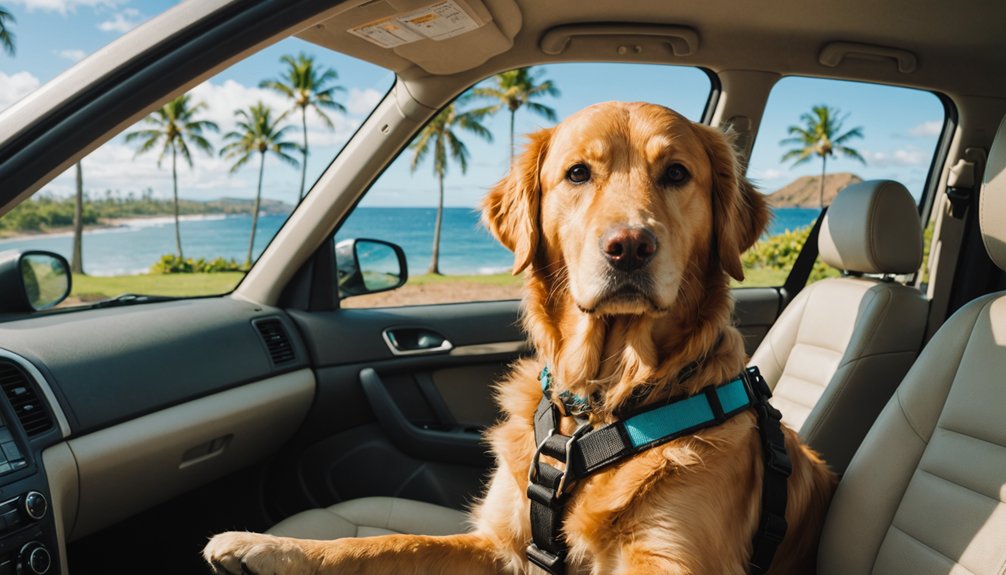
Because Hawaii doesn’t have a dedicated pet seatbelt statute, its lap-dog ban actually stems from HRS § 291C-124(b), a law targeting obstructions to a driver’s view or control of the vehicle.
Under Hawaii laws, lap dogs count as driver obstruction, and traffic rules treat this like other distracted driving violations. Citations run around $97, but the real cost is measured in collision risks: dogs can block airbag deployment, interfere with steering, or become animal projectiles during car accidents, causing injury or lost pets.
For pet owners planning a road trip, driver safety and animal transport go hand-in-hand. State regulations and safety guidance recommend pet car seats, dog restraints, secured containers, or cross-tethering. For added protection, crash test certified carriers such as Sleepypod are designed to keep pets safe during collisions. Keeping dogs restrained protects driver attention, roadway conditions, and everyone’s safety on Hawaii’s roads. Hawaii law specifically requires dogs to be secured with a crate/carrier or tether rather than left loose in the vehicle. Hawaii’s universal seat belt law applies to all human occupants in both front and back seats, reinforcing the broader statewide commitment to restraint use while traveling.
What Rhode Island Requires: Crates, Harnesses, or a Passenger’s Control
Rhode Island’s answer to open-air pet safety lives in General Laws § 31-22-28, a statute covering any animal riding “on or in an open air motor vehicle,” whether for business or pleasure.
If you’re hauling your dog in a truck bed or similar open cargo area, you need one of three things: an enclosed crate, control by a non-driving passenger, or a purpose-built restraint system. Neck restraints don’t count—chains and choke collars won’t satisfy the law. This animal transport rule targets vehicle safety, not enclosed cabins, so a dog riding inside your sedan isn’t regulated the same way. First offenses cost up to $50; repeat violations climb to $200. This law was originally adopted in 1992. Drivers should also remember that unrestrained pets can become projectiles in a crash, making proper restraint even more critical. Separately, dog owners should note that outdoor tethering is also regulated, with violations carrying fines as high as $1,000. Choose your restraint method before you hit the road.
New Jersey’s Steep Fines for Unrestrained Dogs
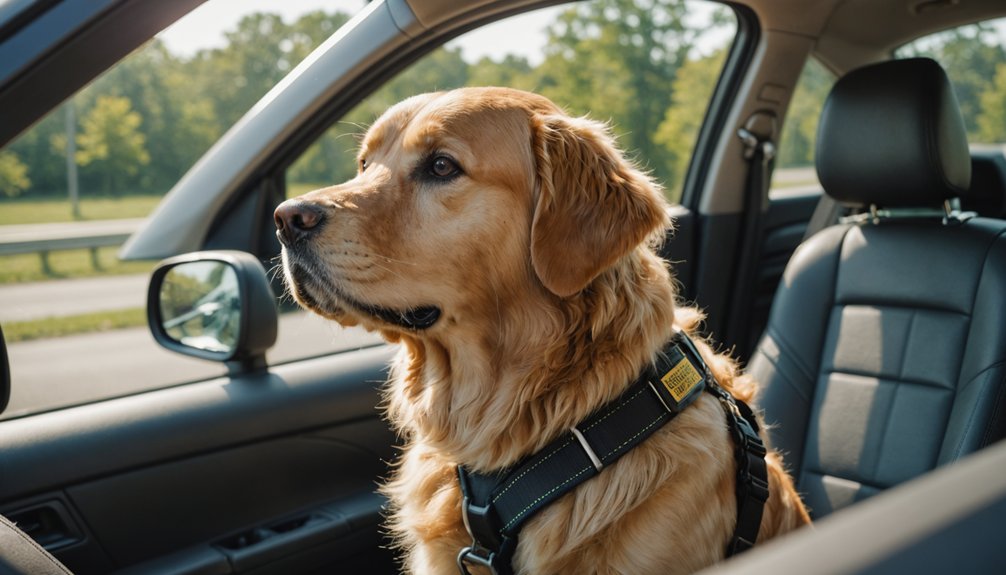
New Jersey doesn’t treat loose pets as a mere traffic slip-up—it treats them as animal cruelty. Under R.S.4:22-17(a), an unrestrained dog or cat isn’t a seatbelt violation—it’s a disorderly persons offense tied to animal welfare enforcement. That means real consequences, not a slap on the wrist. Repeated violations or incidents that cause harm to animals can even bring a 4th degree charge. NJSPCA officers are empowered to pull over drivers who transport animals improperly, since loose pets can act like flying missiles in a crash.
| Violation Type | Fine Range | Additional Penalty |
|---|---|---|
| Standard offense | $250–$1,000 per pet | Up to 6 months jail, 30 days community service |
| Multiple unrestrained pets | Multiplied per animal | Stacked fines apply |
| Repeat/severe cruelty | Up to $10,000 | Up to 18 months jail |
You can be cited for each unrestrained animal, so fines multiply fast. This tracks with nationwide findings that officers in other states, such as Hawaii, are also legally empowered to stop drivers over unrestrained animals. If pet safety matters to your road-trip freedom, buckle up your co-pilot before you hit the highway.
States That Only Regulate Dogs in Truck Beds and Convertibles
Not every state goes as far as New Jersey in policing what happens inside your cab.
California, Connecticut, Maine, Massachusetts, New Hampshire, and Rhode Island only step in when your dog rides in the open—truck bed safety is their focus, not what’s happening behind your windshield.
Drive an enclosed cabin, and you’re free from statewide restraint mandates.
California’s Vehicle Code §23117 requires cross-tethering, a crate, or high enough sides to stop a dog from falling or jumping out of an open truck bed on the highway.
Connecticut demands caging or secure restraint, plus protection from weather and debris.
Maine goes further with convertible regulations, extending the same falling-or-jumping protections to open-top vehicles.
Your cab, though, stays your business.
How Distracted-Driving Laws Catch Unrestrained Dog Owners Off Guard
Because so many states skip a dedicated dog-restraint law, drivers often assume a loose dog in the cab carries no legal risk—until a distracted-driving statute proves otherwise.
Law enforcement doesn’t need pet-specific wording to cite you—distracted driving statutes already cover loose animals that compromise pet safety and vehicle control. Arizona, California, Florida, Virginia, and Washington are among the state laws where an unsecured dog can trigger a moving violation. Washington, D.C. names “interacting with pets” outright, with a $100 first-offense fine. Hawaii and Iowa focus on driver risks tied to blocked sightlines and lost control.
Even where a loose dog won’t spark traffic stops alone, it becomes an add-on charge once another driving behavior draws attention. Treat road hazards from unrestrained pets as real legal exposure, not just safety advice.
When an Unsecured Dog Becomes an Animal Cruelty Case
A loose dog doesn’t just risk a traffic ticket—it can expose you to animal cruelty charges in states without dedicated restraint laws.
Alabama and Texas apply cruelty laws when unsafe transport endangers your dog, even absent a seatbelt statute.
Arkansas and Mississippi treat cruel or dangerous animal transport as a misdemeanor, carrying fines up to $1,000 and potential jail time.
North Dakota goes further, requiring suitable carrying containers for any live animal transport.
New Jersey classifies unrestrained pets in vehicles as outright cruelty, with penalties reaching $1,000 and six months behind bars.
The line gets crossed when your dog faces real injury risk—riding loose in truck beds, ejection during sudden stops, or exposure to extreme weather.
Secure your dog properly, and you avoid both the ticket and the cruelty case.
States With No Dog Seatbelt Law on the Books
While plenty of states regulate how you haul a dog in a truck bed, most don’t say a word about restraining your dog inside the cab.
Alabama, Arkansas, California, Florida, and Idaho have no dog seatbelt law at all.
Alaska, Colorado, Delaware, Georgia, and Illinois follow suit, with no specific pet laws addressing in-cabin restraints.
Maine, Massachusetts, New Hampshire, Rhode Island, and Vermont focus their rules on open truck beds, leaving car interiors untouched.
D.C., Arizona, Connecticut, and North Dakota skip seatbelt mandates too, but don’t assume you’re fully off the hook—distracted-driving and animal-cruelty statutes can still catch you if your dog rides loose on your lap.
Road safety comes down to your judgment, not just the letter of the law.
Common Myths About Dog Seatbelt Laws You Should Stop Believing
Since no federal law requires any occupant—human or animal—to wear a seatbelt, you’re dealing entirely with a patchwork of state rules when it comes to restraining your dog.
Don’t assume you’re in the clear just because your state skips a dedicated statute. You’ve got more to think about than you think:
- Dogs aren’t “persons.” Human seatbelt laws don’t cover pets—many states classify dogs as cargo, so different rules apply.
- No two states match. New Jersey and Rhode Island demand carriers or seatbelts; others only regulate open vehicles like truck beds.
- “No law” doesn’t mean no risk. Distracted or careless driving citations can still hit you.
Pet safety and road awareness go hand-in-hand—know your state’s actual rules before you drive.
What Happens If You Get Pulled Over With an Unrestrained Dog?
Once those lights flash in your rearview mirror, what happens next depends entirely on where you’re driving and how your dog’s riding.
In New Jersey and Hawaii, police actions can start solely because your dog’s unrestrained—these are primary enforcement states, meaning your pet is the traffic stop’s sole cause.
Elsewhere, you’re usually cited only after being pulled over for something else, like speeding.
Expect fines ranging from $50 in Rhode Island to $1,000 in New Jersey, depending on severity and repeat offenses.
Hawaii breaks it down specifically: $97 for a dog in your lap, $57 for one loose elsewhere in the vehicle.
In states without explicit restraint laws, officers can still cite you under animal cruelty or reckless driving statutes if your dog’s setup looks dangerous.
How to Choose the Right Dog Restraint for Your Road Trip
Avoiding a ticket is one thing; keeping your dog alive in a crash is another.
Choosing the right restraint means matching safety standards to your dog’s size, behavior, and your travel style.
Crash testing from independent labs is the real benchmark—don’t settle for marketing claims.
Focus on three essentials:
- Restraint types and vehicle compatibility – confirm your crate, carrier, or restraint system works with your seat belts, LATCH anchors, or cargo tie-downs.
- Sizing guidelines and comfort features – measure chest, neck, length, and weight; use the two-finger fit rule and add breathable padding for long hauls.
- Restraint selection and crate placement – secure restraint systems to anchor points, keep crates level in the back seat or cargo area, and match setups to your dog’s temperament.
Get this right, and the open road stays safe—for both of you.
Frequently Asked Questions
Does My Car Insurance Cover Accidents Caused by an Unrestrained Dog?
Yes, your liability and collision coverage still apply even if your dog caused the crash. But don’t rely on pet insurance for injuries—it won’t cover you. Prioritize dog safety, restrain your pet, and drive free of distractions.
Can I Be Denied Insurance Claims for Pet-Related Crashes?
Yes, you can face denial. If your unrestrained pet contributed to crash liability, insurers may cut collision or liability payouts. Even pet insurance for vet bills can be denied if you ignored restraint rules.
Are Dog Seatbelts Required When Crossing State Lines on Road Trips?
No—there’s no federal mandate, but you’ll need to check each state’s rules as you cross lines. Prioritize Pet Safety, avoid Road Hazards, and secure your dog to dodge fines and stay free to roam.
Do Rental Car Companies Have Their Own Pet Restraint Policies?
Yes, you’ll find distinct pet policies at every rental company. You’re required to follow their rental rules—crating, carriers, or restraints—regardless of state law. Check with your pickup location before you hit the road.
Can Police Stop Me Solely for an Unrestrained Dog In-State?
Yes, in some states—but not all. Local enforcement can pull you over solely for an unrestrained dog only where it’s a primary offense, like New Jersey or Hawaii. Elsewhere, traffic stops require another violation first.
Conclusion
You don’t need a law to tell you what’s smart. Whether you’re crossing into Hawaii, Rhode Island, New Jersey, or anywhere else, buckle up your dog like you would a kid. It’s not about avoiding a ticket—it’s about avoiding a tragedy. Grab a crash-tested restraint, secure that crate, and hit the road knowing you’ve done right by your co-pilot. Safe travels start with you.
References
- https://news.orvis.com/dogs/does-your-state-require-dogs-be-harnessed-in-the-car
- https://www.gopetfriendly.com/blog/state-laws-require-pets-to-be-restrained-in-vehicles/
- https://getodie.com/blog/does-your-dog-need-a-seat-belt-in-your-state/
- https://animalcardonation.org/blog/dog-seat-belt-laws-by-state/
- https://www.adoptapet.com/blog/lifestyle/dog-seat-belt-laws
- https://4knines.com/blogs/news/state-laws-when-traveling-in-a-vehicle-with-your-dog
- https://www.pawsinsider.com/is-it-illegal-to-have-dog-unrestrained-in-car/
- https://www.animallaw.info/topic/table-state-laws-protect-animals-left-parked-vehicles
- https://trypawpystuff.com/blogs/news/dog-seatbelt-laws-by-state-are-you-compliant
- https://lenoof.com/blogs/news/dog-seat-belt-laws-in-the-us-and-canada