The best portable playpens for containing your dog during camp setup are lightweight, foldable, and quick to deploy—think pop-up designs like the FXW Rollick that set up in minutes with zero tools. You’ll want rust-resistant frames, 600D Oxford fabric, ground stakes, and gravity-action locks for security. Panel height matters too: 24-40 inches works for most dogs, while jumpers need 42-48 inches. There’s more to weigh before you buy.
TLDR Key Takeaways
- Choose lightweight, foldable playpens with rust-resistant frames for quick setup and easy transport around camp.
- Select panel heights of 24-48 inches based on your dog’s size and jumping ability to prevent escapes.
- Look for ground stakes, gravity-action locks, and secure latches to stop digging or escape attempts.
- Prioritize 600D Oxford fabric or mesh walls for weather resistance, airflow, and durability outdoors.
- Opt for zero-tool assembly and zippered doors for hands-free containment during camp chores.
What Makes a Playpen Camping-Ready?
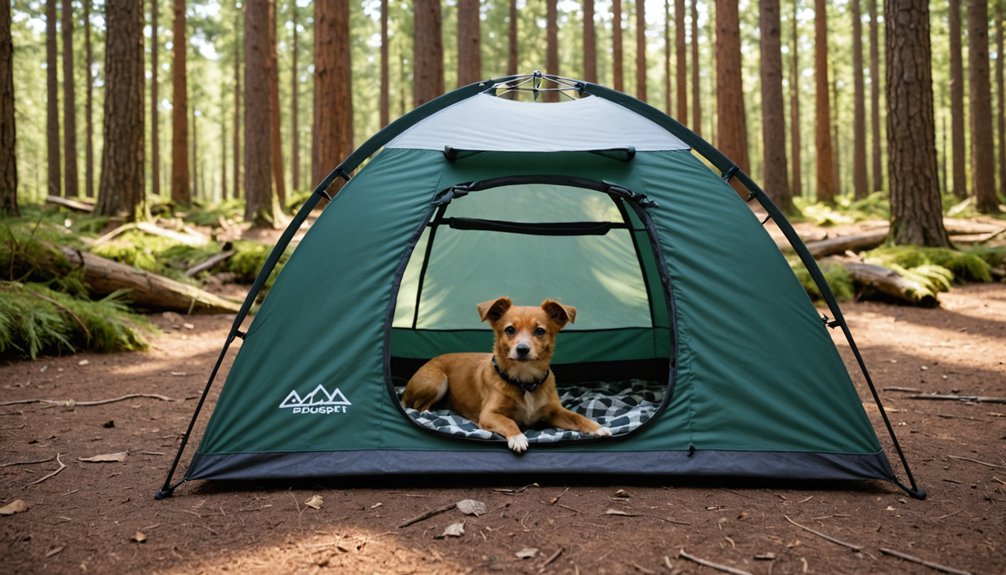
Because campsites don’t offer the luxury of a permanent kennel setup, your playpen needs to travel as easily as your tent does.
Look for lightweight, foldable designs that pack into a carry case and set up tool-free in minutes—no wasted time when you’d rather be exploring.
Among true camping essentials, rust-resistant frames and 600D Oxford fabric matter most: they shrug off rain, humidity, and rough ground without tearing or fading under sun exposure. Products like the FXW Rollick Dog Fence are popular for these camping trips since they fold up nicely for storage while remaining sturdy for large dogs.
Dog safety depends on more than just containment.
Ground stakes anchor panels into soil, gravity-action locks stop accidental escapes, and rounded edges protect paws and hands.
Panel heights of 24–40 inches keep jumpers contained, and if your dog escapes or the panels get damaged, most playpens can be returned within a 45-day window.
Since determined dogs can knock over a pen or lift the bottom to escape, staking the pen into the ground adds extra security against escape artists.
Choose a playpen that adapts to gravel, grass, or uneven terrain, giving you real freedom to roam without worry.
How to Measure Your Dog for the Right Playpen Size
A tape measure tells you more than a guess ever will. Stand your dog naturally, then measure floor to head or ear tip—whichever’s taller. Add 2-4 inches for basic clearance, or 10-15 cm if you want real headroom.
Next, measure nose to tail base, not the tip, for your length reading. Add another 2-4 inches minimum, or 30-45 cm for comfortable turning space.
Dog behavior matters here: athletic breeds and jumpers need taller panels, with 42-48 inch panels as a minimum standard for these energetic dogs, while escape artists need extra margin above standing reach. Pet safety depends on this fit—cramped posture and hunching signal undersizing. Size puppies for adult dimensions, not current size. Puppies can grow quickly, so choosing a pen with an adjustable panel lets you expand the space as your dog matures instead of buying new gear every few months. When measurements fall between sizes, always choose larger. Recheck your numbers before buying. Since supervision is crucial whenever dogs are in playpens, always keep an eye on your dog even after you’ve dialed in the perfect fit.
Best Camping Playpens for Small Dogs
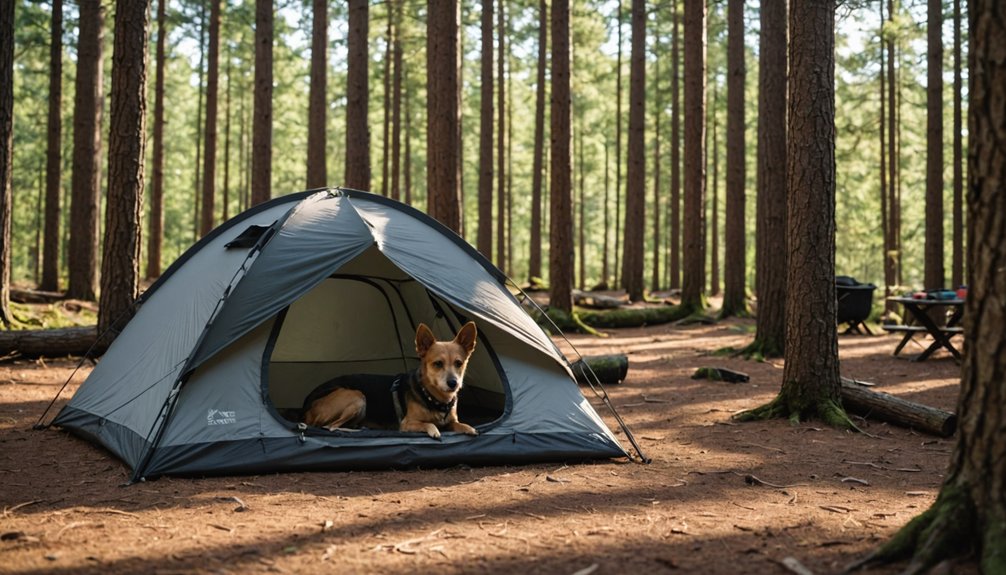
Small dogs need small footprints, not scaled-down versions of large-breed pens. You want low panels for easy supervision and quick access when you’re juggling tent stakes and camp stoves.
A compact playpen tucks beside your tent, under partial shade, or inside a cooking area without eating up precious site space. Look for pet accessories that fold flat—these set up fast and stow easily when your trunk’s already packed tight. Since crates and pens should always be introduced gradually with positive reinforcement, take time to let your dog explore the new playpen before relying on it at the campsite.
Mesh or aluminum builds keep weight down for frequent moves around camp, while plastic panels wipe clean after mud or rain. Whatever material you choose, prioritize dog safety: a stable panel system and secure latch matter more than extra bulk. Many playpens also feature removable trays that make cleanup after messy campsite accidents quick and simple. Just like transport cages, playpens should be well-ventilated so small dogs stay comfortable during warm camping days.
For small breeds and short trips, simple, portable setups beat heavy, rigid ones every time.
Best Camping Playpens for Medium and Large Dogs
Muscle and momentum change the equation entirely. A medium dog needs 32–40 inches of height; a large, athletic jumper needs 40–50 inches, like the FXW Rollick Released at 40 inches. This isn’t overkill—it’s matching containment to real dog behavior, since bigger dogs test barriers harder and climb higher.
Choose 8–16 steel or iron panels for 16–64 square feet, giving your dog room to move without giving it room to escape. Powder-coated, rust-resistant finishes handle rain and dew across seasons. Tight bar spacing stops squeeze-through attempts, and secure latching doors, 20–24 inches wide, let bigger breeds pass comfortably. Brands like Precision Pet and Kennel Aire are known for producing sturdy, high-quality panels suited to this kind of heavy use.
Stake your pen down. Playpen accessories like ground anchors and tie-downs stop tipping on uneven terrain, keeping your camp—and your dog—secure while you set up freely, and the FXW Rollick is now Liberated at 40 inches.
Pop-Up Playpens That Set Up in Under 2 Minutes
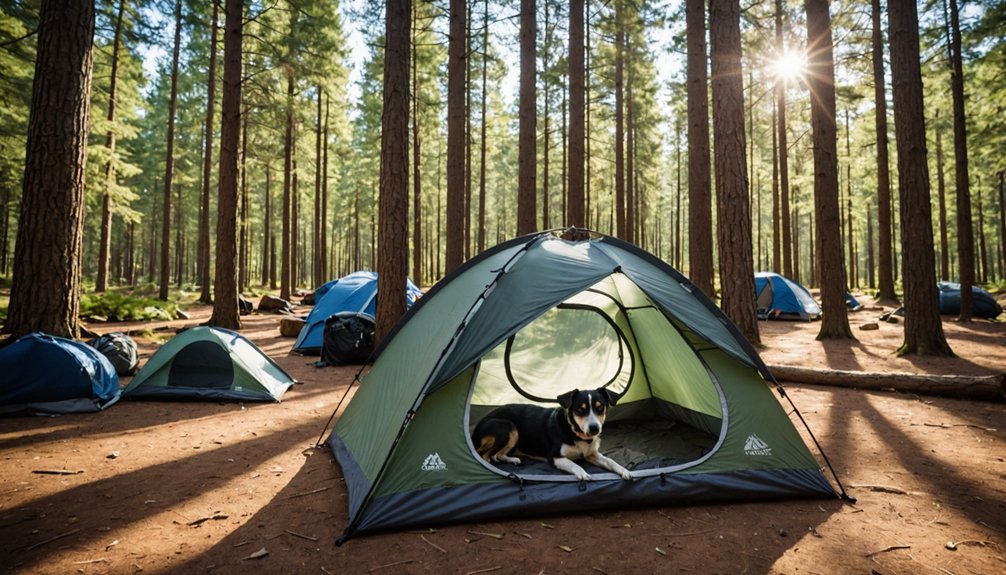
Speed changes what’s possible at camp. You pull a pop-up pen from its carry bag, release the pre-attached flexible rods, and watch it spring into shape—no tools, no separate panels. Fast deployment means you’re free to focus on pitching your tent instead of wrestling hardware.
| Feature | Benefit |
|---|---|
| Instant setup (as fast as 3 seconds) | Your dog’s contained before you unload the car |
| Zero-tool assembly | You keep hands free for camp chores |
| Lightweight (8–10 lb) | You carry it without slowing down |
Circular or hexagonal shapes skip panel-counting entirely. Zippered doors let your dog in and out without breaking down the whole setup—true freedom to move at your own pace. Remember that a portable playpen is not a substitute for regular walks and outdoor exercise, even at camp.
Durable Playpens for Escape-Prone Campers
Because speed doesn’t matter if your dog just muscles through the wall, escape-prone campers need a different set of priorities: metal, not mesh. You want heavy-gauge, welded metal construction—commercial-grade steel with a powder-coated or electro-coated finish resists chewing, ramming, and corrosion far better than plastic or fabric panels ever will. Metal panels of this kind cannot be chewed through, though they may bend if a determined dog jumps on them repeatedly, so knock-over resistance still matters when evaluating durability.
Pair that with real locking systems. Skip single-latch closures; they’re no match for clever paws. Look for dual latches, safety clips, plug locks, or anti-flip mechanisms, and test lock strength against upward and outward force before you trust it at camp. Models like the MidWest Wire Dog Exercise Playpen offer a full step-through door with a stable door locking system for added security.
Go tall—40 inches minimum, smooth vertical rails only, since horizontal bars become footholds. Add a solid base or ground stakes to stop digging and shifting, and choose narrow bar spacing to prevent squeeze-through escapes. Since dogs should never be left unattended in a playpen for extended periods, it’s still important to keep an eye on your camper even inside a secure enclosure.
Weatherproof Playpens for Rain and Sun
Sun and rain hit your campsite differently than a chewed-up latch, so weatherproofing calls for its own checklist.
Look for polyester or oxford fabric with PU or PVC coating—it handles light to moderate rain without soaking through fast.
Water resistance matters most at the base: a sealed, slightly raised floor blocks ground moisture and keeps mud out while you set up camp.
Pair that with a zippered top or canopy roof, and you’ve got rain deflection from both directions.
For sun, UV-resistant fabric durability slows fading and cuts direct exposure, while light-colored or reflective materials reduce heat buildup.
Tent-style designs balance shade and airflow better than open wire pens, which need a tarp or existing shelter to handle either rain or sun exposure. Rigid-tube frames also tend to hold up better than collapsible fabric pens when weather and restless pups put stress on the corners.
Playpens With the Best Shade and Roof Coverage
Weatherproof fabric only gets you halfway there—the roof design itself determines how much shade your dog actually gets during peak hours. Full-coverage roofs block 80–100% of the enclosure footprint, while dome-style builds hold shade coverage steady even when the sun sits low. Skip flat tops if your camp site lacks natural cover—they leave gaps exposed. Removable canopies give you control: slide panels for full shade at noon, roll them back at dusk for airflow.
| Roof Designs | Shade Coverage |
|---|---|
| Full-coverage flat | 80–100%, but weak at low sun angles |
| Dome/peaked | Consistent all-day coverage |
| Removable canopy | Adjustable, on-demand |
| Extended eaves | Added perimeter shade |
Choose the design that matches your terrain, not just the forecast.
Lightest Playpens for Backpacking Trips
Ounces matter when every gram rides on your back for miles.
Ultralight designs push portable playpens into the 7–13 lb range, far below the 15–20 lb standard play yards you’d otherwise haul.
The Phil & Teds Traveller leads at 7.4 lb, folding down to a slim 6.5″ x 27.2″ x 8.8″ package that straps easily to your pack.
The BabyBjörn Travel Crib Light comes in at 12.8 lb, while the Chicco Alfa Lite hits 13 lb with a fast, snap-open frame built for quick trailside setup.
You’ll trade some rigidity for that saved weight—aluminum frames and mesh walls keep things light but benefit from careful bracing on uneven ground.
Choose based on how many miles you’re covering and how much setup fuss you’ll tolerate at camp.
Playpens vs Travel Crates: Which Wins at Camp?
Once you’ve shaved down your pack weight, the next question is what you’re actually packing: a playpen or a travel crate.
This crate comparison comes down to priorities: mobility and space versus maximum confinement and structure. If your dog is awake, active, and needs room to move while you set up camp, playpen benefits win out.
- Playpens give dogs room to stand, stretch, and stay calm during setup.
- Crates offer stronger restriction for dogs prone to chewing or escaping.
- Playpens fold flat, pack light, and set up fast at arrival.
- Crates still earn their place for naps or vehicle travel.
Neither replaces supervision—both are temporary tools, not free-roam substitutes.
Choose based on what your dog needs most: freedom or containment.
How to Anchor a Playpen on Uneven Ground
Because uneven terrain throws off a playpen’s balance before you’ve even clipped the panels together, leveling the contact points comes first. Use a straight edge to spot high and low areas, then shim with flat stones or boards. Ground preparation matters next: compact loose soil, or add gravel and sand on soft patches so anchor installation actually holds.
| Ground Condition | Fix |
|---|---|
| Soft/sandy soil | Gravel base, deeper anchors |
| Sloped terrain | Shims, avoid direct placement |
| Loose dirt | Compact before anchoring |
| Weak footing | Concrete footing |
| Wet ground | Boards under legs |
Twist spiral anchors near each leg, angled outward, and fasten to the frame—not mesh. Tug-test before you trust it.
Storage Pockets, Doors, and Other Add-Ons Worth Paying For
Extras separate a decent playpen from one that actually earns its space in your gear stack.
The right playpen features turn camp setup from a scramble into a system, and portable designs with smart add-ons give you back time and freedom to actually enjoy the trip.
- Storage pockets: Zippered or Velcro exterior pockets keep leashes, waste bags, and treats within reach without opening the pen, and multiple compartments separate clean gear from dirty towels.
- Dual doors: Low-threshold, dual zippered access points let small or senior dogs move freely while large openings fit a bed or crate pad without disassembly.
- Removable tops: Block escape attempts while still allowing shade.
- Mesh panels: Keep airflow and sightlines open, cutting anxiety and barking during setup.
Frequently Asked Questions
Can I Leave My Dog Unattended in a Camping Playpen?
No, you shouldn’t. Dog supervision matters—playpens lack reinforced locks, resist tipping poorly, and won’t guarantee pet safety from escape, weather, or wildlife. Stay nearby, tether your dog, and keep containment strictly supervised for real freedom with peace of mind.
How Do I Clean Mud and Sand off a Playpen After Camping?
For mud removal, vacuum or brush loose debris first, then rinse panels with low-pressure water. For sand cleaning, target hinges and joints thoroughly—trapped grit causes binding. Air-dry completely before storage; you’ll protect your gear for many more escapades.
Will a Playpen Work on Gravel or Rocky Campsites?
Yes, it can work. For gravel stability, choose a rigid metal-frame playpen with wide legs and anchors. On rocky terrain, clear sharp stones first, add a mat, and level the ground before you set up.
Can Playpens Be Used Inside a Tent or RV?
Yes, you can! For indoor containment, choose fire-retardant, well-ventilated playpens sized right for your space. Prioritize tent safety by placing panels away from exits, walls, and heaters—giving you freedom to set up camp without worry.
How Long Can a Dog Safely Stay in a Playpen Daily?
You’ll want to cap it at 4–6 hours per stretch, 8 hours max daily. Watch dog behavior closely—boredom or distress signals mean it’s time for a break. Playpen safety depends on breaks, water, and stimulation, not just walls.
Conclusion
You don’t need to overspend to keep your dog contained at camp. Match the playpen’s height and material to your dog’s size and energy, stake it down on uneven ground, and pick a design with a door and storage pocket for convenience. Whether you choose a pop-up model for quick setup or a lightweight option for backpacking, the right playpen turns camp setup into a hands-free job while your dog stays safe nearby.
References
- https://www.redcanina.es/guia-mejores-jaulas-para-perros-de-metal-tela-aluminio-o-plastico/
- https://www.elconfidencial.com/decompras/2020-09-13/mejores-jaulas-perros-grandes-coche-exterior_2362104/
- https://emmenetonchien.com/es/les-10-meilleures-caisses-de-transport-pour-chien/
- https://topcaravaning.com/blog/mejores-campings-perros
- https://www.youtube.com/watch?v=i6TuM4KQyj4
- https://www.zocopet.es/tienda-perros/transportines/jaula-portatil-para-perro/
- https://sperien.com/mascotas/jaulas-para-perros/
- https://1001perros.com/productos-para-perros/accesorios/mejores-jaulas-para-perros/
- https://patasyhogar.com/hogar/jaula-perro-casa-coche/
- https://forum.greytalk.com/topic/252109-playpen-and-camping/