Field removal works only for a few superficial quills on accessible skin and surface foxtails still riding in outer fur. Pull straight along the entry path with steady traction, and never cut quills—cutting drives barbed tips deeper. Stop immediately if anything’s embedded, between toes, near an eye, the muzzle, mouth, or throat. Those demand veterinary sedation. Knowing which signs mean migration’s already started could save your dog’s life downstream.
TLDR Key Takeaways
- Field removal is only safe for a few superficial quills or fully visible, loosely seated foxtail awns on accessible outer-fur skin.
- Never touch quills near eyes, muzzle, mouth, throat, or neck, and stop immediately if embedded, between toes, or near any body opening.
- Restrain the dog first, then pull with steady, continuous straight-line traction along the entry path, grasping close to the base.
- Carry fine-point locking hemostats, tweezers, blunt scissors, a headlamp, magnifier, antiseptic, and sterile saline in a waterproof grab-and-go pouch.
- After removal, inspect and palpate for buried fragments, then monitor for swelling, draining tracts, coughing, or head tilt over days to weeks.
When to Remove Quills vs. Rush to a Vet
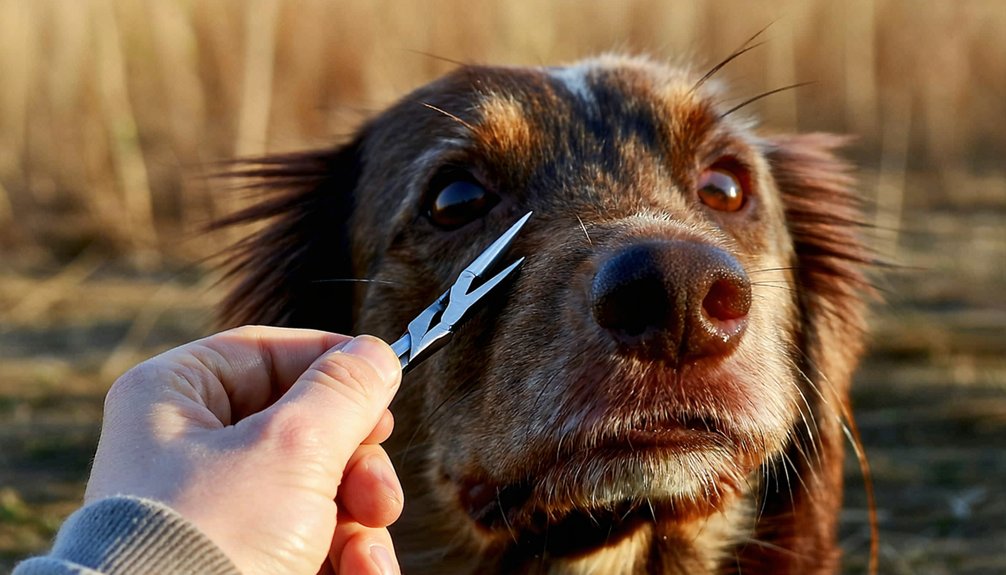
When your dog tangles with a porcupine, you’re facing an emergency, not a minor wound.
Barbed tips drive deeper over time, and quill migration can reach body cavities, causing abscesses, organ damage, and systemic infection.
That’s why veterinary sedation is the default—full-mouth, facial, or dense quilling can’t be safely cleared in the field.
Reserve field removal for a few superficial quills on accessible skin: outer limbs or trunk, never near eyes, mouth, throat, chest, or joints.
Those high-risk zones demand immediate transport.
So does any swelling, drainage, or a dog you can’t restrain safely.
Apply the same caution to foxtail risk—grass awns fragment easily and rarely forgive incomplete extraction.
When in doubt, emergency handling means getting your companion to a vet fast.
High-Risk Quill Spots You Should Never Touch
You’ve already learned that high-risk zones demand transport, not tweezers—now let’s map exactly where your hands don’t belong.
Never touch quills in or near the eye.
To avoid eye injury, leave anything in the globe, eyelids, or medial canthus alone—you risk corneal laceration, globe rupture, and blindness.
Skip the muzzle clusters too; quills there reach the nasal cavity, turbinates, and hard palate, where you can’t assess full length.
The throat, neck, and upper chest sit over carotids, jugulars, trachea, and esophagus, making this a documented migration corridor toward lungs and heart.
To prevent migration risk, don’t cut, snap, or twist—fragments and barbed ends keep traveling.
Inside the mouth, swelling threatens the airway.
Treat these spots as emergency triage demanding immediate vet referral.
Build Your Porcupine Quill and Foxtail Kit
Assemble your kit before you ever need it, because a panicked dog in a remote canyon is no place to improvise.
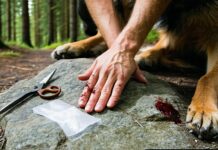
Start with core mechanical tools: fine-point locking hemostats in two or three sizes, splinter-style tweezers, blunt-tip bandage scissors, a compact LED headlamp, and a folding magnifier.
These let you grasp slick quills, trim hair, and spot broken fragments hidden in fur.
Add cleaning supplies: chlorhexidine or povidone-iodine antiseptic and Sterile Saline pods for flushing entry sites and eyes.
Prioritize Tool Sterilization with autoclavable, boil-safe stainless steel, and keep everything in Waterproof Storage to protect tips and prevent contamination.
Pack it all in a single Grab And Go pouch, so you—and your dog—stay ready for anything the trail throws your way.
Restrain Your Dog Without Driving Quills Deeper
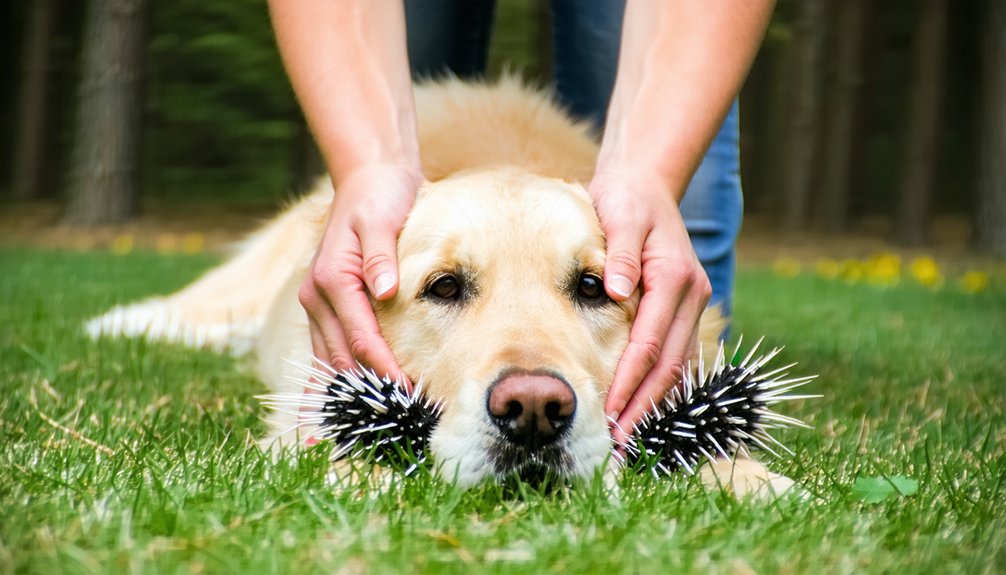
Before you touch a single quill, get your dog still—because a struggling dog drives quills deeper with every twist and lunge.
Move away from the porcupine first, then bring your dog into a quiet, enclosed space on a stable surface.
Animal calming starts with steady support at the body, chest, or shoulders—never the face or embedded quills.
Safe handling means even pressure, not tight squeezing that snaps quills.
- Steady your dog gently; panic makes everything worse.
- Use two-person handling so one comforts while the other prepares.
- Keep the head and neck uncrowded to prevent defensive lunging.
- Stop after one or two failed attempts—you’re protecting your friend.
Glove selection supports injury prevention, but calm immobilization matters most.
When restraint isn’t enough, head to a vet.
Why You Should Never Cut Porcupine Quills
Although it seems logical that snipping a quill might relieve pressure or make extraction easier, cutting does exactly the opposite. Porcupine quills aren’t air-filled balloons you can deflate—they’re solid keratin with backward-facing quill barbs that anchor into tissue.
When you cut a quill, you remove the tapered tip that’s easiest to grip, leaving a slick, shorter shaft buried close to the skin. That forces you to compress tissue with pliers, risking splintering and crushed fragments that are nearly impossible to find.
Worse, shortened quills migrate deeper with every muscle movement, traveling toward eyes, joints, or organs. Retained pieces invite infection, abscesses, and toxin risk from bacterial contamination.
Trust what experienced handlers know: never cut quills—keep them long, and pull them whole.
How to Pull Quills With Steady Traction
Once you’ve committed to removing quills in the field, success depends on preparation as much as technique.
Secure your animal first, then organize quills by region and prioritize dangerous locations near the eyes, mouth, and airway.
Field safety starts with restraint that protects both you and your companion from pain-triggered bites.
Grab each quill close to the skin with locking hemostats, stabilize the surrounding skin, and pull slowly in a straight line along the entry path.
- Steady, continuous traction spares tissue from tearing
- Constant tension respects the pain your friend feels
- Stopping when a quill cracks prevents deeper damage
- Pausing during struggles keeps trust intact
Maintain tool sanitation by wiping away saliva and blood, restoring the grip controlled traction demands.
Inspect for Buried and Broken Quill Fragments
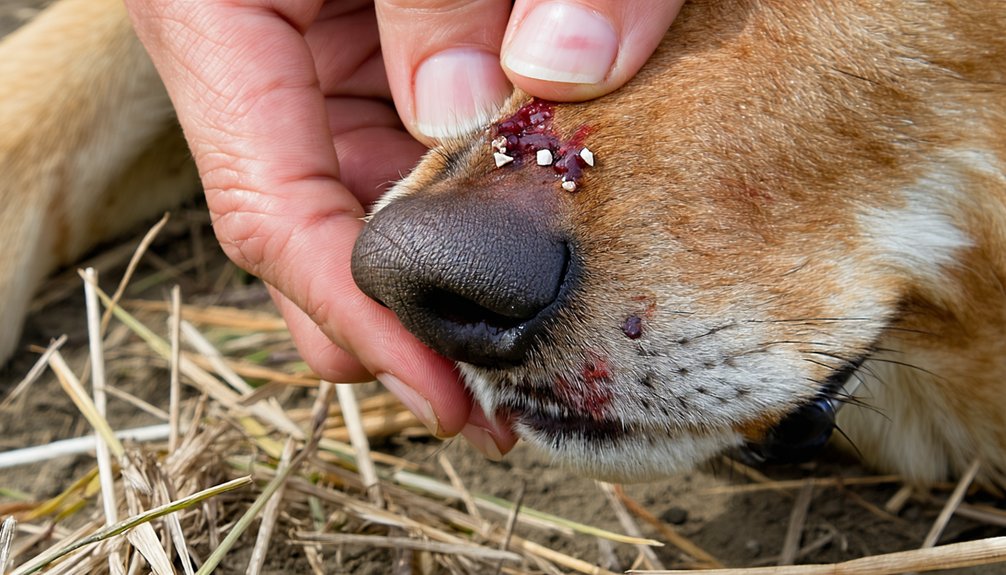
When you’ve pulled the visible quills, your work isn’t done—broken shafts and buried fragments are common, and they cause the infections and abscesses that turn a manageable field incident into a serious problem. Clip fur widely, then use bright light and magnification to examine each puncture. Palpate in concentric circles, feeling for firm cords or fluctuant swellings. This wound mapping pinpoints retained pieces.
| Sign | What It Means | Your Action |
|---|---|---|
| Puncture, no quill | Likely broken shaft | Mark for probing |
| Firm cord | Migrating fragment | Trace its path |
| Fluctuant swelling | Forming abscess | Monitor closely |
| Pain on flexing | Quill near joint | Localize carefully |
| Drainage days later | Migrating piece | Reinspect site |
Gentle needle probing, mirroring splinter technique, confirms fragments just beneath the surface.
How Are Foxtails Different From Quills?
Beneath the surface, quills and foxtails behave like two entirely different enemies. Knowing what you’re up against keeps your animal safe and keeps you confident in the field.
- Material composition: Quills are keratinized hair shafts—stiff, solid, and strong. Foxtails are fragile plant awns made of cellulose and lignin that fray and fragment.
- Field identification: Quills protrude visibly and you can spot them easily. Foxtails hide in dense fur, interdigital spaces, and orifices, demanding a careful search.
- Migration direction: Quills advance slowly and linearly. Foxtails track erratically along tissue planes, fur direction, and openings, traveling fast and far.
- Removal limitations: You can grasp rigid quills firmly. Delicate foxtails fragment under pressure, leaving hidden pieces that often require veterinary imaging.
Spotting Foxtails in Nose, Ears, Eyes, and Paws
Foxtails won’t announce themselves the way quills do, so you’ve got to read your animal’s behavior and target the body’s most vulnerable entry points.
Watch the nose for sudden violent sneezing bursts, one-sided bloody discharge, and frantic muzzle pawing.
For ears, look for acute head shaking, a tilt toward the painful side, and a yelp when you touch the canal.
In the eyes, you’ll spot squinting, heavy tearing, and red conjunctiva—sometimes a visible awn under the third eyelid.
On paws, check between toes for licking, swelling, and puncture-like openings.
During your home inspection, note skin reactions like draining tracts.
Maintain a hydration focus and run thermometer checks, since rising temperatures signal infection.
Trust these signs—you’re your animal’s first line of defense.
Pulling Surface Foxtails and When to Stop
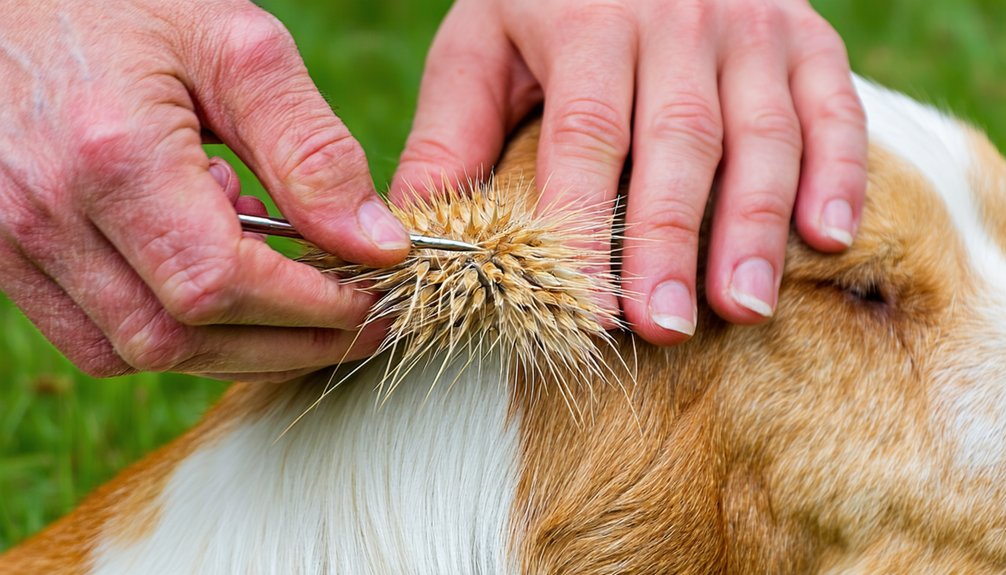
Because not every foxtail demands a vet, you can safely remove the ones still riding on the surface—but only if you read the situation correctly. Pull only when the awn sits loosely in outer fur, fully visible with seed head intact, sliding freely without resistance or pain.
Your dog should stay calm, breathing normally, not chewing or shaking.
- Grasp close to the base, pulling with the hair growth so the barbed shaft won’t snap.
- Use safe restraint methods—leash, helper, or stable surface—to prevent sudden jerks.
- Remove one at a time, confirming the entire awn comes out.
- Keep first aid supplies ready, like dilute chlorhexidine, for any abrasion.
Stop immediately if it’s embedded, between toes, or near any body opening—then seek a vet.
Red-Flag Signs Quills or Foxtails Have Migrated
Once you’ve pulled the safe surface awns, your job shifts to watching for what you can’t see.
Over the next days to weeks, check for firm, hot, painful swelling on the face, limbs, chest wall, or between the toes—signs of migration and abscess formation.
Watch for draining tracts or pustules that ooze, then partially close and recur.
Non-healing wounds that improve on antibiotics but return once you stop demand attention.
Respiratory red flags include persistent coughing, labored breathing, or foul nasal discharge.
Head shaking, head tilt, squinting, or sudden behavior changes signal ear, eye, or neurologic involvement.
Your quill inspection won’t reach deep tracts, so don’t probe blindly.
When deeper material’s suspected, a vet’s sedation options allow safe imaging and removal you can’t manage in the field.
Keep Your Dog Out of Quill and Foxtail Country
Since the best foxtail treatment is never getting one, your smartest move is keeping your dog out of the habitats where these awns thrive.
Dry, weedy grasses and disturbed ground—vacant lots, roadsides, fence lines, irrigation ditches, and gravel shoulders—pose the highest risk from late spring through fall.
Protect your companion by choosing safer ground and practicing seasonal route planning that adapts to annual foxtail growth cycles.
- Walk paved paths, mowed sports fields, and weed-free beaches during peak season.
- Create low awn zones at home with gravel, artificial turf, or healthy, dense lawns.
- Mow fence lines, dog runs, and kennels to shorten seed heads.
- Adjust routines when traveling to endemic western, semi-arid regions.
Together, these habits keep your best friend safe.
Frequently Asked Questions
Can Porcupine Quills Hurt Humans the Same Way They Hurt Dogs?
Yes, they can. You’ll face the same quill puncture severity dogs do—barbed shafts migrating inward, causing infection and tissue damage. Like foxtail embedment depth, retained fragments worsen complications, so you’ve got to remove them promptly and completely.
Are Some Dog Breeds More Prone to Quill or Foxtail Injuries?
Yes, hunting, working, and terrier breeds you love face higher risks. Small mouth breeds aren’t spared either. Long-haired, floppy-eared dogs trap foxtails easily, and foxtail seasonality means you’ll watch closely during dry, warm months together.
How Much Does Veterinary Quill or Foxtail Removal Typically Cost?
You’ll typically pay $100–$300 for basic removal, or $300–$800 with sedation. Mobile clinic costs vary, while emergency visit fees can push your bill to $500–$1,500. We’ve all faced these unexpected expenses together.
Will My Dog Need Sedation or Anesthesia at the Vet?
It depends. For quick removals, you’ll likely get sedation—an anesthesia alternative keeping reflexes intact. For deep, painful procedures or anxious dogs, your vet may recommend general anesthesia. Together, you’ll choose what’s safest for your companion.
Do Cats and Other Pets Face Similar Quill and Foxtail Risks?
Yes, your cat faces foxtail risks like dogs, though cat quill removal’s less common. In your pet risk comparison, smaller mammals and ground-walking birds face similar dangers too, so you’re right to stay watchful together.
Conclusion
You’ve got the tools and knowledge to handle quills and foxtails when a vet’s out of reach. Remove what’s safe, leave the high-risk spots alone, and never cut quills. Watch for migration signs—swelling, abscesses, or sudden pain—and don’t wait if they appear. Your fastest move is prevention: keep your dog out of risky terrain. When in doubt, get professional help. Acting calmly and correctly protects your dog from serious, lasting complications.
Disclaimer: This article is for informational purposes only. Always consult a licensed veterinarian before making medical decisions for your dog.
References
- https://projectupland.com/dogs/porcupine-quills-and-dog-encounters-a-first-aid-and-avoidance-guide/
- https://www.gundogmag.com/editorial/how-to-remove-porcupine-quills/466683
- https://academic.oup.com/jmammal/article/36/3/463/840389
- https://www.themeateater.com/hunt/upland-birds/ask-a-vet-how-to-deal-with-porcupine-quills-in-a-bird-dog
- https://forum.ultimatepheasanthunting.com/threads/proper-porcupine-quill-removal-in-the-filed.18689/
- https://hunt.vet/articles/how-to-handle-a-porcupine-encounter
- https://www.youtube.com/watch?v=eSESj1kyPw8
- https://www.youtube.com/watch?v=3mRQaRehCMQ
- https://www.youtube.com/watch?v=l_N66Li5S-8
- https://www.pnas.org/doi/10.1073/pnas.1216441109