Dog import rules vary by country, but the basics stay consistent. You’ll need an ISO 11784/11785-compliant microchip implanted before rabies vaccination, plus matching documents across the board. The U.S. requires dogs be at least 6 months old with a CDC Dog Import Form. The EU demands a 21-day wait post-vaccination and a 10-day Animal Health Certificate. Start planning 6–12 months ahead. Below, you’ll find each country’s specific requirements mapped out.
TLDR Key Takeaways
- The United States (effective August 1, 2024) requires dogs to be at least 6 months old, microchipped, and have a completed CDC Dog Import Form receipt.
- The EU requires entry from an Annex VIII-listed country, an ISO microchip implanted before rabies vaccination, and entry at least 21 days post-vaccination.
- Great Britain is now “Part 2 listed,” invalidating GB-issued EU pet passports and requiring an Animal Health Certificate within 10 days of travel.
- Quarantine rules vary widely: Australia (10–30 days), Hong Kong (up to four months), Japan (1–180 days), and Seychelles (up to 180 days).
- Rabies risk status depends on where your dog has been over the previous six months, so plot the strictest country first on multi-country itineraries.
The Core Documents Every Dog Needs
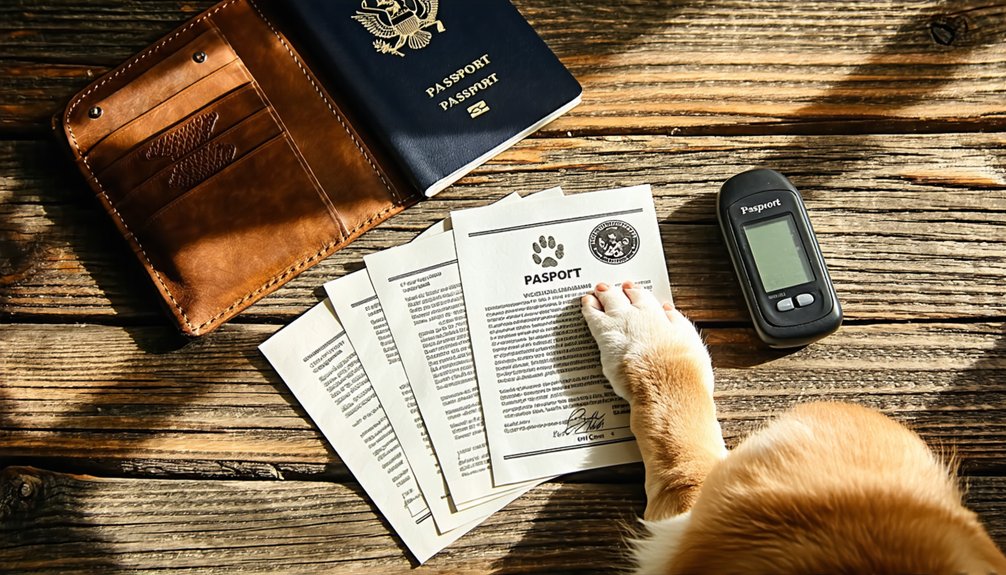
Before you book a single flight, you’ll need to assemble a paperwork foundation that holds up at every border crossing.
Start with an ISO 11784/11785-compliant microchip—implant it *before* the rabies vaccination, since many jurisdictions (the U.S. CDC, EU, Australia, Japan) won’t accept that vaccine otherwise.
Next, secure your rabies vaccination certificate showing date, product, batch, and vet details.
Most destinations require that shot at least 21–30 days before entry, with your dog at least 12 weeks old.
Then book a vet appointment for a general health certificate within 10 days of travel, listing clinical findings, parasite treatments, and your microchip number.
Checklist accuracy matters: that microchip number must appear identically on every document, or border officials can turn you back.
How Rabies Risk Status Shapes Your Route
Although your documents may be flawless, where your dog has been matters just as much as what paperwork you’re carrying. Many destinations judge your dog’s risk by where it’s been during the previous six months, not just where you’re departing from.
That means a short stay in a high-risk country can reset the risk clock, forcing quarantine or re-qualification when you enter rabies-free zones.
You’ll want to plan your route eligibility windows carefully. Travel from high-risk to rabies-free regions is often limited to direct imports from approved countries, so transiting non-approved states can invalidate your low-risk route.
Stage long stops in intermediate low-risk countries to “age out” past exposure.
Always check rabies tier updates shortly before booking, since outbreaks and eliminations shift country status regularly.
New U.S. Dog Import Rules for 2024
If you’re routing through or settling in the United States, you’ll need to reckon with the CDC’s new dog import regulation that took effect August 1, 2024. This rule applies to every dog entering the country, replacing the old suspension and prior policies.
Your companion must be at least 6 months old, carry an ISO-compatible microchip implanted before vaccination, and travel with a completed CDC Dog Import Form receipt. They’ll also need a valid, unexpired rabies vaccine and to appear healthy on inspection.
Build a timeline checklist early, since first or lapsed vaccinations require 28 days before arrival, and titers demand even longer lead times.
Coordinate your airline booking timing around these windows and port-of-entry limits, so you and your dog arrive together, prepared, and welcomed.
What the EU Requires to Import Your Dog

When you’re bringing your dog into the EU, you’ll first need to confirm you’re traveling from an authorized non-EU country listed in Annex VIII, Part I of Implementing Regulation (EU) 2021/404.
You’ll enter through a designated Travelers’ Point of Entry, where border authorities check your paperwork and microchip.
Rabies microchips matter here: your dog needs an ISO-compliant microchip implanted before its rabies vaccination, or that vaccination won’t count.
The primary rabies vaccine can’t be given before 12 weeks, and you’ll wait at least 21 days afterward before entry.
Pet travel timelines tighten from non-listed high-risk countries, requiring a titer test 30 days post-vaccination plus a 3-month wait.
You’ll also need an EU Animal Health Certificate, valid 10 days, plus a clinical exam within 48 hours.
Moving Your Dog Between EU Countries
Once your dog clears EU entry, moving between member states gets simpler, but it’s not paperwork-free.
You’ll rely on your EU pet passport as the main document, with your dog’s microchip or readable tattoo number linked directly to it.
Universal microchipping checks confirm identity, so make sure that number matches your records.
Your dog’s rabies vaccination must stay valid throughout travel, fully documented in the passport.
Some destinations ask more.
If you’re heading to Finland, Ireland, Malta, or Norway, you’ll need vet-administered tapeworm treatment against *Echinococcus multilocularis*—no more than 120 hours and no less than 24 hours before entry.
For smooth border inspection tips: keep documents accessible, since officials check them during movement controls.
Following these shared rules keeps your traveling companion welcome everywhere.
Why UK Dogs Now Need Extra Paperwork
Because Brexit changed Great Britain’s status for pet travel, your dog no longer enjoys the simplicity of the EU pet passport scheme. The EU now classifies GB as a “Part 2 listed” country, triggering post Brexit bureaucracy that affects every trip you take.
Your old GB-issued EU pet passport? It’s no longer valid, forcing passport replacement with new documentation. Instead, you’ll need an Animal Health Certificate for each trip into the EU or Northern Ireland.
These trip specific certificates must be issued within 10 days of travel and cover only a single entry.
From 4 June 2025, you’ll also need a Northern Ireland Pet Travel Document for that route.
Expect rigorous document verification at borders—officials require originals, not photocopies, for every leg of your journey.
Countries That Make Dog Import Easy
While the UK’s new paperwork rules add friction, plenty of destinations still make dog import surprisingly simple. If you’re searching for a place where you and your dog truly belong, focus on quarantine free options built around clear, standardized rules. The EU/Schengen structure leads the way: microchip, rabies vaccination, an EU health certificate, and a 21-day wait after vaccination, with no quarantine for compliant arrivals.
| Destination | Pet Friendly Logistics |
|---|---|
| Portugal | Minimal restrictions; rabies, microchip, health certificate |
| Mexico & Costa Rica | Straightforward entry; vaccination records, microchip, vet paperwork |
Thailand allows dogs easily with no quarantine when requirements are met, and Estonia pairs a nomad visa with pet provisions. Across these countries, you’ll find documentation compliance—not isolation—is what matters most.
Where Quarantine Still Applies to Dogs
Although the EU and Thailand wave compliant dogs through without isolation, plenty of destinations still lock arrivals into mandatory quarantine.
Australia holds dogs 10–30 days and won’t admit you without the correct import permit, so mind those permit lead times.
Hong Kong can demand four months from high-risk origins, while Japan ranges from 1–180 days—proof that risk tier systems, not just destination policy, drive your timeline.
Singapore, Taiwan, Malaysia, Fiji, and New Zealand all impose isolation, and Seychelles stretches to 180 days.
Kennel isolation variability is real: some systems offer home quarantine when antibody requirements are met, others extend periods when rabies document checks fail.
Get your microchip, vaccination, and titer paperwork airtight, and you’ll join the lucky arrivals facing the shortest stays.
How to Get an Import Permit on Time
Once you know your destination demands quarantine or strict entry checks, your import permit becomes the document that makes or breaks your travel date.
Start with buffer time calculations rooted in official timelines: Canada wants applications at least 30 days out via your My CFIA account, USDA APHIS needs 5 business days through eFile, the CDC’s unimmunized-dog pathway needs 10 business days, and New Zealand requires 20 working days for dogs from Australia.
Build form submission checklists for each pathway—Canada’s CFIA/ACIA 5860, transport and quarantine plans; Australia’s accurate details, fees, and supporting documents; New Zealand’s eligibility checks and 72-hour advance arrival notice.
Incomplete entries still delay review, so verify every field.
You belong on that flight when your paperwork’s ready first.
Plan Your Dog’s Travel Timeline

Because pet import timelines stretch far longer than most flights you’ll book, you’ve got to start planning your dog’s move 6–12 months out. Map each country’s lead times, since many destinations require 3–6 months between rabies vaccination, antibody titer, and entry.
Verify rabies-status categories and minimum age rules, then schedule your initial vet consult at least six months ahead to align microchip, vaccine, and testing dates.
For multi-country itineraries, plot the strictest country first. Rabies wait times often demand titer blood draws 30 days post-vaccination and three months before arrival.
Closer in, book certified vet exams early, since accredited vets book out fast.
Time parasite treatments to each country’s window, count health certificate validity backward from arrival, and buffer extra days for delays.
Choose Pet-Friendly Airlines and Ports
Start your airline search by matching your dog’s size to each carrier’s cabin and cargo rules, since that single factor determines most of your options. Small dogs (under 7–8 kg/17–20 lb) qualify for in cabin eligibility on most major carriers, while Alaska and Hawaiian remain your go-to options for medium or large dogs in cargo. For oversized companions, JSX permits cabin dogs up to roughly 79 lb with an adjacent seat. Remember airline capacity limits—most cap pets at 4–6 per cabin—so book early on popular nomad corridors.
| Need | Recommended Carrier |
|---|---|
| Small dog, in-cabin | Delta, JetBlue, United |
| Large dog, cargo | Alaska, Hawaiian |
| Large dog, cabin | JSX |
| Two small dogs | Alaska |
| Multi-dog, second seat | United |
Compare fees, since they accumulate fast.
Keep Your Dog’s Papers Border-Ready
Booking the right flight means nothing if your dog’s paperwork can’t clear inspection at the gate. Fellow nomads know border-ready documents keep the trip moving. Build a core document pack: microchip certificate, rabies vaccination records, titer results, health certificates, and import permits. Store originals in a waterproof folder with certified copies, plus digital PDFs organized by country and date in cloud and offline storage.
Run a microchip checklist before every crossing. Confirm your ISO 11784/11785 compliant 15-digit chip appears on all key documents, and that name, species, breed, color, sex, and birth date match. Complete scan verification with a universal scanner—unreadable or mismatched chips trigger denial or quarantine. Carry prior entry stamps and old certificates to prove your documented movement history.
Frequently Asked Questions
How Much Does International Dog Travel Typically Cost Overall?
You’ll typically spend $1,000–$6,000 per trip, depending on your dog’s size, route, and services. For your cost estimate, budget scenarios start around $650, while large dogs to strict countries hit $8,500+. Smart pet budget planning matters.
Can My Dog Fly in the Cabin?
Yes, if you’re a small-dog owner, you’ll likely qualify. Check carrier size, airline pet policies, and destination eligibility first. In-cabin restrictions require your dog fitting under the seat, so confirm acceptance directly before you book.
What Sedation or Anti-Anxiety Options Are Safe for Flights?
You’ll find vets recommend anxiolytics like trazodone or gabapentin over sedation, plus pheromones and supplements. Like fellow nomads, prioritize anxiety training and a vet checklist preparation, always trialing meds beforehand—experts agree this keeps your companion safest.
Are Certain Dog Breeds Banned From Air Travel?
Yes, you’ll find many airlines ban snub-nosed and “bully” breeds from cargo, though some allow cabin travel. Check veterinary documentation and quarantine requirements too—we’ve all steered this, and you’ll get your companion flying safely.
What Happens if My Dog Gets Sick Abroad?
You’ll find the nearest 24-hour clinic, call for triage, and stabilize your dog during transport. Carry emergency veterinary coverage to offset costs, keep all records handy, and follow reuniting procedures abroad if travel plans change.
Conclusion
You’ve now got the structure to move your dog across borders without costly surprises. Start with the core documents, verify each country’s rabies-risk classification, and apply for import permits well before you fly. Build in buffer time for vaccinations, titer tests, and microchip requirements. Choose airlines and ports that welcome pets, and keep your paperwork organized and accessible at every checkpoint. Follow these country-specific rules, and you’ll travel confidently with your dog anywhere.
References
- https://alpasjourneys.com/digital-nomad-with-dog/
- https://europa.eu/youreurope/citizens/travel/carry/pets-and-other-animals/index_en.htm
- https://dogtripguide.com/blog/digital-nomad-with-dog-complete-guide/
- https://www.petsintransit.com/2026/02/04/pet-travel-quarantine-by-country/
- https://en.wikivoyage.org/wiki/Dog
- https://www.cdc.gov/importation/dogs/high-risk-countries.html
- https://www.cdc.gov/importation/dogs/rabies-free-low-risk-countries.html
- https://www.aphis.usda.gov/pet-travel/another-country-to-us-import
- https://petair.jp/en/complete-guide-to-pet-care-during-overseas-assignment-family-choice/
- https://www.freedomiseverything.com/20-insights-about-traveling-with-a-dog-internationally-digital-nomad-survey/