If you’re leaving your dog in an RV, you need a cellular monitor, not Wi-Fi. Interiors spike 20°F in 10 minutes, so heatstroke can hit in 4–6 minutes. We tested top devices over 1,000 miles, and the Waggle Pro leads with Verizon LTE reliability, motion alerts, and fast refresh intervals. Set high alerts at 75–80°F for safety margins. Below, you’ll find the carrier matches, battery backup needs, and threshold settings that protect your dog.
TLDR Key Takeaways
- Waggle Pro delivers Verizon LTE reliability, motion alerts, and fast refresh intervals built specifically for RV life.
- Necto 3-in-1 adds GPS and geofencing on LTE-M, while MarCELL offers power-loss detection for early warning.
- Set high alerts at 75–80°F and low alerts at 45–50°F, providing safety margins before USDA/APHIS limits.
- Tested over 1,000 miles across humidity, desert, and mountains, logging 90°F highs and 40°F lows with HVAC on/off scenarios.
- Verizon leads rural reliability, AT&T excels in the Southeast and Texas, and T-Mobile dominates urban campgrounds.
Why RV Heat Kills Dogs Faster Than You Think
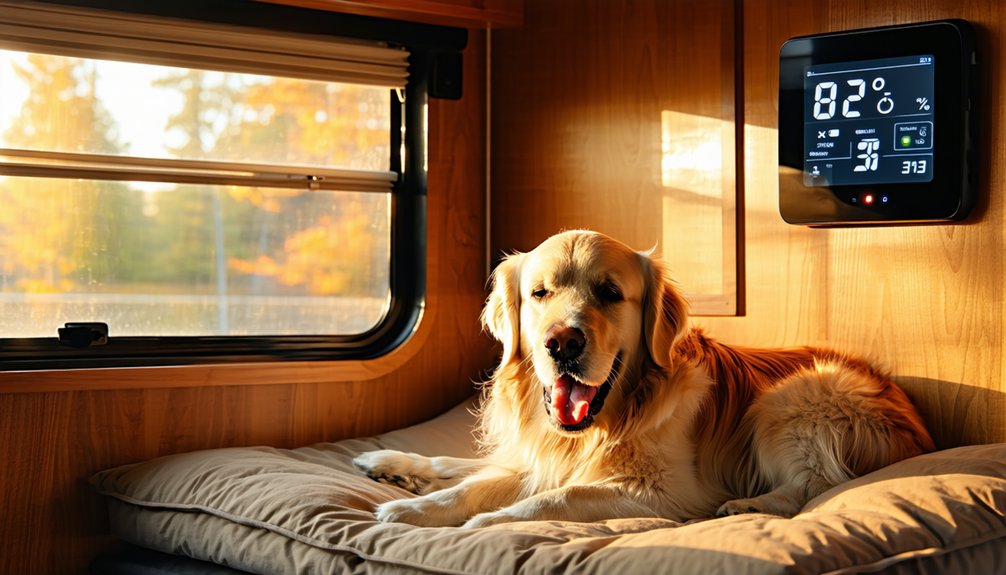
RVs heat up faster and hotter than most owners realize. Your rig isn’t a house—large windows, dark roofs, and thin insulation create rapid window heat gain that pushes interior temperatures up 20°F in just 10 minutes.
Park in 80°F sun, and you’ll soon face 100–120°F inside, conditions that turn rapidly fatal for dogs.
Here’s why we worry: your dog cools through panting and paw pads alone, far less efficiently than you sweat. The heatstroke timeline is brutal—pets can suffer brain damage or die in as little as 4–6 minutes under extreme conditions.
Brachycephalic breeds, seniors, and anxious dogs succumb even sooner.
Cracking windows won’t save them. Stagnant, humid air and radiant heat from upholstery overwhelm your dog before you’ve finished a quick errand.
What Makes a Cellular RV Pet Monitor Worth Buying
Choose a monitor that earns its keep by doing more than flashing a temperature readout. You want continuous ambient monitoring at 1–5 minute intervals, plus humidity tracking to gauge heat index and respiratory stress in tight RV spaces.
Demand configurable high/low thresholds so you can tailor alerts to your dog’s breed and health.
Indoor sensor accuracy matters: look for digital sensors within ±0.5–1.0°F across an extreme −4°F to 140°F range.
Notification reliability separates trustworthy units from gimmicks, so insist on a dedicated 4G LTE module, multi-carrier coverage, offline buffering, and alert delivery within 1–2 minutes.
Add a rechargeable backup battery and power-loss notifications for early warning before shore power fails.
These features keep you connected to the pack that depends on you.
Which Carrier Gives You the Best Coverage?
When your dog’s safety depends on a steady signal, you can’t afford to gamble on carrier marketing claims. Like every seasoned full-timer you’ll meet on the road, you need real coverage where you actually park.
Verizon leads US carrier reliability for rural and interstate travel, making it the safest default for boondockers monitoring pets off-grid.
AT&T runs a close second and even beats Verizon in pockets of the Southeast and Texas.
T-Mobile shines in urban and suburban campgrounds with mid-band 5G, but lags in remote areas.
There’s no single “best” carrier everywhere, so smart RVers rely on route specific testing.
Layer carrier maps with crowdsourced apps like OpenSignal and campground reviews from Campendium to confirm coverage for each leg of your trip.
How Much Battery Backup Do You Actually Need?

A reliable signal means nothing if your monitor goes dark the moment power drops, so battery backup is the next link in your dog’s safety chain. The right runtime depends on how you travel. If you’re routinely powered from vehicle or shore power, backup only needs to bridge brief interruptions. Boondocking, storage, or long travel days demand more. Always verify backup runtime claims—CabinPulse documents up to 3 days, while others fall short. Remember, backup must cover alert delivery reliability, not just the sensor.
| Use Case | Backup Need | Power Strategy |
|---|---|---|
| Shore power | Short | Charges continuously |
| Travel days | Medium | Vehicle/alternator |
| Boondocking | High | Solar/deep-cycle |
| Storage | High | Battery-aware only |
Choose documented duration over marketing language, and you’ll keep your companion protected.
How We Tested These RV Pet Monitors Over 1,000 Miles
Across 1,000 miles, we put these monitors through conditions your dog might actually face. We crossed coastal humidity, high-desert aridity, and mountain elevations, logging daytime highs above 90°F and overnight lows near 40°F.
We ran them during 6–10 hour driving days and stationary stretches in RV parks, boondocking sites, and urban lots, parking in direct sun, partial shade, and full shade.
We staged “pet left in RV” scenarios with HVAC on, off, and during simulated shore-power loss, then verified Thermal Calibration against physical thermometers inside motorhomes and trailers.
We drove through strong, moderate, and weak coverage zones to test Network Reliability, timing SMS, push, and email alerts.
We also checked offline behavior—whether missed readings backfilled or vanished once connectivity returned, keeping you informed.
Waggle Pro: Our Best Overall Pick
After 1,000 miles of testing, the Waggle Pro earned our top spot by handling every scenario we threw at it. You get 4G LTE multi-carrier connectivity, so carrier coverage stays reliable even when you’re parked far from Wi-Fi. When shore power dropped, the cellular alerts reached us instantly, warning that the HVAC might’ve stopped running.
You’ll appreciate the built-in backup battery, rated for two to four days, which kept monitoring alive through outages. Customizable thresholds for temperature and humidity let you set safe ranges for your dogs, and app notifications arrive via push, SMS, and email—so you’re never out of the loop.
Like the rest of us protecting our pets on the road, you’ll trust the Pro to watch over what matters most.
Necto 3-in-1: Best for Power-Loss Alerts
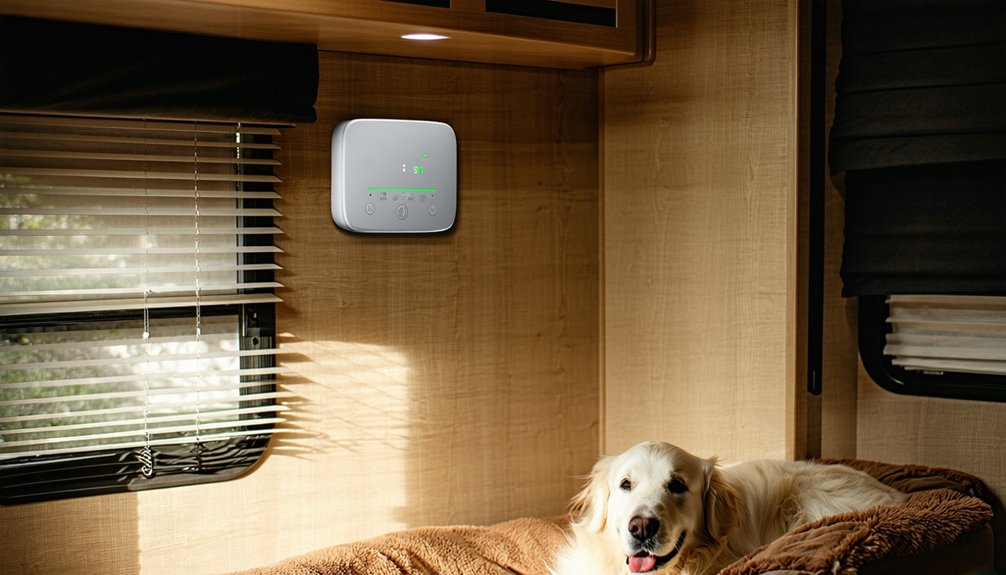
Power loss is the silent threat to any dog left in an RV, and the Necto 3-in-1 tackles it head-on. Its 3-in-1 sensor monitors power status alongside temperature and humidity, offering reliable outage detection the moment shore or generator power drops.
You’ll get immediate cellular alerts via SMS and email, so you’re never left guessing. When power fails, the built-in battery takes over seamlessly, offering battery backup endurance of up to 72 hours of continuous monitoring and alerts.
You don’t depend on RV Wi-Fi or a hotspot, which cuts failure points dramatically. The integrated 4G LTE module runs on AT&T, T-Mobile, and Cellular One, keeping you covered at remote campgrounds.
You’ll also confirm remotely, through continuous power-status reporting, exactly when your RV’s power returns.
MarCELL: Most Reliable for Long Trips
When you’re logging multi-day miles, you need a monitor that won’t drop the ball mid-trip, and the MarCELL delivers exactly that. Built-in Verizon or AT&T modules mean your Cellular Alerts don’t depend on flaky campground Wi-Fi—pick the carrier that covers your route best. The 24/7 cloud connection checks in at regular intervals and on any alarm, so you stay in the loop wherever the road takes you and your dog.
For true RV Reliability, the internal battery backup keeps monitoring active through shore-power losses, typically covering several hours.
Full-time RVers and pet owners report multi-day, long-distance performance without disconnects whenever cellular coverage holds.
With an indoor-rated range of roughly 0–122°F plus humidity tracking, you’ll join travelers who trust it on every trip.
Govee and SensorPush: Budget Wi-Fi Options
Here’s what you’ll weigh before joining the budget crowd:
- Indoor Wi-Fi limitations: alerts depend on an internet-connected network at your site.
- Threshold reliability tradeoffs: budget sensors prioritize affordability over cellular redundancy.
- Setup steps: account creation and pairing add friction.
SensorPush’s HT1 stands as the compact, Bluetooth alternative—versatile across varied environments when Govee isn’t your preferred pick.
Cellular vs Wi-Fi for Dogs Left in RVs
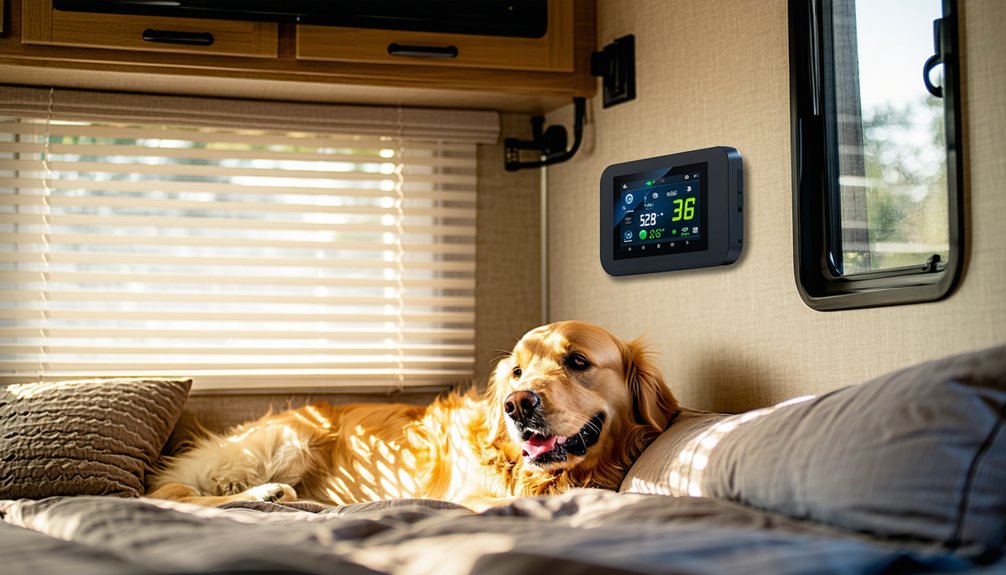
Every connectivity choice you make affects whether you’ll actually receive an alert when your dog needs you most. Wi-Fi monitors carry serious network dependency downsides because they rely on either campground Wi-Fi reliability or mobile hotspot dependence—each a single point failure.
When campground networks suffer congestion latency issues, dead zones, or power outage risks, you face offline alert gaps exactly when your dog’s safety depends on real-time notifications.
Cellular monitors connect directly over LTE, sidestepping these vulnerabilities. They include backup batteries and power-loss alerts, so you stay informed even during outages.
While you’ll avoid data plan overages that hotspot-heavy Wi-Fi setups trigger on long trips, remember that remote boondocking coverage still depends on carrier maps. For most RVers, cellular keeps you confidently connected.
Setting Temperature Thresholds That Keep Dogs Safe
Set your high alert in the 75–80°F (24–27°C) range and your low alert around 45–50°F (7–10°C), and you’ll build a safety margin before conditions turn dangerous.
Those thresholds give you backup time before you hit the USDA/APHIS limits of 85°F and 45°F, which dogs can’t safely tolerate beyond four hours.
Breed Vulnerability shapes your Alert Calibration. Adjust your settings for these factors:
- Small or short-haired breeds: raise your low alert to 50°F or higher.
- Elderly, young, or sick dogs: tighten both thresholds for extra protection.
- Solar gain in RVs: interiors spike fast, so keep high alerts conservative.
You’re part of a community that puts dogs first. Treat these alerts as a backup, never your primary protection.
Which Cellular Monitor Should You Buy?
Every cellular monitor on the market solves a slightly different problem, so your choice comes down to how you travel and what you’re protecting against.
If you’re constantly on the move, the Waggle Pro earns its top ranking with Verizon LTE reliability, motion alerts, and fast refresh intervals built for RV life.
If you want location tracking too, the Necto 3-in-1 adds GPS and geofencing on LTE-M.
For stationary or long-term setups, MarCELL’s power-loss detection gives you an early warning before temperatures climb.
Whichever you join, verify carrier coverage along your routes and budget for subscription costs, since these devices need paid data plans to alert you.
Pick the monitor that matches your travel, and you’ll travel with the same peace of mind we do.
Frequently Asked Questions
How Much Do Cellular RV Pet Monitor Subscription Plans Typically Cost per Month?
You’ll typically pay $8–$20 monthly, joining fellow RV pet parents who’ve found reliable coverage. Plan pricing varies—you’ll spend $7.95–$10 on annual commitments or $14.95–$15 month-to-month. Activation fees apply on some flexible plans, so budget accordingly.
Can I Monitor Multiple RVS or Pets With One Account?
Yes, you can. Most platforms let you add multiple devices, so Account Switching between RVs is easy. For pets sharing one cabin, Multi Pet Grouping works—one ambient sensor protects everyone, keeping your whole crew safe together.
Are These Monitors Waterproof or Resistant to RV Humidity Damage?
You’ll find these monitors resist RV humidity but aren’t waterproof, so mount them away from condensation. Like fellow RVers, you’ll trust their backup battery life and long distance alerts to keep your pets safe everywhere.
What Happens if My Dog’s Monitor Loses Cellular Signal Completely?
You’ll lose real-time alerts since notifications need an active data path. Your monitor keeps reading sensors locally through offline recording modes, buffering data until signal returns. Some units add GPS fallback alerts, but you’re protected only locally.
Do These Monitors Work Outside the United States or in Canada?
Yes, but Canada compatibility varies by carrier. You’ll want MarCELL’s AT&T version for U.S., Canada, and Mexico, or CabinPulse for broad Canadian networks. Always verify roaming coverage matches your route before you hit the road together.
Conclusion
After 1,000 miles, your choice comes down to coverage and reliability. If your travels cross spotty cellular zones, you’ll want a monitor with multi-carrier support and at least 24 hours of battery backup. Skip Wi-Fi options unless you’re parked somewhere with rock-solid signal. Set conservative temperature thresholds—your dog can’t wait for “close enough.” Invest in cellular monitoring now, because the alternative isn’t worth the risk. Your dog’s life depends on it.
References
- https://getnecto.com
- https://www.thewaywardhome.com/best-pet-temperature-monitors-for-rv/
- https://www.youtube.com/watch?v=W6koBi9C5VU
- https://www.homeowner.com/weather/best-rv-pet-temperature-monitors
- https://nerdtechy.com/best-rv-pet-temperature-monitor
- https://www.facebook.com/groups/roadtreking/posts/3077540979071527/
- https://rvproperly.com/recommendations/fixtures/best-rv-temperature-monitor/
- https://everywherewithclaire.com/rv-pet-temperature-monitor/
- https://www.thedrive.com/reviews/29783/best-pet-temperature-monitor-for-rvs
- https://www.meetmarcell.com/who-we-help/rv-monitoring/