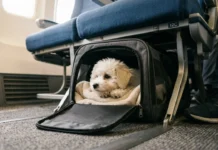
Your under-seat carrier fit depends on your aircraft, not your airline. Wide-bodies like the 777 give you roughly 18×14×9 in, narrow-bodies like the 737 or A320 offer 17×13×8 in, and regional jets or turboprops shrink to just 14–15×12×7 in. Seat rails, IFE boxes, and bulkhead walls can steal even more room. Aim for 17×13×9 in to stay safe across most planes—but the full breakdown ahead reveals exactly where your carrier will and won’t slide in.
TLDR Key Takeaways
- Wide-body jets offer the most under-seat room, averaging 18×14×9 in, ideal for pet carriers.
- Narrow-body jets like the 737 and A320 average 17×13×8 in, tighter but generally workable.
- Regional jets and turboprops have the smallest footwells, ranging from 12.8 to 14.5 inches.
- Bulkhead and row 1 seats often eliminate under-seat storage due to full-height partitions.
- Soft-sided, compressible carriers fit irregular footwells better than rigid hard-sided options.
Why Under-Seat Space Varies by Aircraft
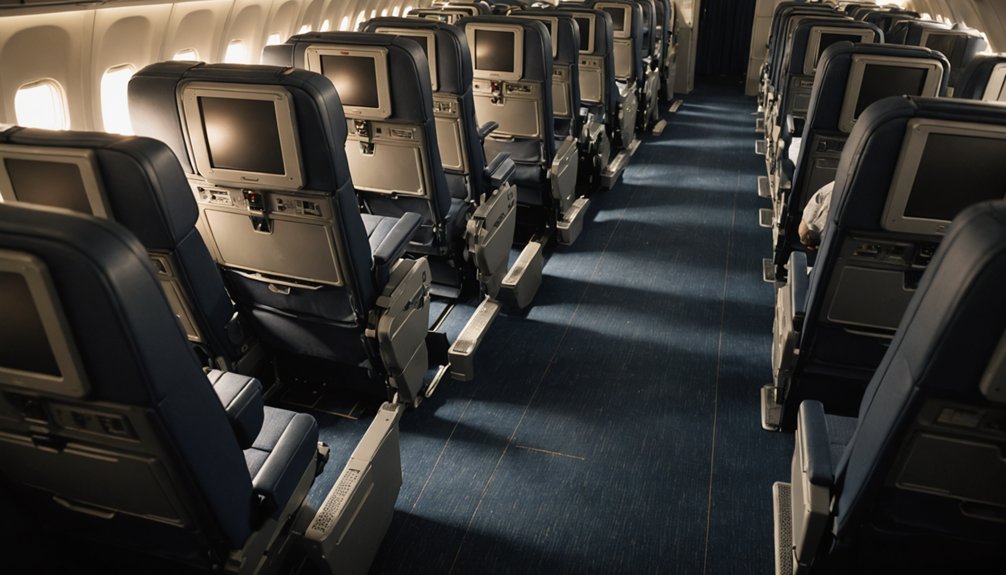
Because cabin size dictates how much room engineers can allocate beneath each seat, your under-seat space shrinks or grows depending on the aircraft you’re flying.
Wide-body jets like the 777 and A350 average 46 x 36 x 23 cm, while narrow-bodies like the 737 or A320 offer roughly 43 x 33 x 20 cm.
Regional jets, including the CRJ series, drop to 38 x 30 x 18 cm—the tightest fit you’ll encounter.
This aircraft comparison shows structural elements matter too.
Seat frames, support rails, and mounted equipment create seat variation even within the same row.
Bulkhead seats offer none at all.
Wiring and other components under the seat can also further limit the available space for your bag.
Measurements should also account for electronics boxes and life vest containers tucked beneath certain seats, which can reduce usable depth even further.
The shape of this area also differs between narrow-body and wide-body jets, so a bag that fits one type may not fit the other in the same way, largely due to aircraft type.
Before you pack, check your specific aircraft and seat position—don’t assume one flight’s clearance matches another’s.
How to Measure Your Carrier the Right Way
Once you know your aircraft’s rough clearance, you still need to measure your own carrier against it—not just trust the label. Accurate carrier dimensions require three axes—length, width, height—measured at maximum external points, including wheels, handles, zippers, and clips.
Skip the interior dimensions; airlines check external footprint only. Use proper measurement techniques: a rigid metal tape, a flat hard surface, and gentle compression to mimic real-world sliding. Record both uncompressed and compressed figures, then subtract at least 0.5 inch from depth as a buffer.
Measure with typical contents loaded, since packing can add 0.5–1 inch of bulge. Soft-sided carriers need re-measurement whenever contents or configuration change—rigid frames stay consistent, but don’t assume yours does. Carriers with a high percentage of mesh material can compress further than rigid ones, so factor that flexibility into your measurements. Keep in mind that under-seat luggage dimensions vary by airline and aircraft model, so a carrier that fits on one flight may not fit on another. For reference, airlines with extra large underseat sizes, such as Qantas and Virgin Australia, allow dimensions up to roughly 48 x 34 x 23 cm.
Seat Rails and IFE Boxes: The Hidden Space Stealers
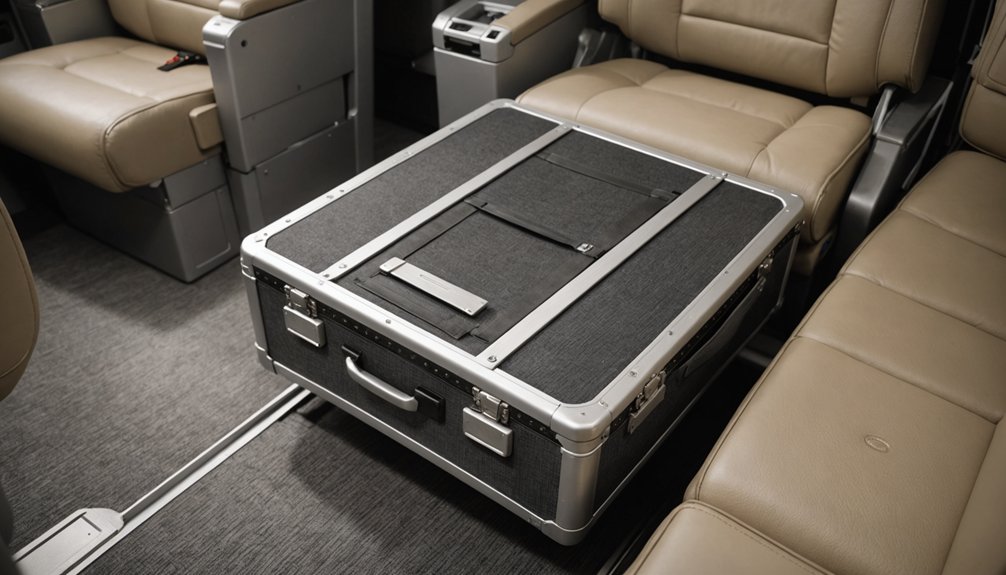
While your carrier’s spec sheet lists clean, universal numbers, the floor beneath your seat isn’t nearly so tidy.
Seat Track systems run 34–45mm wide with a raised 13–15mm profile, creating a physical ridge your carrier’s wheels or corners must clear.
That ridge isn’t cosmetic—it’s structural, built to lock seat fittings into place, and it interrupts flat Floor Contour exactly where you need it most.
Add IFE boxes bolted onto or near these rails, and you lose usable inches you never accounted for.
Two parallel rails per seat pair mean your carrier might straddle a gap on one flight and hit a mounting box on the next.
These rails are manufactured to strict aerospace specifications, including AS33601 and MS33601 standards, which prioritize structural locking strength over passenger cargo clearance.
Notably, this style of aircraft flooring is not certified for official wheelchair restraint use, despite superficially resembling systems that are.
Wear on these rails is closely monitored too, since regulators require replacement once a locking pin hole diameter reaches 0.42 of an inch.
Same seat width, different floor reality—plan for the rail, not just the seat.
Bulkhead Seats and Why They Change the Rules
Bulkhead seating puts you behind a wall or fixed divider, not a seatback, which fundamentally alters seat geometry.
Pitch often jumps to 38–45 inches versus 30–32 in standard economy, but that extra distance can mean nothing if a full-height partition eliminates under-seat storage completely.
Many row 1 seats, plus configurations like Delta’s 737-900ER first class and American’s MCE row 8, explicitly ban floor storage during taxi, takeoff, and landing. On aircraft like the B 737-800, bulkhead rows are often chosen for their extra leg room, even though bags must then go entirely into the overhead bin.
Partial bulkheads preserve some space; full-height walls don’t. Passengers with service animals or immobilized legs are given priority for bulkhead seats under federal law, which can affect who ends up in these rows regardless of booking order. On United’s 737-800, Economy Plus seats 7D/7E/7F benefit from a partial-height bulkhead that delivers outstanding legroom while still allowing some underseat clearance.
Even within the same fleet—like United’s 737-800 row 7—storage availability shifts by aircraft.
Check your specific configuration before assuming that generous pitch guarantees room for your bag.
Narrow-Body Jets: Under-Seat Dimensions for the 737 and A320
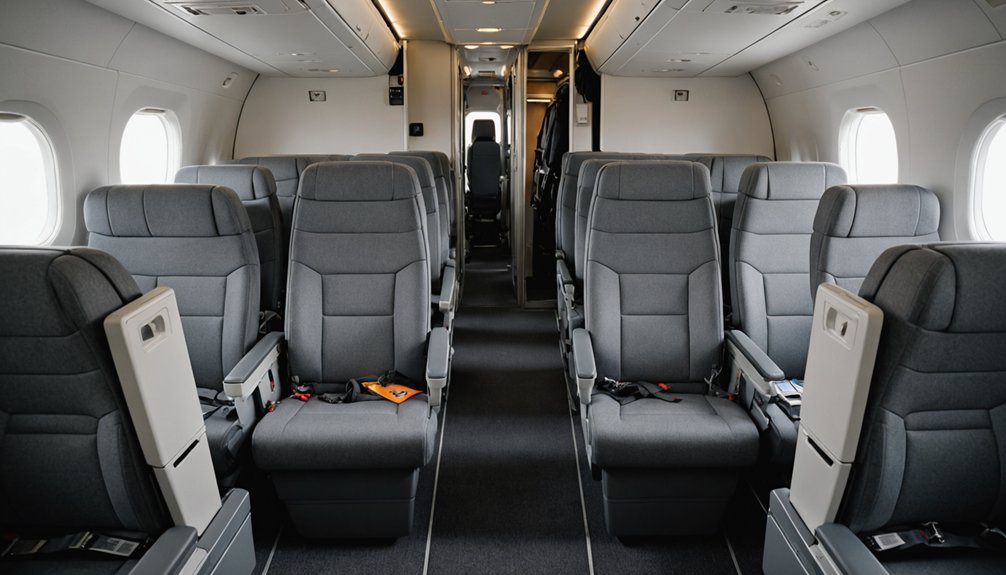
The 737 and A320 dominate domestic fleets, yet their under-seat dimensions don’t match up as closely as you’d expect from two similarly sized jets.
Your 737 typically gives you 16–20 in W × 17–20 in D × 9–11 in H, with American’s 737-800 topping out at 20×17×11.75 in and Southwest running tighter at 19×19×9.5 in.
The A320 shrinks that footprint to roughly 18×15 in, with usable space closer to 17×13×8 in once you factor in life-vest compartments.
Airline comparisons matter here—Continental’s 737 space runs smaller than American’s on the same aircraft type.
Your seat measurements also shift by position: aisle seats often lose width to structural boxes, while window seats gain height where vest packs aren’t stored. Carriers must also be positioned front-to-back rather than sideways to fit properly within these under-seat dimensions.
Wide-Body Jets: Extra Room on the 777, 787, and A350
Because wide-body jets carry deeper fuselages and heavier structural tolerances, you’ll typically find more forgiving under-seat space on the 777, 787, and A350 than on any narrow-body jet.
Wide body jets average 46 x 36 x 23 cm (18 x 14 x 9 in) of usable under-seat storage, compared to 43 x 33 x 20 cm on the 737 or A320.
On the 777, expect roughly 20 x 18-19 in of clearance, though seat rails and life-vest boxes can shrink actual height to 8.5-9 in. Bulkhead rows on the 777-200 often have different seat features that can limit the usable space for carriers, so it’s worth checking configuration before booking.
The 787 and A350 improve on this with slimmer seat frames, giving you more consistent space across economy rows. Remember that compressibility matters more than a carrier’s listed dimensions when judging whether it will actually squeeze into these under-seat spaces.
Middle seats often offer the most predictable rectangular footprint for your bag or carrier.
Regional Jets and Turboprops: The Tightest Fit
If you fly regional jets or turboprops, expect the tightest under-seat dimensions in commercial aviation: about 38 x 30 x 18 cm (15 x 12 x 7 in) on average, well below both narrow-body and wide-body figures.
Regional constraints hit hardest on the CRJ-200, where depth drops to 13.5 in, and row 1’s fixed bulkhead kills rolling totes entirely. The CRJ-700 and E175 offer marginal relief at 14.2–14.5 in, but seat rails and IFE boxes still eat into usable space. Turboprop limitations show up in irregular footwells—the ATR 72-600 measures just 12.8 in, with tapered sidewalls that reject rigid frames outright.
Pack soft-sided, compact bags for these routes, and prepare to gate-check anything larger than a slim daypack.
Under-Seat Limits at Delta, United, and American
Compare that regional squeeze to the “Big Three” US carriers, and you’ll find more breathing room—though not as much as their published carry-on specs suggest.
Delta, United, and American each cap carry-ons at 22 x 14 x 9 inches, but that’s overhead-bin space, not a guarantee for under your seat.
Airline comparisons reveal a pattern: none of these carriers publish a fixed personal-item dimension.
Instead, your bag must fit whatever space the aircraft provides.
United’s Basic Economy adds travel restrictions, often limiting you to a personal item only.
Your safest bet?
Pack toward 17 x 13 x 9 inches.
That target keeps you clear of under-seat surprises, regardless of which of the three you’re flying.
Under-Seat Limits at Southwest, JetBlue, and Alaska
While Southwest, JetBlue, and Alaska all skip assigned seating drama, they don’t skip specificity when it comes to personal-item sizing.
Southwest cites 18.5″ × 13.5″ × 8.5″ officially, though stricter guides recommend 16.25″ × 13.5″ × 8″ for consistent fit across 737 rows.
JetBlue’s spec runs tighter at 17″ × 13″ × 8″, with aircraft comparison across A320, A321, and E190 fleets showing aisle seats slightly narrower due to support structures.
Alaska’s under-seat max sits at 17″ × 11″ × 9″, paired with its 22″ × 14″ × 9″ carry-on allowance across 737 and E-175 fleets.
For pet travel, you’ll want a semi-rigid, low-profile carrier—airline policies require full under-seat containment for the entire flight, and power-box equipped seats reduce usable height and width further.
Soft-Sided vs. Hard-Sided Carriers: Which Fits Better?
Because most under-seat spaces aren’t perfect rectangles, the carrier’s structure matters as much as its listed dimensions.
Soft-sided pet carriers compress to fit irregular footwells, with mesh panels and flexible walls squishing down where rigid shells can’t.
That’s why most airline restrictions center on soft-sided baselines near 18 x 11 x 11 inches.
Hard-sided carriers offer no such give: if any dimension exceeds the tightest clearance, you risk rejection at the gate.
NEXT-generation aircraft interiors, with as little as 6 to 7 inches of under-seat height, expose this weakness fast.
Anecdotal evidence backs it up—soft carriers slightly over listed limits often still slide in, while hard-sided ones rarely get that same margin.
For reliable, cross-airline fit, soft-sided wins.
Best Pet Carrier Sizes for Under-Seat Travel
Once you’ve settled on soft-sided over hard-sided, the next question is exactly which dimensions to buy.
Stick to the 18 x 11 x 11-inch benchmark for maximum flexibility, but verify against stricter limits like KLM’s 46 x 28 x 24 cm before booking.
For Pet Comfort, use the IATA formula: length equals nose-to-tail measurement plus half the elbow height, width doubles the body width, and height adds mat thickness to shoulder height.
Brachycephalic breeds need 10% more room to breathe easy.
Don’t oversize, though—Carrier Safety depends on snug-but-not-cramped space, roughly 7 cm of clearance above the head and around the body.
Your pet should stand, turn, and lie down without pressing against any wall.
The Ultimate Under-Seat Carrier Fit Chart by Aircraft
Aircraft type dictates under-seat volume more than airline branding does. For accurate aircraft comparison, narrow-body jets average 17 x 13 x 8 in, wide-bodies stretch to 18 x 14 x 9 in, and regional jets shrink to 15 x 12 x 7 in.
You’ll find outliers everywhere: Delta’s CRJ200 offers 18 x 16 x 10.5 in, while Lufthansa caps height at just 3.9 in. This variance means carrier selection shouldn’t rely on airline reputation alone—you need aircraft-specific data.
Your safest bet across most fleets is a carrier at or under 16 x 12 x 6 in. That size clears narrow-body, wide-body, and regional thresholds simultaneously, giving you the freedom to book any route without measuring anxiety or gate-side surprises.
Frequently Asked Questions
Can I Call the Airline to Confirm My Exact Seat’s Under-Seat Dimensions?
You can call, but don’t expect exact seat measurements—airline policies rely on standard aircraft dimensions, not row-specific data. Agents confirm your aircraft type and general limits; you’ll still verify tight-fit seats yourself once boarded.
Will Gate Agents Actually Measure My Carrier Before Boarding?
Not routinely. Gate policies favor visual checks over strict measuring—agents typically intervene only when your carrier looks oversized. Airline procedures leave enforcement to staff discretion, so you’re generally free to board unless your bag clearly exceeds space limits.
Can I Request a Specific Seat With More Under-Seat Space?
Yes, you can request it, but airlines won’t guarantee results. Use seat selection tools to avoid bulkhead/exit rows, verify your carrier size against aircraft charts, and confirm specifics directly with the airline before booking.
What Happens if My Carrier Doesn’t Fit Once I’m Onboard?
Crew will reassign, relocate, or check your carrier if it doesn’t fit—no exceptions. As pet owners, you’re bound by real-time travel restrictions: comply immediately, or risk denied cabin transport and forfeited in-cabin pet privileges entirely.
Do Airlines Allow Carrier Exchanges or Refunds for Size Issues?
No—you won’t get exchanges or refunds for size restrictions alone. Refund policies cover defects and shipping damage, not gate-check failures. You’re responsible for verifying dimensions beforehand; airlines treat sizing disputes as your call, not theirs.
Conclusion
You don’t need to guess anymore. Once you know your aircraft type, seat position, and actual carrier dimensions, you can predict fit with real accuracy—not luck. Measure your bag, check the chart, and account for seat rails or bulkhead restrictions before you book. Skip the gate-side surprises: match your carrier to the data, and you’ll board knowing exactly where it’ll go and whether it’ll fit.
References
- https://mrpeanutspetcarriers.com/pages/airline-approved-pet-carrier-size-guide-2026
- https://www.facebook.com/groups/1180884898968404/posts/2580917938965086/
- https://thelovelyescapist.com/the-honest-guide-to-pet-carriers-that-fit-under-airline-seats/
- https://www.carlfriedrik.com/magazine/us-underseat-luggage-size
- https://www.petmagasin.com/blogs/latest-posts/airline-pet-carrier-size-requirements
- https://www.cabinzero.com/pages/airlines-underseat-size-chart-all
- https://companionpettravel.com/airline-under-seat-dimensions-what-you-need-to-know-for-your-next-flight/
- https://travelpro.com/pages/underseat-luggage-and-personal-items
- https://thetravelyard.com/flight_info/underseat-luggage-dimensions-airlines-2024/
- https://it.cabinzero.com/pages/airlines-underseat-size-chart-my