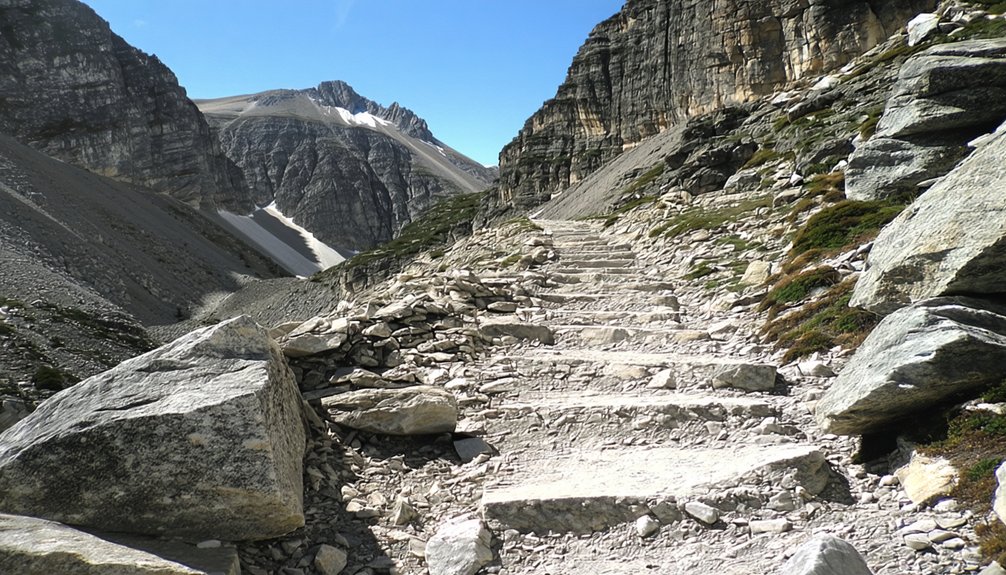
A trail’s too technical for your dog when terrain demands human-style climbing—rock steps above shoulder height, chimney gaps, near-vertical slabs, or waterfall edges. If ropes, ladders, or cables are required, stop; they’re built for hands, not paws. Watch for scree that shreds pads, surfaces hot enough to fail the 7-second hand test, Class 5 scrambling, and drop-offs above rapids. Your dog’s age, gear, and body language matter too. Below, you’ll find every red flag.
TLDR Key Takeaways
- Rock steps, ledges, or near-vertical slabs exceeding shoulder height demand climbing with no safe ramped alternative for dogs.
- Human-support features like ropes, ladders, and cables are built for hands, not paws, raising slip and entrapment risk.
- Chimney-like gaps, narrow gullies, and vertical stream banks can trap limbs or send dogs falling backward.
- Class 5 terrain is a hard stop, while Class 3–4 scrambling and exposure warrant serious caution.
- Water crossings above rapids or falls are automatic no-go zones too dangerous for any dog.
Terrain Features No Dog Should Climb

On the trail, certain terrain features cross the line from challenging to dangerous, and dogs simply can’t manoeuvre them safely.
Rock steps or ledges exceeding your dog’s shoulder height demand climbing, not scrambling, and offer no safe ramped alternative.
Chimney-like gaps and narrow gullies trap limbs or send dogs falling backward.
Vertical stream banks and waterfall cut-edges require human-style moves no dog can replicate.
Near-vertical slabs give minimal claw purchase, forcing sustained friction that paws can’t hold.
When your terrain reconnaissance reveals these barriers, apply clear bailout criteria and turn back.
Smart alternative route planning keeps your companion safe, because solo rescue limits are real—you can’t haul a wedged or fallen dog from technical ground alone.
Honest hikers know when to retreat together.
Why Ropes, Ladders, and Cables Mean Stop
At a rope, ladder, or cable, you’ve hit a technical zone built for human hands and straps—not for paws.
These systems demand grip, clipping, and deliberate support your dog simply can’t provide.
Rope handling requires precise paw placement and body control, so slips, fatigue, and panic rise fast—especially uphill, descending, or crossing sideways.
Frayed fibers snag nails, toes, collars, and harness hardware, raising real entrapment risk.
Ladders force near-vertical climbing outside normal canine movement, where one missed rung means a leg slip or hind-end loss of control.
Cables sway under load, offer minimal contact area, and can trap a limb if your dog turns mid-crossing.
When a feature depends on human support, you stop.
That’s the line we hold for every dog.
Scree and Boulder Fields That Wreck Paws
Where ropes and ladders signal a hard stop, scree and boulder fields demand a different kind of judgment—one that hinges on your dog’s paws. Loose, shifting rock and jagged edges punish tender pads in ways smooth trail never does.
As fellow hikers who care about our dogs, we owe them honest attention here.
Watch for these warning signs:
- Redness between toes or on pads, signaling friction damage
- Limping or shortened stride, reflecting pain or a lodged pebble
- Frequent licking or stopping, pointing to debris or discomfort
- Cuts, abrasions, or swelling, confirming the surface has already done harm
Preventive booties create a barrier against rough rock, and regular paw checks catch trouble early. When damage appears, you exit—no exceptions.
Surfaces That Burn or Slice Paw Pads
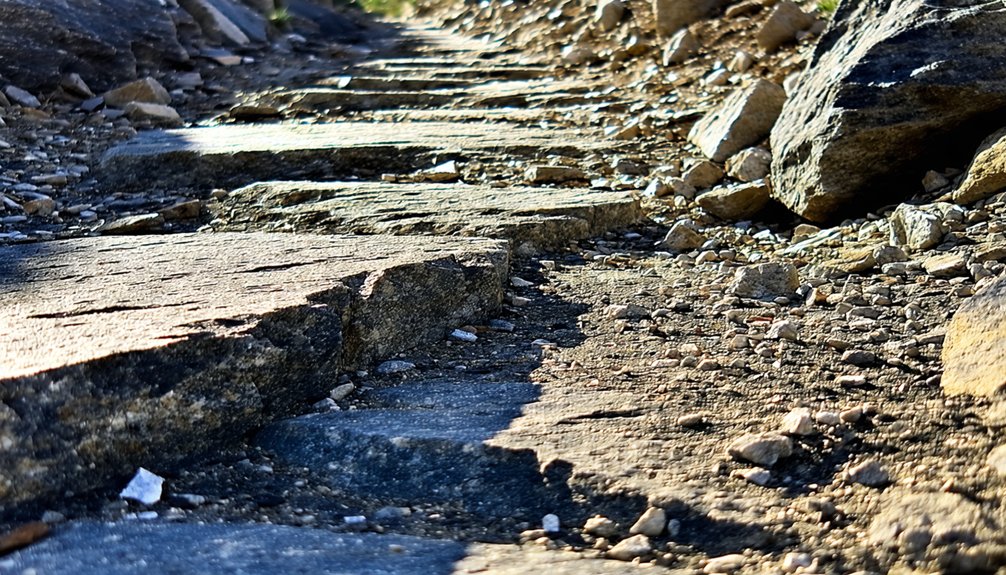
Beneath a midday sun, the trail surface itself can turn against your dog. Thermal pavement like asphalt hits 125–140°F when air sits at just 85–90°F, searing paw pads within minutes.
Use the 7-second hand test: if you can’t hold your hand to the surface, neither can your dog’s pads.
Metal grates, manhole covers, and sun-baked rock superheat even faster, causing instant burns.
Watch for redness, blistering, peeling, limping, or constant licking.
Sharp hazards cut just as deeply. Broken glass, jagged gravel, and crushed debris slice pads into bleeding flaps prone to infection.
Punctures from nails or metal can reach nerves and joints—get those checked by a vet.
Add chemical exposure from de-icers or fuel, and minor cuts become serious wounds fast.
Water Crossings and Drop-Offs to Avoid
When water moves fast, even a strong-swimming dog can lose footing and get swept into hazards, which is why the National Park Service tells you to turn back when water’s too high, too cold, or too swift. Read the crossing before you commit, because where you enter and exit matters as much as the water itself.
- Never cross above rapids or falls—these are automatic no-go zones.
- Avoid water deeper than knee height unless it’s a flat pool with little current.
- Skip steep or rocky banks that trap your dog at the waterline.
- Watch for standing waves—they hide boulders, logs, and uneven bottoms.
Plan your after crossing logistics first, keep leash and control tight, and choose another route when doubt creeps in.
Trail Ratings and Words That Warn You Off
Before you ever set foot on a trail, the rating system tells you whether it’s safe for your dog—if you know how to read it. Smart hikers like you treat trail rating cautions as non-negotiable.
YDS class 3–4 means scrambling and exposure; class 5 is a hard stop. IMBA black and double-black diamonds signal expert terrain that’s tough on canine joints and paws. Anything rated “difficult,” “expert,” or 7–10 out of 10 warns you off.
Add these descriptors to your dog safety checklist: “technical,” “high exposure,” “scramble,” “hand-over-hand,” “loose rock,” “talus,” “scree,” and “route-finding required.” Watch for black-diamond symbols, “expert only” or “backcountry” icons, and trailhead warning signage. When you spot these red flags, you’ll know to choose a gentler route together.
Dog Body Language That Says Turn Around
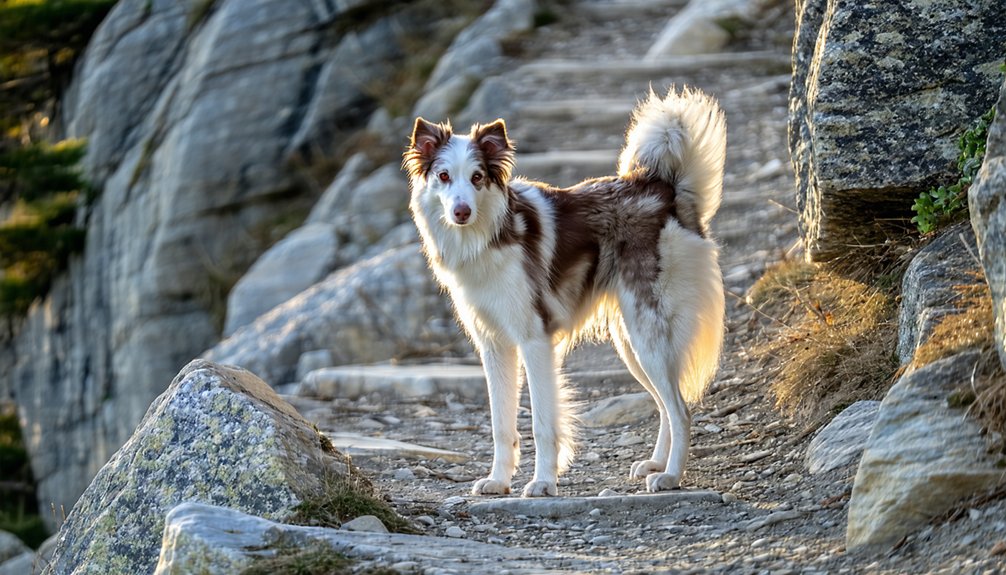
Trail ratings warn you off before you start, but your dog gives you real-time data once you’re moving. We who hike with our dogs learn to read these signals like a shared language.
Stiff legs, weight pitched backward, and a tucked tail are obstacle refusal cues telling you the terrain exceeds their comfort. Watch for handler pressure buildup, too—your tension travels down the leash.
Turn around when you see:
- Whale eye and head turned away, signaling fear and a need to disengage.
- Repeated lip licking or yawning when they’re not tired or eating.
- Frozen posture breaking into sudden darting, showing unstable arousal.
- Full-body shake-offs paired with ongoing tension.
Trust these cues. Honor them. Choose retreat together.
When Distance and Elevation Outpace Your Dog
Although your dog reads terrain in real time, distance and elevation can outpace their conditioning before any obstacle stops them cold. Recognize fatiguing terrain by respecting your dog’s training baseline: when planned distance exceeds it by more than 25–30%, you’re risking fatigue, injury, and overexertion. An unconditioned dog starts near one mile; a young adult used to neighborhood walks handles 3–5 easy miles. Reassess around 40% of your route so there’s energy for the return.
Plan conservative elevation, too. Sustained climbs fatigue dogs faster than mileage, and doubling usual gain in one outing flags overuse injury.
Change only one variable—distance, slope, or load—at a time.
Steep descents stress shoulders and wrists, so count cumulative climb, not summit height, when you commit together.
Does Your Dog’s Age and Health Fit This Trail?
Because aging joints tolerate impact less well than soft, even surfaces, senior dogs often need gentler terrain than the route you’re eyeing. Before you commit, honestly assess whether your dog’s age and condition match the demands ahead.
Watch for these warning signs that say *not today*:
- Stiffness after resting or reluctance to walk—a red flag for overload.
- Quick fatigue on short outings, signaling fitness and trail demands don’t align.
- Diagnosed arthritis or hip dysplasia, which call for a conservative plan.
- Heart or mobility concerns flagged at a recent senior vet checkup.
Run simple mobility testing on flat ground first, checking for limping or difficulty standing. Add hydration planning—extra water and a collapsible bowl—because older dogs dehydrate faster than you’d expect.
Rules, Wildlife, and Crowds That Raise the Stakes
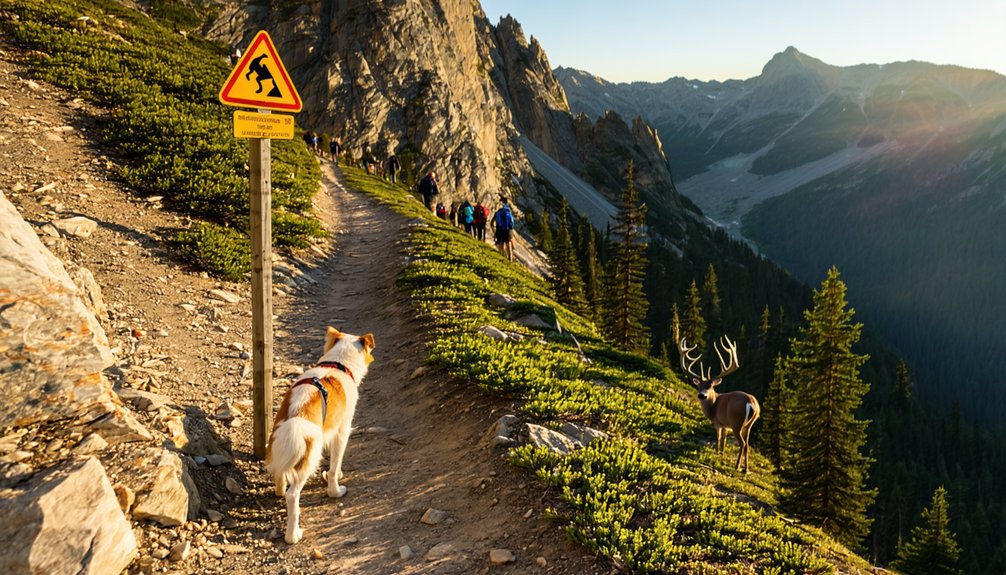
A trail’s legal status, wildlife density, and crowd levels can turn a technically manageable route into a genuine liability. Before you commit, check the dog policy: national parks, wilderness segments, and watershed preserves often ban dogs outright. Where dogs are allowed, leash compliance matters—many systems require a six-foot leash, and failing right-of-way on cliffside tread invites accidents and citations.
| Factor | Red Flag | Smart Response |
|---|---|---|
| Dog policy | Outright trail bans | Verify before arriving |
| Leash compliance | 6-foot leash required | Practice solid skills |
| Wildlife closures | Nesting, calving zones | Honor seasonal rules |
| Predators | Bear, lion activity | Choose lower-risk routes |
| Crowd management | Lunging, barking complaints | Yield, stay controlled |
Respecting these limits keeps you welcome in the trail community.
Gear Gaps That Prove You’re Underprepared
When you scan a hiker’s pack and find nothing custom-fit to their dog or the terrain ahead, you’re looking at the clearest predictor of trouble. Those of us who belong on technical trails carry gear that matches the route, not the parking lot. Watch for these red flags:
- No canine harness rated for lifting on routes with drop-offs or mandatory boosts—your dog can’t scramble without you.
- Missing paw protection where rock hits 120°F or scree shreds pads, the most common trail injury in veterinary surveys.
- Worn road shoes and zero traction devices, where slip-and-fall rates spike on wet rock and ice.
- Phone-only guidance, no headlamp, no spare power—route time misjudgment leaves you benighted without rescue plan essentials.
How to Bail Out Before Your Dog Gets Hurt
Right gear gets you onto the trail, but knowing when to leave it keeps your dog whole. You belong to a community that turns back early, not one that pushes past warning signs. Watch your dog closely and act on the cues below.
| Red Flag | Your Move |
|---|---|
| Limping or favoring a paw | Stop and inspect; carry out if needed |
| Excessive panting, drooling | Rest in shade, offer water |
| Wobbly movement, weakness | End the hike immediately |
| Repeated lying down | Start the return trip now |
| No recovery after 15 min rest | You’ve gone too far |
Strong hydration planning and a smart shade strategy buy you time, but when fatigue strikes far from the trailhead, turn back without hesitation.
Frequently Asked Questions
Can I Carry My Dog Through Short Technical Sections Safely?
Yes, you can—but only over short, discrete obstacles on dry, stable ground. Use a strap with proper gear fit, support chest and rear, and avoid wet rock where paws slipping risks both of you.
What Dog Breeds Handle Technical Trails Better Than Others?
You’ll find Border Collies, Australian Shepherds, and German Shorthaired Pointers excel on technical trails, thanks to agility and focus. Build their trail fitness gradually, prioritize paw protection on rocks, and you’ll both belong out there confidently.
How Do I Condition My Dog for Harder Trails?
Start with conditioning basics: short flat walks, then gradually add distance, incline, and terrain—changing one variable at a time. Build strength, balance, and endurance with rest days. Prioritize trail safety, and you’ll both belong out there confidently.
Are Puppies Ever Ready for Moderately Technical Hikes?
No, puppies aren’t ready until growth plates close—around 12 months, or 18 months for large breeds. Prioritize age maturity and safety readiness, and you’ll join fellow hikers protecting developing joints by waiting for proven adult conditioning.
Should I Hike Technical Trails Alone With My Dog?
You shouldn’t, honestly. Solo technical trails leave you without backup if your dog’s injured, and carrying them out’s often impractical. Prioritize trail safety planning and wildlife hazard awareness, but join fellow hikers—we’re safer together.
Conclusion
You know your dog better than any trail review. When the terrain demands ropes, scorches paw pads, or drops off into danger, you’ve already got your answer—turn around. The research is clear: most serious backcountry dog injuries are preventable, and they happen when handlers ignore obvious red flags. Don’t let summit pressure override sound judgment. A trail you skip today means countless safer journeys ahead. Choose wisely, and your dog will thank you.
References
- https://k9conquest.com/trail-difficulty-for-dogs/
- https://www.reddit.com/r/RunningWithDogs/comments/o3szbs/dogs_and_longermore_technical_trail_runs/
- https://www.youtube.com/watch?v=n-973a4O8iY
- https://www.youtube.com/watch?v=1rnWRNuu5_c
- https://robertbruton.com/2025/10/10/hiking-safely-with-your-dog-knowing-when-adventure-should-wait/
- https://www.youtube.com/watch?v=YS1VzaFRYX4
- https://www.outdoors.org/resources/amc-outdoors/outdoor-resources/hiking-with-dogs-how-to-hike-safely-and-considerately/
- https://www.hikingupwiththepup.com/preparing-your-pup-for-the-trail-training-endurance-and-more/
- https://northernboundaryadventures.com/2022/12/29/trail-etiquette-for-dogs/
- https://earlybirdonthetrail.com/how-to-start-hiking-with-your-dog/