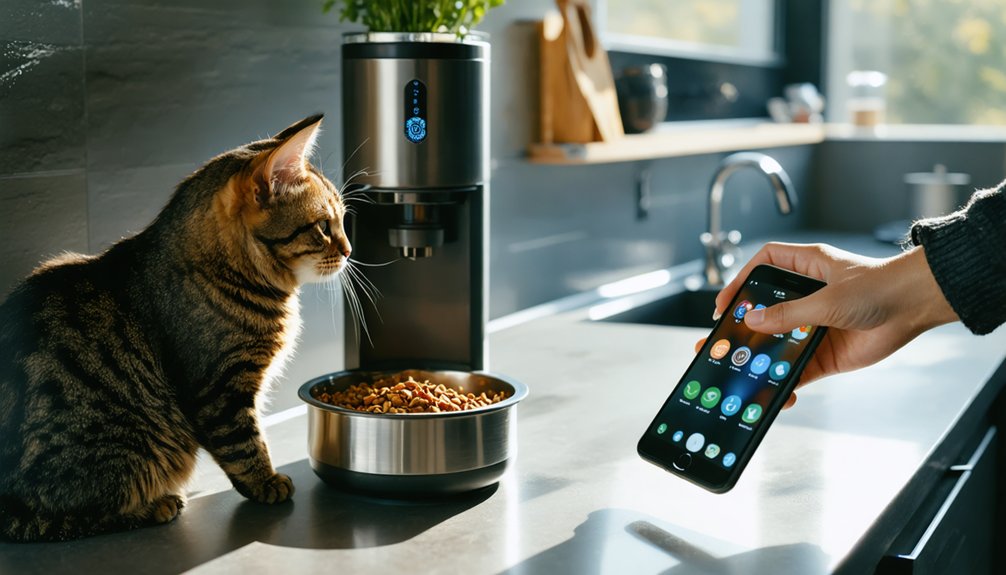
A smart pet feeder should offer precise portion control, ideally with weight-based scale support or consistent anti-clog dispensing for small servings. It should schedule multiple daily meals, send instant app alerts for dispensing, low food, jams, and connectivity issues, and run reliably on 2.4 GHz Wi-Fi. Buyers should also match hopper size to pet needs, choose easy-clean parts, and look for battery backup. The best options also reveal how each feature performs in everyday use.
Highlights
- Choose a feeder with weight-based dispensing or proven portion controls, plus anti-clog rotors or tilted chutes for consistent meal accuracy.
- Look for instant app alerts for dispensed meals, low food, jams, and connectivity issues, with timestamps and portion details.
- Pick a model with reliable 2.4 GHz Wi-Fi, remote feeding, and notification support on iOS and Android for dependable control.
- Match hopper size and meal scheduling to your pet’s routine, such as 2–6 L capacity and up to 10–12 meals daily.
- Prioritize jam detection, backup battery power, and easy-clean sensors, since maintenance and outage protection improve alert reliability and feeding consistency.
Start With Portion Accuracy
Because portion control directly affects a pet’s weight and routine, the first feature to evaluate in a smart feeder is dispensing accuracy. Buyers should compare how precisely models define servings: PETLIBRO allows 1-48 portions per meal, IMIPAW offers 1-15 servings at 7-9 grams, and Petory PF01 provides 1-50 portions of 1/10 cup each. Some feeders also offer 50–100 g portions, which can suit cats and small to medium-sized dogs with simpler feeding needs. Precise dispensing also helps reduce overfeeding, which can support healthier weight management over time.
Reliability matters just as much as size settings. Dual rotors, tilted chutes, and anti-clogging designs help maintain consistent delivery across kibble shapes. App-based controls further support accuracy by enabling remote adjustments, while digital displays act as a portion tracker by confirming settings and feeding logs. Models with dependable scheduling, from 1 to 10 meals daily or more, help households stay aligned around a pet’s care. Regular firmware updates can also improve dispensing precision over time. For cats in particular, accurate scheduling can better mimic natural grazing by dividing food into several smaller meals throughout the day.
Look for a Smart Pet Feeder Scale
While app controls and portion presets are useful, a smart pet feeder with an integrated scale offers a higher standard of precision by measuring food by weight rather than volume. That matters because cup-based servings can vary, while gram-level weighing delivers consistent meals customized to individual dietary needs. The best models support very small increments and larger capacities, helping households feel confident that pets receive the right amount every time. Some app-connected models also provide low-food alerts through smartphone notifications, adding another layer of confidence that meals will stay on schedule.
Reliable scale-equipped feeders also pair precision with practical safeguards. Jam-fix systems, blockage detection, and conveyor designs support dry and semi-moist foods without disrupting service. Real-time eating and low-food alerts keep owners connected to daily habits, while battery backup protects operation during outages. A feeder with backup power can keep operating for up to 6 days using three D batteries during an outage. Some advanced options also include live video monitoring through the app, allowing owners to check in on meals remotely. Shoppers should also assess material durability and design aesthetics, since dependable performance and a cohesive look both strengthen long-term satisfaction.
Check How Many Meals It Can Schedule
A smart pet feeder’s meal schedule limit should match the pet’s routine, since models commonly support anywhere from 5 to 12 feedings per day. That range matters for households managing grazing habits, weight control, or dietary restrictions.
PetSafe Smart Feed and SimplePets SMARTFeeder each program up to 12 meals daily, while Petlibro Granary supports 10. Simpler options like the PetSafe 5-Meal cap meal scheduling at five feedings. PetSafe also lets owners trigger an extra meal instantly through a Feed Now button in the app or on the feeder. It also sends low-food alerts to a smartphone, which helps owners stay ahead of missed meals when the hopper is running low.
Buyers should also compare how scheduling interacts with portion control and hopper size. PetSafe dispenses from 1/8 cup to 4 cups per meal, and Petlibro allows 1 to 50 portions, also reaching 4 cups. Because feeder size is usually listed by volume rather than weight, checking the liters-to-grams estimate helps owners match hopper capacity to their pet’s daily intake.
Larger reservoirs, such as PetSafe’s 24-cup hopper or SimplePets’ 17-pound capacity, better support frequent daily feedings and help keep a consistent routine the household can trust.
Make Sure App Alerts Are Instant
For a smart feeder to be genuinely useful, app alerts should arrive within seconds of every feeding event, not minutes later. Buyers should prioritize instant alerts that confirm successful dispensing, show timestamps, and report portion accuracy immediately. Fast notifications reduce uncertainty and help households feel confidently connected to a pet’s routine, even when away. Many models also provide low-food alerts to warn owners before the feeder runs empty. Some feeders also include empty-food sensors that send smartphone notifications when the hopper is fully depleted. App connection supported for remote feeding control is a practical remote feeding advantage for owners who want fast updates wherever they are.
Low app latency also matters for urgent issues. A strong system sends immediate warnings for jams, connectivity problems, and unusual eating activity, while supporting shared notifications across multiple smartphones. Reliable performance typically depends on stable 2.4GHz WiFi, current iOS or Android compatibility, and backup power that preserves updates during outages. Advanced models add real-time video clips, scale-based eating notifications, and network status indicators, giving owners a clearer, more reassuring view of every meal.
Choose a Smart Pet Feeder With Low-Food Alerts
Instant feeding alerts matter most when they are paired with dependable low-food warnings, since a feeder cannot stay reliable if the hopper runs nearly empty without notice.
Shoppers should prioritize sensor‑food systems using infrared light or base sensors that trigger an “ADD FOOD” notice at a defined low threshold, preserving dependable alert‑timing without draining battery life through constant monitoring. Check the feeder display for an “ADD FOOD” message and make sure the screen is not frozen.
Reliable app‑alerts also depend on practical sensor‑maintenance. Dust or debris on the food container base can block detection and lead to a missed low-food warning. Because low-food detection is not continuous, refilling may require manual activation in the app to refresh the warning status.
A dry soft cloth should clean the detection light, tank window, and container base, while loose weight brackets and desiccant holder placement should be checked.
Notification permissions must be enabled both on the phone and in the app, then synced after refilling by pressing Feed Now or power cycling the base.
Models such as PETLIBRO One RFID and Granary Smart Feeder illustrate these low-food safeguards well.
See How the Smart Pet Feeder Handles Jams
Often, the clearest sign of feeder reliability is how well it responds when kibble stops moving through the chute. Models with jam detection can sense resistance, reverse the mechanism, and restore food flow, as seen in designs like Xiaomi Smart Pet Food Feeder 2. This protects the motor from strain and helps households feel confident that portions remain consistent.
Shoppers should also match kibble to feeder specs, since most units work best with pieces between 2mm and 10mm. Irregular, oversized, or oily kibble commonly triggers blockages. A practical maintenance schedule matters just as much: weekly dry‑brush cleaning, monthly chute clearing, and hopper filling to about 75 percent reduce pressure, moisture clumping, and residue. Persistent grinding noises or chronic jams usually point to a flawed design that deserves warranty replacement.
Compare WiFi Options for Remote Control
When comparing WiFi options for remote control, buyers should first confirm that a smart pet feeder supports 2.4GHz networks, since this band delivers the broadest compatibility and is the standard for most models using 802.11b/g/n routers.
Advanced dual-band models can add 5GHz, but 2.4GHz remains the safer choice for dependable setup and wider router support in shared households.
Remote features matter only when connectivity stays stable. A feeder should operate within strong signal range, away from signal interference caused by microwaves or crowded wireless areas, and a WiFi extender may help in larger homes.
Buyers should also review app support for iOS and Android, multi-phone access, and family sharing so everyone stays connected. Useful extras include Feed Now controls, scheduling up to 10 meals, Alexa integration, real-time alerts, Bluetooth backup, and appropriate WiFi bandwidth management.
Pick the Right Smart Pet Feeder Capacity
After confirming reliable app and WiFi control, buyers should size a smart pet feeder by how much food the household uses between refills.
Most models span 2–6L. A 2L hopper suits one cat or small dog, holding about 900g–1,000g. A 3L unit fits one to two cats, while 4–5L better serves multi-pet homes or medium dogs. Travel-heavy households may prefer 6L or larger.
Capacity should reflect daily intake, kibble size, and available floor space. A single cat eating 70g daily can reach about 20 days of autonomy, while two cats often get 11–12 days.
Buyers should also weigh design design, locking lids, anti-clog pathways, and material durability, since larger bins must stay fresh, resist jams, and feel dependable in shared, routine-focused homes.
Use Monitoring Features to Track Eating Habits
Use monitoring tools to turn a smart pet feeder from a simple dispenser into a practical health-tracking device. Models with 140° cameras, live app feeds, automatic meal recordings, two-way audio, and infrared night vision let households confirm eating behavior at any hour and stay connected to daily routines.
The strongest systems combine gram-level portion records with alerts for feeder visits, missed meals, low food levels, and schedule disruptions. Historical dashboards showing daily, weekly, and monthly intake support habit analytics and sharper trend detection, helping users spot slower eating, skipped portions, or gradual appetite decline.
In multi-pet homes, RFID identification and app-based profiles separate each animal’s data. Some feeders also use AI calibration over several days to optimize portions and flag intake that falls below established baselines for faster veterinary follow-up.
Prioritize Backup Power and Easy Cleaning
Because reliability matters as much as portion accuracy, a smart pet feeder should pair mains power with automatic battery backup and a design that is genuinely easy to sanitize.
Buyers should favor mains-powered units that switch seamlessly to emergency battery mode during outages, keeping scheduled meals on track without draining batteries during normal use.
Models using three or four D-cell batteries, sold separately, can offer up to six days of battery durability, while chew-proof cables add everyday safety.
Cleaning simplicity matters just as much.
Removable lids, hoppers, and bowls allow thorough washing, and top-rack dishwasher-safe parts reduce upkeep.
A 304 stainless steel bowl resists stains and bacteria, while a BPA-free tank and moisture control help prevent mold.
Anti-jam food chutes, semi-moist compatibility, and app alerts also support cleaner feeding routines overall.
References
- https://petgadgetinsider.org/blog/smart-app-best-automatic-cat-feeder-app-control
- https://www.simplepets.com/blog/inside-the-smartfeeder-app-smarter-feeding-happier-pets/
- https://pawsync.com/blogs/news/best-pet-feeder-for-your-pet-top-picks-buying-guide
- https://www.youtube.com/watch?v=IqmnagBy9Kc
- https://petgadgetinsider.org/blog/smart-feeding-automatic-dog-food-feeders-portion-control
- https://mossroze.com/sv/products/portion-perfect-smart-automatic-pet-feeder-app-controlled?pr_prod_strat=e5_desc&pr_rec_id=c927bc190&pr_rec_pid=8545225212070&pr_seq=uniform
- https://petgadgetinsider.org/blog/portion-control-best-automatic-cat-feeder-for-fatty-kitties
- https://wopet.com/cats/automated-pet-feeders-complete-guide-for-portion-control-and-health-of-pets/
- https://www.youtube.com/watch?v=zSB_xyFbhkU
- https://www.youtube.com/watch?v=ScS9wpaEEYA