For multi-day treks over rocky scree and brush, you’ll want the Ruffwear Approach. It outlasts and outcarries the Kurgo Baxter, with high-denier nylon, reinforced stitching, and 10.5–18.5L capacity that reportedly lasts 8–15 years. Its padded chassis spreads heavy loads across your dog’s chest and ribcage for comfort mile after mile. You’ll pay 30–60% more, though. If you’re hiking light instead, the Kurgo’s a smarter buy—and we’ll show you exactly when.
TLDR Key Takeaways
- Ruffwear Approach wins for multi-day treks, offering rugged durability, heavy-load support, and reported longevity of 8–15 years of regular backpacking.
- Ruffwear’s padded harness distributes load across chest, shoulders, and ribcage, maintaining comfort and stability across 6–8 hours daily.
- Kurgo Baxter suits day hikes, with a lighter, sleeker build (3.75–7.5 L) but performance fades near maximum weight.
- Ruffwear offers larger capacity (10.5–18.5 L) and weather-resistant ripstop nylon, ideal for back-to-back days on rugged terrain.
- Ruffwear costs 30–60% more than Kurgo, though hydration bladders and seasonal discounts of 15–30% narrow the gap.
Ruffwear vs. Kurgo at a Glance

Choosing between Ruffwear and Kurgo comes down to how hard you plan to push your dog’s gear.
If you’re part of the crowd tackling multi-day treks, the Ruffwear Approach Pack is your match—a premium, high-volume pack built for serious mileage, heavy loads, and rugged terrain.
The Kurgo Baxter, meanwhile, suits day hikers who want versatile, budget-friendly gear for shorter outings and lighter loads.
The comfort tradeoffs are clear: Ruffwear delivers substantial padding and load-forward weight distribution for long-distance wear, while Kurgo stays lighter and sleeker but less cushioned.
Both packs offer a solid sizing range, though Kurgo leans on multiple adjustment points for fit.
Pick Ruffwear for expedition-grade durability, or Kurgo for accessible, everyday escapades that won’t strain your budget.
How to Choose a Dog Hiking Pack
Before you compare brands, nail down the fundamentals that determine whether any pack will work for your dog. Start with sizing measurements: measure chest girth at the widest part of the ribcage and torso length from neck base to tail base, then follow the brand’s chart rather than guessing by body weight. Aim for a snug fit that won’t rotate, slide forward, or dig into the armpits. Keep the total load around 10–15% of body weight, building up gradually over multiple walks.
Don’t overlook safety readiness. Consider your dog’s age, fitness, and joint health, and watch for excessive panting, limping, or lagging on test hikes. Prioritize padded straps, breathable mesh, durable ripstop nylon, and a low, saddlebag-style profile that centers weight over the shoulders.
Why Ruffwear Handles Rough Treks Better
Once you’ve locked in fit and load fundamentals, the next question is which brand holds up when the trail gets demanding—and that’s where Ruffwear pulls ahead. You’re joining a community of long-haul trekkers who trust gear that lasts. Ruffwear’s high-denier nylon, reinforced stitching, and abrasion resistant paneling on high-wear zones shrug off rocks, scree, and brush. Reinforced longevity testing in the field backs this up: Approach packs routinely serve 8–15 years of regular backpacking.
| Feature | Trail Benefit |
|---|---|
| Form-stable saddlebags | Less seam stress when loaded |
| Heavy-duty hardware | Survives repeated load cycles |
| Strategic wear panels | Reduced tearing on contact |
| Padded grab handle | Controlled lifts over obstacles |
| Compression straps | No bouncing on partial loads |
You’ll feel that durability difference everywhere.
What Makes the Kurgo Baxter Lighter
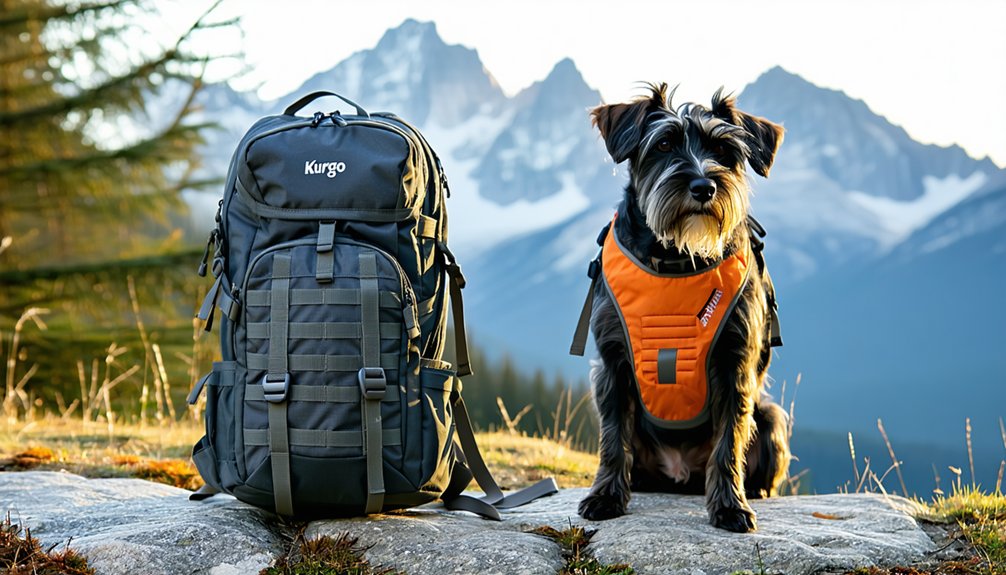
If durability defines Ruffwear, restraint defines the Kurgo Baxter. You’re carrying a day-pack-sized saddlebag with a 3.75-liter capacity, so you’re using less fabric, padding, and reinforcement from the start. The Padded vs. Lightweight tradeoff favors you here: 300D and 400D polyester and 1-inch nylon webbing keep mass low. Smart material sourcing emphasizes function over overbuilt bulk.
Three choices make the Baxter lighter:
- Harness simplicity — 8 to 9 adjustment points tune fit instead of adding load-bearing hardware.
- Low zipper count — just 4 pockets mean fewer seams, zippers, and reinforcement.
- Minimal extras — a rear leash hook and top handle, no heavy stabilization gear.
If you favor light, efficient gear for day hikes, you’ll feel right at home.
Comfort and Weight Distribution Compared
Every comfort difference between these packs traces back to one design philosophy: integration versus simplicity. When you choose the Ruffwear Approach, you’re getting a padded harness panel that spreads load across your dog’s chest, shoulders, and ribcage. The Kurgo Baxter concentrates pressure at narrower strap contact points, which matters more as loads grow.
For chafing prevention, Ruffwear’s wide, padded belly and chest straps minimize edge-digging in high-friction zones, while Kurgo’s thinner webbing risks rubbing on long days.
Multi-point adjustability lets you contour the fit around neck, chest, and girth—improving thermal comfort by reducing hot spots.
Ruffwear’s forward-biased saddlebags keep weight over the shoulders, where dogs are strongest. That efficient distribution means less fatigue and strain across multi-day treks you’ll tackle together.
Which Pack Carries More Gear?
When raw capacity decides your trip, the Ruffwear Approach wins outright. Its 10.5–18.5 L gear capacity dwarfs the Kurgo Baxter’s 3.75–7.5 L, so you’ll fit multi day essentials—kibble, collapsible bowls, compact pads—without overstuffing a single pocket. The Approach’s multipack organization separates bulk from small items, letting you load food and water in the saddlebags while stashing first-aid and waste bags within reach.
Here’s how the two stack up for your pack:
- Ruffwear Approach: 10.5–18.5 L, built for multi-day food, water, and sleeping gear.
- Kurgo Baxter: 3.75–7.5 L, tuned to day hike limits—snacks, water, light first-aid.
- Best fit: Choose Ruffwear when you’re carrying serious volume.
If you’re trekking with the pack, you belong with Ruffwear.
Straps, Trim, and Weather Protection
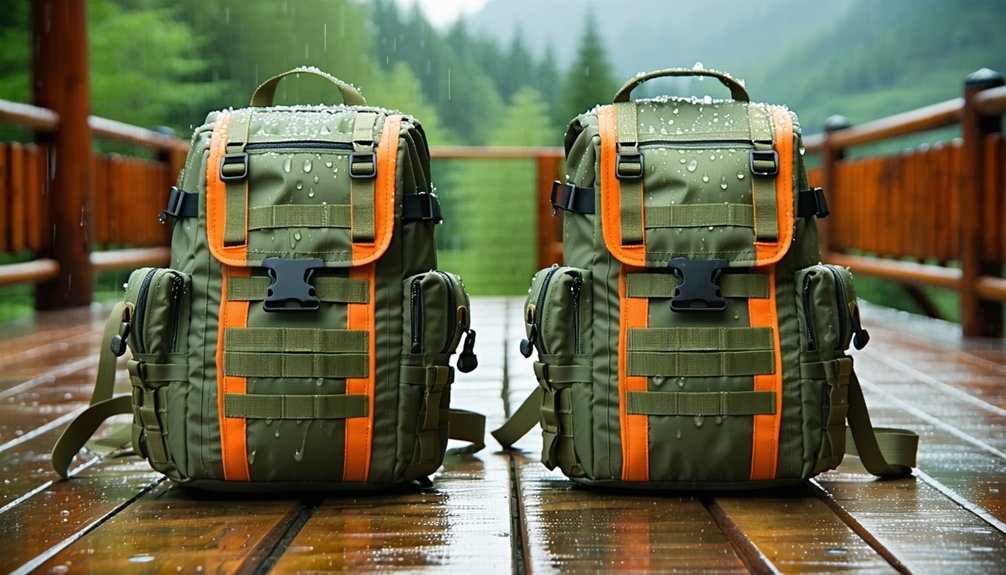
Three features separate these packs on the trail: straps, trim, and weather protection. When you’re logging multi-day miles, Ruffwear’s padded shoulder straps and ergonomic layout distribute load evenly, while compression and stabilization straps limit bounce on uneven terrain.
Kurgo counters with a simpler, lighter design and easy-adjust straps that suit shorter hikes.
For visibility, Ruffwear’s reflective trim keeps you tracking your dog through forest shade, fog, and pre-sunrise starts; Kurgo emphasizes streamlined construction over high-visibility detailing.
Weather protection seals the case for expedition crews like ours: Ruffwear’s water resistant materials and durable ripstop nylon help repel moisture and resist abrasion across long exposures.
If durability testing matters to you, Ruffwear’s weather-resistant build earns the nod for serious treks.
Fit and Adjustability for Your Dog
Because fit determines whether a pack performs or fails on the trail, you’ll want to measure your dog before trusting any size label. You’ll want to measure your dog before trusting any size label. Take these measurements first:
- Upper and lower neck for accurate harness-style placement.
- Chest circumference to prevent shifting under motion.
- Back length to match the pack’s specification sheet.
Manufacturer size charts beat weight alone because proportions differ widely among dogs. Once fitted, leave two fingers of clearance under the straps to reduce pinch points. Ruffwear’s Approach distributes load ergonomically for long treks, while Kurgo’s Baxter offers easy adjustability for shorter outings. Check shell storage and gear organization when balancing both sides evenly. Test the fit, then readjust after movement begins—because staying centered keeps your companion comfortable mile after mile.
Which Pack Fits Your Dog’s Size?
How do you know which pack actually fits your dog? Start by measuring chest girth at the widest part of the ribcage, just behind the front legs—that’s the primary metric both brands rely on. Size chart accuracy depends on it.
If you’ve got a toy, narrow, or barrel-chested breed, Ruffwear’s XXS–XL range (roughly 13–42 in) gives you more granularity than Kurgo’s medium–large focus.
Got a large, deep-chested lab or hound? Kurgo’s Baxter and Big Baxter bracket 30–110 lb confidently.
Confirm neck circumference and back length too, especially for short-backed bully breeds or corgis that suit Ruffwear’s contoured saddle.
Here’s one of our best fit boundary tips: when you’re stuck between two sizes, choose the larger to allow adjustment and layering.
Trek Length: When Each Pack Wins
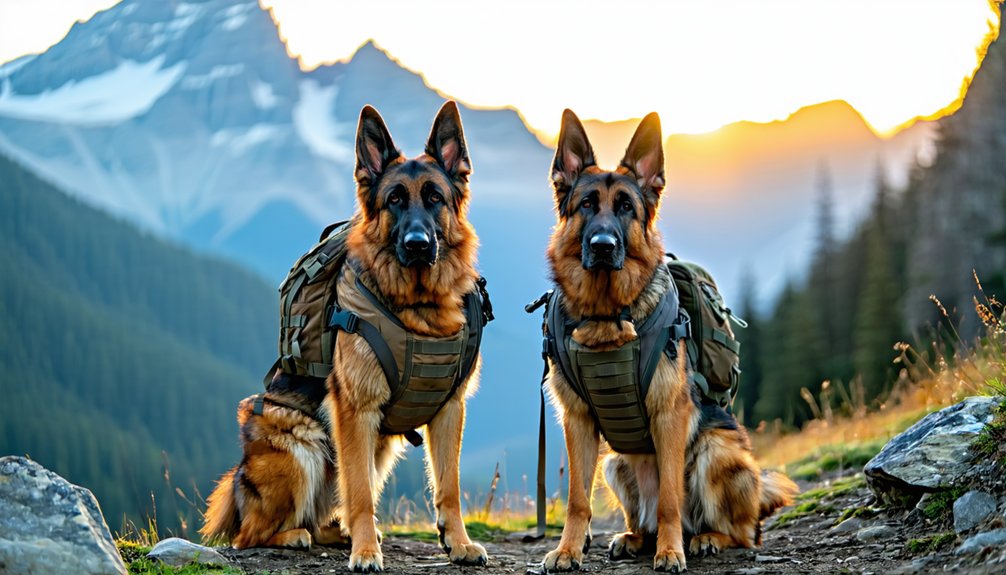
Once you’ve nailed the fit, the next question is how far you’re actually going—because trek length determines which pack earns its place on your dog’s back. Match your gear to your mileage:
- Ultra-short outings (1–3 hours): Kurgo’s lighter, flexible build prevents over-gearing during conditioning walks and quick training sessions, with quick on-off convenience for repeated removals.
- Day hikes and light overnights: Kurgo’s streamlined saddlebags reduce fatigue on half-day treks, carrying water, treats, and a compact first-aid kit affordably.
- Multi-day (3–5 day) treks: Ruffwear wins on long distance comfort *motion*, with *durable* padding that maintains stability across 6–8 hours daily.
For weekend trek performance, Ruffwear’s weather-resistant fabric and load distribution keep your trail partner comfortable mile after mile.
Price vs. Performance Under Load
Every dollar you spend should buy real performance under load, and that’s where Ruffwear and Kurgo split sharply. Ruffwear sits 30–60% above Kurgo at full retail, but you’re not just paying for a name.
You’re getting forward-shaped panniers, multiple adjustable straps, and a padded chassis that keep heavy loads stable and balanced.
Add bundled hydration bladders and removable saddlebags, and that price gap narrows fast—especially during seasonal sales of 15–30%.
Kurgo’s value tradeoff is real: lower entry cost, simpler design, solid capacity.
But its load performance fades near max weight, where panniers sag and fewer contact points concentrate pressure.
If you’re trekking light, Kurgo earns its place.
Push hard and far, and Ruffwear’s load performance justifies every dollar.
Our Verdict: Long Treks vs. Day Hikes
Price tells you where each pack fits, but the trail tells you which one to buy. Match your choice to how you actually hike, and you’ll join the crowd that gets it right the first time.
- Multi-day treks: Choose the Ruffwear Approach. Its ergonomic chassis, padded straps, stable volume, and weather resilience handle food loads, brush, and stream crossings across back-to-back days.
- Day hikes: Grab the Kurgo Baxter. Lighter, streamlined, and snag-resistant, it carries water, snacks, and waste bags without overheating your dog on short outings.
- Mixed use: Lean Ruffwear if you ever push into the backcountry.
It comes down to trip specific comfort: structured durability for expeditions, simple efficiency for quick journeys.
Frequently Asked Questions
How Do I Clean and Maintain My Dog’s Hiking Backpack?
Empty and pre-rinse it, then hand-wash with mild soap—proper washing instructions protect water resistance care. For odor prevention, try a peroxide-baking soda soak when deodorizing fabric. Air dry fully, then store loosely. You’ve got this, fellow trekker!
Can My Dog Wear the Pack in Hot Weather Safely?
Yes, but you’ll need smart hydration planning and heatstroke prevention. Hike early, choose shaded trails, keep loads light, and take frequent cooling breaks. Watch for heavy panting—stop immediately if you see it. We’ve got this together.
How Much Weight Can a Dog Safely Carry?
Your dog can safely carry 10–15% of body weight, with weight limits topping at 25% for conditioned athletes. Start at 5–10% and build through training progression. We’ll get your hiking buddy trail-ready together, safely.
At What Age Can a Dog Start Backpacking?
You’ll want age readiness around 18–24 months, once growth plates close, before adding pack weight. Start gradual acclimation earlier—8–12 months—with empty packs and short hikes. Join fellow backpackers confidently, but get your vet’s clearance first.
Do Dogs Need Training to Wear a Loaded Pack?
Yes, your dog needs training. Start with positive reinforcement and proper pack fit, then use gradual acclimation—adding weight slowly over time. Reinforce leash manners too, so you’ll both feel confident joining fellow hikers on the trail.
Conclusion
If you’re tackling multi-day treks with serious weight, choose Ruffwear—its superior load distribution and rugged build handle punishing terrain without breaking down. For day hikes and lighter loads, the Kurgo Baxter wins on value and packability, saving you money and ounces. Match the pack to your dog’s size and your route’s demands. You can’t go wrong with either, but your trek length and budget should drive the final call. Buy smart, hike confident.
References
- https://gearjunkie.com/dogs/best-dog-backpack
- https://wulaplanet.com/tutorial/comparison-pet-hiking-camping-gear/
- https://www.reddit.com/r/BackpackingDogs/comments/6cbw5t/mountain_smith_ruff_wear_kurgo/
- https://www.reddit.com/r/dogs/comments/67oj0u/discussion_ruffwear_vs_kurgo_vs_ezydog_vs_dublin/
- https://adventureontheside.com/camping-with-your-dog/dog-camping-gear/best-dog-camping-gear-brands/
- https://www.techgearlab.com/topics/home/best-dog-harness
- https://petpalhq.com/guides/best-premium-dog-hiking-backpacks-2026
- https://www.gopetfriendly.com/blog/whats-the-best-backpack-for-your-dog/
- https://www.cleverhiker.com/more-gear/best-dog-backpacks/
- https://www.thisexpansiveadventure.com/hiking/dog-hiking-backpack/ratings/