Flying your 70-lb dog from the US to Europe runs $1,000–$6,000, but most owners land around $2,500. You’ll pay $200–$500 each way for checked-pet fees, $150–$600 for an EU health certificate, plus $101 for USDA endorsement. Don’t forget IATA crate gear, ground transport ($50–$800+), and arrival handling fees. Smart owners pad their budget 15–20% for surprises. Knowing where each charge hides can save you hundreds before you ever board.
TLDR Key Takeaways
- Flying a 70-lb dog from the US to Europe typically costs $1,000–$6,000, with a core all-in estimate of $1,900–$4,500.
- Pre-travel documentation includes microchipping ($25–$100), rabies vaccines ($20–$50), and an EU health certificate ($150–$600) plus USDA endorsement ($101).
- For a 70-lb dog, checked-pet fees run $200–$500 one way, while cargo shipping costs $400–$2,000+ one way.
- Arrival handling adds costs like Heathrow HARC fees (£99–£279), customs clearance ($50–$200), and broker fees ($50–$1,000).
- Smart owners pad their budget by 15–20% (about $285–$900) for re-issued certificates, crate upgrades, and surcharges.
The Full Cost Range at a Glance
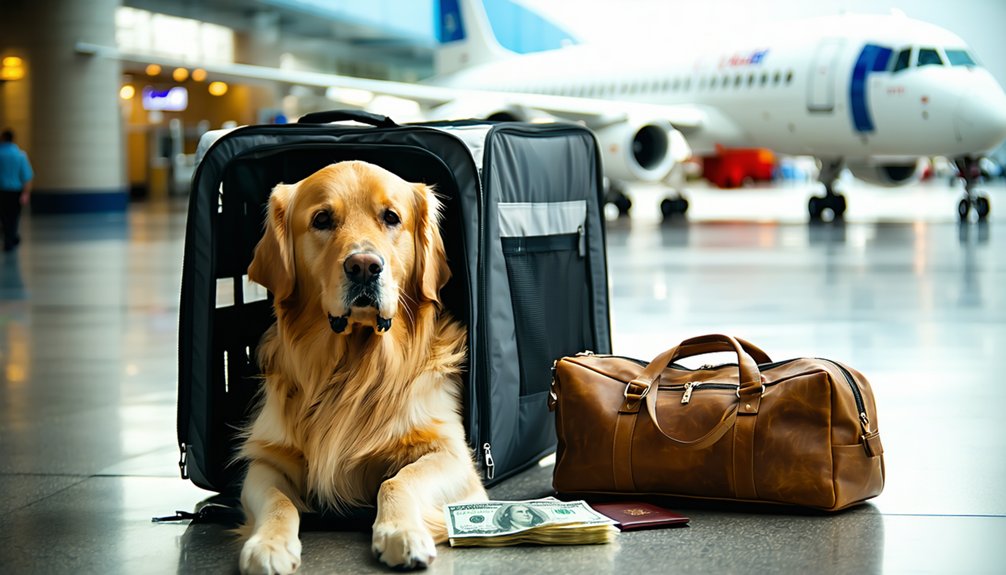
Before you book anything, you should know that flying a 70-lb dog from the US to Europe typically runs between $1,000 and $6,000 total, with most owners landing somewhere in the middle.
Where you fall depends on real variables you’ll face alongside every other pet parent making this move.
Economy hold fees, where allowed, run $200–$350 each way per segment, while cargo rates stretch from $400 to over $2,000 one way.
Door-to-door relocation services often total $2,500–$6,000+.
Cargo seasonality matters, since summer heat embargoes and weather delays can reroute or postpone your flight.
Airport variability affects what you’ll pay, too, as European arrival handling charges differ by location.
Add crate, vet paperwork, and ground transport, and you’ll see why budgets swing so widely.
Microchip, Rabies, and Vaccination Fees
| Service | US Range | UK/EU Range |
|---|---|---|
| Microchip | $25–$100 | £35–£90 |
| Rabies vaccine | $20–$50 | £40–£80 |
| Exam + rabies combo | $55–$125 | varies by consult |
Budget extra for registration fees, typically $0–$25.
Health Certificates and USDA Endorsement Costs
Once your dog’s microchip, rabies vaccine, and shot records are squared away, the next expense you’ll face is the paperwork that actually clears your dog for travel: the health certificate and its USDA endorsement.
For the vet-issued EU Animal Health Certificate alone, you’ll typically pay $150–$600, though clinic pricing varies by location and urgency.
One verified itemization breaks down to $89 exam + $45 certificate + $99 paperwork handling = $233.
On top of that, the USDA APHIS endorsement runs $101 per certificate when no lab tests are listed—the usual scenario for direct US-to-mainland-EU dog travel.
Because the certificate must be endorsed within 10 days of arrival, rush scheduling can force premium appointment fees, pushing your total document costs toward the upper range.
Picking an IATA Crate Without Overpaying
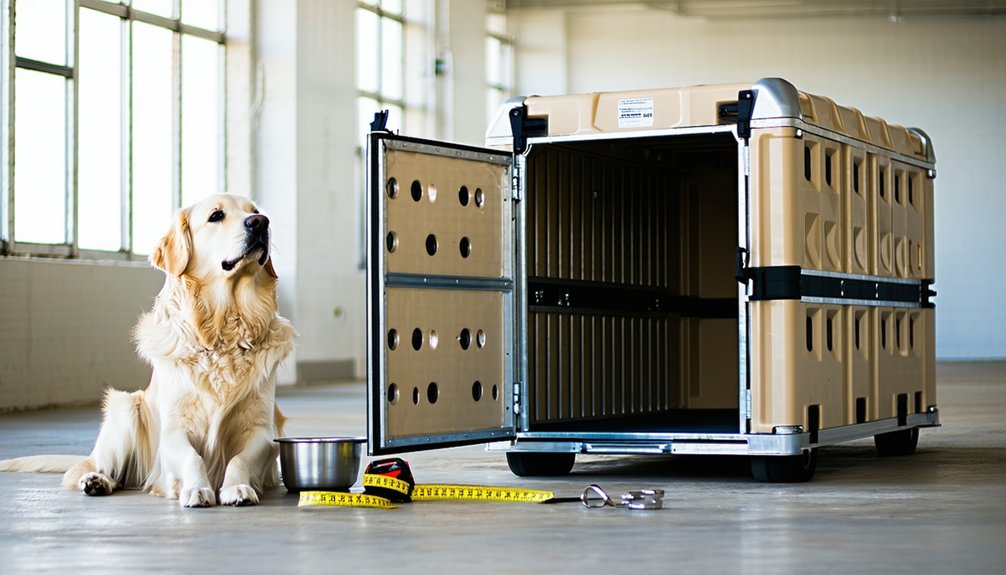
While the paperwork clears your dog for travel, the crate physically gets it there—and airlines won’t budge on the specs. IATA mandates rigid, ventilated, escape-proof crates with ventilation on at least three sides (four for international) and secure metal door hardware. Soft-sided and wire crates get refused at the gate.
Before you buy, measure crate dimensions using the IATA formula: A (nose to tail base) plus half B (elbow height) for length, and D (ground-to-ears) for height.
Most compact 70-lb Labs fit a “Large” (36″) rather than an XL (40+), so you avoid oversized costs—both the $120–$250 price band and higher cargo weight brackets. Check actual interior dimensions, since they vary by brand.
Skip budget crates with plastic fasteners; airline rejection means expensive airport repurchases.
Crate Gear and Replacement Costs to Expect
Buying the right crate is only your first expense. Once you’re part of the community of dog parents flying internationally, you’ll quickly learn that gear and replacements add up trip after trip.
Airlines often demand all-metal bolts, so you’ll upgrade non-compliant hardware for $15–$40 per international trip.
Bedding replacement becomes routine since stress panting, drooling, and accidents can ruin pads every 1–3 trips. Cleaning supplies matter too—enzyme cleaners and disinfectants run $5–$20 per trip.
Here’s what you’ll budget beyond the crate itself:
- Hardware kits: $10–$35 for airline-compliant bolts and fasteners.
- Replacement doors: $30–$80 plastic, up to $250 aluminum.
- Absorbent pads or liners: $20–$80 per set.
- Cleaning supplies: $5–$20 per trip for sanitation.
Plan accordingly.
Checked Pet vs Cargo: Which Costs More?
When you compare checked pet versus cargo for a 70-lb dog flying US to Europe, cargo almost always costs more—often by a wide margin.
Checked-pet fees usually land between $200 and $500 one way, with many airlines banding medium and large dogs at $250–$400.
Air cargo pricing works differently: it’s weight- and volume-based, so your dog’s XL crate generates high dimensional weight, pushing intercontinental quotes into the $1,500–$5,000+ range once fuel surcharges, terminal handling, and airwaybill fees stack up.
The catch you’ll face: many US carriers have ended checked-pet service for the public, and UK-routed flights often require cargo for non-assistance dogs.
Factor in seasonal surcharge planning, since hot-weather embargoes can force you into pricier cargo regardless of advertised checked rates.
Airline Pet Fees by Route and Segment
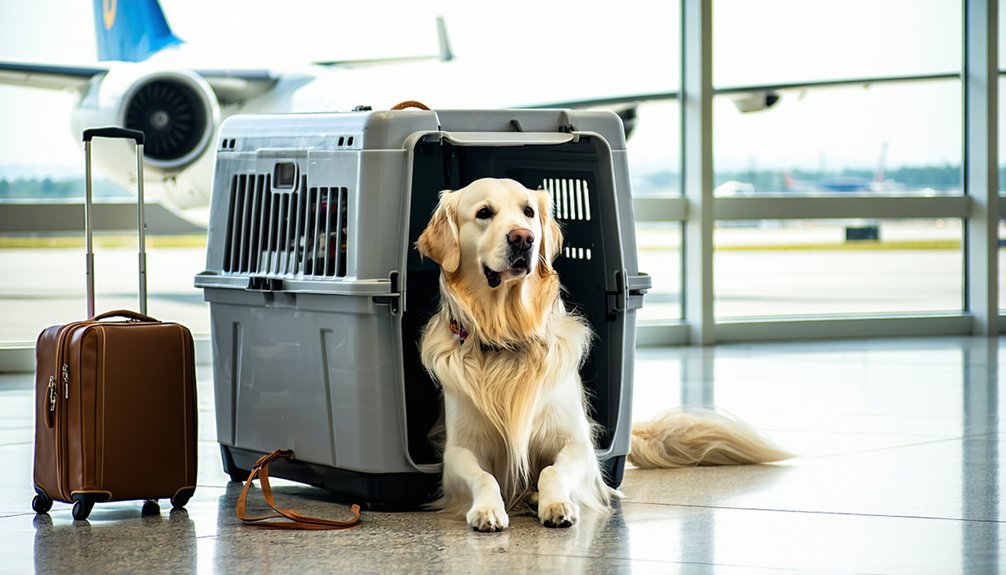
Route and segment rules drive your pet-fee total more than any single advertised price. Once you join the community of cross-Atlantic pet owners, you’ll learn that segment rules matter as much as headline numbers.
Delta charges $200 each way for international in-cabin pets, while American lists $200 per kennel. But American applies fees *per destination*, and any voluntary stopover or connection of 4+ hours triggers fee stacking on each segment.
Watch for these cost drivers:
- $200 each way, so round trips double instantly.
- Per-destination pricing on multi-leg European itineraries.
- 4-hour-plus connections adding separate charges per segment.
- EUR billing when you exit Europe with Delta.
Since all pet fees are non-refundable, mapping your route carefully protects your budget.
Arrival Handling and Customs Clearance Fees
The moment your dog touches down in Europe, a new layer of fees kicks in—charges that have nothing to do with the airline ticket you already paid for. Like every owner before you, you’ll face airport handling first: Heathrow’s HARC charges £99 to collect your pet, plus £203 boarding when paperwork’s pre-checked or £279 when it isn’t. Document timing matters—a clean pre-check saves you real money.
| Fee Type | Range | Notes |
|---|---|---|
| Airport handling | £177–£500+ | Scales by crate, time |
| HARC boarding | £203–£279 | Pre-check dependent |
| Customs clearance | $50–$200 | Country-specific |
| Broker variability | £50–£1,000 | Route complexity |
| Hessen exam | €35–€55 | Weekend surcharge |
VAT minimums sting too—the UK applies 20%, with roughly £100 minimum per dog.
When Quarantine Adds to Your Bill
Although quarantine isn’t routine for every dog entering Europe, it can blow up your budget the moment destination rules demand it or your paperwork falls short. For Europe-focused planning, your quarantine detention risk usually ties to documentation accuracy, not flight distance.
Incomplete rabies records or missing health certificates can hold your dog until authorities verify compliance, and that’s where costs snowball.
Here’s what you’re likely to face:
- Facility fees charged per day or as a fixed stay—expect facility fee variability across countries.
- Veterinary checks adding exams, monitoring, or re-testing.
- Feeding and care charges billed atop the base rate.
- Pick-up and transfer costs when the site sits far from arrival.
Extended stay compounding can push your total from hundreds into thousands.
Hiring a Shipper vs Doing It Yourself
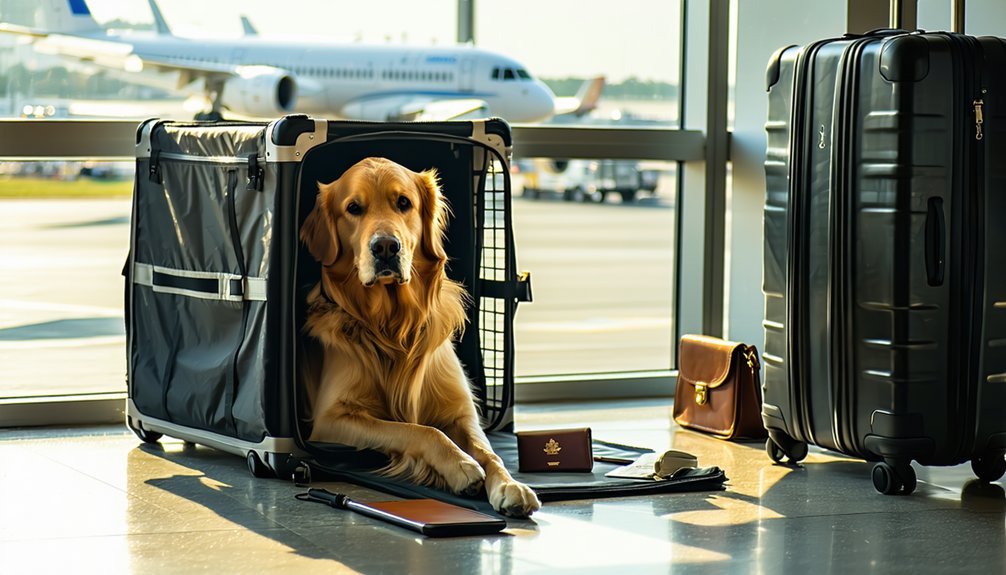
When you’re moving a 70-lb dog from the US to Europe, your first big decision isn’t the airline—it’s whether to hire a professional pet shipper or handle every step yourself.
Hiring a shipper typically costs $3,000–$8,000+, because that $500–$2,000 service fee buys real peace of mind.
Your shipper manages airline restrictions, the microchip/rabies sequence, health certificate timing, USDA endorsements, and crate compliance—handling the details that trip up first-timers.
Going DIY can trim that service fee, but you’ll still pay $1,500–$5,000 in airline cargo fees, $200–$500+ for vet work, $160–$275 for USDA endorsement, and $250–$450 for an IATA-approved crate.
One mistake—wrong vaccine order, mistimed exam—means denied boarding and costly rebooking.
You belong wherever your dog does.
Choose what protects you both.
Ground Transport and Owner Travel Add-Ons
Once you’ve settled the shipper-versus-DIY question, the costs don’t stop at the cargo hold.
You’ll need to move your dog to the US departure airport and onward once you land in Europe—and you’ll travel too.
Pet taxi pricing in major metros runs $50–$150 one way, while specialized long-haul ground transport climbs to $300–$800+.
Watch the surcharge hotspots: after-hours, weekend, and holiday pickups add 10–25%, and access fees pile on for stairs or remote pickups.
- Pet taxi pricing: $50–$150 one way in US metros.
- Layover tradeoffs: shared vans cut per-mile cost but add hours and stress.
- Surcharge hotspots: weekend or holiday pickups add 10–25%.
- Budget timing: your transatlantic economy seat runs $500–$1,500 round-trip.
Plan accordingly.
Your All-In Budget and Smart Buffer
Build in contingency planning so unexpected expenses don’t derail your trip. Smart owners pad their budget by 15–20% to cover re-issued health certificates, last-minute crate upgrades, or airline route changes.
| Budget Component | Smart Buffer Range |
|---|---|
| Core all-in estimate | $1,900–$4,500 |
| Recommended contingency (15–20%) | $285–$900 |
| Total with buffer | $2,185–$5,400 |
You’re not overspending—you’re protecting against the surprises that hit every international pet move. With this cushion in place, you’ll travel confident, prepared, and ready for whatever the trip throws your way.
Frequently Asked Questions
Can My Dog Fly During Summer Heat Embargoes?
Usually not as cargo—summer travel rules block most 70-lb dogs on embargoed routes. Airline heat policies bar pets above ~84°F. You’ll need specialized pet charters or dedicated pet airlines, since mainstream carriers won’t accept your big dog.
What Happens if My Dog Gets Sick Mid-Flight?
You’ll find airline contingency plans limited mid-flight—crew can relocate your dog’s carrier, notify the captain, and request priority landing, but there’s no onboard emergency vet access. They’ll coordinate ground veterinary services upon arrival, keeping your companion’s care prioritized.
Are Certain Breeds Banned From Flying to Europe?
Yes, you’ll face breed restrictions set by individual countries—the UK, France, Germany, Denmark, and Norway ban specific “dangerous” breeds. Your airline may add stricter rules, so verify both alongside your pet documentation before booking.
How Early Should I Book My Dog’s Flight?
Start 3–4 months out, joining fellow pet-parents who plan ahead. Align with airline pet schedules early, since cargo slots fill fast. You’ll prep weatherproof packing and crate training, easing your airport check-in stress later.
Can I Sedate My Dog for the Journey?
You shouldn’t sedate your dog—AVMA and IATA both advise against it, since sedation risks respiratory and cardiac complications mid-flight. Seek veterinarian guidance instead; they might recommend anxiety medication only if it’s medically necessary for your pup.
Conclusion
You’ve now seen every line item, from the $30 microchip to the $2,500 full-service shipper. Budget realistically: expect $1,500 to $5,000 all-in for your 70-lb dog, and pad that figure with a 15% buffer for vet surprises, crate upgrades, or rebooked flights. Book your USDA endorsement early, confirm your airline’s IATA crate specs, and verify the destination’s import rules. Plan deliberately, and you’ll move your dog safely without overpaying.
References
- https://www.gamintraveler.com/2026/05/12/flying-a-dog-to-europe-costs-more-than-most-americans-budget-full-breakdown/
- https://petcaresouthtyneside.co.uk/how-much-does-it-cost-for-a-dog-to-fly-2025-prices-by-airline-route-and-size
- https://petloungecr.com/how-much-does-it-cost-to-fly-a-dog-internationally/
- https://travelreadypets.com/airline-pet-travel-costs-guide/
- https://www.dreamvacati.com/blog-elmo.html
- https://ia600709.us.archive.org/3/items/aa21_20260410/aa2.pdf
- https://airpetsinternational.com/cost-to-fly-a-dog/
- https://www.youtube.com/watch?v=VV1WpLlBSKg
- https://transconpet.com/how-much-does-it-really-cost-to-fly-your-pet-overseas/
- https://www.facebook.com/groups/1180884898968404/posts/2803128196744058/