To insure your dog during international transit, you’ll want pet travel insurance, which covers loss, injury, or death on an airport-to-airport basis. For ongoing care abroad, international pet health insurance reimburses emergency vet visits at licensed veterinarians. Don’t assume death or heat in cargo is covered—it depends on exact wording and named perils. Choose a policy that follows your dog, not just the itinerary. Below, you’ll uncover how to spot the gaps.
TLDR Key Takeaways
- Pet travel insurance covers loss, injury, or death during transit, often limited to an airport-to-airport basis.
- “Covered in transit” usually protects against transport accidents during the moving period, not ongoing veterinary care.
- Death or heat in cargo is covered only through specific mortality or transit clauses with named perils like collision or fire.
- Confirm named territory rules, since some U.S. policies limit eligibility to domestic treatment, Canada, or Puerto Rico.
- Gather transit liability proof using a cargo evidence checklist to support custody, carriage, or delivery claims.
What “Covered in Transit” Really Means for Dogs

When you see “covered in transit” on a pet policy, it usually means protection for loss, injury, death, or transport-related accidents during your dog’s trip from one point to another—not ongoing veterinary care.
You’re joining countless pet owners who’ve learned that policy wording alternatives matter enormously here. Many policies apply only while your dog’s actually being moved, with some limiting benefits to “airport to airport” rather than your full trip or destination stay.
Misinterpretation pitfalls often catch families off guard—you might assume broad protection when the contract restricts coverage to specific transit milestones.
Remember, transit coverage isn’t traditional pet health insurance. It’s trip-specific and temporary.
The provider’s exact language controls everything, so read carefully to understand precisely when your dog’s protected and when they aren’t.
Five Insurance Types That Cover Dogs Abroad
Now that you understand what transit coverage actually protects, you can match the right policy to your dog’s specific travel. Five insurance types serve different needs, and knowing the distinctions helps you avoid costly policy exclusions.
- International pet health insurance reimburses emergency vet visits, surgery, and medications at licensed veterinarians—ideal for longer stays abroad.
- Pet travel insurance covers loss, injury, or death during transit, often airport to airport, priced at $75–$200 internationally.
- Dog liability insurance with worldwide coverage protects against third-party injury and meets bonding requirements in places like Germany.
Travel insurance with a pet add-on handles trip disruptions and quarantine costs, while specialized relocation insurance covers organized transit. Whatever you choose, confirm caregiver duties, prepare claim documentation carefully, and read every exclusion closely.
Pet Health vs. Pet Travel Insurance for Transit
Although both policies mention your dog, they protect fundamentally different things. Pet health insurance reimburses eligible veterinary care—diagnosis, surgery, medications—while pet travel insurance covers the trip itself, including delays, cargo temperature problems, and return-transport costs. When you understand this split, you join the travelers who actually get reimbursed.
| Feature | Pet Health Insurance | Pet Travel Insurance |
|---|---|---|
| Primary focus | Medical treatment | Trip disruption |
| Typical coverage | Surgery, meds, specialists | Delays, boarding, transport |
| Best use | Vet care abroad | Transit emergencies |
Review policy eligibility details before departure, since international veterinary coverage is often conditional and may require prior notification. For travel claims, claim documentation essentials—delay records, vet receipts, transport reports—determine your payout. Match each policy to its purpose, and you’ll close the gaps that strand unprepared owners.
Transit Risks Worth Insuring Your Dog Against
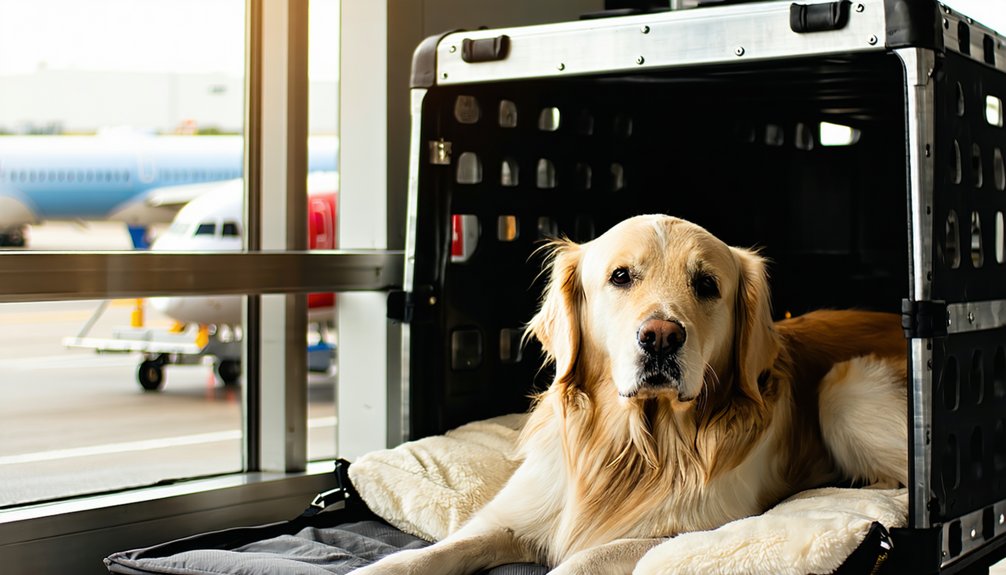
Because transit exposes your dog to hazards that aren’t covered by routine vet care, you need to know which risks justify dedicated insurance. Like other pet parents who’ve journeyed through international moves, you’ll want coverage for the threats that matter most during loading, transfers, and busy travel periods.
- Mechanical injury and crate-related trauma, where broken latches, falls, or protruding nails cause limb injuries—proper crate preparation reduces exposure.
- Escape and loss during delays and transfers, where microchips, travel labels, and current photos drive effective loss prevention.
- Temperature-related exposure, where holding areas outside the 7.2°C–29.5°C range demand vigilant temperature monitoring.
Don’t overlook dehydration either; IATA requires water access every 12 hours. Insuring these specific risks protects your dog when standard policies won’t.
Does Death or Heat in Cargo Get Covered?
Whether death or heat in cargo gets covered depends entirely on your policy’s exact wording, not on what you’d assume standard pet coverage includes. Death in transit is sometimes covered, but only through specific mortality or transit clauses—not ordinary veterinary expense coverage.
United India’s policy, for example, explicitly adds “death by accident in transit by air, rail, road and water,” proving such protection must be written in directly.
Run policy wording checks before you trust any assumption. Most mortality policies rely on named peril definitions—collision, fire, flood, lightning—and heat rarely appears among them. Since no standard cover treats heat as a standalone peril, you’ll need it explicitly included.
Like others who travel with their dogs, you deserve certainty. So confirm every clause before booking.
Does Your Transit Policy Work Outside the U.S.?
Where your transit policy actually works depends on its type, not its label. You’re not alone in assuming coverage follows you everywhere—but it doesn’t.
Some insurers explicitly include Canada, U.S. territories, and military installations abroad, while others stop at U.S. borders. Read the policy language, not the marketing, because that’s where your real protection lives.
- Territory inclusion rules: Confirm your destination country, territory, or base is named as covered.
- Veterinary licensing checks: Verify care comes from a licensed veterinarian recognized in that location.
- Reimbursement documentation pitfalls: Keep itemized bills and certificates to avoid denied claims.
Watch for emergency criteria variations, too—what one insurer treats as a covered emergency, another excludes entirely. Matching policy terms to your trip keeps you genuinely protected.
What International Transit Insurance Actually Pays For
Once you’ve confirmed where your policy works, you need to know what it actually pays for.
Most plans center on emergency veterinary care, with one offering up to $2,500 for eligible treatment when your dog falls ill or gets injured during the trip.
You’ll also find trip-disruption support, covering extra accommodation, boarding, or kennel fees if your pet’s too sick to travel home.
Some policies reimburse theft, loss, and recovery costs, plus replacement travel documents, listed at up to £250 in one guide.
Quarantine expenses may apply when illness or missing paperwork keeps your pet abroad.
Policy exclusions clarity matters here—pre-existing conditions are typically excluded.
Master claim documentation basics, since reimbursement usually requires a specifically listed event and reduces by your excess or deductible.
Documents That Make or Break a Transit Claim
Knowing what your policy pays for means little if you can’t prove your claim, and that proof comes down to documentation.
Like every responsible pet owner in this community, you’ll want your file airtight before you submit it.
Insurers match your dog to the policy using name, species, breed, and identifying details, and they verify Claimant Identity to confirm who’s submitting.
Medical necessity rests on your vet’s full clinical history, SOAP notes, and a signed statement.
- Pet and ownership proof: name, breed details, and ownership records tied to the trip
- Itemized invoices and invoice originals: charges separated by category, plus receipts proving payment
- Transit documents: booking records, reservation numbers, non-refundable amounts, and cancellation confirmations
Keep your claim file number for tracked follow-up.
When You Need Transport-Provider Coverage
When the transport company accepts responsibility for loss, injury, death, or damage during the trip, that’s when you need transport-provider coverage rather than routine veterinary care. This liability coverage protects businesses that ship, deliver, or transport pets, focusing on events that happen in transit by air, rail, road, or water.
You’ll typically buy it through the relocation, shipping, or pet-taxi service, tied to your specific contract and declared route.
Look for “death by accident in transit” language—it’s the clearest sign this coverage is in play. Future Generali and UIIC both offer transit and worldwide transit add-ons confirming this.
When you’re assuming custody, carriage, or delivery risk, gather your transit liability proofs and follow a cargo evidence checklist. That’s how you protect the trip you’re trusted with.
Coverage Gaps That Catch Dog Owners Off Guard
Although you’ve bought a policy that promises travel coverage, the fine print often hides gaps that surface only after your dog needs care abroad.
Many U.S. policies limit destination eligibility to domestic treatment, with only some extending to Canada or Puerto Rico—not every country.
Policy exclusion clauses commonly drop routine, preventive, and pre-existing care, so vaccinations and maintenance prescriptions rarely qualify.
Knowing the claim denial triggers protects you from costly surprises.
- Destination eligibility: Foreign claims fail when wording covers only “covered trips” or defined geographic areas.
- Vet documentation gaps: Missing invoices, treating-clinic notes, or untranslated foreign-language records delay or sink reimbursement.
- Compliance failures: Skipped microchip, vaccination, or health-certificate rules trigger exclusions.
Match your documentation to the policy’s timing, diagnosis, and treatment requirements.
How to Compare Claim Limits and Caps
Coverage gaps aren’t the only fine-print trap that can leave you paying out of pocket abroad—the way a policy structures its limits matters just as much.
Start with the policy wording: request written cap definitions for “incident,” “condition,” and “illness” before you compare anything.
The same diagnosis can land in one condition bucket or reset as a new incident, and that distinction drives your real payout.
Don’t judge caps alone.
Run the deductible math alongside the reimbursement rate, because a higher rate often beats a slightly higher cap on mid-sized claims.
Industry guidance treats $5,000 to $10,000 annually as a practical starting range.
Written definitions also protect you from insurer disputes later, so you’re never left guessing whether the limit was applied correctly.
Pick a Policy That Truly Covers Transit
- Verify destination vet coverage so you’re reimbursed wherever a licensed veterinarian’s available abroad.
- Check transit injury limits like Travelex’s $2,500 emergency vet benefit, triggered by illness or injury while traveling.
- Confirm claim documentation rules and watch for pre existing exclusions that quietly deny payouts.
You belong among owners who plan smart—pick wording that truly follows your dog, not just your itinerary.
Frequently Asked Questions
How Much Does International Dog Transit Insurance Typically Cost?
You’ll typically pay a price range of $75–$200 for single-trip international dog transit insurance, though extensive plans reach $100–$500. Your coverage limits, destination, and trip length drive costs, so you’re never alone maneuvering these choices.
Can I Insure Senior Dogs or Specific Breeds for Transit?
Yes, you can. Senior coverage often pairs travel protection with a health plan offering international vet care. For breed eligibility, you’ll want to check exclusions and surcharges upfront, since carriers and destinations vary widely.
How Long Does It Take to Process a Transit Claim?
You’ll typically see claim approval timelines of 5 to 10 business days. Submit your required documentation digitally—itemized invoices, medical records, paid receipts—and you’ll join policyholders enjoying faster turnaround, sometimes under 48 hours with complete, clear paperwork.
Can I Buy Transit Coverage After Booking My Dog’s Flight?
Yes, you can buy transit coverage after booking, often until departure. Just check policy exclusions first, gather your veterinary records and claim documentation, and confirm flight delays are covered—joining travelers who protect their pets confidently.
Are Multiple Dogs Covered Under a Single Transit Policy?
Yes, you can cover multiple pets under a single insured group policy if each dog’s listed in the schedule. You’ll still follow co insurance rules, limits, and per-animal documentation—so your whole pack travels protected together.
Conclusion
Don’t assume your dog’s automatically protected the moment you book a flight. You’ve got to read the fine print, verify cargo coverage, and confirm that death, heat, and delays are included—not buried in exclusions. Compare claim limits, demand transport-provider coverage when carriers require it, and close those gaps before departure. The right policy won’t just promise protection; it’ll deliver it when your dog needs it most. Choose deliberately, and you’ll travel with genuine peace of mind.
References
- https://irdai.gov.in/documents/37343/993134/27.+Dog+Insurance_GEN373.pdf/b65d371d-b0a0-efa2-3e87-b05d4bc8f624?version=1.1&t=1668417161633&download=true
- https://www.dogtripguide.com/blog/pet-travel-insurance-guide/
- https://tailwindglobalpet.com/blog/pet-travel-insurance/
- https://www.uiic.co.in/web/sites/default/files/Policy-Document/Rural & Social – Pet Dog Insurance_1.pdf
- https://www.travelexinsurance.com/travel-insurance/traveler/pets
- https://www.battleface.com/en-us/travel-insurance-resources/what-is-pet-travel-insurance/
- https://www.pawlicy.com/blog/pet-travel-insurance/
- https://www.internationalinsurance.com/advice/traveling-with-pets/
- https://www.tescoinsurance.com/pet-insurance/guides/taking-pets-abroad/
- https://www.youtube.com/watch?v=Pw-iRiDinpU
- https://www.insureon.com/pet-care-business-insurance/pet-transportation
- https://www.pdsa.org.uk/what-we-do/blog/things-to-know-before-taking-your-pet-on-public-transport
- https://www.ncbi.nlm.nih.gov/books/NBK19631/
- https://www.aphis.usda.gov/pet-travel/pets-on-planes/care-handling-air-travel
- https://inspection.canada.ca/en/importing-food-plants-animals/pets/transporting-pets
- https://www.govinfo.gov/content/pkg/CFR-2025-title9-vol1/pdf/CFR-2025-title9-vol1-sec3-18.pdf
- https://www.petrelocation.com/blog/post/pet-travel-layover-and-transit-requirements-at-airports
- https://www.cdc.gov/importation/dogs/faqs.html
- https://www.insureon.com/blog/property-in-transit-coverage
- https://www.petsintransit.com