A layover can flip your pet from “transit” to “arriving import,” triggering customs rules, health certificates, and permits you never anticipated. True transit means staying airside, keeping the same airline or aircraft, and never reclaiming baggage or clearing customs. But change planes, switch terminals, or transit an EU country, and fresh requirements kick in fast. Skip a permit and you’ll face denied boarding or fines. Here’s exactly how to protect your pet.
TLDR Key Takeaways
- A plane change, baggage reclaim, or switching terminals can flip your pet’s status from transit to import, triggering customs rules.
- Transiting an EU country may require a USDA-endorsed EU animal health certificate documenting microchip, rabies, and treatments, even for non-EU destinations.
- Routes through unlisted third countries trigger a rabies titer requirement of at least 0.5 IU/ml from an EU-approved laboratory.
- Countries like the UK, Hong Kong, Taiwan, Thailand, and Singapore commonly require pet transit permits, with fines for skipping them.
- Staying within the international transit zone—same airline, same secure area, no baggage reclaim—usually prevents import and entry rules from triggering.
What Counts as True Pet Transit?
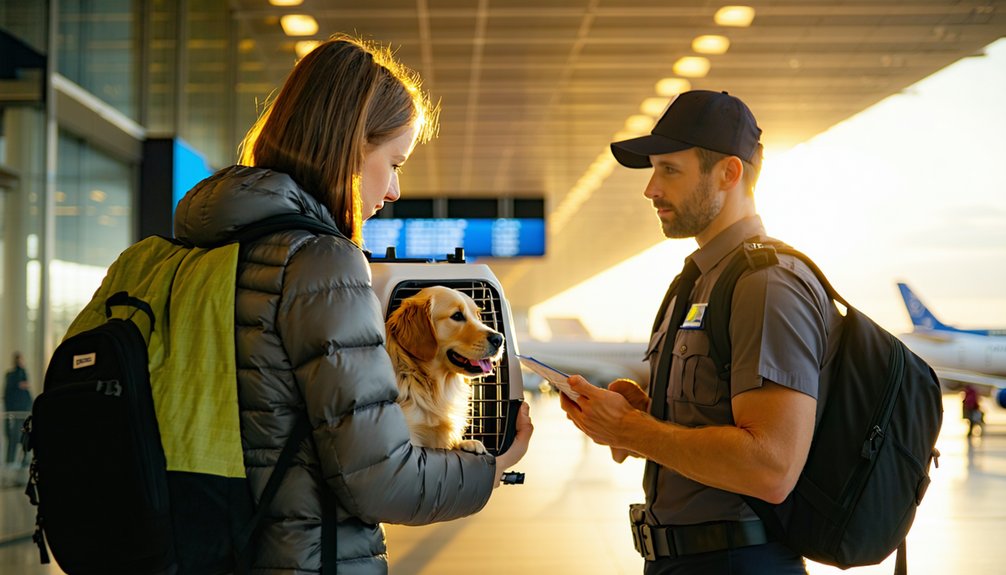
Before you book that convenient layover, understand what actually qualifies as true pet transit.
A transit occurs when your pet’s itinerary doesn’t shift from domestic to international or vice versa, uses the same airline through the intermediary airport, and doesn’t need to clear security to board the next flight.
Same aircraft continuity matters most: if your pet stays on the same plane—or the flight numbers stay identical across both legs—the movement counts as true transit, and you join travelers who pass through without issue.
Secure area behavior reinforces this status; your pet remains within the terminal’s secure zone, never entering the country or clearing customs.
The practical test? Your pet’s only passing through, not entering for entry-control purposes.
Anything else risks importation rules.
When a Plane Change Triggers Import Rules
A plane change isn’t always harmless, and the difference can flip your pet from transit to import in a single connection. When you switch airports, collect baggage, or re-check, you often leave the sterile airside structure that protects true transit.
Customs authorities distinguish transit from import by whether your pet stays under controlled, sealed movement or enters domestic circulation. Once you reclaim baggage or move through a separate terminal, customs clearance rules typically apply, and your pet’s treated as an arriving import.
Switzerland’s transit structure shows the pattern: you avoid extra requirements only if you don’t leave the transit area and already hold the right paperwork. So treat any plane change as a red flag, and confirm your transit documentation keeps your pet’s custody chain unbroken throughout.
How Staying in the Transit Zone Protects You
When you stay in the international transit zone, you don’t formally enter the country—and that’s exactly why import and entry rules usually never trigger. The transit area is a sterile zone, deliberately separated from landside border control so you can connect onward without passing through passport control or customs.
Those two checkpoints are where a country’s entry and import rules begin to apply, so staying within the sterile area boundaries keeps you a transit passenger, not an arriving entrant.
Transit zone eligibility usually hinges on a confirmed onward ticket within the allowed window—24 hours in China’s direct-transit scheme, 240 hours to a third country.
Keep your bag inside the airline’s interline system, too; collecting baggage breaks your transit status and lands you landside.
EU Layovers and Transit Health Certificates

Although your final destination lies outside the EU, transiting an EU country can still trigger its own pet rules—and that surprises a lot of travelers. According to USDA APHIS guidance, you’ll still need an EU transit health certificate for that transit country—the same certificate you’d need if the EU were your final stop.
Your dog, cat, or ferret must carry an animal health certificate issued by an official veterinarian and endorsed by the competent authority, documenting microchip, rabies, and applicable treatments.
Don’t confuse passport vs certificate: as a non-EU traveler, you need the certificate. Skip it, and you’ll hit document verification flags and airline transit delays.
While quarantine risk misconceptions worry many, the real threat is incomplete paperwork. Plan for the specific country you’re crossing—you belong prepared.
Why USDA Endorsement Matters for EU Transit
Because USDA endorsement is what converts your EU health certificate into a document customs authorities will actually accept, it’s the step you can’t afford to skip.
After your accredited veterinarian signs the certificate, the USDA Endorsement Office must approve it within 10 days of your pet’s arrival in the EU.
If you’re transiting an EU country en route to a non-EU destination, APHIS says you’ll need a transit health certificate too—even when the EU isn’t your final stop.
So validate document timelines against your actual route, not just your departure city, because the EU transit point becomes the critical checkpoint.
Confirm endorsement eligibility with a USDA-accredited vet, and remember that a delayed itinerary can expire your window before you ever arrive.
Rabies Titer Rules for Transiting the EU
USDA endorsement gets your paperwork accepted, but it won’t override a rabies requirement you’ve failed to meet on time.
If your itinerary routes through an unlisted third country, you’ll need proof of a rabies titer of at least 0.5 IU/ml, performed at an EU-approved laboratory by an authorized vet.
For a primary vaccination, the blood sample must be drawn at least 30 days after the shot.
Then comes the timing trap: a three-month waiting period applies before travel can begin, counted from the sample date.
That’s why layover timing matters—an unlisted transit point can trigger this wait.
Titer validity carries forward as long as you keep boosters current, so you won’t repeat the test.
Listed territories are exempt, sparing you this hurdle entirely.
Countries That Demand Pet Transit Permits
While most true airside transits skip local paperwork entirely—your pet stays on the same aircraft and never crosses border controls—some countries still demand a transit permit for layovers that don’t count as full entry.
You’ll find the United Kingdom, Hong Kong, Taiwan, Thailand, and Singapore commonly listed among them.
These layover permit exceptions catch travelers off guard, so don’t assume you’re exempt just because your pet never officially “enters” the country.
Transit permits typically come from the government body handling live-animal import and export.
Remember, these airside paperwork requirements differ from your final-destination rules, so research them separately.
Permit needs aren’t universal, but when they apply, they’re non-negotiable.
Confirm early, and you’ll keep your pet—and your peace of mind—exactly where they belong.
How to Secure a Transit Permit in Advance
Once you’ve confirmed a transit permit applies to your layover, timing becomes your biggest ally. Start with eligibility verification, since rules vary by country, agency, and cargo category. Then build your document checklist early and respect each jurisdiction’s permit leadtime—Singapore requires strategic goods transit permits at least 5 working days before arrival, while APHIS processing can take 30–60 days. Smart advance planning is your best risk assessment tool, reducing delays from reviews, modifications, or approval conditions.
| Requirement | Singapore | APHIS |
|---|---|---|
| Channel | TradeNet | eFile/PPQ 586 |
| Leadtime | 5 working days | 30–60 days |
| Identity | UEN | Application |
| Documents | Attachments | Safeguarding review |
Apply before your conveyance arrives or loading begins. You’ll join travelers who transit smoothly because they planned ahead, not scrambled last-minute.
What Happens if You Skip a Transit Permit
Skip a required transit permit, and you’re not just risking a delay—you’re inviting denial of boarding or transfer outright. Carriers can refuse check-in or onward transit when your paperwork’s missing or invalid, leaving you held at the airport until you resolve it.
That border denial often triggers full itinerary disruption: missed flights, ferries, and rail departures, plus last-minute tickets, hotels, and change fees your insurance likely won’t cover.
Expect fines, too. Singapore charges a $50 penalty per offence, and payment deadlines can demand settlement within 14 days.
Stricter places escalate further—China allows administrative detention of 5 to 10 days and fines up to 1,000 renminbi.
Worse, violations leave a record, creating future screening impact: longer inspections, more document requests, and escalating penalties on later trips.
Microchip and Vaccine Checks at Layovers
Because a layover country can treat your pet as entering its territory, you’ll often face a fresh document check mid-journey—one that scrutinizes both microchip identity and rabies vaccine validity.
At layover verification, officials scan your dog’s microchip to match it against the paperwork; the CDC accepts any brand if a universal scanner detects it.
Your transit documentation must show the microchip number, especially if your dog visited a high-risk country within the prior six months.
Inspectors also confirm your rabies vaccine was given after microchip insertion and remains unexpired—sometimes administered at least 21 days before travel.
Like fellow pet travelers who’ve cleared these checkpoints, you’ll move through smoothly when you carry both originals and digital copies, ensuring your records match the route and each country’s rules.
Handling Documents on Multi-Airline Routes
A multi-airline itinerary’s biggest pitfall is assuming one booking means one document check. Even when you’ve bought the trip as a single itinerary, each carrier applies its own rules at check-in and boarding, and any one of them can refuse you if your documents fall short for its segment.
So you’ve got to carry on verification at every handoff.
Keep confirmations, boarding passes, and booking references for each airline segment within reach, especially on separate-ticket routings.
Practice document matching too: your name on passports, tickets, and booking records should match exactly, because mismatches trigger problems at multi-airline handoffs.
Use the IATA Travel Centre to verify passport, visa, and transit needs for every country you enter, transit points included.
We all want smooth connections—preparation gets you there together.
Plan Direct Routes to Dodge the Layover Trap
Verifying documents at every handoff matters, but you can sidestep that whole headache by avoiding extra countries in the first place. Nonstop itineraries eliminate transit-country pet rule exposure entirely, while a “direct” label can still hide a stop.
Like fellow pet travelers who’ve cracked this, lean on route-search tools to keep your trip clean:
- Book nonstop to remove layovers and layover airport screening risk.
- Use ITA Matrix routing codes to exclude specific transit countries.
- Filter with Kiwi.com’s “Exclude countries” or Skyscanner’s layover controls.
- Choose single-ticket routes to dodge airline code share issues and baggage reclaim.
Frequently Asked Questions
Can My Pet Eat or Use the Bathroom During Long Layovers?
Yes, but it depends. Bathroom breaks policies vary by airport and transit country, so you’ll need relief-area access and advance coordination. Feeding’s often discouraged. Always meet transit crate requirements, ensuring water’s available throughout your pet’s travel.
What Happens if My Connecting Flight Is Canceled Overnight?
You’ll get rebooked on the next routing, and if you’re stranded, your carrier should arrange overnight sheltering plus care. Pack your pet’s diapering protocols too. We’ve all been there—save receipts and request the cancellation reason in writing.
Are Emotional Support Animals Subject to Different Transit Rules?
Yes, you’ll face stricter transit rules. Under DOT ADA standards, your emotional support eligibility doesn’t grant service-animal access, so agencies treat ESAs as pets—demanding emotional support documentation, fees, or denying you onboard entirely.
Do Transit Rules Differ for Cats Versus Dogs?
Yes, they can differ. You’ll find cat dog allowances often match on carriers, crates, and confinement, but dogs face stricter border rabies and age requirements. Airline vet checks apply to both, especially during layovers you’re traversing together.
Who Pays for Unexpected Quarantine Costs During a Layover?
You’ll typically pay yourself unless insurance coverage applies or airline liability kicks in. Like fellow travelers, you’ll cover lodging, documentation fees, and pet-friendly transit lounges, since mandatory government-ordered quarantine—not personal disruption—triggers reimbursement under most policy terms.
Conclusion
You’ve seen how a simple layover can turn into a regulatory minefield. Don’t assume your destination’s rules are all that matter—transit countries enforce their own, and skipping a permit or health certificate can strand your pet. Whenever you can, book direct routes to sidestep the trap entirely. If you can’t, verify each country’s requirements, secure USDA endorsement, and keep your documents organized. Plan ahead, and you’ll protect your pet from costly, avoidable complications.
References
- https://www.pettravel.com/information/pet-travel-by-air/transiting-a-country-with-a-pet/
- https://www.petsintransit.com/2026/02/04/pet-travel-quarantine-by-country/
- https://commission.europa.eu/news-and-media/news/travelling-your-pets-europe-2024-08-02_en
- https://english.nvwa.nl/topics/travelling-to-the-netherlands-with-your-dog-or-cat/travelling-with-your-pet-from-a-country-outside-the-eu-via-the-netherlands
- https://europa.eu/youreurope/citizens/travel/carry/pets-and-other-animals/index_en.htm
- https://food.ec.europa.eu/animals/live-animal-movements/dogs-cats-and-ferrets/non-commercial-movement-non-eu-countries_en
- https://www.travelandtourworld.com/news/article/france-joins-netherlands-austria-germany-switzerland-and-more-as-europes-leading-countries-offering-unbeatable-pet-friendly-travel-and-effortless-transit-access-find-out-the-deta/
- https://www.petrelocation.com/blog/post/pet-travel-layover-and-transit-requirements-at-airports
- https://www.cdc.gov/yellow-book/hcp/family-travel/traveling-with-pets-and-service-animals.html
- https://verwaltung.bund.de/leistungsverzeichnis/EN/leistung/99110021012000/herausgeber/BY-29385/region/090000000000
- https://www.aphis.usda.gov/pet-travel
- https://www.tripswithpets.com/twp-blog/getting-around-town-with-your-four-legged-friend-a-guide-to-pet-friendly-public-transportat
- https://www.canadianveterinarians.net/policy-and-outreach/position-statements/statements/transport-of-dogs-and-cats/
- https://paxpettransport.com/blog/usda-pet-transport-requirements
- https://www.rover.com/blog/guide-to-dog-friendly-public-transportation/
- https://citizenshipper.com/blog/animal-transport/
- https://www.akc.org/expert-advice/dog-breeding/finding-safe-pet-transportation-puppies/
- https://www.petsintransit.com/how-it-works/
- https://www.bissellpetfoundation.org/news/responsible_pet_transport/
- https://www.state.gov/transition-center/pets-and-international-travel