If you’re traveling with your dog to Great Britain, Ireland, Finland, Norway, or Malta, you’ll need a vet to administer praziquantel tapeworm treatment between 24 and 120 hours before entry. These countries strictly enforce this window to protect against *Echinococcus multilocularis*. Your vet must record the exact date, time, product, and active ingredient. Miss the window, and you’ll risk refusal, quarantine, or costly delays. Here’s how to calculate your timing perfectly.
TLDR Key Takeaways
- Approved tapeworm treatment containing praziquantel must be vet-administered between 24 and 120 hours before entry.
- Great Britain, Ireland, Finland, Norway, and Malta strictly enforce this window to protect against *Echinococcus multilocularis*.
- Documentation must record the exact date, time, product name, and active ingredient in the pet passport or Animal Health Certificate.
- Only dogs require treatment, as they are definitive hosts; cats and ferrets are explicitly exempt.
- Incorrect timing can lead to refusal, delays, quarantine, or repeat treatment at the owner’s expense.
What the Tapeworm Treatment Window Actually Means

Behind the phrase “tapeworm treatment window” sits a precise regulatory rule: a fixed time interval before entry into certain countries when an approved tapeworm treatment must be given to your dog.
Typically, you’ve got to administer the dose not less than 24 hours and not more than 120 hours (5 days) before entry into Great Britain, Finland, Ireland, Malta, Norway, and other listed destinations.
Border timing compliance isn’t optional—it’s a legal prerequisite, and incorrect timing can mean refusal of entry, quarantine, or repeat treatment at your expense.
Your vet records the date and time of administration in your dog’s Animal Health Certificate or pet passport, and that drug recording evidence proves you’ve met the requirement.
Get it right, and you’ll cross smoothly.
Why 24 to 120 Hours Is the Magic Range
Within that 24-to-120-hour span, biology and border control meet on purpose. You’re working inside a window where compliance timing aligns with drug action kinetics, not bureaucratic guesswork.
The 24-hour minimum gives praziquantel time to start killing adult worms—its rationale rests on rapid action that begins within hours—while letting your vet complete the veterinary documentation properly.
The 120-hour maximum keeps treatment recent enough to stay reliable, so parasite risk doesn’t creep back before you cross.
This is travel border logic shared across Great Britain, Finland, Ireland, Malta, and Norway, all reusing the same proven biology.
When you hit this range, you’re joining travelers who clear *Echinococcus multilocularis* correctly, protecting tapeworm-free destinations and earning smooth, documented entry every single time.
Which Countries Strictly Enforce the Tapeworm Rule
When you’re planning travel with a dog, five countries demand your attention: Great Britain, Finland, Ireland, Malta, and Norway. These nations treat themselves as free of *Echinococcus multilocularis*, so they enforce strict border biosecurity to protect that status. You’ll find these rules embedded in EU Regulation (EU) 576/2013 for EU/EEA states and GB pet travel rules post-Brexit.
Here’s what unites them: every dog needs veterinarian-administered tapeworm treatment containing praziquantel, given 24 to 120 hours before entry.
Veterinarian verification isn’t optional, and passport documentation—recording date, exact time, product name, and active ingredient—must accompany your dog in the EU Pet Passport or Animal Health Certificate.
Miss the window, and you risk refused entry, quarantine at your expense, or other enforcement action.
Cats and ferrets are exempt.
Why Dogs Need Treatment but Cats and Ferrets Don’t
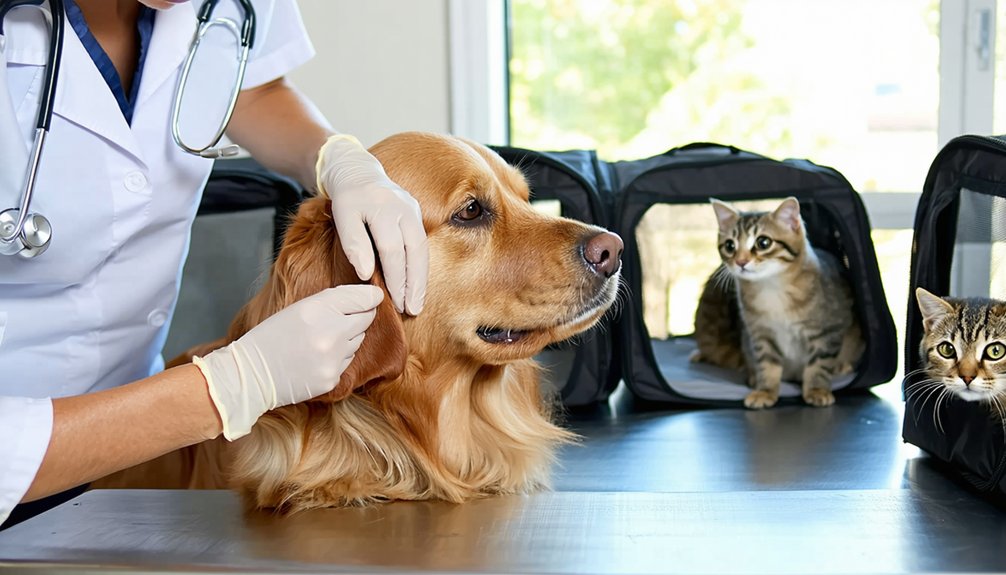
Although the rule might seem like an oversight for cat and ferret owners, it’s actually a deliberate, risk-based decision rooted in biology.
The Dog Definer Focus comes down to one fact: dogs commonly act as definitive hosts for *Echinococcus multilocularis*, shedding eggs into the environment after eating infected rodents.
Since your dog roams fields, forests, and parks, hunting and scavenging, it’s the species most likely to maintain and spread this tapeworm.
The Cat Exempt Rationale is equally evidence-based.
While cats can carry tapeworms like *Dipylidium caninum* and *Taenia* spp., they’re not clearly implicated as major reservoirs for *E. multilocularis*.
Ferrets are rarely significant hosts either.
That’s why Finland’s food safety authority confirms only dogs need treatment—cats and ferrets don’t.
How to Calculate the Window From Your Arrival Time
Because timing is everything with this rule, you’ll want to calculate the treatment window backwards from your scheduled arrival, not your departure.
Start your time window calculation by confirming your route includes a country that enforces it—Great Britain, Ireland, Finland, Norway, or Malta.
Next, fix the official arrival time from your ferry, train, or flight booking.
Count back 24 hours to find the earliest legal point, then count back 120 hours to find the latest.
Book your vet appointment between those two marks, leaving buffer time for delays.
If you’re arriving overnight or crossing time zones, use clock time and stick to local time alignment at your point of entry.
Small hourly miscalculations can invalidate treatment, so you’ll want precision here—the whole community depends on getting it right.
What Tapeworm Medication Counts and Who Can Give It
Veterinary supervision matters just as much as the medication.
A licensed vet must give or directly oversee the treatment and certify it.
Owner-administered doses usually don’t count.
Keep your prescription documentation and ensure official certificate evidence carries the vet’s signature, stamp, and clinic details—that’s what gets you through the border together.
What Your Vet Must Record on the Certificate

Once your vet administers the tapeworm treatment, they’ve got to document it precisely—and incomplete entries get pets turned away at the border. Proper medication documentation protects your trip, so confirm your vet meets every recording requirement before you leave the clinic.
Certificate legibility matters, since border officials must read each entry without guesswork.
Make sure your vet records:
- Product name, manufacturer, and active ingredient proof—praziquantel must be clearly identified, with batch number when required.
- Treatment date and exact time in day–month–year and 24-hour format.
- Your dog’s microchip number, cross-referenced to the identification section.
- Vet’s name and original signature—signature validity demands handwritten, not photocopied.
- Official stamp placement beside the entry, showing practice contact details.
These details keep you compliant.
Which Travel Routes Skip Repeat Treatment
Where you travel determines whether you’ll need a second tapeworm treatment before heading home. If you stay entirely within Great Britain, Northern Ireland, Ireland, Finland, and Malta, you’ll skip repeat treatment, since these places are free from *E. multilocularis*. The moment your route leaves that group, the requirement returns.
| Route | Stays in Exempt Group? | Repeat Treatment? |
|---|---|---|
| GB → Ireland → GB | Yes | No |
| GB → Finland → GB | Yes | No |
| GB → Malta → GB | Yes | No |
| GB → France → GB | No | Yes |
Smart itinerary planning tips keep you inside this corridor. The biggest exemption risk factors? Any side trip into another EU state or non-exempt transit stop. Plan carefully, and you’ll travel confidently alongside fellow pet owners.
How Travel Delays Can Void Your Tapeworm Treatment
Because tapeworm treatment must land inside a strict 24–120 hour window before arrival, any travel delay can quietly push your compliant dose into illegal territory. Since arrival timing—not departure—drives the calculation, a single schedule change can shift you outside the legal band, triggering certificate invalidity at the border.
Watch for these common delay scenarios that void your timing:
- Flight delays and missed connections pushing landing beyond the 120‑hour limit
- Ferry or train cancellations forcing later, non‑compliant rebookings
- Overland detours or overnight stays from strikes, weather, or border delays
- Last‑minute itinerary changes, like switching to a later carrier
- Multi‑leg trips where an added stop extends total voyage time
Arrive too early—under 24 hours—and you’ll break the rule too.
What Happens if You Miss the Treatment Window

Miss the 24–120 hour window, and the consequences hit immediately at the border. You’ll face entry refusal or delayed entry, and authorities may impose mandatory quarantine until you achieve compliance. You’re now part of a group of travelers who’ve learned this lesson the hard way—and you’ll need re-treatment abroad to restart the countdown.
| Immediate Impact | What You Face |
|---|---|
| Border response | Refusal, delay, or quarantine |
| Legal document issues | Non-compliance record on pet passport |
| Added costs | Extra vet visits, rebooking, quarantine fees |
Beyond the border, legal document issues can flag your movement records, increasing future scrutiny. Skipped treatment also risks veterinary emergencies—rising worm burdens that demand corrective care. You’ll rebook transport, extend accommodation, and absorb costs you didn’t plan for.
Why Norway Enforces the Rule for Dogs Only
- Dogs consuming infected rodents develop adult tapeworms and shed large numbers of eggs.
- Cats and ferrets are explicitly exempt, posing lower epidemiological risk.
- Imported dogs are a major controllable pathway for introducing the parasite.
- Norway aligns with Finland, Ireland, Malta, and the UK’s dog-only scheme.
- Regulatory language consistently references “dogs to be imported to Norway.”
Should You Repeat Treatment After Returning Home?
| When You Travelled | Repeat Treatment? |
|---|---|
| UK–Ireland–Finland–Malta only | Lower priority |
| Endemic regions (central/eastern Europe) | Strongly advised |
| Short trips (under 120 hours) | Often single dose suffices |
| Longer or multi-country trips | Post-return dose recommended |
Talk to your vet about risk based dosing and proper vet scheduling. You’re protecting your dog—and everyone’s pets back home.
Frequently Asked Questions
Does the Tapeworm Treatment Cause Any Side Effects in Dogs?
Yes, but you’ll find tapeworm medication safety reassuring—most dogs experience only mild, brief effects like vomiting or tiredness. Serious adverse reaction risks stay rare, so you’re joining countless owners trusting this excellent, well-documented treatment.
How Much Does Veterinary Tapeworm Treatment Typically Cost Before Travel?
You’ll typically pay £45–£55 (or €40–€76) for a travel vet visit including tapeworm dosing before travel. Cost varies by country rules and clinic—extra dogs often add just £15 each, so you’re covered together.
Are Puppies Under a Certain Age Exempt From Treatment?
No, you won’t find puppy exemption rules for tapeworm treatment in cited guidance—it’s timing-based, not age-based. Like fellow travelers, you’ll face border entry inspections enforcing the 24–120 hour window, so confirm your destination’s official requirements.
Can I Use the Same Certificate for Multiple Dogs?
No, you can’t. Each dog needs its own certificate with separate tapeworm and rabies vaccination entries. Like fellow responsible travellers, you’ll guarantee individual microchip-matched records, since certificate validity depends on dog-specific details authorities strictly check.
What Happens if My Dog Vomits Shortly After Treatment?
If your dog vomits shortly after treatment, vomiting timing matters—rapid vomiting risks poor absorption, affecting certificate validity. You’ll want your vet to assess redosing and update documentation, keeping you compliant within that key 24–120 hour window.
Conclusion
You’ve got everything you need to nail the tapeworm treatment window. Time your dog’s treatment within that 24-to-120-hour range before arrival, and you’ll sail through customs in countries like the UK, Ireland, Finland, Norway, and Malta. Don’t let travel delays catch you off guard—they can void your compliance and trigger quarantine. Keep your pet’s documentation precise, work with an authorized vet, and you’ll protect both your travel plans and your dog’s health.
References
- https://petabroad.eu/tapeworm-treatment-for-dogs-travel/
- https://catabroad.com/norway/
- https://www.gov.uk/bring-pet-to-great-britain/tapeworm-treatment-dogs
- https://travelvet.co.uk/pet-travel-faqs/tapeworm-treatment-requirements-for-pet-travel/
- https://nlsnorwayrelocation.no/the-strict-24-120-hour-tapeworm-treatment-rule-for-dogs-entering-norway/
- https://getpettravel.com/understanding-tapeworm-parasite-and-other-mandatory-treatments-required-before-international-pet-travel-canada-worldwide/
- https://autumntrailsvet.com/planning-international-pet-travel-rules-risks-requirements-part-2/
- https://europa.eu/youreurope/citizens/travel/carry/pets-and-other-animals/index_en.htm
- https://www.vetsaglik.com/en/post/us-to-uk-pet-travel-requirements-2026-microchip-rabies-tapeworm-entry-rules-explained
- https://www.ruokavirasto.fi/en/themes/import-and-export/eu-countries-norway-and-switzerland/animals/dogs-cats-and-ferrets/frequently-asked-questions-about-echinococcus-or-tapeworm-treatment/