There’s no safe duration—not even a minute. Major organizations like the RSPCA, AVMA, and ASPCA agree: zero minutes is safe. Shade only slows the danger; it doesn’t stop it. On a 95°F day, a shaded van’s interior can climb toward 100°F within an hour, with the steepest spike in the first 10–15 minutes. Your dog can’t escape or cool itself effectively. Here’s exactly why shade fails and what to watch for.
TLDR Key Takeaways
- There is no safe duration—not even one minute—for leaving a dog alone in a shaded van.
- Shade slows heating but cannot stop it; interiors can hit ~100°F within an hour on a 95°F day.
- The steepest temperature rise occurs in the first 10–15 minutes, climbing 10–20°F above ambient.
- Confined dogs cannot self-rescue, and panting fails in hot, stagnant, trapped air.
- Shifting sun angles can turn a shaded spot into full sun within 15–60 minutes.
The Honest Answer: Zero Minutes Is Safe
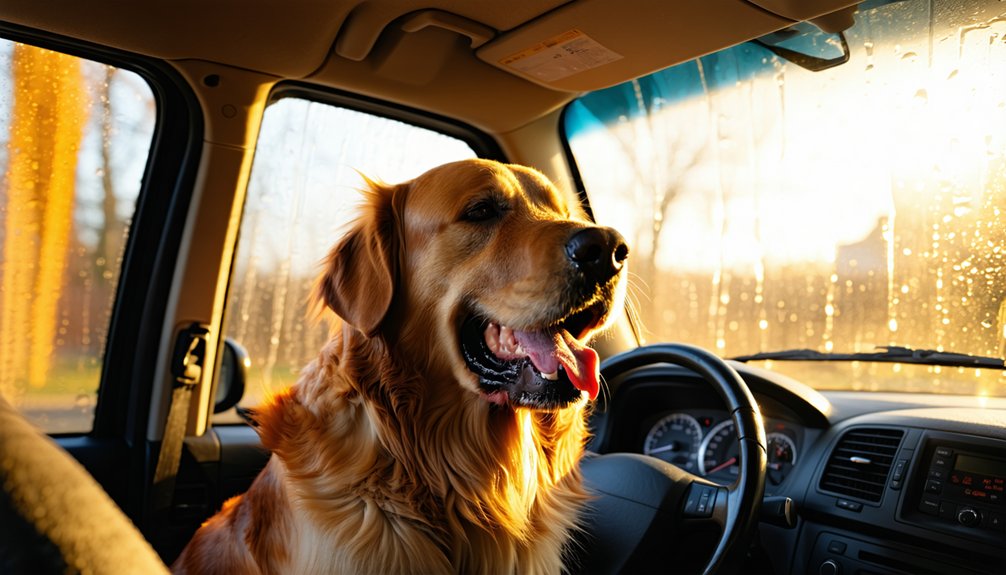
If you’re hoping for a number—five minutes, ten, maybe twenty in the shade—you won’t find one here, because none exists.
Major organizations like the RSPCA, AVMA, and ASPCA agree: there’s no safe time to leave your dog alone in any vehicle.
Veterinary guidance treats shade and cracked windows as risk-reducing, not risk-eliminating.
Conditions can still turn deadly.
When you join the community of responsible owners, you accept the thermal liability that comes with confinement—your dog can’t self-rescue.
Current risk messaging is blunt: “not even for a minute.”
That’s not fearmongering; it’s evidence.
And your legal responsibility doesn’t disappear because you parked under a tree.
The honest answer, the one that keeps your dog alive, is simple: zero minutes is safe.
How Fast a Shaded Van Really Heats Up
The shade buys you time, but it doesn’t stop the climb.
When you park in shade on a 95°F day, the interior still climbs toward 100°F within an hour.
The steepest rise hits in the first 10–15 minutes, driven by the greenhouse effect and low air exchange.
Trapped longwave radiation can push the cabin 10–20°F above ambient within the first 10–20 minutes, even out of direct sun.
Radiant heat compounds the danger: dashboards reach ~118°F, steering wheels ~107°F, seats ~105°F—far above safe contact levels for your dog.
That “quick stop” you’re tempted to make lands squarely in the rapid-rise portion of the curve.
We all want to believe shade protects them, but the numbers say otherwise.
The heat keeps building, continuously.
Why Shade Won’t Save a Dog in a Van
Shade slows the climb, but it can’t stop it—and that distinction matters more than most owners realize.
On a 78°F day, a shaded car’s interior still hits roughly 90°F, already dangerous territory.
Dogs rely on panting and minimal paw sweating, but airflow limits inside a van trap hot, stagnant air, crippling evaporative cooling.
Your dog can’t open doors, find a breeze, or shift to cooler surfaces.
- Temperature misjudgment kills—”mildly warm” cars have caused fatal heatstroke.
- Heat stroke begins around 105.8°F core temperature.
- Brain damage or death develops in just 4–6 minutes.
- Brachycephalic, obese, senior, and ill dogs face heightened risk.
- Emergency cooling and vet care become urgent once signs appear.
Heatstroke is always a medical emergency—shade won’t protect anyone.
How Glass Traps Heat Like a Greenhouse
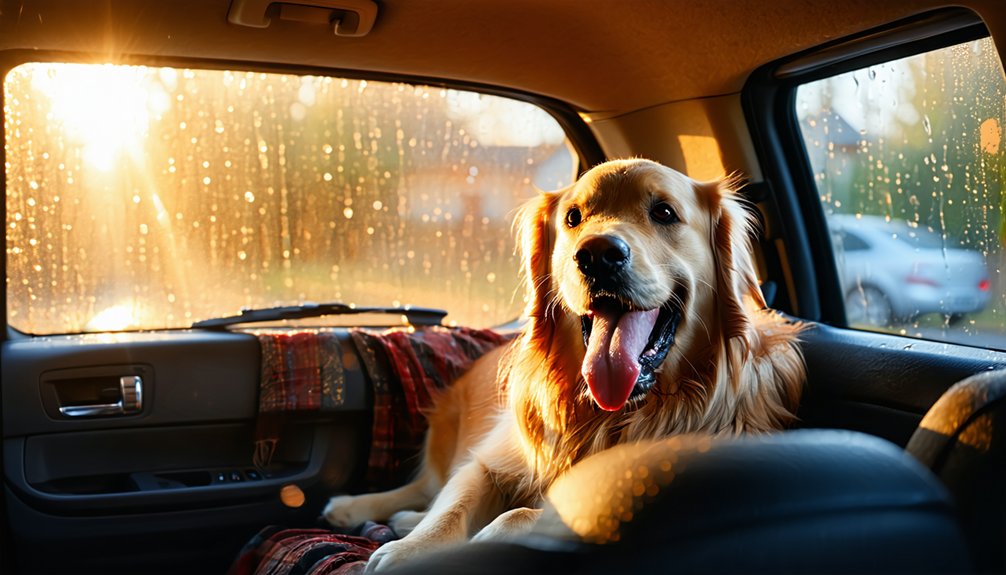
Because glass plays favorites with light, it turns your van into a heat trap. Sunlight pours in as shortwave radiation, hitting seats and floors that absorb it and re-emit it as longwave infrared. Here’s the catch: your glass blocks that infrared from escaping. This infrared trapping explains why temperatures climb fast, and the greenhouse analogy proves it’s the same physics warming our planet.
| Radiation Type | Glass Behavior |
|---|---|
| Visible light | Passes through easily |
| Infrared heat | Reflected, absorbed inward |
| Warm air | Can’t escape sealed cabin |
| Net energy | Accumulates rapidly |
| Result | Interior soars above ambient |
Like everyone learning this, you’ll see energy enters faster than it leaves. That’s why your van overheats, threatening any dog inside.
When the Shade Moves and the Sun Hits
That greenhouse effect doesn’t wait for permission, and the shade you parked in won’t last. The sun angle shifts fastest in early morning and late afternoon, so a spot that’s shaded now can sit in full sun within 15 to 60 minutes—often inside a single 20-to-40-minute errand.
Partial shade won’t save your dog either, because direct beams still slip through windows and roast metal, plastic, and upholstery.
Watch for these realities we’ve all underestimated:
- Roof and frames heat up even when the ground looks shaded
- Tree shade shifts with wind and sun movement
- Hot spots form fast on interior surfaces
- Interiors run hotter than outside air
- Temperatures keep climbing for 60+ minutes
You can’t outguess the sun.
How Heat Pushes a Dog Toward Heat Stroke
Once a dog’s core temperature climbs past its normal range of 38–39.2°C (100.4–102.5°F), the body fights back the only ways it can—panting to drive evaporative cooling from the respiratory tract, dilating peripheral blood vessels to shed heat through the skin, and ramping up heart rate to keep blood moving.
Inside a poorly ventilated van, those defenses fail fast. Trapped air blocks convective and evaporative loss, triggering a rapid core rise that overwhelms compensation.
As your dog drools and pants harder, plasma volume drops, blood thickens, and hypotension sets in.
Watch for emergency dehydration signs: bright-red or pale gums, prolonged capillary refill, glassy eyes, and ataxia.
Once temperature crosses 41°C (105.8°F), you’re facing heatstroke—and your dog needs you acting now.
Which Dogs Overheat the Fastest in a Van
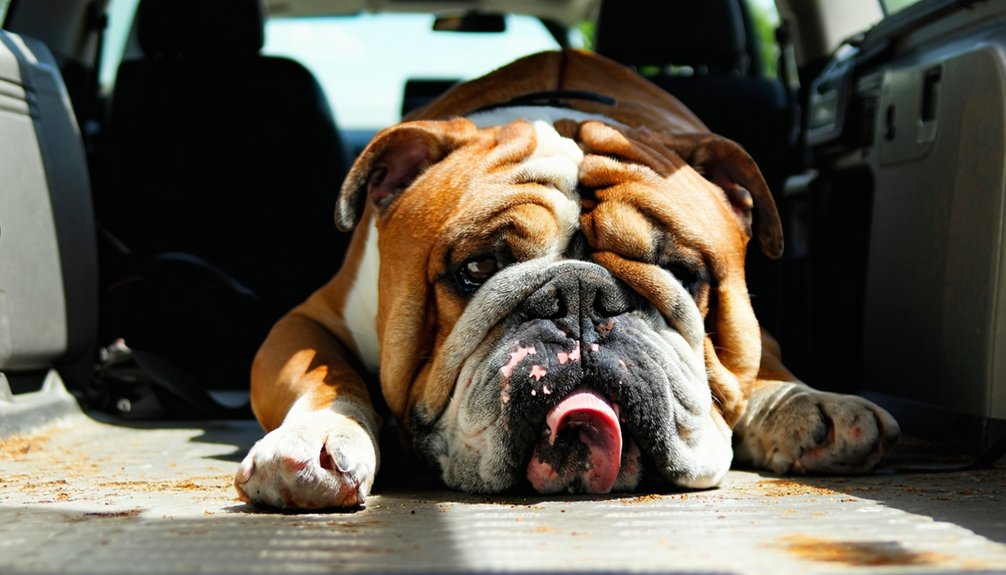
Knowing how heat overwhelms a dog’s defenses is one thing; recognizing which dogs hit that breaking point first can save a life.
If you love a flat-faced, giant, or thick-coated dog, you need to understand your companion’s specific vulnerability.
How brachycephalic breeds overheat reveals troubling heat intolerance mechanisms—their narrowed airways spark panting failure triggers long before other dogs struggle, especially when van airflow limits evaporation.
Watch these high-risk dogs closely:
- Brachycephalic breeds: Bulldogs, Pugs, and Shih Tzu overheat even in “warm” shade.
- Large and giant breeds: High mass-to-surface ratios trap metabolic heat fast.
- Double-coated dogs: Huskies and Malamutes retain dangerous warmth.
- Dark-coated dogs: Black fur absorbs radiant heat.
- Dogs with cardiac or respiratory disease: Comorbidities accelerate collapse.
Know your dog’s risk.
Why “Just a Quick Stop” Still Kills
The clock starts working against your dog the moment you cut the engine.
You might think you’ll only be five minutes, but rapid overheating doesn’t wait.
Interior temperatures climb 3–4°C every five minutes, and on a “mild” 22°C day, cabins can hit 47°C within the hour—most of that rise happening in the first 15–30 minutes.
Cracking windows won’t save them; ventilation limits mean airflow can’t overcome greenhouse heating.
Your dog’s heat physiology compounds the danger: they cool through panting and limited paw-pad sweating, far less efficiently than you do.
Shade shifts as the sun moves, turning a cool spot into kennel risk fast.
We all want to believe a quick stop is harmless—but the evidence says never leave them.
Early Warning Signs You Can’t Ignore
How quickly can you spot trouble? You’re part of a community that refuses to lose dogs to preventable heat death, so train your eyes on these early signals. Effective temperature monitoring with a rectal thermometer catches trouble at 39–40°C, before classic heatstroke strikes.
Watch for these red flags:
- Harder, louder panting while resting in shade, shifting shallow and fast
- Gums turning bright red or dark with a dry, tacky feel
- Warm, dry skin on ears, armpits, and groin
- Restlessness or sudden lethargy, plus decreased responsiveness to your voice
- Thick, ropey drool with reluctance to drink
Spot these signs and act immediately. Start cooling methods, prepare emergency transport, and call ahead for vet triage—every minute counts.
What Heat Stroke Looks Like as It Worsens
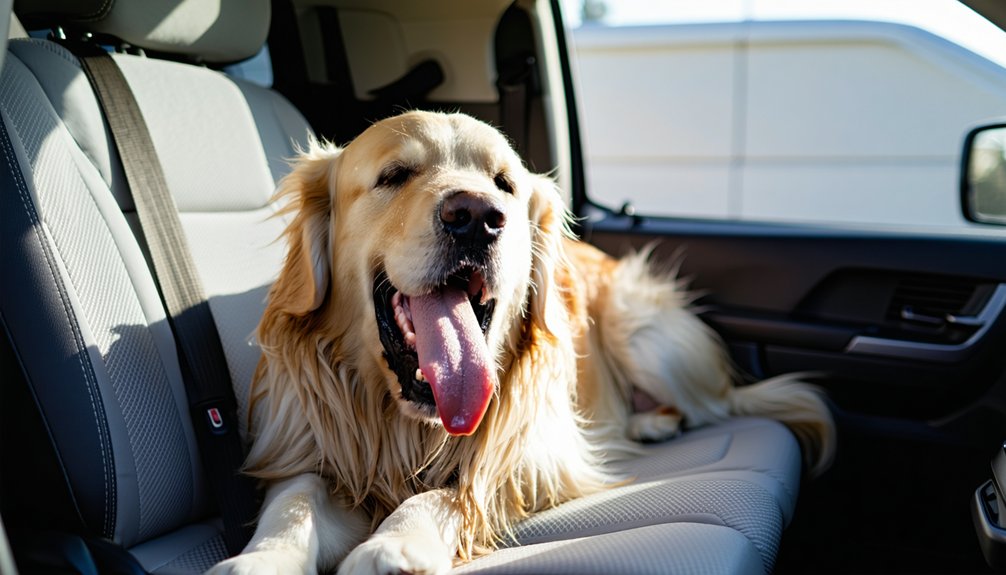
A worsening heat stroke attacks the brain, heart, gut, and blood all at once, and you’ll see the damage escalate fast. As your dog’s temperature climbs past 41°C, neurological deterioration signs appear: disorientation, restlessness, staggering ataxia, then stupor, seizures, or coma.
Watch his eyes—absent menace response and uneven pupils signal severe brain injury.
His heart races to compensate, but weak pulses, pale gums, and prolonged capillary refill reveal shock. Breathing turns shallow and labored.
You’ll notice vomiting, bloody diarrhea, and black, tarry stool as the gut breaks down.
These are multi organ failure indicators—failing liver, kidneys, and clotting systems showing petechiae or spontaneous bleeding. Along this brutal heat stroke timeline, treatment escalation urgent care isn’t optional.
Every minute you wait, his survival odds collapse.
First Aid Steps Before You Reach the Vet
Cool first, transport second—that’s the rule that saves lives. The moment you recognize overheating, you join thousands of owners who’ve acted fast and won. This is time critical: every minute of delay raises the risk of organ damage and death.
Move your dog to a cool, shaded, ventilated spot, stop all exertion, and start cooling immediately.
- Pour cool or tap‑temperature water over the neck, chest, groin, and inner thighs.
- Pair water with airflow—a fan or AC—to drive evaporation cooling.
- Apply cool, soaked towels to head, neck, feet, and chest, rejuvenating often.
- Offer small sips of cool water, never forcing it down.
- Avoid ice baths; they constrict vessels and trap heat.
Call your vet the moment cooling begins.
What to Do If You Spot a Dog in a Hot Van
When you spot a dog locked in a hot van, your first job is assessment, not panic.
Scan for heatstroke signs—heavy panting, drooling, bright red or dark tongue, glassy eyes, confusion, vomiting, or collapse.
Note the weather, sun exposure, ventilation, and how long the dog’s been inside.
Record the vehicle’s make, model, color, and plate, then photograph the scene and screenshot the temperature with a timestamp.
Stay beside the vehicle for continuous dog monitoring.
For emergency reporting, call animal control if the dog’s uncomfortable but stable, or 911/999 immediately if it’s critical.
Ask businesses to page the owner.
Provide clear details and request first responder guidance and response times.
Understand legal safety before considering vehicle rescue—you’re part of a community that protects these animals together.
Frequently Asked Questions
Is It Illegal to Leave a Dog in a Parked Car?
Yes, it’s often illegal. Many jurisdictions ban leaving dogs in parked cars when confinement risks suffering. You’re protecting public safety and your beloved companion, so check local enforcement rules—penalties include fines, criminal charges, even imprisonment.
Can I Break a Window to Rescue a Distressed Dog?
You can, but legal limits vary by state. Check your local “hot car” laws first—call 911, document distress, and use minimal force. We’re all protectors here, so afterward, rush them to an emergency vet immediately.
Are Cracked Windows Enough if I Leave Water Inside?
No, they’re not. Cracked windows and water won’t keep your dog safe—heat builds dangerously fast. No thermometer placement or hydration monitoring changes this. Like responsible owners everywhere, you should never leave your dog inside.
Do Cooling Mats or Fans Make a Parked Van Safe?
No, they don’t. Even in indirect sunlight, cooling mats and fans can’t beat ventilation limits in a closed van. Join responsible owners—follow local regulations, never leave your dog unattended, and keep an emergency hotline handy.
How Long Does Heat Stroke Recovery Take for Dogs?
Recovery typically takes 2–4 weeks, though severe cases need 6–8. Understanding cooling timelines and emergency vet signs helps you protect your dog. You’ll watch for kidney, liver, or neurologic complications, ensuring your companion recovers fully alongside you.
Conclusion
Don’t gamble with your dog’s life. Shade won’t protect them when a van’s glass traps heat like a greenhouse, pushing temperatures to deadly levels within minutes. You’ve seen how fast heat stroke sets in and how quickly it turns fatal. The safest number isn’t five minutes or two—it’s zero. Leave your dog at home when you can’t take them inside. If you spot a dog trapped in a hot van, act immediately.
References
- https://pmc.ncbi.nlm.nih.gov/articles/PMC7459873/
- https://agriculture.vic.gov.au/livestock-and-animals/animal-welfare-victoria/dogs/health/heat-and-pets
- https://cvmbs.source.colostate.edu/never-leave-your-pet-in-a-hot-car/
- https://www.aspca.org/sites/default/files/pets-in-hot-cars.pdf
- https://www.aspca.org/news/dogs-hot-cars-and-other-summer-dangers
- https://peconicvet.com/blog/2857-heatstroke-in-dogs-dead-in-minutes
- https://www.vet.cornell.edu/departments-centers-and-institutes/riney-canine-health-center/canine-health-topics/summer-heat-safety-tips-dogs
- https://www.climatecentral.org/climate-matters/dog-days-of-summer-when-heat-endangers-pets
- https://www.cdc.gov/heat-health/risk-factors/heat-and-pets.html
- https://www.pdsa.org.uk/pet-help-and-advice/looking-after-your-pet/all-pets/dogs-die-in-hot-cars-and-on-hot-walks