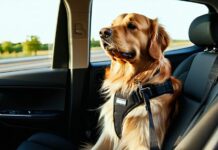
For large dogs, the Sleepypod Clickit Sport is your top pick, using a three-point seat-belt connection and ballistic-grade nylon for dogs up to 75 pounds. Need more capacity? The Clickit Terrain handles dogs up to 90 pounds with CPS-certified 5-star claims. The Kurgo Impact uses 4,000-lb tubular webbing for dogs up to 130 pounds, though it isn’t CPS-certified. EzyDog Drive adds multi-standard certification. Below, you’ll see how fit, materials, and installation make each choice work.
TLDR Key Takeaways
- Sleepypod Clickit Sport offers CPS-grade safety with a three-point seat-belt connection and ballistic nylon, restraining dogs up to about 75 pounds.
- Clickit Terrain suits dogs up to 90 pounds with CPS-certified 5-star claims validated against U.S., Canadian, and E.U. standards.
- Kurgo Impact uses single-piece 4,000 lb tubular webbing and FMVSS 213-style Calspan testing for dogs up to 130 pounds, though not CPS-certified.
- EzyDog Drive is certified across FMVSS 213, ECE Regulation 16, and ADR42/04, anchoring via two webbing loops to reduce rotation.
- CPS certification is the gold standard, using instrumented canine dummies in frontal-collision sled tests with injury metrics like no head excursion.
Why Crash Testing Matters More for Large Dogs
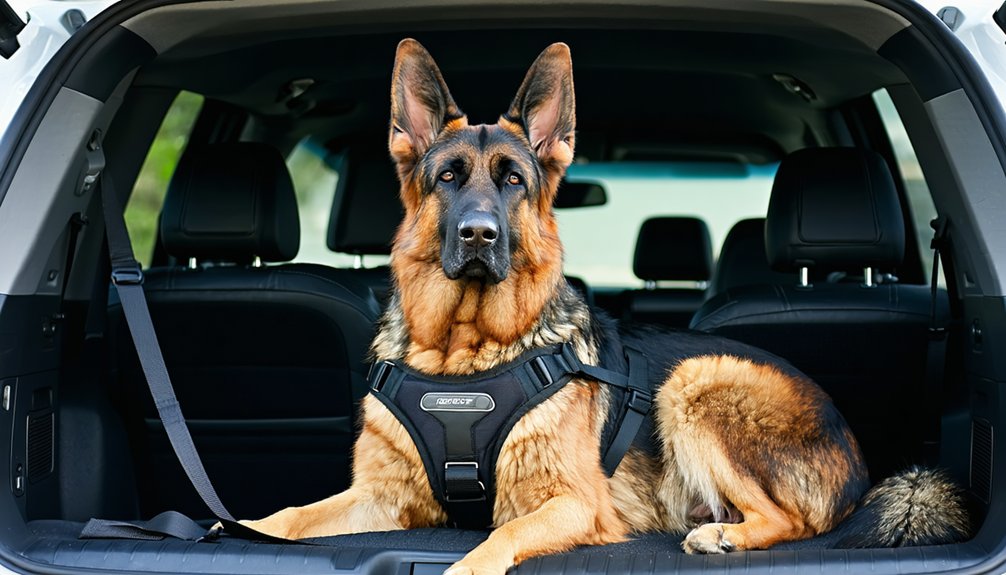
Because kinetic energy scales with mass, a 90 lb dog in a 30 mph collision generates far more force than a 20 lb dog at the same speed, pushing webbing, buckles, stitching, and seat-belt interfaces toward failure much faster.
When you understand mass vs momentum, you see why your big dog demands more from every component than smaller breeds do.
Early crash-test programs documented 100% failure among restraints marketed for large dogs—buckles snapped, stitching tore, and dogs got ejected.
That’s why anchor point integrity matters so much for you.
An unrestrained 90 lb dog becomes a high-mass projectile, threatening everyone in the cabin.
Like others who love their large dogs, you deserve restraints proven against realistic large-dog loads, not just marketing claims.
What “Crash Tested” Really Means Without a Standard
What separates the brands you can trust? Real test criteria—FMVSS 213-style protocols, ~30 mph deceleration pulses, independent labs like Calspan or MGA, and CPS pass/fail thresholds. Look for those specifics, not slogans.
How to Judge a Large-Dog Harness Before Buying
Before you trust any crash rating, you need to know whether a seatbelt actually fits, protects, and holds up under load.
Start with a sizing checklist: measure chest girth at the widest rib cage point and neck circumference where the collar sits.
Then test the strap adjustment points—you want at least four or five to accommodate deep chests and broad shoulders, plus the two-finger rule under each strap.
Check materials quality next: high-denier webbing, reinforced box-stitching, and metal D-rings beat plastic for large dogs.
Finally, do your own pressure point mapping.
Confirm the seat belt rests on the sternum and ribs, leaves shoulder blades free, and stops before the floating ribs.
When you nail these basics, you’re already ahead of most owners.
Why CPS Certification Is the Gold Standard
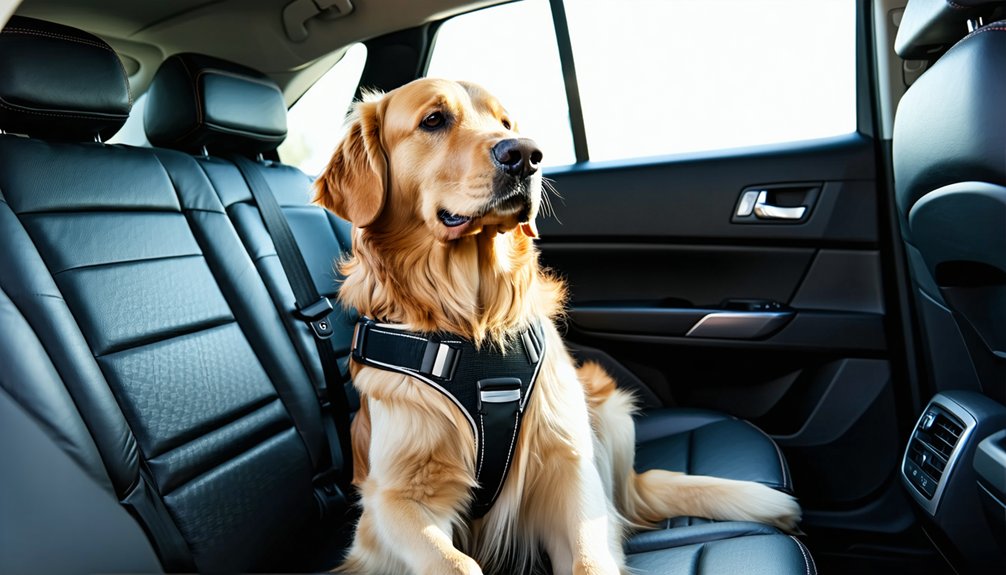
The Center for Pet Safety (CPS) sets the bar that every other safety claim gets measured against. When you choose a CPS-certified harness, you’re joining owners who trust independent science over marketing. CPS adapts child passenger and automotive safety principles, running instrumented canine dummies through frontal-collision sled tests at speeds comparable to federal child seat standards.
Here’s what sets CPS apart:
- Third Party Verification: As an independent nonprofit with no product sales, CPS keeps test outcomes separate from commercial incentives.
- Real Injury Metrics: Certification demands no head excursion, no full-body launch, and no catastrophic webbing, buckle, or stitching failures.
- Revocable Standards: Any design or material change without retesting voids the mark.
That rigor explains why so few products ever qualify.
Sleepypod Clickit Sport: Our Top Pick
A standout among crash-tested options, the Sleepypod Clickit Sport earns our top pick by translating CPS-grade safety principles into a strap that works for large dogs.
You get a three-point seat-belt connection that limits forward and lateral movement, distributing crash forces across your dog’s chest, shoulders, and back.
Built with ballistic-grade nylon and high-strength hardware, it restrains dogs up to about 75 pounds, fitting many large breeds in its Large size.
The bench seatbelt routing guides lap and shoulder belts through specified paths, working best on outboard rear seats.
You’ll appreciate the padded, Y-front vest design that spreads pressure while allowing natural movement.
Most dogs accept it after a comfort break in period, especially when you introduce it during short drives before longer trips.
Clickit Terrain: Best for Heavy, Active Dogs
When your dog tops the Clickit Sport’s 75-pound limit or pulls hard on every walk, the Clickit Terrain steps up to fill the gap. You’re joining owners of strong, active dogs who need restraint built for serious forces. This CPS-certified, 5-star harness withstands crash loads for dogs up to 90 pounds, validated against U.S., Canadian, and E.U. child seat standards.
Here’s what makes the Terrain right for your heavy hauler:
- High load durability from ballistic-grade fabric, heavy-duty webbing, and strong metal hardware.
- Rear seat stability through multi-point seat-belt routing that limits forward and lateral movement.
- Padded chest plate that distributes crash forces across the torso, sparing the neck.
It doubles as a walking harness, so you’ll switch gear less.
Kurgo Impact: Best Widely Available Option
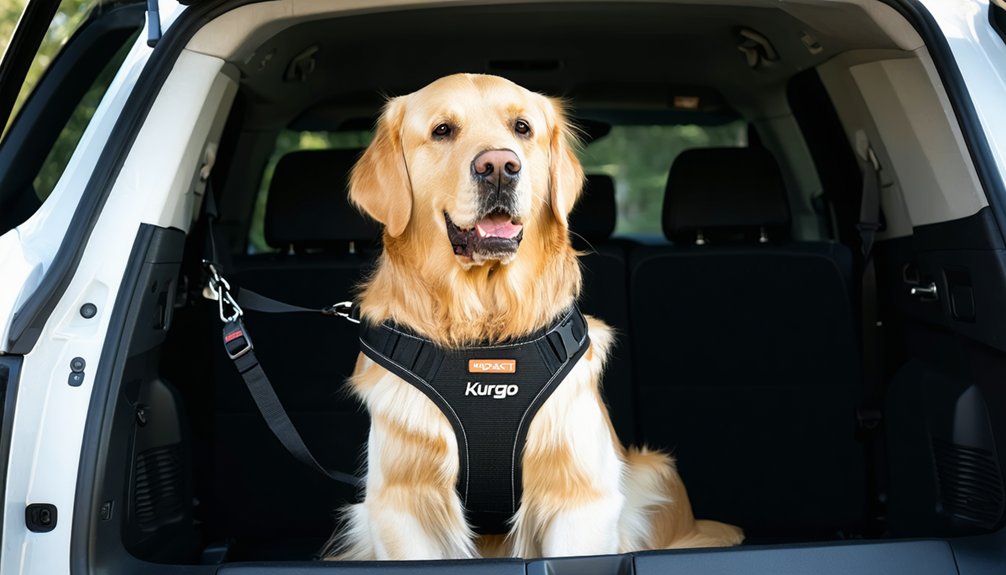
Beyond the Clickit lineup, you’ll find the Kurgo Impact wherever you already shop for pet gear—major online platforms and brick-and-mortar pet chains. That accessibility matters when you’re joining the community of owners who refuse to compromise on safety. Kurgo built this strap from a single piece of 4,000 lb tubular webbing, reducing break points under crash load, and reports FMVSS 213-style testing at Calspan with dogs up to 130 lb. All-metal buckles and “nesting steel” hardware keep plastic out of the primary load path.
For large breeds, sizing guidance prioritizes chest girth over weight alone. Use those four adjustment points for proper fit verification, since deep-chested dogs may need up-sizing. Just know it’s manufacturer-tested, not CPS-certified—you’re trusting their documentation, not third-party ratings.
EzyDog Drive and Other Strong Contenders
If accessibility drew you to the Kurgo Impact, the EzyDog Drive answers a different priority: international crash certification.
You’ll find it certified across three major standards:
- USA FMVSS 213 child-restraint standard
- ECE Regulation 16 (Europe)
- ADR42/04 (Australia)
This step-in harness threads your vehicle’s seat belt through two webbing loops, anchoring your dog to the back seat and reducing rotation in collisions.
The soft padded chest plate delivers collision comfort, distributing force across deep-chested frames, while aluminum-alloy tri-glides and seat-belt webbing provide durable hardware that’s survived real-world impacts intact.
It isn’t perfect, though.
Reviewers report fit challenges on broad, barrel chest breeds like Mastiffs, plus chafing when seated.
Measure your dog’s girth carefully, and you’ll join owners trusting certified protection.
How These Large-Dog Harnesses Compare
Now that you’ve seen each module on its own, you can weigh them side by side against the criteria that actually matter for large dogs: crash-test performance, restraint design, and sizing range.
On certification, the Sleepypod Clickit leads with its CPS 5-star rating, while the Kurgo Impact, Ruffwear Load Up, and AllSafe rely on documented lab tests rather than CPS approval.
Comparative restraint styles vary widely: the Clickit’s Infinity Loop creates a rigid tether, Kurgo emphasizes minimal hardware, and Ruffwear and AllSafe prioritize comfort movement allowances so your dog can shift, sit, or lie down.
For sizing, Kurgo (~108 lb) and Clickit Terrain/AllSafe (~110 lb) suit the biggest breeds, while Ruffwear accommodates barrel-chested, long-backed dogs.
Choose restraints routing the seat belt through built-in loops.
Getting the Fit Right on a Big Dog

Picking the right model from the comparison above only gets you halfway; how that enclosure fits your dog determines whether its crash rating actually protects him. Like the rest of us who buckle our dogs in, you’ll want Accurate Body Measurements first:
- Neck circumference at the base above the shoulders, tape flat against the coat.
- Chest girth around the widest part of the ribcage, 1–2 inches behind the front legs.
- Back length from withers to tail base for brands that require it.
Compare these to the manufacturer’s chart, prioritizing girth over weight. For Proper Strap Sizing, leave only two fingers between strap and body—that’s key to Preventing Harness Slipping.
Use padded sections over the sternum and shoulders, Avoiding Pressure Points entirely.
Installing the Harness in Your Car Correctly
Once your dog’s strap fits correctly, where and how you anchor it in the car decides whether that crash rating means anything.
Start with placement: the rear seat lowers injury risk, and the center position offers the best side-impact protection when a shoulder belt or suitable anchor exists.
Give each dog its own seating position to prevent entanglement.
For seat belt routing, use only your harness maker’s approved methods—direct-thread through designated loops or locking carabiners to the buckle stalk or LATCH anchor.
Lock the retractor by pulling the belt fully out until it clicks, avoiding slack that allows dangerous forward movement.
Keeping tethers short matters too: adjust length for preventing front reach, window access, and footwell sliding, then leave that hardware installed for consistency.
Which Harness Fits Your Dog Best?
Your dog’s weight, body shape, and temperament determine which gear actually fits—not just the brand’s reputation. Like every owner in this community, you want a match that protects and reassures.
Start with three factors that drive the right fit:
- Weight and size: The Clickit Sport suits 18–90 lb dogs, while the Terrain and Kurgo Impact handle heavier builds up to ~110 lb and 108 lb respectively.
- Body shape: For breed specific comfort, deep-chested breeds do better in the Ruffwear Load Up, while barrel-chested or athletic dogs benefit from Kurgo’s four adjustment points solving common fitting challenges.
- Temperament: Match restraint tolerance to movement range—calm dogs accept restrictive vest designs, while restless dogs prefer the Ruffwear’s positional freedom or strap-focused alternatives.
Frequently Asked Questions
How Often Should I Replace My Dog’s Crash-Tested Harness?
Replace your pet gear every 3–5 years, or sooner with daily use. Like fellow caring owners, you’ll want regular pet gear fit checks and should honor expiration timeframes—plus replace it immediately after any crash, fraying, or corroded hardware.
Can Crash-Tested Harnesses Be Machine Washed Safely?
Yes, if your rig is labeled “machine washable.” For machine wash safety, use cold water, gentle cycle, and a laundry bag. For drying after washing, always air dry—heat damages safety-critical components we all trust.
Are These Harnesses Suitable for Use on Airplanes?
Usually not. For airplane safety, you’ll need an airline-approved carrier, since crash-tested car straps don’t guarantee compliance with travel regulations. Like fellow pet parents, you should check your airline’s policy—carrier-style restraints work best for large dogs.
Do Crash-Tested Harnesses Work for Puppies Still Growing?
They can, but you’ll need diligent puppy fit adjustment as your dog grows. Most crash-tested models require minimum weights (15–18 lb), so prioritize growth pattern monitoring and re-fit straps snugly, keeping your growing companion safely protected.
Should I Replace the Harness After a Car Accident?
Yes, you should replace it. Crash forces can hide damage in webbing and hardware, so trust your post accident inspection and follow manufacturer replacement guidelines. Like fellow responsible owners, you’ll keep your dog safest by choosing replacement.
Conclusion
You’ve now got the evidence to make a confident choice. For most large dogs, the Sleepypod Clickit Sport is our top pick, backed by CPS certification and rigorous crash testing. But your dog’s measurements matter most, so prioritize a precise fit over brand loyalty. Measure carefully, install the restraint correctly using your seatbelt and tether points, and double-check every buckle. Do that, and you’ll keep your big dog genuinely protected on every drive.
References
- https://petpalhq.com/guides/best-crash-tested-dog-car-harnesses-2026
- https://www.petscare.com/en-gb/news/faq/what-helps-dogs-on-long-car-rides
- https://woofarena.com/dog-products/best-dog-car-harnesses/
- https://www.dogster.com/dog-health-care/best-crash-tested-dog-harnesses
- https://store.ezydog.com/products/dog-car-harness
- https://sakercanine.com/collections/crash-tested-harnesses
- https://www.gopetfriendly.com/blog/crash-tested-dog-harnesses/
- https://thedoggolife.com/best-dog-car-restraints-crash-tested-harnesses/
- https://www.thedogclinic.com/dog-harnesses/car
- https://naids.org/dog-product-review/crash-tested-harnesses/