Cooling vests win on raw power, extracting nearly three times the heat of a soaked bandana—331 versus 113 W·h·m⁻². But that edge collapses if you can’t carry the water or weight. Bandanas stay under 4 oz and target neck blood flow; vests run 3–5 lb and demand resupply or recharging. For long, high-sun routes, choose a vest; for fast, unsupported efforts, go light. The smartest setups, though, often pair both.
TLDR Key Takeaways
- Cooling vests deliver far higher heat extraction than bandanas, with active vests (~331 W·h·m⁻²) outperforming PCM (~164) and evaporative bandanas (~113).
- Bandanas win on weight and simplicity, staying under 4 oz when soaked versus 3–5 lb phase-change vests.
- PCM vests cool only briefly (~60 minutes), then add dead weight, risking false confidence and core temperatures exceeding 38°C.
- Evaporative cooling from bandanas fails in hot, humid, or windless conditions, collapsing once wet-bulb temperatures exceed ~31°C.
- Desert air above 40–45°C limits all skin-based heat transfer, making water-circulating or active vests the most reliable choice.
How Cooling Vests and Bandanas Cool You Down

A cooling vest and a cooling bandana tackle desert heat from opposite ends of the same problem: your body’s struggle to dump excess heat faster than the environment dumps it back.
When you wear a vest, you’re cooling your torso directly—conduction and convection pull heat from your trunk, lowering skin temperature and chilling the blood that circulates to the rest of you.
That eases cardiovascular strain, drops your heart rate, and supports natural sweating even when sun exposure and sweat rate climb.
PCM and ice vests absorb heat as they melt; evaporative vests rely on dry air to wick warmth away.
Bandanas target your neck, cooling blood near the surface.
Both buy you time when the trail’s heat outpaces your own cooling.
Which One Wins in Hot, Dry Desert Air?
So which one actually wins when the air’s hot and bone-dry? It depends on what you’re willing to carry. Active and PCM vests deliver far more cumulative cooling (≈331 and 164 W·h·m⁻²) than evaporative bandanas (≈113), giving you stronger core protection on long, full-sun trails.
| Factor | What You Need to Know |
|---|---|
| Cooling Capacity | Vests win on total heat extraction |
| Logistics | Bandanas win on weight and simplicity |
| Field Reliability | Mixed—vest design matters |
But desert hydration logistics complicate evaporative options, since constant wetting outpaces practical water resupply. Airflow dependency modeling shows evaporative gear fades without steady wind. For those of us covering serious miles, a quality PCM or active vest usually wins—just respect its finite cooling and your water limits.
Cooling Vest Types: PCM, Water, and Active
Before you pick a vest, you need to know that “cooling vest” covers three distinct technologies, each with different tradeoffs. PCM vests use phase change materials that melt around 15–18°C, providing consistent, ice-burn-safe cooling for 2–3 hours with no wiring or tubing—ideal when mobility matters.
Water-circulating vests pump chilled water through internal tubes, providing the strongest, most consistent cooling for long, heavy work, though they need an external pump and reservoir.
Active vests run pumps, fans, or thermoelectric modules on battery power for 6–12 hours, providing the highest performance at higher cost and complexity.
In 8-hour testing, active extracted 331 W·h·m⁻², PCM 164, hybrid 146, evaporative 113. Given evaporative limitations and desert hydration constraints, you’ll appreciate systems that don’t depend on sweat or water you can’t spare.
How Long Each Option Keeps You Cool
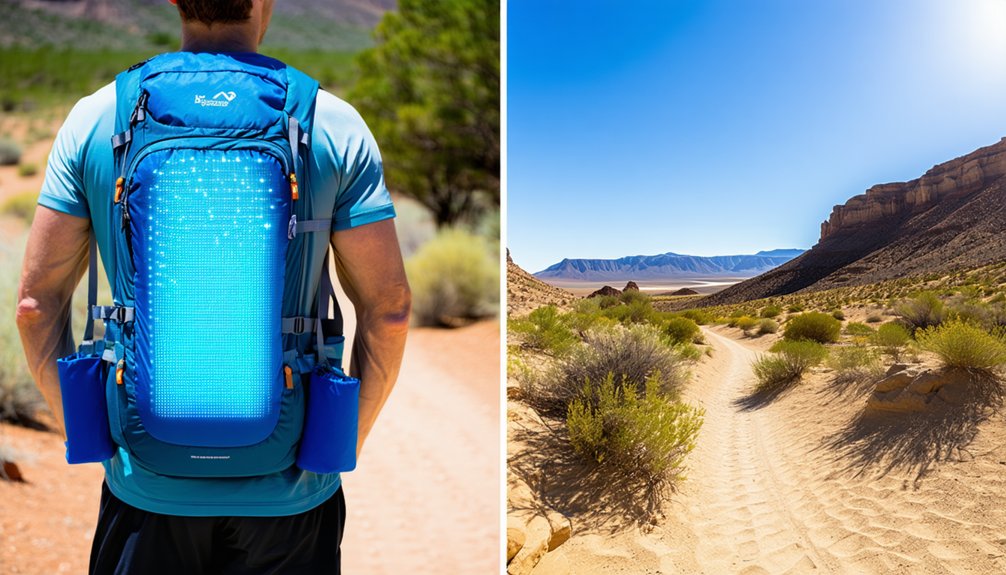
Because runtime determines whether a vest carries you through the hottest stretch of trail or quits halfway, you need to weigh realistic durations rather than marketing claims. On desert trails, ambient heat, direct sun, and exertion shorten every system, so plan for the lower end. Smart desert heatproofing means pairing your gear with hydration planning, since cooling and water work together.
| Option | Realistic Duration |
|---|---|
| Ice/gel vests | 1.5–3 hours |
| PCM vests | 4–8+ hours |
| Fan/active vests | 4–6 hours |
Evaporative bandanas trail behind, offering brief relief that fades fast in dry, stagnant heat. Remember that comfort often lingers longer than measurable core-temperature effects, so don’t mistake feeling cooler for staying genuinely cool when the trail keeps climbing.
What Field Studies Reveal About Core Temp
Feeling cooler and staying genuinely cool aren’t the same thing, and field studies on actual desert expeditions show why.
When researchers tracked three ultrarunners across 4,300+ km of Sahara over 111 days, their Tcore typically stayed below 39.0°C, even in brutal heat.
That’s core acclimatization at work—lower resting temperatures and steadier exercise readings as your body adapts.
Field thresholds run higher than lab numbers too: real-world exhaustion hits around 39.5°C versus 38.6°C in controlled settings, an ~0.8°C edge you earn through outdoor exposure.
But here’s what matters for your gear choice—humidity effects can erase that advantage.
When wet-bulb temperatures climb past ~31°C, evaporative cooling fails, and Tcore stability collapses.
Why Bandanas Punch Above Their Weight
Though a bandana weighs next to nothing, it punches well above its class on desert trails—and the physics explain why. Its high surface-area-to-mass ratio maximizes evaporative cooling per gram, so you get noticeable relief from minimal water. Placed on your neck, head, or temples, it cools superficial blood vessels that drive your perceived heat load.
Fast saturation and re-wetting let you cycle evaporation repeatedly—true arid comfort optimization on a tight hydration budget.
You’re not just cooling, either. Pull it over your face, and tightly woven cotton delivers real dust filtration tactics, blocking coarse particles that trigger coughing on dusty playa.
Reconfigure it as head wrap, sweat mop, or sun shield in seconds. That’s multi-use function per gram you’ll quickly come to trust.
Heat Extraction Numbers: Vests vs. Bandanas
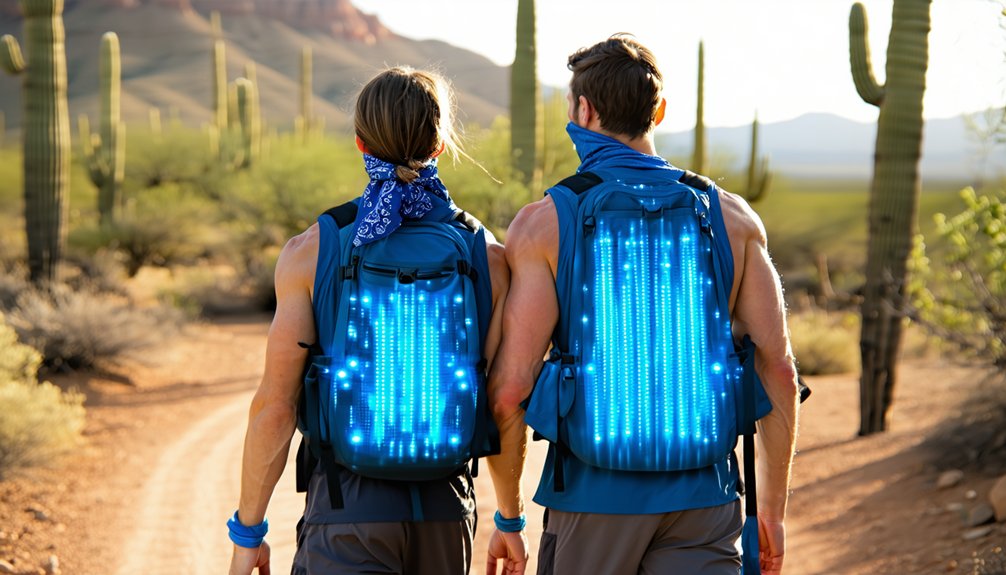
Bandanas earn their keep, but let’s put hard numbers on what they—and vests—actually extract. When you’re chasing real heat perf efficiency, active cooling vests lead, providing roughly 331 Wh·m⁻² over 8 hours, while PCM vests manage 146–164 and evaporative types around 113.
In torso tests, PCM/fan vests averaged 56–67 W of continuous cooling over 3 hours, with PCM packs front-loading a stronger first hour before tapering.
Bandanas can’t match that total extractable energy—they simply carry far less coolant mass.
But here’s where perfusion targeting changes the math: partial cooling of neck, chest, and underarm regions nearly matches full-vest effectiveness per unit area.
Vest and Bandana Weight on Long Trails
Because every ounce you carry costs energy on a desert climb, weight matters as much as cooling power.
A phase-change vest runs 3–5 lb (1.4–2.3 kg), while a soaked bandana stays under 4 oz—that’s a 10–20× difference.
Evaporative vests weigh less but double in mass once saturated, adding 8–16 oz of water you’ll haul through early miles.
For a 75 kg hiker, a 2 kg vest adds ~2.7% body mass, raising energy expenditure 3–5% and burning 20–35 extra kcal per hour.
That load reshapes your gait and fatigue, eccentrically loading quads and calves on descents.
Packing logistics favor bandanas too: they’re inherently zero-volume, recharge with any water source, and won’t crowd your hydration vest or demand freezer access on multi-day trails.
The Water Trade-Off: Drinking vs. Soaking
Whenever you pour water onto a bandana instead of into your mouth, you’re making a calculated bet: that skin cooling will save more sweat than the water you’re “spending.” The math is tighter than it looks.
Sophisticated cooling vests cut sweat rate by only about 0.24 L/h—roughly a quarter-canteen per hour—and a soaked bandana delivers far less.
Since that soaked water still comes from your carried supply, your cooling water balance has to account for both what you drink and what you evaporate.
The good news: desert air is bone-dry, so a small volume on thin fabric cools efficiently.
For your hydration logistics, treat soaking as a modest assist, not a sweat-replacement strategy. Drink first; soak strategically when you’ve got water to spare.
When to Combine a Vest and Bandana

When the air turns hotter than your skin—roughly 95°F (35°C) and up—neither tool alone keeps pace with the heat load, and that’s when you pair them. The vest spreads evaporation across your torso while the bandana targets the high-blood-flow neck, and together they shine in dry desert air under 35% humidity.
Use both on exposed mid-day crossings, long climbs, and reflective slickrock where radiant heat overwhelms single-point cooling.
Pre-cool before steep ascents, then re-wet during shade breaks when water’s available. This is where hydration scheduling matters: balance what you drink against what you soak.
Smart gear weight management keeps the combination practical—don’t haul more than you’ll use.
Back it all with early starts, sun-protective clothing, and a wide-brim hat to protect performance.
Where Cooling Gear Fails in Desert Heat
Pairing gear extends your margin, but it won’t rewrite physics. When desert air climbs above 40–45 °C, heat transfer limits kick in hard. Your skin can’t shed heat into hotter air, and humidity constraints choke the evaporation your bandana relies on.
PCM vests help, but phase change duration runs about 60 minutes—then the melted material adds weight without cooling. Recharge logistics make this worse: re-freezing packs on a remote, multi-hour trail isn’t realistic without cold storage.
Worse, vests trim only ~0.5–1.5 °C from your torso microclimate and won’t rapidly cool a dangerously high core temperature. One field study even found higher odds of exceeding 38 °C, hinting at false confidence.
Know these failure points, and you’ll plan smarter alongside everyone hiking with you.
Picking the Right Vest or Bandana Setup
Because the previous section laid out where cooling gear breaks down, you can now pick a setup that works within those limits instead of fighting them.
Match your gear to your route’s heat load, duration, and moisture sourcing, and you’ll join the runners who finish strong.
- Short or low-heat efforts: Go minimalist. A technical-fabric bandana plus light clothing cools your carotids and delays perceived fatigue without bulk.
- Long, high-sun desert routes: Choose a vest. Fan-assisted models deliver 4–8 hours; phase-change inserts give 1.5–3 hours of intense torso cooling.
- Unsupported trails: Favor easy reactivation strategy. Evaporative bandanas and ultralight vests re-soak from streams, tanks, or carried water—no freezers or charging stations required.
Plan your reactivation strategy around realistic moisture sourcing.
Frequently Asked Questions
Can I Machine Wash My Cooling Vest or Bandana?
You can if the label says “machine washable.” Check wash care first, remove gel/electronics, and confirm detergent compatibility. Use cold, gentle cycles. For drying time management and odor prevention tips, air-dry flat—you’ll fit right in.
What Fabric Material Works Best for Cooling Bandanas?
You’ll get the best results from cotton or synthetic blends with polymer cores. While Merino wool offers breathability, our breathability testing shows lightweight cotton wins on evaporative cooling—so you’re joining smart hikers who stay reliably cool.
Are Cooling Vests Safe for People With Heart Conditions?
Often, yes—cooling vests can reduce your cardiac strain, but you’ll want medical clearance first. Choose phase-change vests with hydration compatibility, avoid intense ice-pack cooling, and watch for heat warning signs. We’re keeping each other safe out there.
Do Cooling Vests Interfere With Backpack Straps or Hip Belts?
Yes, they can. Bulky vests push your straps outward and shift load off your hip belt. Choose low-profile, cropped vests with good breathability fit and strap compatibility, then re-tension everything. You’ll stay comfortable alongside fellow hikers.
What’s the Typical Price Range for Quality Cooling Vests?
You’ll typically pay $40–$150 for quality cooling vests, with premium models reaching $300. Like fellow desert hikers, prioritize breathable sizing comfort plus hydration visibility essentials. Evaporative options start around $35; active systems begin near $150.
Conclusion
On desert trails, your choice comes down to evaporation physics. In dry heat, evaporative vests and soaked bandanas outperform PCM and water-circulating designs—but they drain your water supply fast. You’ll get the best results by matching gear to conditions: a vest for sustained core-temp control, a bandana for quick neck cooling. Combine both when temps spike, and always weigh soaking against drinking. Know your sweat rate, plan your water, and you’ll stay ahead of the heat.
References
- https://www.sciencedirect.com/science/article/pii/S030645652200256X
- https://cdn.ymaws.com/members.iamu.org/resource/resmgr/toolbox_talks/2025/toolbox_talk_2025_cooling_cl.pdf
- https://www.tandfonline.com/doi/full/10.1080/00140139.2020.1853820
- https://ehp.niehs.nih.gov/doi/10.1289/isee.2021.O-SY-141
- https://academic.oup.com/annweh/article/61/4/481/3038244
- https://www.alibaba.com/product-insights/travel-neck-fan-vs-cooling-bandana-which-lowers-core-temp-faster-in-desert-destinations.html
- https://www.alibaba.com/product-insights/dog-cooling-vest-vs-bandana-which-actually-lowers-body-temperature.html
- https://journals.sagepub.com/doi/full/10.1177/15280837251349943
- https://pmc.ncbi.nlm.nih.gov/articles/PMC2231399/
- https://www.reddit.com/r/environmental_science/comments/vsxu4v/anyone_used_cooling_vests_for_outdoor_work/