Your puppy’s growth plates are softer than the tendons and ligaments around them, making them vulnerable to injury that a grown dog would simply shrug off as a sprain. Growth plates close at different ages depending on breed size, so hiking too far, too soon can cause deformities or joint problems. Stick to soft surfaces, follow the 5-minute rule, and watch for limping or stiffness. There’s more you’ll want to know before hitting the trail.
TLDR Key Takeaways
- Growth plates close by breed size: small 6-8 months, medium 8-12, large 14-16, giant 18-24 months.
- Follow the 5-minute rule: five minutes of structured walking per month of age, capped appropriately.
- Choose soft, natural surfaces like dirt or grass; avoid pavement, rocky, or uneven terrain.
- Skip loaded backpacks until growth plates close; avoid packs entirely for puppies under 10 lb.
- Watch for sudden lameness or stiffness, signaling possible growth plate injury requiring rest.
Why Are Puppy Growth Plates So Vulnerable?
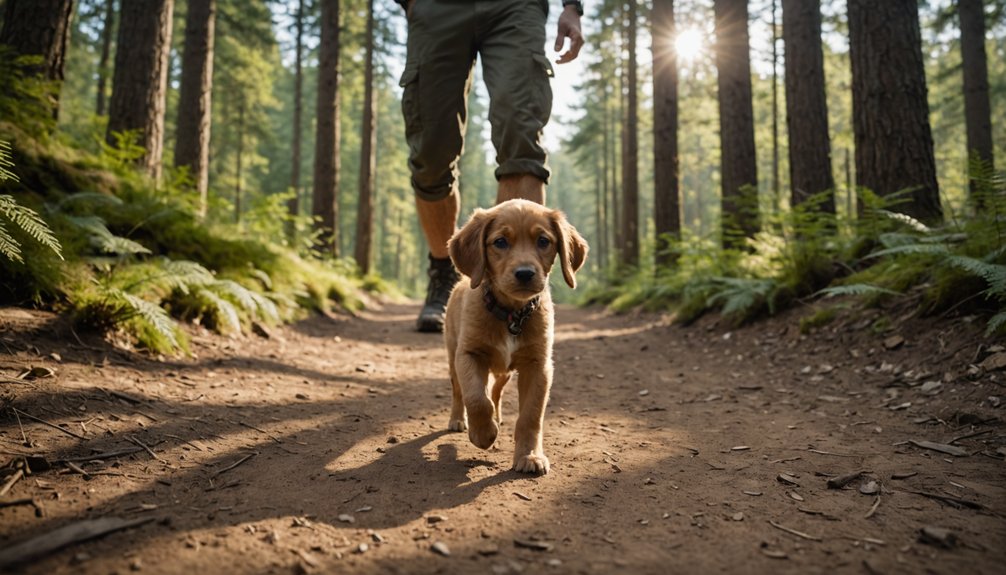
Because your puppy’s bones aren’t fully formed yet, they contain soft spots that adult dogs simply don’t have. These growth plates sit at the ends of long bones, driving longitudinal growth through rapidly dividing cartilage cells. They’re softer and less dense than surrounding bone, making them the weakest link in your puppy’s skeleton. In fact, your pup’s tendons and ligaments are stronger than these plates—so forces that’d cause a simple sprain in an adult dog can injure the plate itself in a puppy.
Puppy development moves fast between 3-8 months, the critical window when growth stages demand the most protection. Injuries during this time can lead to uneven bone growth, which may cause deformities later on. These plates eventually close and harden once your puppy has finished growing. For large or giant breeds, this closure can take 12-18 months or longer, so patience matters even more with bigger pups. Understanding this vulnerability isn’t about limiting your escapades—it’s about timing them right, so your trail companion grows into the strong, capable hiking partner you’re building toward.
When Do Growth Plates Close by Breed Size?
Size dictates timing when it comes to growth plate closure, and your puppy’s adult weight class tells you roughly what to expect. If you’ve got a toy or small breed, growth stages move fast—plates often close by 6-8 months, with near-adult size showing around 6 months.
Medium breeds run 8-12 months, hitting adult height around the one-year mark while some plates close as early as 4-6 months. Large breeds take longer, typically 14-16 months, sometimes stretching to 18. Giant breeds test your patience most, with plates staying open 18-24 months in some cases, especially at the tibial tubercle. Regardless of size, growth plates are made of cartilage, a flexible material that gradually hardens as your puppy matures. Giant breeds like Great Danes grow so quickly that they rely heavily on hormones to build the muscle mass needed to support their developing bone structure.
Know your breed size before you hit the trail hard. It’s the single best predictor of when your puppy’s skeleton can handle real hiking demands.
Can Hiking Hurt Your Puppy’s Growth Plates?
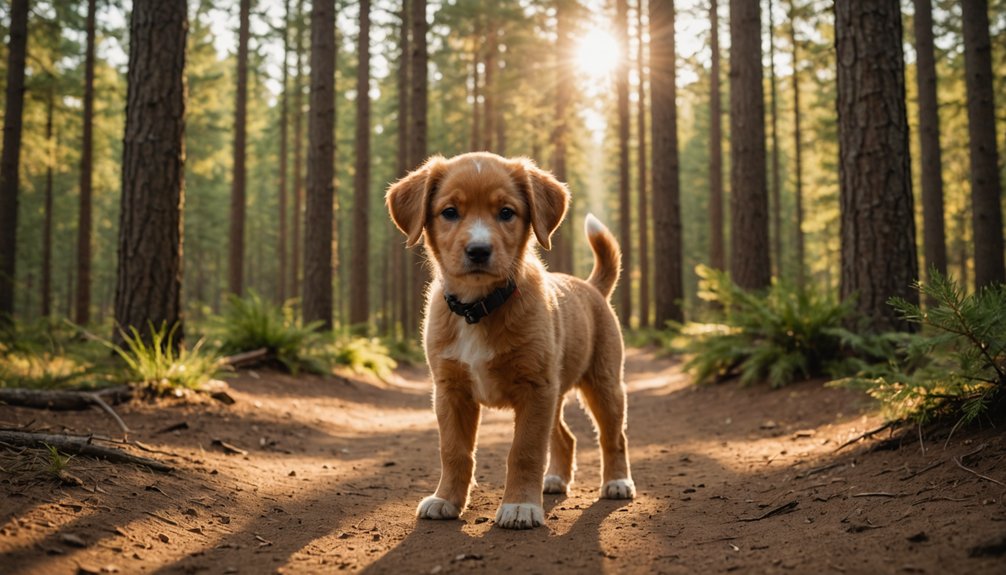
Yes—hiking can hurt your puppy’s growth plates, and the mechanism comes down to basic anatomy.
Growth plates are soft cartilage, still hardening into bone, making them the weakest point in your puppy’s skeleton.
Long hikes, especially with uphill climbs and sustained mileage, place repetitive stress on these vulnerable areas.
That’s where growth risks intensify: uneven bone growth, joint instability, or deformity can follow.
But circumstances matter.
Puppy exercise itself isn’t the enemy—free play is generally low-risk.
What’s dangerous is repetitive, high-impact, or torque-heavy movement, like maintaining a forced pace on steep terrain without rest breaks.
You want your puppy to move freely, not grind through miles it can’t self-regulate.
That distinction—type over quantity—determines whether hiking helps or harms development.
Injury to growth plates during these high-impact hikes can cause problems with proper healing and bone development down the line.
Large and giant breeds can take up to 24 months to reach full skeletal maturity, so hikes should stay gentle well beyond puppyhood’s early stages.
The 5-Minute Rule for Age-Appropriate Walks
If you’re wondering how long a walk your puppy can actually handle, the 5-minute rule gives you a starting point. The formula is simple: 5 minutes of structured walking per month of age, once or twice daily. It’s not a scientific law—PDSA notes there’s no hard evidence behind it—but it’s a solid guideline for puppy exercise while growth plates are still closing.
| Age | Walk Duration |
|---|---|
| 2 months | 10 minutes |
| 4 months | 20 minutes |
| 6 months | 30 minutes |
Use this cap for leash training and dog walking sessions, not free play in the yard—puppies self-regulate there. Stick to soft surfaces, skip stairs and hills, and let gradual progression guide your puppy care routine. Watch for signs of over-exercising like stiffness or exhaustion, as these are cues to scale back the duration or intensity of your walks. Repetitive on-lead walking or jogging on hard surfaces should also be avoided, since it places unnecessary strain on soft growth plates. Keep in mind that breed plays a role too, since larger breeds take longer to reach full growth and need extra caution during this stage.
How Much Hiking Is Too Much?
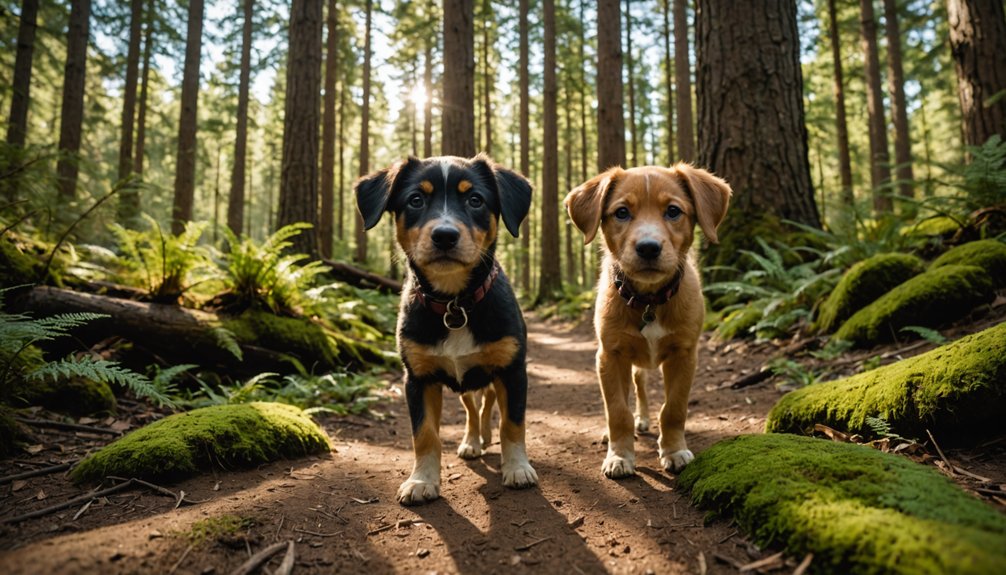
Too much hiking happens the moment your puppy’s activity outpaces what immature joints and bones can handle—and that threshold is lower than most owners expect.
Puppy limits aren’t arbitrary: an 8-week-old maxes out at 5 to 10 minutes, while a 6- to 7-month-old might handle 45 to 60 minutes.
Hiking guidelines like 5 minutes per month of age, or the 1-to-2-mile cap until 20 months, exist because growth plates stay vulnerable until 18 to 20 months.
True hikes should wait until then.
Even at a year old, stick to a mile or two before building distance gradually, and just like adult dogs, puppies need regular conditioning rather than sporadic big adventures to build lasting endurance.
Ignore these limits, and you risk overloading muscles and bones that simply aren’t ready for sustained, purposeful walking yet. Weather conditions also matter greatly, since heat or cold can further limit how much a young puppy should safely hike. Instead of long purposeful hikes, letting your puppy engage in free running in a safe, fenced area is a far better way to let them exercise and explore at their own pace.
Best Trail Surfaces for Protecting Growth Plates
Time and distance aren’t the only variables that matter—what’s under your puppy’s paws counts just as much.
Trail selection directly affects joint stress, so prioritize soft, natural ground: grass, well-maintained dirt trails, leaf-littered forest floor, mud, and loose soil all act as shock absorbers for developing bones.
These surface materials offer even footing and low-slip traction, reducing awkward landings and repetitive strain on growth plates.
Pavement and hard-packed paths aren’t off-limits, but keep exposure brief and controlled—short leash walks work fine when distances stay limited and conditions stay cool.
Watch for slipping or fatigue on firmer terrain; supervision matters more than the surface itself. Rocky or uneven terrain can also strain joints, so avoiding mountain climbing with a growing puppy is wise.
Choose trails with gentle, consistent texture.
Minimal abrupt changes and natural cushioning give your puppy the freedom to move confidently without unnecessary risk.
Worst Surfaces and Terrain to Avoid
While soft ground protects your puppy’s joints, certain surfaces do the opposite—they punish developing bones with every step.
Concrete and asphalt transmit concussive force straight through immature limbs, while hot pavement burns paw pads and wrecks your pup’s gait.
Tile, marble, and wet grass strip away traction, sending legs sliding into awkward twists that strain growth plates. Smooth surfaces like these offer no traction for puppies, whose tiny sharp nails need something to dig into for propulsion.
Rough trails full of rocks, roots, and hidden holes force constant balance corrections that overload tarsi and carpi.
Rocky terrain with loose gravel or unstable stones invites rolled joints and sprains.
Steep hills and stairs add braking and propulsive stress your puppy’s skeleton isn’t ready for.
Skip these surfaces now—your dog’s freedom to run hard later depends on the joints you protect today.
Should Your Puppy Wear a Hiking Pack?
A loaded pack looks cute on a puppy, but it’s doing real damage to skeleton that hasn’t finished forming. Pack safety means no load-bearing before growth plates close—12 to 24 months, depending on breed size. Empty-pack training is fine with vet approval; loaded hikes aren’t.
For small pups or those under 10 lb, skip the pack entirely. Backpack alternatives like structured carrier backpacks offer horizontal support without spinal strain—just limit continuous wear to 30-60 minutes and watch for overheating.
| Age/Stage | Pack Use | Alternative |
|---|---|---|
| Under growth-plate closure | Empty pack only | Carrier backpack |
| Post-closure, novice dog | ≤10% body weight | Standard hiking pack |
| Fit adult, experienced | 15-18% body weight | N/A |
Your puppy’s freedom to hike long-term depends on protecting that skeleton now.
How to Structure a Puppy-Safe Hike
Because a puppy’s joints and stamina are still developing, structure matters more than distance. Cap hiking time at roughly 2 minutes per week of age, keep total distance under 1–2 miles, and stick to flat terrain.
Good hike planning means adjusting only one variable at a time—distance, elevation, or difficulty—never all three at once.
Set the pace to your puppy’s natural speed, with sniff breaks and rest every 15–30 minutes.
Puppy monitoring is your job as owner responsibility: watch gait and enthusiasm constantly, and turn around at the first sign of fatigue or limping.
Trail preparation includes obedience basics like recall and “leave it,” which double as puppy socialization tools around other hikers, dogs, and wildlife on the trail.
Swimming and Other Low-Impact Alternatives to Hiking
Some days, even a well-structured hike asks too much of a young body. That’s when water therapy earns its place in your routine. Swimming gives you all the conditioning benefits without the concussive risk—buoyancy supports your pup’s weight, so growth plates stay protected while muscles still work hard.
One minute in the water delivers roughly four minutes of running’s worth of effort. That’s efficient puppy conditioning, not a compromise.
| Benefit | Why It Matters |
|---|---|
| Buoyancy | Removes impact from joints and growth plates |
| Resistance | Builds muscle across core, shoulders, rear limbs |
| Cooling effect | Lets you train hard without overheating |
Swimming builds the strength and coordination your dog needs for tougher trails later—freedom now sets up freedom ahead.
Warning Signs of Growth Plate Injury
Watch your puppy’s gait closely after every hike—sudden lameness in one limb, favoring a leg, or stiffness when rising all signal trouble at the growth plate.
Don’t dismiss reluctance to jump or climb stairs; it’s often pain talking, not laziness. Check for swelling, heat, or tenderness around the wrist, elbow, or knee, and note any yelping when you touch the area. Growth issues rarely announce themselves loudly at first, so injury prevention means catching subtle changes early.
Call your vet immediately if you notice:
- Non-weight-bearing lameness that doesn’t improve with rest.
- Persistent swelling near a joint lasting several days.
- Recurring limps shifting between legs.
Freedom on the trail depends on catching these signs before they become permanent damage.
Building Toward Real Hikes After Growth Plates Close
Once your vet confirms skeletal maturity through X-ray or clinical exam, you can finally start building real mileage—but don’t rush the shift.
Start with short, low-elevation hikes—1 to 3 miles—to see how your dog’s body responds. From there, follow a steady Post Maturity Mileage Progression: increase distance by roughly 10-20% per week, giving tendons, ligaments, and muscles time to adapt. Schedule rest days between longer hikes, especially if you’ve got a large or giant breed that matured closer to 18-24 months. Watch gait, energy, and post-hike stiffness closely—these signs tell you whether your dog’s ready for more or needs a slower climb. Freedom on the trail comes from earning it, one deliberate mile at a time.
Frequently Asked Questions
Can I Get My Puppy’s Growth Plate Closure Confirmed With an X-Ray?
Yes, you can get definitive x ray confirmation from your vet—it’s the gold standard for checking closure. Radiographs reveal each plate’s status directly, supporting smart growth monitoring so you’ll know exactly when your pup’s ready for unrestricted escapades.
Are Certain Dog Breeds More Genetically Prone to Growth Plate Injuries?
Yes—genetic factors drive real breed tendencies. If you’re raising a bulldog, dachshund, or giant breed like a Mastiff, you’re facing higher risk. Know your breed, respect their timeline, and you’ll hike safely for years ahead.
Does Neutering or Spaying Early Affect Growth Plate Closure Timing?
Yes, it does. Early spaying or neutering disrupts hormone impact on your pup’s skeleton, delaying plate closure by weeks or months. Surgical timing matters—choose wisely, and you’ll protect your dog’s freedom to grow safely and strong.
What Diet or Supplements Support Healthy Growth Plate Development?
Feed a complete, balanced puppy nutrition formula with controlled calcium and calories—don’t add extras. Skip joint supplements unless your vet confirms a real deficiency. You’ll protect growing plates best by trusting proper diet, not supplementation, plus regular vet checkups.
Will Pet Insurance Cover Treatment for Growth Plate Injuries?
Yes, you can get coverage—if you enroll before the injury happens. Investigate insurance options with strong accident benefits, check waiting periods, and weigh financial implications like deductibles and reimbursement rates before you hit the trail.
Conclusion
Your puppy’s growth plates aren’t optional guardrails—they’re biological limits you can’t rush. Stick to the 5-minute rule, watch for limping or fatigue, and choose swimming or short walks over ambitious trails while your pup grows. Patience now pays off later: once those plates close, you’ll have a stronger, injury-free hiking partner ready for real trails. Protect the foundation first, and the escapades will follow.
References
- https://www.caninehealthandrehabilitation.com/blog/puppies-exercise-and-growth-plates
- https://hikingwithpups.com/a-guide-to-hiking-with-puppies/
- https://www.reddit.com/r/BorderCollie/comments/mxaznq/am_i_damaging_my_puppys_growth_plates_and_bones/
- https://vcahospitals.com/pediatric/puppy/health-wellness/puppy-exercise
- https://www.reddit.com/r/Dogtraining/comments/sjfdp0/when_can_i_take_my_pup_on_a_hike/
- https://www.reddit.com/r/puppy101/comments/8419ow/growth_plates_is_it_too_late/
- https://pathsandpaws.com/dog-types/puppies/
- https://www.thetrainingofdogs.com/post/puppy-growth-plates-safe-exercise-training
- https://pathsandpaws.com/learn/when-can-puppy-start-hiking/
- https://www.facebook.com/groups/102479463123007/posts/9588442974526561/