Keep paper originals of your rabies certificate, health certificate, and import permits, since border officials require them. Back everything up digitally: scan documents at 300–400 DPI, run OCR for searchable PDF/A files, and follow a 3‑2‑1‑1‑0 backup approach. Store key records in a waterproof, tabbed binder, and save offline copies on encrypted USB drives. Test airplane-mode access before you go. Knowing which documents need originals makes all the difference below.
TLDR Key Takeaways
- Use a 1–1.5 inch waterproof binder with tabbed dividers organized by category, keeping originals like rabies and health certificates accessible.
- Scan documents on a flatbed scanner at 300–400 DPI, save as TIFF or PNG, then run OCR for searchable PDF/A files.
- Standardize filenames as `YYYY-MM-DD_PetName_DocType_ShortDetail` and build per-pet folder hierarchies with category subfolders for easy retrieval.
- Apply a 3-2-1-1-0 backup approach and keep an offline-first strategy with encrypted USB media tested in airplane mode.
- Duplicate critical records—rabies proof, core vaccinations, exam notes, and prescriptions—in both paper and digital formats for border checks.
Which Vet Records You Need for Travel

Why do so many trips get derailed at the airport counter or border checkpoint? Usually because of missing paperwork or an identification mismatch.
To travel with confidence alongside other prepared pet owners, you’ll need a Certificate of Veterinary Inspection issued by a licensed, often USDA-accredited vet, plus proof of rabies vaccination showing dates, lot number, and manufacturer.
Bring your full vaccination record, microchip documentation confirming ISO compatibility, and registration with current contact details.
Many destinations require a rabies titer test and parasite treatment records too.
Mind your vaccination timeline—rabies often needs 21–30 days before entry.
Carry a summary of medical history listing chronic conditions and emergency medications.
Finally, run document expiration checks before departure, since most CVIs stay valid only within tight windows.
How Do You Check Destination Pet Entry Rules?
Knowing which records to carry only helps if you also know what your destination demands. Start with official sources: your national veterinary authority (like USDA APHIS’s “Pet Travel” tool) and the destination country’s government portal. These pages let you verify border requirements, including microchips, vaccinations, certificates, and quarantine rules at inspection points.
Don’t stop there. Run airline transit checks, since carriers add their own restrictions on crate type, breed, age, and health certificate timing. Layover countries may also enforce their import rules, especially in rabies-controlled regions like the EU and UK.
Confirm species specific entry rules, because requirements differ for dogs, cats, ferrets, and birds. Pay close attention to rabies certificate timing—many destinations demand a 21-day waiting period, or longer when titers apply.
Build a Vet Records Binder That’s Easy to Grab
When a border agent asks for proof of vaccination, you don’t want to be digging through a shoebox of crumpled receipts. Build a slim, travel-ready system using a 1–1.5 inch waterproof binder that protects records from spills, rain, and crate water bowls.
Choose standard letter-size sheets so clinic printouts and health certificates file without trimming. Set up tabbed dividers—“ID & Licenses,” “Vaccines,” “Medications,” “Lab Results,” and “Travel Docs”—so officials and new vets flip straight to what they need.
File by category, not date, keeping quick access to proof-of-vaccine pages. Add interior pockets for rabies tag copies and a zipper pouch for a USB drive and spare pet photos.
Treat this binder as your essential travel checklist, ready to grab and go.
Put Your Pet’s Medical Snapshot Up Front
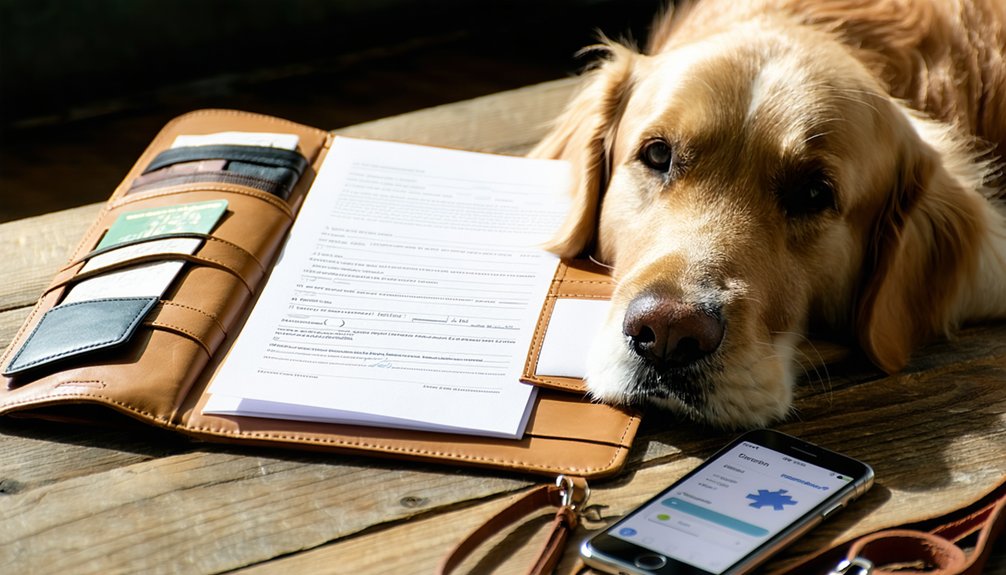
At the front of every travel packet, place a one-page medical snapshot that speeds triage for new or emergency veterinarians.
Think of it as a table of contents pointing to deeper records: identifying data, active diagnoses, current medications, and vet contacts in one view.
List rabies status with dates, core vaccines, parasite prevention, and fit-to-travel clearance up front for border checks.
Emergency readiness improves when you format for quick scanning—bold headers, bullet lists, and large fonts make medical alerts like allergies and seizure history impossible to miss.
Use contact clustering to group your regular vet, the nearest 24/7 clinic at your destination, and poison control together.
Add a recent photo and note where full records live.
You’ll travel knowing your pet’s covered.
Match Your Microchip Across Every Record
Because a single mistyped digit can block a registry match, your pet’s microchip number has to read identically across every record you carry. Enter it without spaces, punctuation, or the manufacturer name, and repeat it exactly on vet files, registration databases, shelter paperwork, and travel documents. Remember, the chip stores an identification number only—not contact details, genetic testing results, or behavior history—so registries hold what reconnects you with your companion.
| Record Type | Holds Chip Number | Recovery Risk if Mismatched |
|---|---|---|
| Vet File | Yes | Wrong patient match |
| Registry Database | Yes | No owner contact |
| Travel Documents | Yes | Border verification fails |
Before any trip, a quick microchip scanning at your vet confirms the chip’s still detectable and matches your paperwork—keeping your family connected.
Scan and Save Vet Records the Right Way
Since a blurry or cut-off scan can stall you at the border, you’ll want to capture vet records right the first time. Use a flatbed scanner instead of your phone to avoid shadows and distortion, scanning text-heavy forms at 300–400 DPI in grayscale.
Before batch scanning, remove staples, smooth creases, clean pages, and protect fragile thermal paper.
Save master copies as uncompressed TIFF or PNG, never JPEG, to preserve contrast that boosts OCR accuracy.
Run OCR to create searchable PDF/A files, then verify critical fields like microchip and rabies dates.
For smart file organization, group records chronologically by type and bundle them per pet.
Finally, keep secure storage in two places—cloud and local device—so you’re always travel-ready, like every prepared pet parent.
Name and Organize Digital Files for Fast Retrieval

Once you’ve scanned and saved your records, you’ll want to name and organize them so you can find any document in seconds—not while a border agent waits.
Clear Naming and smart Search Indexing turn a chaotic drive into a system you’ll trust under pressure.
Build habits that keep every pet owner in your circle confident and prepared.
- Standardize filenames using `YYYY-MM-DD_PetName_DocType_ShortDetail`, like `2026-03-12_Rover_Vaccine_Rabies.pdf`, avoiding spaces and special characters.
- Build folder hierarchies with one top-level folder per pet, then category subfolders like `Health Records`, `Travel`, and `Identification`.
- Tag and label files with terms like `rabies`, `import`, and `urgent` for faster filtering.
- Maintain an index spreadsheet tracking dates, document types, regulations, and expirations.
Mirror this structure across every device.
Back Up Vet Records in Three Safe Places
Although your files are now perfectly organized, a single hard-drive crash or cloud lockout can wipe them out in seconds—so you need redundancy you can count on. Smart redundancy planning follows the trusted 3‑2‑1 rule: keep three copies on two media types, with one stored offsite. For veterinary data, extend it to 3‑2‑1‑1‑0—adding one immutable backup and error‑free verification—so you’re never left stranded.
| Copy | Where It Lives |
|---|---|
| Cloud (2FA‑secured) | Geographic redundancy, shareable links |
| External drive (encrypted) | Multi location storage, offline access |
| Vet portal/e‑certificate | Authoritative institutional backup |
Review your strategy annually and after major changes—a new country, vet, or diagnosis. Test each location regularly, because backups you’ve never verified aren’t backups you can truly trust.
Keep Vet Records Accessible Without Internet
Backups protect you from losing records, but they won’t help at a remote border crossing or rural clinic where there’s no signal to retrieve them. That’s why fellow travelers rely on an offline first backup strategy that keeps every document at their fingertips, no connection required.
- Choose an offline-first app that stores and searches vet PDFs locally, then enable its export feature.
- Use encrypted device storage on your phone and tablet, downloading copies from portals and email in advance.
- Verify access through airplane mode testing, opening every file, QR code, and attachment before you leave.
- Carry a duplicate media copy on an encrypted USB or SD card, confirmed compatible with multiple devices.
Now you’re genuinely prepared, wherever the road takes you.
Which Documents Need Originals vs Digital Copies?

Now that your records are accessible offline, you need to know which ones travel as originals and which work as digital copies.
Original paperwork rules apply to documents officials physically inspect: rabies certificates, health certificates, import/export permits, microchip implantation paperwork, and surgery or sterilization certificates. Keep these signed and dated on paper, since boarding checks and customs authorities often request the exact document presented at approval.
Routine exam summaries, vaccination history pages, lab results, medication lists, and allergy summaries work fine digitally, because staff need quick access to information, not original sheets.
For safety, keep border document backups of your most critical records in both formats. Rabies proof, core vaccinations, recent exam notes, prescriptions, and vet travel letters belong in duplicate, protecting you if paper goes missing.
Update Vet Records After Every Visit
Records go stale fast, so you’ll want to update them right after every appointment while details are fresh. Logging visit date, clinic, vet, symptoms, and diagnostics keeps your pet’s history accurate and ready for emergency triage.
Capture the working diagnosis, treatment plan, and follow-up instructions before they fade from memory.
Stay current with these essentials:
- Medication updates: record drug name, dose, frequency, route, and start/end dates immediately after new prescriptions.
- Side effect tracking: document any adverse reactions after each medication or vaccine change for safer future decisions.
- Recheck scheduling: note recheck timelines and booster due dates so nothing slips through.
- Completed treatments: mark end dates clearly to avoid confusion during travel.
You’ll join countless pet parents who keep records consistently reliable.
What Goes in Your Travel-Day Document Kit?
When you’re packing for travel day, your document kit needs to cover five fronts: identity and contacts, medical records, proof of ownership, care notes, and smart packing.
Start with your vet’s clinic details and your own owner reachability—home address, phone, and a travel number for same-day contact.
Add emergency contacts: 24-hour clinics near your departure, route stops, and destination.
Include a recent photo and a description sheet with microchip number.
Pack medical records, vaccination and rabies documentation, prescription lists, and emergency summaries for fast treatment decisions.
Bring ownership proof, microchip registration, insurance, and behavioral or feeding notes.
Place everything in a waterproof folder, keep paper and digital backups, and store the kit somewhere reachable.
You’re prepared, and so is your companion.
Frequently Asked Questions
How Much Does Pet Travel Documentation Typically Cost to Prepare?
You’ll typically spend $200 to over $1,200 per pet, covering vet exams, certificates, and USDA endorsements ($101–$275+). Remember to update costs for stringent destinations and check whether your insurance coverage offsets any travel-related veterinary expenses.
What Should I Do if My Pet’s Documents Are Lost Abroad?
Contact your home vet immediately for digital records, then visit a local licensed vet for replacement certificates. You’ll need emergency consulate contacts to confirm legal requirements and replacement microchip records aligning your pet’s ID across documents.
Can I Travel Internationally With Multiple Pets Using Shared Records?
Yes, you can. A shared vet record works for multi pet travel if your document organization keeps each animal’s identity separate. During itineraries planning, duplicate core documents per pet so you’ll all belong together internationally.
How Long Does It Take to Get a Rabies Titer Test?
You’ll typically wait 7–15 days for lab processing, though turnaround times can stretch 3–6 weeks with shipping. Some labs offer express result delivery in 24–72 hours, but emergency scheduling isn’t always available—so plan early, friend.
Do Service Animals Need the Same Vet Records for Travel?
Yes, you’ll usually need the same vet records—microchip, rabies vaccination, health certificates—as pets. While Emotional Support animals face stricter Documentation Requirements, your service dog’s underlying health paperwork typically mirrors pet rules crossing borders.
Conclusion
You’ve got everything you need to travel confidently with your pet. Keep your records binder updated, match your microchip across every document, and store digital backups you can reach without Wi-Fi. Always verify destination entry rules before you go, since requirements change. Carry originals where they’re required and copies everywhere else. When your paperwork’s organized and current, you’ll breeze through checkpoints and focus on what matters: enjoying the trip with your companion.
References
- https://www.pawspet.it/publications/come-organizzare-documenti-animali-passaporto-microchip-assicurazione/
- https://buriedinwork.com/veterinary-health-records-checklist/
- https://www.alibaba.com/product-insights/how-to-organize-a-pet-s-vaccination-records-digitally-so-they-re-instantly-accessible-at-borders.html
- https://www.facebook.com/groups/9003421258/posts/10158209090386259/
- https://www.alibaba.com/product-insights/how-to-store-pet-travel-documents-digitally-without-risking-lost-usb-drives.html
- https://familyaffairmoving.com/preparing-your-pets-records-for-a-move/
- https://co.vet/post/veterinary-medical-records-laws/
- https://blog.petgenius.ai/2024/08/how-to-obtain-and-maintain-vet-records.html
- https://www.reddit.com/r/puppy101/comments/1rx2ddg/how_do_you_actually_keep_track_of_all_the_vet/
- https://web.petsclubapp.com/en/pet-health-records-app