Start by charging a short, unique cue—a word or whistle—with high-value, meat-based treats reserved only for recall. Practice indoors at 1–2 meters, keeping success near 100%, then generalize using the “7-7-7” pattern: seven recalls, seven days, seven places. Add a long line and proof against real trail variables like wind, bends, and distractions. Aim for 80–90% immediate response from 50–100 feet before heading out. Here’s exactly how to build it.
TLDR Key Takeaways
- Establish a baseline in a low-distraction, familiar space, requiring immediate commitment to a single cheerful cue with no repeated calling.
- Use the “7-7-7” pattern—seven recalls over seven days in seven places—to prove generalization, starting at 3–5 meters before increasing distance.
- Select a short, unique cue or whistle, charge it with high-value meat treats reserved only for recall, and keep tone upbeat.
- Meet readiness benchmarks: 80–90% immediate response, recall from 50–100 ft on a long line, and reliability across 5–7 locations.
- Proof against real trail variables like wildlife scent, around-a-bend recalls, and wind interference, never pairing the cue with punishment.
What Reliable Trail Recall Actually Means
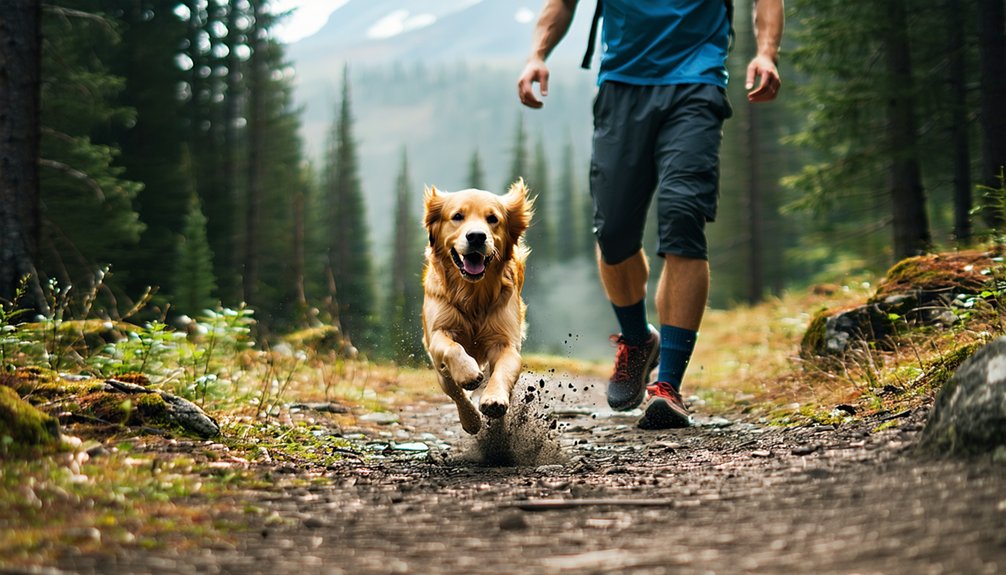
When trainers call a recall “reliable,” they don’t mean perfect from day one—they mean a response so well-trained it works nearly every time you call. Photograph being “99.99% sure” your dog comes enthusiastically, regardless of location or distraction. That’s the standard you’re aiming for, and you’re not alone in pursuing it.
Let’s clear up some recall myths. Reliable doesn’t mean instinctive; it’s a trained skill built through repetition and proofing. An instant response—your dog orienting quickly, then running toward you without hesitation—comes from consistent reinforcement, not luck.
Judge reliability by five criteria: consistency, speed, enthusiasm, distance tolerance, and distraction tolerance. Your dog should return promptly and energetically, finishing close enough for immediate handling. That’s what separates a true trail recall from wishful thinking.
Why Strong Recall Keeps Your Dog Safe
A strong recall isn’t just a convenience—it’s a safety tool that can save your dog’s life.
When you and your dog head off-grid, trail hazards multiply: traffic, toxic scavenging, unstable terrain, and oncoming off-leash dogs.
A reliable recall gives you immediate redirection, breaking chase behavior before your dog bolts after wildlife or runs into a road.
Think of it as your emergency control—a panic button that pulls your dog back from sudden dangers like falling branches or cliff edges.
Recall also reduces the risk of your dog getting lost, facing dehydration, hypothermia, or predation in remote country.
Beyond protecting your dog, it supports community safety, preventing bites, livestock chasing, and wildlife conflicts.
That’s how you earn trusted off-leash freedom.
Test Your Dog’s Recall Baseline First
Before you head off-grid, you need to know exactly where your dog’s recall stands. Start in a low-distraction space your dog already loves, like indoors or a fenced yard, before adding distance or distractions.
Set clear behavior criteria: success means your dog turns and commits immediately to a single, cheerful cue—no repeated calling.
Try the proven “7-7-7” pattern: seven recalls over seven days in seven places, proving your dog generalizes the skill everywhere your pack roams.
Begin at just 3–5 meters, increasing distance only after repeated success.
Sharpen your reward timing by marking the moment your dog commits, not just when they arrive.
Record every session so you’re trusting data, not memory.
If your dog hesitates, ease back—you’re building reliability you can both depend on.
Pick the Right Recall Cue and Reinforcers
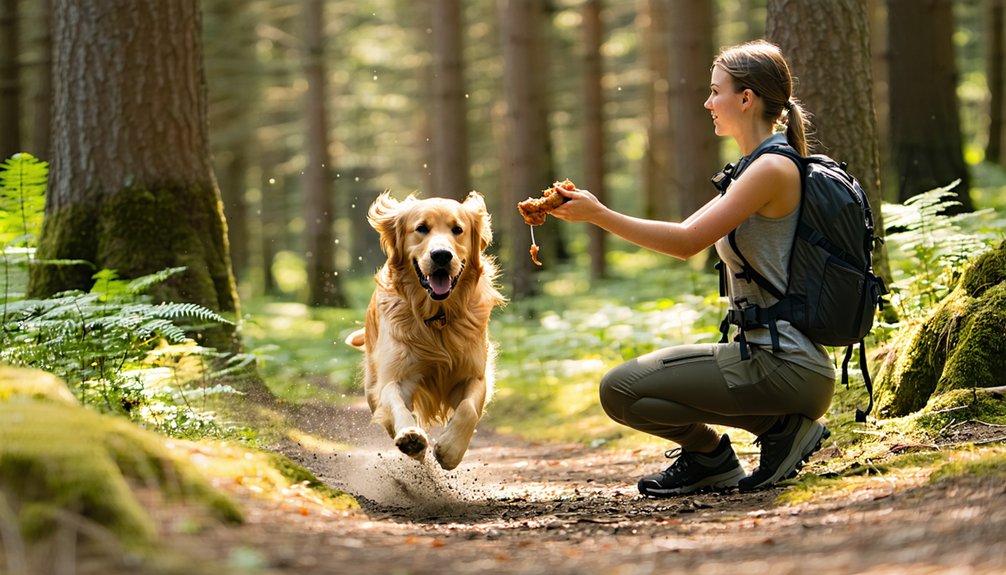
Choose your recall cue carefully, because it’s the single signal your dog must trust above all the trail’s distractions. Pick a short, unique word or whistle pattern that won’t overlap with everyday cues like “stay,” “no,” or your dog’s name alone. Whistles travel farther over wind and elevation, while a high, clear vocal tone holds attention better than a monotone. Distinguish emergency vs routine recall, reserving your emergency cue for rare, critical moments to preserve its reliability.
- Choose cue consistency: every family member uses identical wording, tone, and rules.
- Pair the cue with high-value, meat-based treats and upbeat body language.
- Never link recall to punishment, vet procedures, or the end of all fun.
Your shared signal becomes the bond that keeps you connected off-grid.
Charge Your Recall Cue With High-Value Rewards
Because your recall cue is only as powerful as the rewards behind it, you’ll need to “charge” it through deliberate Pavlovian conditioning.
Say your cue, then immediately deliver top-tier food—chicken, steak, or meat-based treats reserved exclusively for recall work.
Your dog doesn’t need to move yet; you’re simply teaching that the cue predicts wonderful things.
Run many short bouts daily, a few reps each, to keep excitement high and prevent satiation.
Timing precision matters enormously: mark and pay the instant your dog responds, so the cue’s emotional intensity strengthens.
Watch for early conditioned responses—head whips, ear perks, rapid eye contact—and reinforce them.
With clean marker placement, you’ll build a cue that triggers fast orienting and genuine joy every single time.
Start Recall Training in Low-Distraction Spots
Once you’ve charged your recall cue, you’ll want to put it to work where success comes easy. A quiet environment—an indoor room or enclosed yard—lets your dog learn the cue faster, with fewer early failures.
Begin at very short distances of 1–2 meters, so your success rate stays near 100%, then expand only after you see consistent, rapid responses.
Keep sessions short, just 1–3 minutes, repeated several times daily. This session consistency builds a strong reinforcement history and protects against later cue “poisoning.”
- Choose familiar, predictable spaces to lower arousal and scent-driven distraction.
- Reward every recall richly to cement the behavior–reward bond.
- Vary your position and orientation to generalize recall while distractions stay low.
You’re building the foundation that off-grid reliability depends on.
Why a Long Line Is Non-Negotiable for Recall
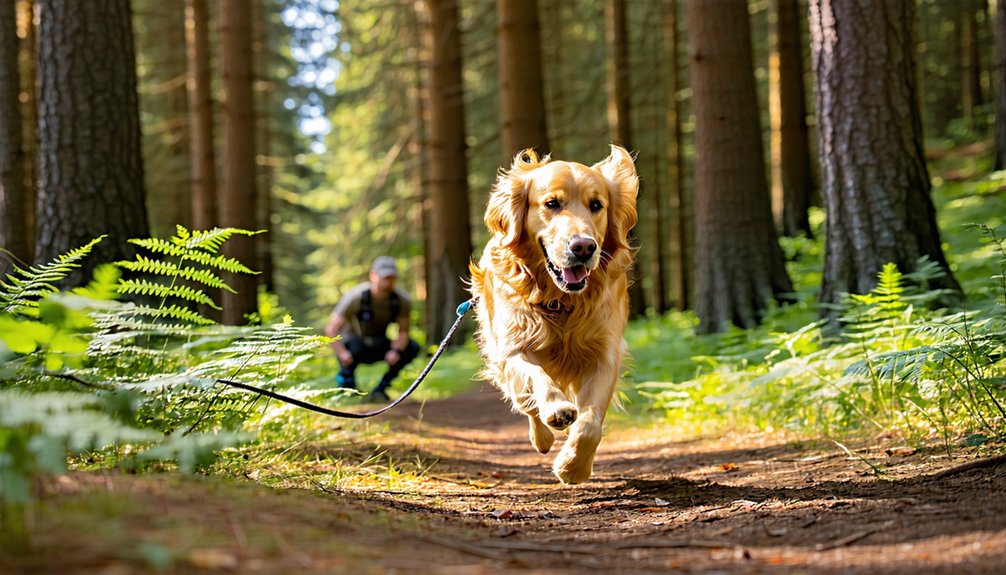
Between the controlled quiet of indoor practice and the open chaos of a trail lies a gap, and a long line is how you bridge it safely. At 20–50 feet, you’ll run full-length recalls while preventing your dog from bolting toward wildlife, bikes, or other dogs. That physical safety backup matters most when recall fails, stopping flight toward traffic, cliffs, or roads before injury happens.
A long line also handles legal compliance in leash-law regions, functioning as a control tool where true off-lead isn’t permitted. It prevents your dog from rehearsing the choice to ignore you, keeping reliability near that 80–95% target. For sighthounds, hunting types, or rescues with poor recall, you’re not optional here—you’re responsible. Join the handlers who train smart.
Add Distance, Duration, and Distractions Slowly
The three D’s—distance, duration, and distraction—make or break your recall, so you’ll change only one at a time.
Build distance in small 3–5 m increments, treating each new distance as its own step—distance only generalization means never assuming 10 ft transfers to 100 ft.
Use progressive success benchmarks, holding 80–90% success before advancing.
For duration, start with instant reinforcement, then add 1–3 seconds in a gradual duration buildup.
Master distraction hierarchy planning by ranking challenges from rustling leaves to wildlife, then training easiest to hardest.
- Stay in your lane: keep 80% of reps virtually guaranteed, only 20% at the challenge edge.
- Drop back fast: if success dips below 80%, return to an easier rung immediately.
- Reward arrival: high-value payoffs sustain motivation.
Proof Your Recall for Real Trail Conditions
Because controlled fields don’t replicate the chaos of an actual trail, you’ll need to proof your recall against real-world variables before trusting it off-leash.
Start by training recalls near—but not inside—high-distraction zones like game trails and rodent-dense edges, where wildlife scent ranks among the strongest competing motivators.
Use high-value reinforcers like meat or a favorite toy to outcompete strong olfactory stimuli.
Practice “around-a-bend” recalls behind trees, rock outcrops, and brush to simulate line-of-sight loss on curved, hilly terrain.
Add sound interference from wind and water to strengthen cue reliability when voice projection fails.
Account for heat, cold, altitude, and fatigue, which slow response.
Is Your Dog’s Recall Ready for Off-Grid?
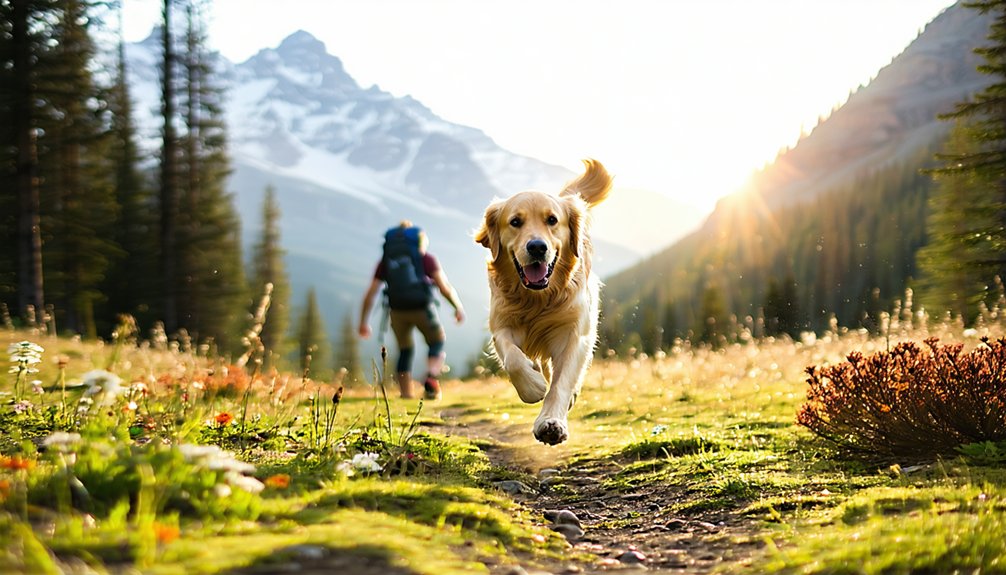
Proofing your recall against trail chaos sets the stage, but you still need objective benchmarks before you unclip the leash off-grid. You still need objective benchmarks before you unclip the leash off-grid.
Join the ranks of seasoned handlers who measure readiness, not guess at it.
Your dog should hit an 80–90% immediate-response rate on a single cue, recall reliably from 50–100 ft on a long line, and generalize across 5–7 locations. Honest motivation assessment matters too: your reinforcement history—food, play, release—must outvalue wildlife scent, dropped food, and moving animals.
- Habit strength: Hundreds of reinforced repetitions build distraction-proof responses.
- Backup control: Proof an emergency stop or “this way” redirect.
- Safety gear: Use a reinforcement current ID, microchip, and GPS collar.
Handler consistency seals these standards before off-grid freedom.
Recall Mistakes That Quietly Ruin Reliability
Behind most unreliable recalls, you’ll find small handler habits that quietly erode months of training.
You repeat the recall word when your dog’s unlikely to respond, turning it into meaningless background noise. You pair it with nail trims, baths, or the end of play, building negative word association that slows every return.
Awkward cue timing—chanting, escalating your volume, or sharpening your tone after slow responses—teaches your dog that recall predicts conflict, not reward.
The damage continues after your dog comes back.
You leash up immediately, scold the delay, or force grooming, making recall predict lost freedom or rough handling.
Mix in inconsistent payment, where some returns earn nothing and others end badly, and you’ll produce a dog who can’t trust the cue.
Adjusting Recall for High-Prey or Anxious Dogs
While a solid recall works for most dogs, high-prey and anxious dogs need adjustments that account for the powerful instincts driving their behavior. You’ll want to manage the environment first—use a long line in open areas and avoid off-leash access where prey density is high, preventing rehearsed chasing. Respect anxiety thresholds by choosing quieter locations that won’t trigger panic-driven flight. Strike a reinforcement balance with top-tier rewards reserved for recalls away from wildlife, moving bikes, or unfamiliar dogs.
- Channel the drive: Use flirt poles, tug, and scent games so real prey feels less overwhelming.
- Train disengagement: Build a “leave it” cue and emergency U-turn for instant interruption.
- Reward every return: Reinforce even slow recalls to reduce anxiety about failing.
You belong here.
Frequently Asked Questions
How Long Does It Take to Train a Reliable Trail Recall?
You’ll typically need 6–12 months for reliable trail recall, though high-prey dogs distracted by scent tracking may take longer. Using positive reinforcement with high-value rewards, you’ll join countless handlers who’ve built dependable, enthusiastic recall through consistent daily practice.
What Whistle Brand or Type Works Best for Recall?
You’ll want the ACME 211.5—it’s the gold-standard pealess whistle trusted by working-dog pros. Its fixed frequency guarantees whistle volume consistency, and it cuts through long distance distractions, helping you join the off-grid community confidently.
Can Older Dogs Still Learn Dependable Off-Leash Recall?
Yes, your senior dog can master dependable recall. Research confirms it. Focus on senior training basics: sharp reinforcement timing, gradual shift leash transition, and managing scent distraction. Like fellow handlers, you’ll build trust and reliable trail recall together.
Should I Use an E-Collar as Recall Backup?
Yes, but only as backup. Build solid recall first with food and long line, then layer low-level stimulation. Follow safety protocols and e collar ethics—it’s a prompt, not punishment. You’ll join responsible handlers off-grid.
What Gear Should I Pack for Off-Grid Hikes?
Pack a topo map and compass to sharpen your direction skills planning, plus first aid supplies basics, water filter, layered clothing, shelter, fire kit, and a PLB. You’ll hike confidently alongside fellow off-grid thrill-seekers.
Conclusion
You’ve now got the structure to build recall you can actually trust off-grid. Don’t rush it—reliable recall comes from consistent reinforcement, gradual proofing, and honest assessment of your dog’s baseline. Test in real conditions before you depend on it, and never let a single failed recall go unaddressed. Whether you’re working with a high-prey hunter or an anxious companion, adjust your approach accordingly. Put in the reps now, and you’ll both stay safe out there.
References
- https://www.youtube.com/watch?v=y_bVwjNVvSc
- https://www.youtube.com/watch?v=TQtU4irGDko
- http://www.trailhoundwelfare.org.uk/downloads/TrainingRecall.pdf
- https://ridgesidek9raleigh.com/reliable-recall-training-for-dogs-in-raleigh/
- https://www.reddit.com/r/Dogtraining/comments/ym6nh5/those_who_have_trained_great_recall_how/
- https://www.finddogpark.com/blog/how-to-build-reliable-recall-in-off-leash-areas/
- https://ridgesidek9norcal.com/summer-recall-training-northern-california/
- https://www.whole-dog-journal.com/training/teaching-a-reliable-recall/
- https://www.keendogtraining.com/blog/importance-of-reliable-recalls-on-your-hike
- https://thepuppytrainingpodcast.buzzsprout.com/274881/episodes/14329682-episode-163-tips-for-a-reliable-recall