In the EU, you get a single, reusable blue pet passport for dogs, cats, and ferrets. An authorised vet issues it once your pet’s microchipped and vaccinated against rabies—in that order. The US has no passport system. Instead, you’ll need per-trip certificates involving USDA-accredited vets and APHIS endorsement. To enter the EU from the US, you’ll need an Animal Health Certificate within 10 days of travel. The details below explain exactly what’s required.
TLDR Key Takeaways
- The EU issues a single, reusable blue pet passport for dogs, cats, and ferrets, valid for life while rabies vaccination stays current.
- EU passports are issued only by authorised veterinarians and require an ISO-compliant microchip before rabies vaccination, with a 21-day waiting period.
- The US has no pet passport system, instead relying on single-use health certificates per trip with USDA-accredited vets and APHIS endorsement.
- US certificates run 10–30 days and require airline timing, while returning pets need a CDC Dog Import Form receipt valid for six months.
- US travelers entering the EU need an EU Animal Health Certificate completed within 10 days of travel, as EU passports are void for non-residents.
What Exactly Is an EU Pet Passport?
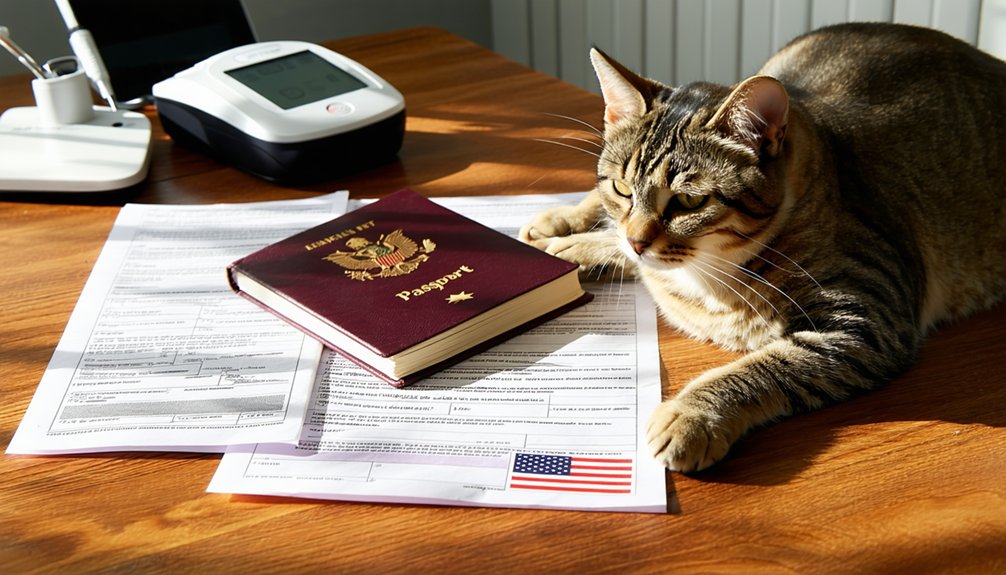
An EU pet passport is a standardized identification and health document defined in EU law for dogs, cats, and ferrets traveling between member states. It proves your pet’s identity, rabies vaccination, and compliance with EU animal health rules for non-commercial travel. Think of it as your pet’s ticket to belonging across borders—a single, reusable blue booklet recognized in all 27 EU countries and associated nations like Norway and Switzerland.
Only authorised veterinarians issue it, and passport eligibility rules require prior microchipping with an ISO-compatible transponder plus valid anti-rabies vaccination given afterward. The rabies record specifics include vaccine manufacturer, product name, batch number, vaccination date, validity period, and the vet’s signature.
Keep enhancements current, and it stays valid for life.
EU Passport vs. US Certificate Compared
Now that you know what an EU pet passport is, let’s compare it directly to how the United States handles pet travel documentation, because the two systems work in fundamentally different ways.
You’ll quickly see the EU passport’s a permanent, reusable document, while the US relies on single-use, USDA-endorsed certificates issued per trip.
Here’s what sets the two systems apart:
- Reusability: The EU passport’s a lifetime document; US certificates are single-use per trip.
- Issuance: Authorized EU vets issue passports; USDA-accredited vets and APHIS endorse US certificates.
- Validity: Passports stay valid with current rabies; certificates run 10–30 days, demanding airline document timing.
When you join EU travelers, remember breed specific rabies planning keeps your pet’s eligibility uninterrupted across every trip.
How the US Handles Pet Travel Without Passports
Although the US has no official pet passport system, that doesn’t mean your pet travels without paperwork. Instead of a single booklet, you’ll gather a bundle of stand-alone documents—health certificates, vaccination records, and microchip information—tailored to your destination, species, and route.
Three authorities guide you: the CDC handles public health and rabies control, USDA APHIS oversees animal health for imports and exports, and state agencies set local rules.
When your dog enters or returns to the US, you’ll need a CDC Dog Import Form receipt, completed online, valid for multiple entries over six months.
Don’t overlook airline document rules, since carriers may require additional health and vaccination proof.
Always verify US CDC forms and current requirements before each trip, because rules change.
Who Can Issue an EU Pet Passport?

Unlike the US patchwork of stand-alone documents, the EU pet passport comes from a single source: an authorised veterinarian. To join the community of EU pet travellers, you’ll need a vet who’s been approved under your country’s vet authorization rules. Here’s what you should know:
- Only authorised veterinarians in an EU Member State or certain associated countries (Norway, Switzerland, Iceland, Liechtenstein) can issue your passport.
- Your competent authority grants authorisation under national law, ensuring member state supervision keeps every issuer compliant.
- Non-EU vets in the US or GB can’t issue a valid EU passport.
In practice, most practising small-animal vets qualify once they’re registered as pet-passport providers.
Some states also involve official veterinary authorities or veterinary universities, so you’ll always find a trusted issuer nearby.
What Goes Inside the Pet Passport Booklet
Every EU pet passport packs a standardized set of records into one compact booklet, and knowing what fills its pages helps you enhance your pet travel-ready.
The booklet data fields start with your pet’s identification: species, breed, sex, coat color, birth date, and a unique passport number.
You’ll find microchip or tattoo details, plus your full owner information for traceability.
Identification photo rules stay optional—some formats include a 50×50 mm photo area, but entry doesn’t require it.
The rabies section demands required veterinary verification: vaccination dates, batch numbers, and boosters, all confirmed after microchip implantation.
You’ll also see non-rabies vaccines, parasite treatments, and country-specific tapeworm entries.
Official stamp placement matters too—each entry needs your vet’s signature and stamp beside it, preserving validity for lifetime use.
How Pet Travel Works Within the EU
When you travel within the EU, your pet passport does the heavy lifting—it lets dogs, cats, and ferrets move between all member states without quarantine, provided you’ve met the core requirements. You’re free to roam, but you’ll want to stay prepared:
- Border checks random: Officials can verify your passport, microchip, and rabies entries on air, sea, and some land crossings—even within Schengen.
- Pet limit: You can bring up to five pets per person for non-commercial movement; beyond that, competition documentation applies.
- Carrier welfare refusal: Transporters may turn away visibly unwell animals, so your pet must be clinically healthy and fit to travel.
Meet these conditions, and you’ll belong to the seamless community of EU pet travellers.
Pet Passport Microchip and Rabies Timing Rules

Because order matters more than you might expect, the EU structure hinges on one non-negotiable rule: microchip first, then rabies vaccination. You need an ISO 11784/11785, 15-digit, non-encrypted chip implanted before any rabies shot, or that vaccination won’t count and must be repeated. Once you’ve nailed vaccination sequencing compliance, a 21-day waiting period applies before the primary vaccine becomes valid for travel.
| Step | Requirement |
|---|---|
| 1. Microchip | ISO 15-digit, non-encrypted |
| 2. Rabies vaccine | Given after chipping, age 12+ weeks |
| 3. Waiting period | 21 full days (primary) |
| 4. Documentation | Microchip location matching to passport |
Your EU passport must show the chip number, implantation date, and location, so officials can confirm your pet belongs to its documents at every border.
How Long Your Pet Passport Stays Valid
Once you’ve sorted out the microchip-then-rabies sequencing, you’ll want to know how long your paperwork actually holds up. Your validity depends on where you’re traveling from and whether your pet’s health info stays current.
Unlike US pet registration systems, the EU ties everything to your rabies record, not a fixed expiry date. Here’s how the travel timeline differences break down:
- Inside the EU: Your pet passport stays valid for life, as long as the rabies vaccination remains in date.
- From outside the EU: You’ll need a health certificate, issued within 10 days of arrival, valid for 6 months onward.
- From Great Britain: You’ll need a new animal health certificate for every single trip.
Keep your vaccinations current, and you’ll belong wherever you roam.
What You Need to Enter the EU From the US
Since the EU ties entry to your pet’s health record rather than a fixed passport, you’ll need to assemble three core documents before you fly. First, your pet needs an ISO-compliant microchip (readable by 11784/11785 scanners) implanted before the rabies shot—a vaccine given beforehand won’t count.
Second, you’ll need a valid rabies vaccination, observing the rabies waiting period of at least 21 days before arrival.
Third, secure an EU Animal Health Certificate from a USDA-accredited vet, completed within 10 days of travel, followed by USDA APHIS certificate endorsement.
At EU border checks, officials verify document matching: the microchip number scanned must match your certificate exactly. Discrepancies trigger quarantine or refusal.
Complete the destination-country section accurately—including clauses for Ireland or Malta—and you’ll belong among confident, prepared travelers.
Why High-Biosecurity Countries Skip Passports
While the EU ties entry to a reusable health record, high-biosecurity nations like Australia, New Zealand, and Japan reject passport-style systems entirely.
They prioritize risk elimination over convenient documentation, reassessing each shipment through centralized permits rather than decentralized veterinarian-issued papers.
Border biosecurity here aims for zero rabies and exotic disease incursions, since even one breach threatens public health and wildlife.
Here’s what you’ll face instead:
- One-off import permits that reevaluate your animal’s risk for every trip.
- Laboratory proof of immunity, like RNATT testing, paired with mandatory waiting periods.
- Quarantine enforcement as a final barrier against clinical disease or document fraud.
You’re joining a system built on government control and traceability—one where passports simply can’t deliver the certainty these nations demand.
What Changed for UK and Non-EU Travelers
| What You Need | The New Reality |
|---|---|
| EU passport | Void for non-residents |
| AHC validity | 10 days to entry |
| Per trip | New certificate required |
| Vet endorsement | Official authority needed |
Each pet needs its own Animal Health Certificate, endorsed by an authorised vet, for every single trip. You’re not alone—every non-EU traveller faces this.
Which Documents You Actually Need for Your Route
Before you book anything, you need to know exactly which documents your specific route demands—because the requirements shift depending on where you start, where you’re headed, and who’s traveling. As a US-based traveler, you’ll rely on the EU Animal Health Certificate (AHC), not a Pet Passport, for each trip.
Here’s what your route-specific certificates require:
- Core documents: ISO-compliant microchip, valid rabies vaccination certificate, the AHC with accredited vet endorsement (USDA-validated), and your written declaration of non-commercial movement.
- Titer test: a rabies antibody titration report if you’re entering from a non-listed country.
- Destination extras: *Echinococcus* (tapeworm) treatment documentation for Ireland, Malta, or Finland.
Match every detail to your itinerary, and you’ll cross borders confidently—right where you belong.
Frequently Asked Questions
How Much Does an EU Pet Passport Typically Cost?
You’ll typically pay €10–€30 for the passport booklet itself, though with microchip and vaccination fees, your total runs €50–€120. Border control costs vary by route, so join fellow travelers budgeting €15–€70 across EU clinics.
Can Birds or Rabbits Get an EU Pet Passport?
No, you can’t get an EU pet passport for birds or rabbits—it’s reserved for dogs, cats, and ferrets only. Under EU bird rules and rabbit passport requirements, you’ll need national health certificates instead.
What Happens if My Pet Passport Is Lost?
If you’ve a lost passport, you can replace it through an authorized vet. While there aren’t EU-wide emergency procedures or temporary travel documents, you’ll get a new passport once your rabies vaccination and microchip records match.
Are Emotional Support Animals Exempt From Pet Travel Rules?
No, you’re not exempt. US ESA rules and EU limitations treat your animal as a pet, so you’ll meet identical proof requirements—microchip, rabies vaccination, verification documents like health certificates—just like everyone else traveling with companions.
Can I Travel With Multiple Pets on One Passport?
No, you can’t. Comparing individual pet vs single travel document rules, each pet needs its own passport. EU microchip requirements per pet mean every animal’s chip must match its document, so you’ll need separate passports for all.
Conclusion
Now you know the system isn’t one-size-fits-all. If you’re traveling within the EU, that passport booklet’s your best friend—it stays valid for life as long as your pet’s rabies vaccination’s current. If you’re coming from the US, you’ll rely on USDA-endorsed certificates instead. Check your specific route’s requirements early, because microchipping, rabies timing, and titer tests can’t be rushed. Plan ahead, and you’ll cross borders without a hitch.
References
- https://www.aphis.usda.gov/pet-travel/another-country-to-us-import/pet-passports-european-union
- https://dogtripguide.com/blog/pet-passport-international-travel-guide/
- https://www.cnn.com/travel/article/pet-passports-international-travel-guide/index.html
- https://europa.eu/youreurope/citizens/travel/carry/pets-and-other-animals/index_en.htm
- https://www.acrossthepondpet.com/resources/blog/128-the-complete-guide-to-pet-passports-in-2025-requirements-for-uk-eu-and-us-travel
- https://petabroad.eu/pet-travel-usa/
- https://www.nerdwallet.com/travel/learn/passport-for-pets
- https://www.0xcargo.com/post/the-eu-pet-passport-what-it-is-and-what-it-definitely-isn-t
- https://www.facebook.com/groups/1180884898968404/posts/3089334638123411/
- https://patifyapp.com/en/content/detail/pet-passport-myths-what-it-covers-and-what-it-doesnt-2026