Choose an inverter generator that runs at 50–55 dB or lower to shield your anxious dog from startle triggers like fireworks. Remember that ratings assume a 23-foot measuring distance, so placing the unit closer raises real exposure. Stay well below 85 dB to protect your dog’s hearing. Steady, low-level hum masks unpredictable spikes, reducing barking, pacing, and whining. Pick variable-speed eco-mode and 8-hour runtime for overnight coverage. The right setup makes all the difference.
TLDR Key Takeaways
- Target a generator rated 50–55 dB or lower, ideally near 40 dB, since standard portables at 70–80 dB exceed comfort.
- Check that published ratings are measured at 23–25 ft, because placing the unit closer raises real noise exposure above the listed rating.
- Choose inverter models with clean sine-wave output, low harmonic distortion, and variable-speed eco-mode that reduces RPM and noise at partial loads.
- Pick enclosed “suitcase” housings, which run 10–20 dB quieter than open-frame units, and add 20–25% load headroom to prevent noisy cycling.
- Place the generator 20+ feet from the dog’s resting area, aim exhaust away, and introduce it gradually at low volume paired with high-value treats.
How a Generator Calms an Anxious Dog
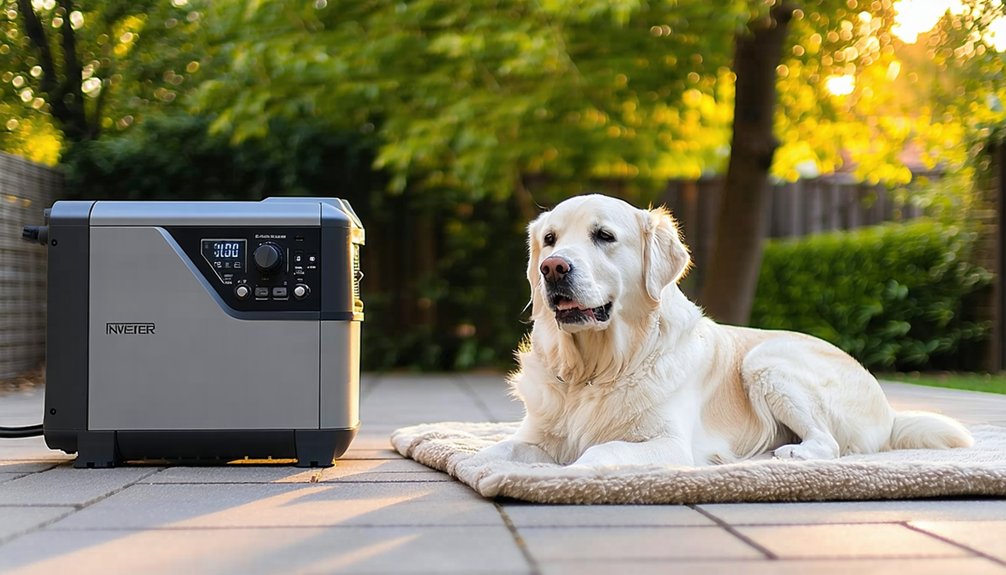
Picture your generator’s steady hum as a sound shield for your dog. That constant, low-level noise works like white noise, masking the sudden fireworks, traffic, and slamming doors that trigger startle responses.
You’ll notice less barking, pacing, and whining as those unpredictable acoustic peaks fade into the background. Research shows this steady sound promotes a stable heart rate and reduces vigilance, signaling lower arousal in sound-sensitive dogs.
You’re not alone in wanting calm. Build noise predictability routines by running your generator at consistent times, so your dog learns to associate that hum with safety.
Pair it with safe space scent pairing—familiar smells, soft bedding, and favorite toys—and you’ll create a cocoon that buffers external triggers, helping your dog truly settle and feel secure.
What Counts as Quiet for Sensitive Ears
That calming hum only works if it stays in the right range, so let’s define what “quiet” actually means for sensitive ears.
Aim for a quietness target range at or below 50–55 dB measured at 23–25 ft.
That decibel measurement distance matters: published ratings assume you’re standing 23–25 feet away, so placing the unit closer pushes real exposure well above the number you see.
For noise rating accuracy, trust inverter generators tested in the 48–60 dB band, and treat 40 dB as genuinely “very quiet,” like a soft library.
Standard portables at 70–80 dB blow past dog comfort thresholds entirely.
If you want your companion settled and feeling safe alongside you, target sub-55 dB and respect that measurement distance honestly.
How Loud Is Safe for Your Dog’s Ears?
While 50–55 dB keeps your dog calm, a separate question is what actually protects their ears from harm.
Understanding dog hearing limits helps you draw a firm line.
Sound at or below 70 dB shouldn’t cause measurable hearing loss over a lifetime, but trouble starts climbing fast above that.
Most sources flag 80–85 dB as the practical upper limit, where discomfort and damage risk begin.
Above 90 dB, sustained exposure can erode hearing over time, and 120 dB—think fireworks or gunshots—threatens permanent injury.
Quiet Operation and Stable Output to Look For
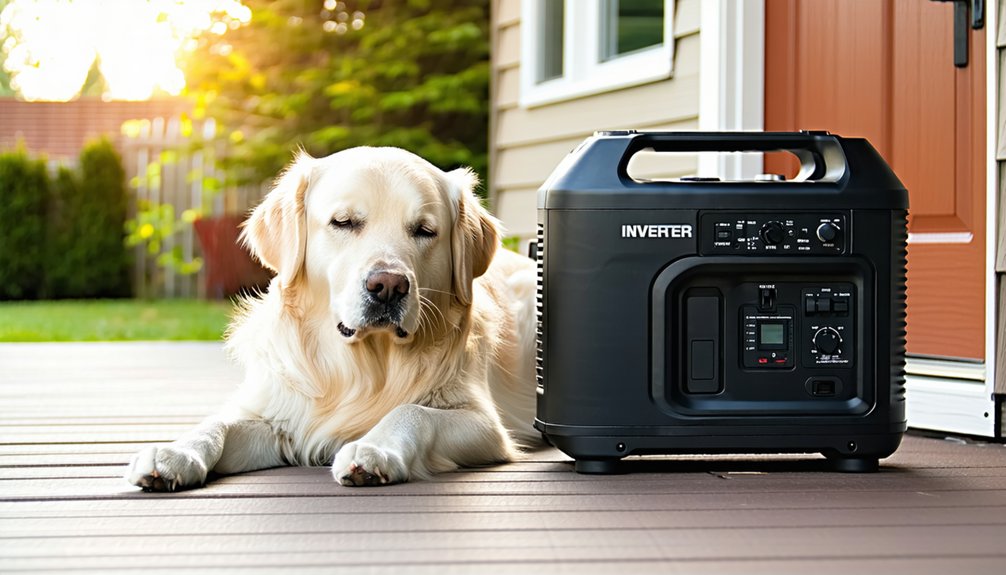
Because a generator’s noise profile depends as much on its engineering as its decibel rating, you’ll want to scrutinize how a unit produces and delivers power.
Start with a Silent Inverter Design: electronic inversion creates clean sine-wave AC with total harmonic distortion at or below 3–5%, sparing your dog the buzzing, flickering, and irregular appliance behavior that unsettle a quiet room.
Variable-speed eco-mode engines adjust RPM to match load, cutting noise at partial loads, while enclosed “suitcase” housings run 10–20 dB quieter than open-frame rivals.
Prioritize Low Ripple Output and automatic voltage regulation to avoid micro-surges that trigger sudden compressor noises or relay clicks.
Size for 20–25% headroom, too, so you prevent overload, RPM hunting, and the noisy cycling anxious dogs notice immediately.
Runtime You Need to Cover Fireworks Night
When fireworks rattle your dog, the disturbance rarely stops the moment the last shell fades, so you’ll want runtime that covers the entire stress window—pre-show buildup, the peak, and the wind-down. Aim for at least 8 hours at 50% load for overnight coverage, giving you margin for setup delays and post-event settling.
Three priorities guide smart fireworks schedule planning:
- Load measurement basics: Match the generator to actual wattage, since published runtimes assume 25% or 50% load, not full output.
- Fuel tank strategy: Choose a single-tank runtime of 8+ hours, because larger tanks extend coverage without midnight refills.
- Refueling interruption avoidance: Never refuel during active noise—it creates a fresh disturbance.
Start early, fuel fully, and your dog stays calmer alongside you.
Best Generator Sounds for Masking Dog Anxiety
Although your generator already hums in the background, you can pair it with the right masking sound to blunt the fireworks your dog dreads.
White noise stands out as the most consistently recommended option because its broad range creates anxiety trigger overlap, covering fireworks, thunder, and traffic.
If you prefer a calmer texture, nature recordings like ocean waves work too.
Choose loop-free playback so audio gaps don’t re-alert your dog, and start at a low volume before increasing gradually.
Place the sound near your dog’s resting area for sound diffusion benefits, concentrating coverage where anxiety strikes hardest.
Match masking strength to the trigger—storms and fireworks demand more than household noise.
When you get this right, you’ll give your dog the steady, reassuring refuge they deserve.
Why Brown Noise Beats White Noise for Storms
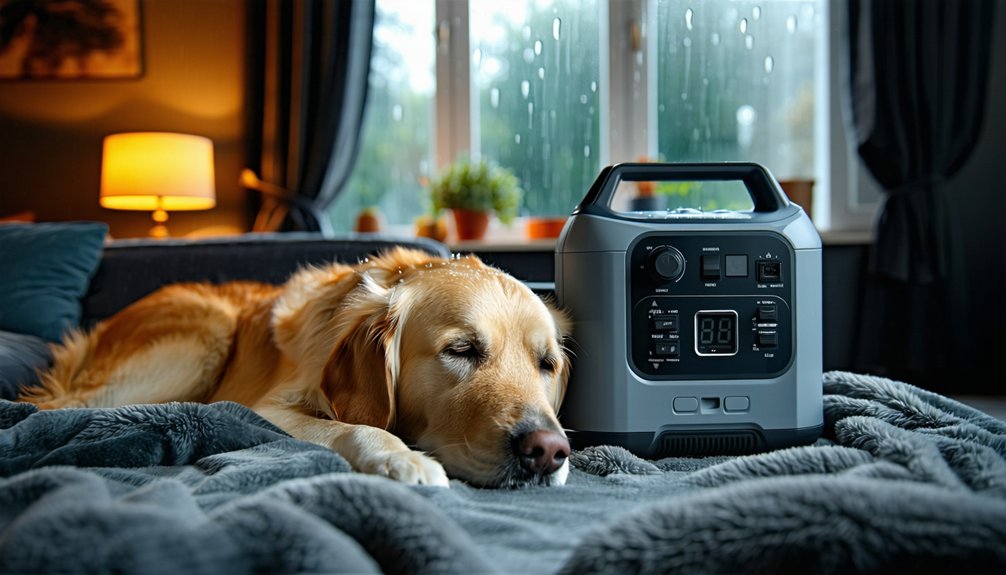
Thunder is a low-frequency sound, and that’s exactly why brown noise outperforms white noise as a storm mask. Brown noise carries the most low frequencies of any noise color, so it sits acoustically closer to thunder—making thunder salience reduction far more effective. White noise, weighted toward high frequencies, simply can’t cover those rumbles as well.
Here’s why brown noise wins for storm sound phobia triggers:
- Strongest low-frequency masking, matching thunder’s profile and dampening its intensity.
- Calming, versatile coverage, ideal as a constant background during storms.
- Better foundation for training, supporting gradual counterconditioning and treat based reinforcement.
You’re not alone in this—pair brown noise with treats, keep the volume safe, and watch your dog’s fear ease.
Where to Place the Generator Near Your Dog
Brown noise calms your dog only if the generator producing your backup power doesn’t add its own stress and danger.
Place the unit as far from your dog’s resting area as code allows, ideally 20+ feet from doors, windows, and vents.
Never run it in garages, basements, or covered patios—exhaust safety tips matter because carbon monoxide harms dogs and people alike.
Aim the exhaust away from dog runs, dog doors, and common paths, letting prevailing winds carry fumes off.
Avoid recesses where shrubs trap exhaust.
Set it on level gravel or concrete, away from high-traffic fetch routes that double as dog stress triggers.
Use barriers if your curious companion lingers, but keep clearances open.
Thoughtful placement protects the whole family you’re keeping safe.
Set the Generator at Your Dog’s Ear Height
Measure your dog from floor to ear tip, because that height determines how much noise actually reaches their ears. This dog ear measurement becomes your reference point for positioning the generator vertically, so critical noise sources sit above rather than at ear level.
Once you’ve measured, use that number to guide three decisions:
- Raise the exhaust outlet above ear height by elevating the generator 30–50 cm, projecting sound over your dog instead of into their ears.
- Use smart sound barrier placement, keeping the barrier’s top edge 15–30 cm above ear height to force noise to diffract.
- Avoid same-height line of sight, since matching heads-on positions deliver direct exposure.
Like any caring owner, you’re protecting what matters—your dog’s comfort and calm.
How to Introduce the Generator Gradually
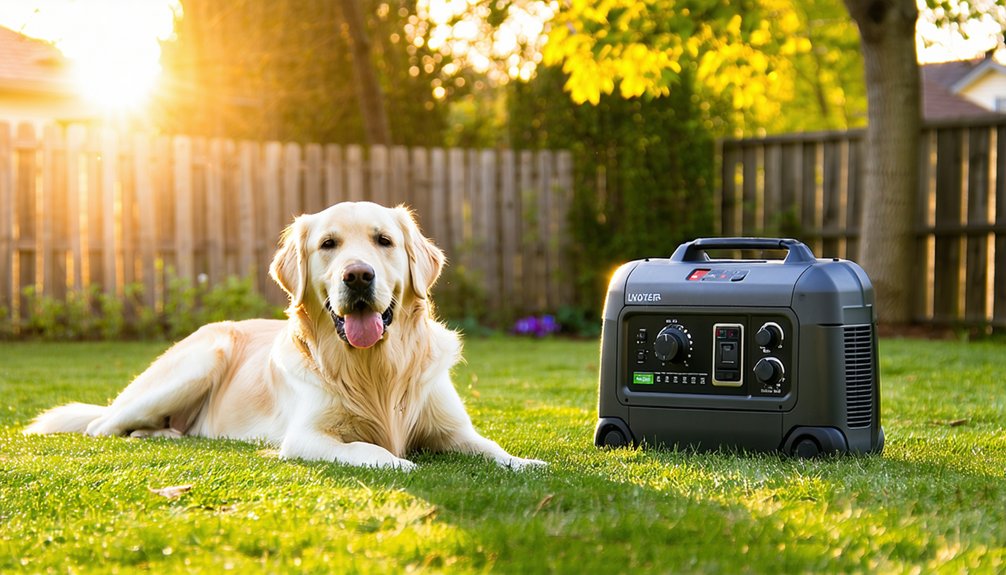
Because flooding an anxious dog with sudden loud noise only deepens fear, you’ll start at a volume so low it’s barely audible—quiet enough that no visible distress appears.
Keep early indoor practice sessions short, around five to ten minutes, and pair the sound with high-value treats.
Use brief reward timing, delivering praise the moment your dog stays calm, so the association forms reliably.
Climb a gradual volume ladder, raising the level only after multiple relaxed exposures at the current step.
Move in small increments, never large jumps, and change just one thing at a time.
Measuring stress signals matters throughout.
Watch your dog’s body language continuously, and pause, lower, or stop the moment fear appears.
End each session while your dog’s still calm, never after panic begins.
When You Need Higher Volume Temporarily
Although gradual conditioning is your long-term goal, some situations call for a temporary volume increase to mask sudden, predictable triggers. Storms, fireworks, and construction noise create spikes that startle reactive dogs, so raising ambient noise to roughly 60–70 dB helps cover them.
Use weather trigger timing to anticipate events, then apply gradual volume ramping rather than abrupt jumps that worsen anxiety.
Keep three principles in mind:
- Respect noise exposure limits—stay well below 85 dB and limit raised output to minutes or a few hours.
- Maximize distance based sound control—longer cords and barrier placement tactics reduce experienced levels while maintaining power.
- Build emergency timeout planning—use timers to step volume back once triggers pass.
You’ll protect your dog’s comfort without sacrificing necessary masking.
When a Fan or Speaker Beats a Generator
When you’re masking sudden triggers like fireworks or thunder, a fan or white-noise machine often beats a generator outright.
Here’s why: broadband sound spreads energy evenly across frequencies, creating the spectral smoothness that soothes sound-reactive dogs.
A fan’s airflow masking and a sound machine’s broadband comfort wrap your dog in a “sonic blanket,” softening the contrast between background and sudden noise.
Generators, even “super quiet” ones rated at 48–60 dB, carry tonal harshness—cyclical low-frequency hums and harmonics that anxious dogs may read as threatening.
That engine signature lacks the steady, predictable profile your dog needs to relax.
When your goal is calming rather than powering equipment, reach for a fan or speaker first.
You’ll give your companion the predictable comfort they deserve.
Frequently Asked Questions
Can I Run a Generator Indoors for My Dog?
No, never run a generator indoors—it’s deadly for you and your dog. Carbon monoxide kills silently. Keep your family safe with secure placement planning outdoors, 20+ feet away, plus noise management tips to calm anxious pups.
How Much Do Quiet Generators Typically Cost?
You’ll typically spend $350–$1,500 for quiet portable inverters, while premium Honda/Yamaha models run $2,800–$5,000. Ignore noise level myths—check shopping guides, prioritize energy efficiency, and use budgeting tips so you and your pup feel right at home.
Will the Generator’s Fumes or Fuel Harm My Dog?
Yes, fumes can harm your dog. Carbon monoxide poses serious danger, so watch for exposure symptoms like lethargy, weakness, or bright-red gums. Keep generators outdoors, several meters away, and you’ll protect the companion you love.
Are Inverter Generators Better Than Conventional Ones for Pets?
Yes, you’ll find inverter generators better for pets. Inverter noise reduction runs around 48–60 dB versus 70–85 dB in conventional generator comparison—roughly 20 dB quieter. That steadier, softer sound won’t trigger your anxious dog’s stress.
Can I Leave the Generator Running While I’m Away?
You shouldn’t. Most manuals warn against unattended operation, and carbon monoxide safety demands you follow ventilation guidelines while supervising. Like responsible owners everywhere, you’ll protect your pet, neighbors, and home by staying nearby and monitoring closely.
Conclusion
You’ve got the tools to protect your dog and keep the peace. Choose an inverter generator rated under 60 decibels, confirm stable output, and secure enough runtime to outlast the fireworks. Position it at your dog’s ear height, introduce it gradually, and reserve higher volumes for true emergencies. When white noise alone will do, a fan or speaker often wins. Match the solution to your dog’s needs, and you’ll both rest easier.
References
- https://topdogtips.com/best-white-noise-machine-for-dogs/
- https://equilibriumpet.com/products/pet-calming-sound-machine
- https://babyshusher.com/products/doggie-shusher-portable-dog-calming-machine
- https://www.akc.org/expert-advice/home-living/white-noise-machines-for-dogs/
- https://creators.spotify.com/pod/profile/brandon-reed36/episodes/Brown-Noise-Sound-Machine-for-Dogs-12-Hours—Reduce-Anxiety–Mask-Unwanted-Sounds–Promote-Restful-Sleep-e1qj5d1
- https://powerequipment.honda.com/generators/super-quiet-generators
- https://www.youtube.com/watch?v=BGJ4KCwm040
- https://www.youtube.com/watch?v=vmgmYDa_Fiw&vl=en-US
- https://www.electricgeneratorsdirect.com/power/quiet-generators.html
- https://assisi.zomedica.com/calmer-canine-science-backed-non-drug-treatment/