Never leave your dog alone in a parked van—AVMA guidance is clear, regardless of temperature or duration. Interiors can spike about 19°C in just 30 minutes. Park in shade, block western sun, and run fans plus AC set to a conservative 72–76°F. Keep cool water flowing all day, and watch for heavy panting, ropey drool, or gum changes. Heatstroke starts near 105°F. Knowing exactly how to respond next could save your dog’s life.
TLDR Key Takeaways
- Follow AVMA guidance: never leave your dog alone in a parked van, regardless of temperature or duration.
- Set AC to a conservative 72–76°F and use roof and cross-ventilation fans with backup power.
- Block sun by parking under trees and installing reflective covers on windows, windshields, and skylights.
- Provide continuous cool, clean water with ice blocks or insulated bowls and frequent refreshes.
- Use a pet temperature monitor with an upper alert at or below 75–80°F to catch dangerous heat.
What Temperature Is Too Hot for Your Dog?
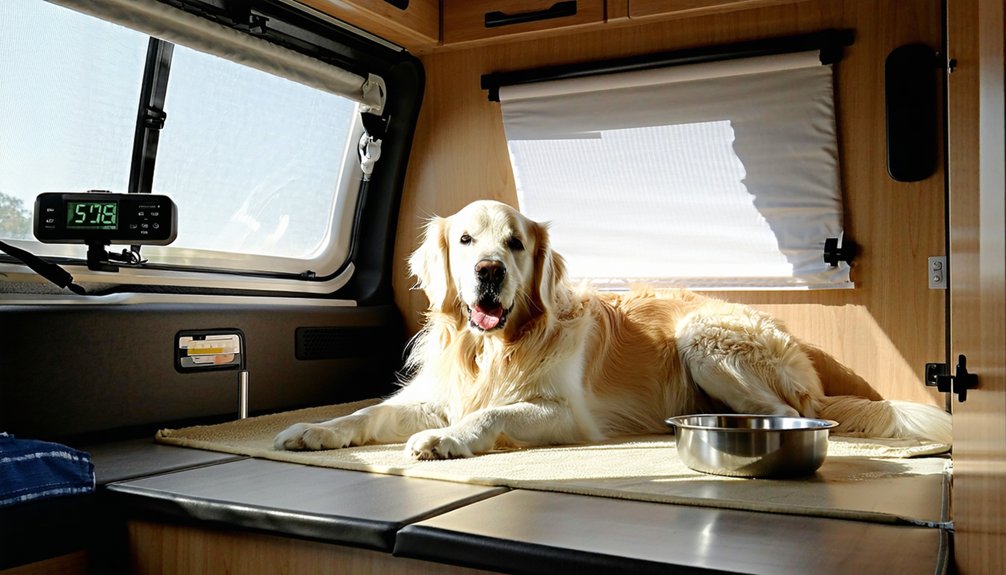
How hot is too hot for your dog? Your dog’s normal body temperature sits around 101–102.5°F, and heatstroke begins near 105°F—an emergency at 106°F and above.
Once ambient temps hit 82°F, most dogs face high overheating risk during activity; at 90°F, it’s simply too hot for extended time outdoors.
Remember the heat-index rule: when temperature plus humidity reaches 150, exertion turns dangerous.
Effective heatstroke prevention means knowing your dog, too.
Brachycephalic breeds, seniors, puppies, and dogs with thick coats or heart conditions can struggle in just 70–80°F.
Inside a parked camper van, things escalate fast—70–75°F outside can exceed 100°F within minutes.
Watch the thresholds closely, schedule frequent hydration breaks, and never assume your dog tolerates heat like you do.
When Cold Weather Puts Your Dog at Risk
Heat isn’t the only threat a parked camper van poses—cold weather can be just as dangerous, and it sets in faster than you’d expect.
A stationary van acts like a refrigerator in winter, quickly equalizing with outside air.
Cold-related stress begins around 45°F (7°C), and at or below 20°F (−6°C), all breeds face serious hypothermia and frostbite risk.
Small breeds, puppies, seniors, and dogs with health conditions feel it sooner.
Watch for shivering, lethargy, or stiffness.
Manage indoor airflow and humidity control to prevent damp bedding and chilling drafts.
Schedule warm up intervals so your dog isn’t lying on cold metal too long.
If signs don’t improve within 30 minutes of emergency warming, seek veterinary care immediately—your dog’s safety comes first.
Park Your Van in Shade and Block the Sun
Because a parked van heats up fastest when sunlight hits it directly, your first line of defense against dangerous interior temperatures is blocking the sun before it ever reaches the metal and glass.
Smart shade placement matters most: park under a group of trees or a built structure so western afternoon sun stays blocked all day.
Avoid reflective surfaces like water, concrete, or pale walls, which bounce extra radiant heat into the van.
Deploy your awning and shade sails to shield exposed panels and ground.
Inside, prioritize window blocking by closing blinds and installing reflective covers on windshields, side windows, and skylights.
Position the van so fewer windows face the sun.
Combined with ventilation and evaporative cooling, these steps keep your dog—your trusted companion—safe and comfortable.
Set Up Fans, AC, and Backup Power
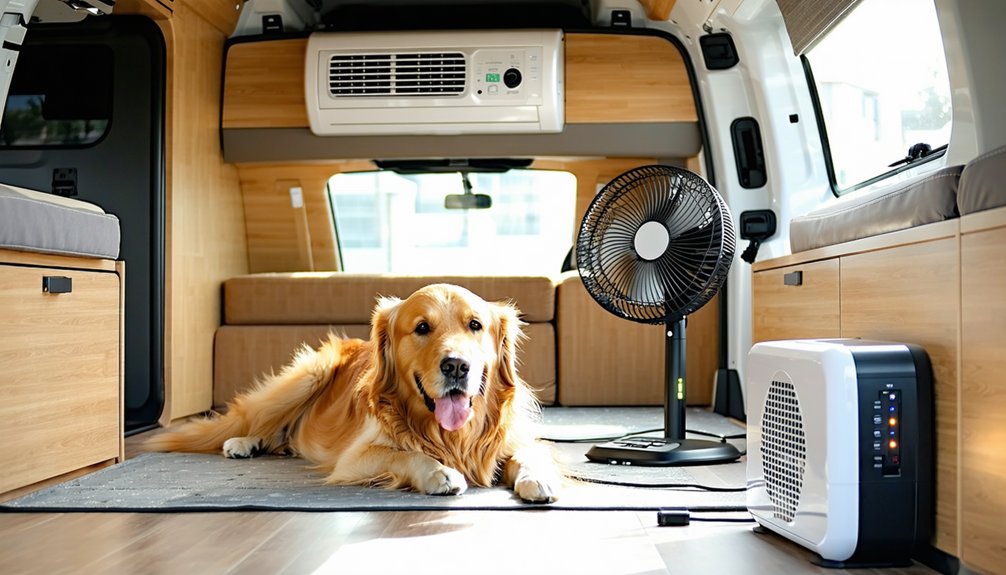
Three systems—fans, air conditioning, and backup power—work together to keep your van’s interior safe while you’re away. Install a roof vent fan near the center or rear, then add a second fan for cross-ventilation, creating a clear airflow path.
Use 12V fans with Fan Speed Control so you balance airflow, noise, and power draw, and position a low vent so cooler air reaches your dogs at rest. Size a rooftop or mini-split AC to your van’s volume, run it 15 minutes before leaving, and set conservative Thermostat Guardrails (72–76°F) for a safety margin.
Calculate continuous draw, convert to amp-hours, and add a 25–50% buffer. Connect AC and fans to multiple power sources, install a transfer switch, and size your inverter for startup surge.
Keep Cool, Fresh Water Available All Day
Dogs always need continuous access to cool, clean water, and that’s especially true in a parked camper where temperatures climb fast.
As your dog pants to stay cool, fluid loss rises, pushing daily needs above typical maintenance levels (often >50–60 ml/kg/day).
Keep water cool by adding ice blocks, using insulated bowls, and placing them in shaded, well-ventilated spots away from sunny windows and hot metal walls.
Refresh the water several times daily—warm, stale water tastes off, so your dog drinks less when it matters most.
Set out two or more spill proof bowls in different locations, and keep backup jugs for quick refills.
Make hydration monitoring part of your routine, checking levels often so your companion stays safe, comfortable, and properly cooled throughout the day.
How Long Can You Safely Leave Your Dog?
Fresh water buys you time, but it won’t stop a parked camper from becoming a death trap. The American Veterinary Medical Association says never leave your dog alone in a parked vehicle, regardless of temperature or duration. Even with cooling and monitoring, you’re playing a dangerous game—interiors climb ~19°C in just 30 minutes.
Like the rest of us who love our pups, you want clear limits:
- Cool weather (≤18–20°C): Limit absences to a few hours, max.
- Moderate (20–24°C): Stay under 1–3 hours.
- Warm (24–27°C): Keep it well under an hour.
- Hot (>27°C): Don’t leave your dog at all.
- Overnight: Never—power loss is fatal.
Make frequent ventilation checks, and remember wind shifts can shrink minutes into seconds.
Set a Pet Temperature Monitor for Alerts
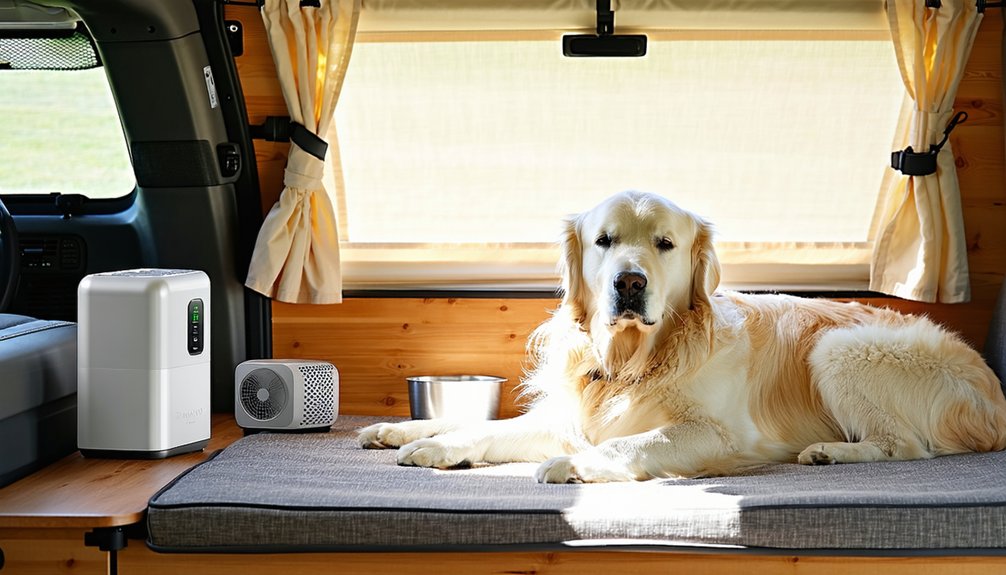
Because mechanical cooling can fail without warning, you need a pet temperature monitor as your backup eyes inside the van.
Choose a device with customizable alert thresholds, setting an upper alert at or below 75–80°F and a lower alert around 35–40°F.
Go cooler for brachycephalic breeds, seniors, puppies, or dogs with cardiac issues.
Sensor placement matters: position it at your dog’s level, away from sunlight, windows, and vents, so readings reflect real ambient conditions.
Enable humidity monitoring, since humidity stress worsens canine heat risk even at moderate temperatures.
Before leaving, do thorough connectivity testing—verify cellular or Wi-Fi signal at your campsite and confirm test alerts arrive via SMS, email, and app.
Enable multiple recipients and power-loss alerts.
You’re never truly away when you’re watching together.
Tell a Neighbor Before You Walk Away
While monitors and cooling systems give you data, a real person watching your van gives you a response.
Before you walk away, leave a written note on your window stating “dog inside,” your return time, and a request for a welfare check.
Post your emergency contact list—mobile number, lot number, and campground office line.
Give your neighbor clear stepwise instructions on what to do if your dog shows distress, and consider leaving spare key access under a written agreement.
- You’re trusting someone to protect what matters most to you.
- A quick conversation could save your dog’s life.
- Neighbors become family when they’re watching your back.
- One barked alert means someone cares enough to act.
- You’re never truly alone in a caring campground community.
Spot the Early Signs of Heatstroke
How quickly heatstroke takes hold depends on you catching the first signs. Watch the breathing clues first: panting that turns faster, louder, or harsher than usual, often with a wide-open mouth and fully extended tongue.
Check gum color for early heatstroke detection—bright red, dark red, or pale gums signal circulatory trouble, while dry, tacky gums point to dehydration.
Notice behavior shifts: restlessness, pacing, whining, or an inability to settle, which can flip to lethargy and reluctance to move as things worsen.
Drooling changes matter too—saliva that thickens, ropes, or foams tells you overheating’s escalating.
Your dog might also seek cool surfaces, pressing against vents or the floor.
Spot these subtle warnings before collapse, and you’ll act while it still counts.
Move Your Dog Out of the Heat Fast
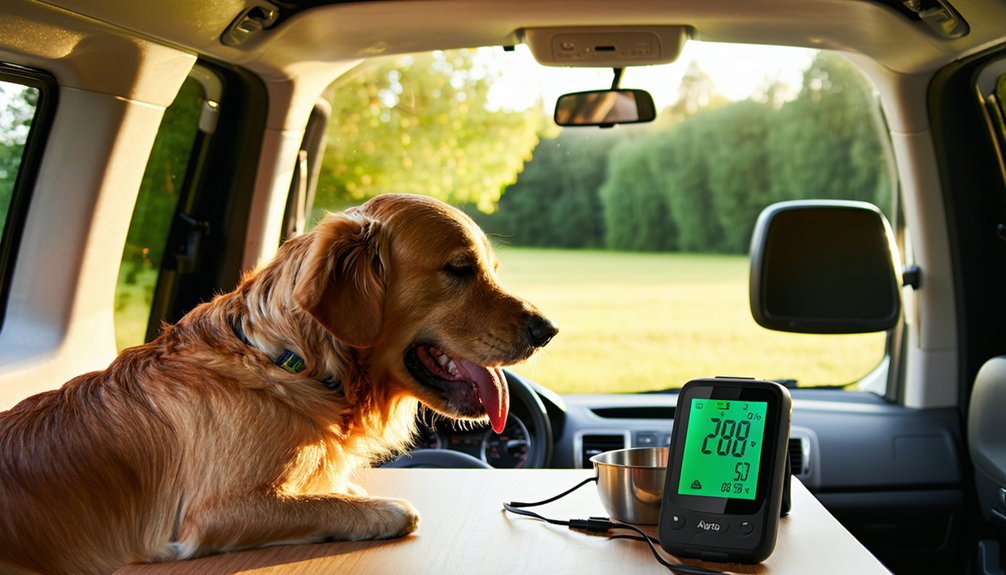
Act the moment you spot trouble: get your dog out of the van immediately. Interior temperatures climb fast, even in shade with windows cracked, so don’t wait. Move your dog to the nearest cool, shaded, well-ventilated spot—or better, an air-conditioned building or vehicle. Effective crisis priority planning means you’ve already arranged your destination and identified an emergency vet before the heat hits.
Choose shade plus airflow and water access—never direct sun.
Take the shortest path to cooling or veterinary care.
Use a secured crate or crash-tested fitting during transport.
Arrange an immediate safe handoff to a trusted person or staff.
Never leave your dog unattended in the receiving vehicle.
If your dog’s condition worsens, contact a veterinarian instantly while continuing to cool.
Cool Your Dog Down the Right Way
Once you’ve moved your dog out of the heat, you need to cool them down correctly—and that means avoiding common mistakes that can do more harm than good. Apply cool—not icy—water to the belly, paws, chest, and inner thighs, since very cold water triggers vasoconstriction that traps heat. Use evaporative towel cooling on the groin, stomach, and neck, then position a fan to enhance efficiency. Offer portable water bowls with a few ice cubes to encourage steady drinking and lower core temperature.
| Method | Where to Apply | Why It Works |
|---|---|---|
| Cool misting | Belly, paws, thighs | Evaporative cooling |
| Wet towels | Groin, chest, neck | Safe heat transfer |
| Gel pads | Resting body | Draws heat away |
| Portable water bowls | Mouth | Internal cooling |
| Fans | Damp fur | Speeds evaporation |
Why Ice Water Makes Heatstroke Worse
Although the claim that ice water “shocks” your dog’s system and worsens heatstroke circulates widely, mainstream medical literature doesn’t support it.
Fact-checks from Snopes and medical experts classify this as a myth, finding no evidence that cold water bursts blood vessels or triggers fatal events.
Hospitals even use chilled IV fluids to cool severe heat illness.
Cold water myths persist because very cold fluids can cause stomach cramps or vomiting, complicating care—not because temperature itself harms.
Here’s what genuinely threatens your overheated companion:
- Delayed cooling that lets dangerous temperatures climb
- Aspiration risk when your dog’s mental status is altered
- Underlying illness compounding the crisis
- Dehydration weakening recovery
- Shock from circulatory instability
You’re protecting family. Offer cool water, prioritize rapid, safe cooling.
Frequently Asked Questions
What Dog Breeds Tolerate Heat Better Than Others in Campers?
You’ll find Greyhounds, Whippets, Basenjis, and Pharaoh Hounds offer better heat tolerance for campers. Prioritize breed selection favoring low coat density, lean builds, and warm-climate conditioning. Even then, you’ll need shade, water, and ventilation—never parked-van exposure.
How Do I Acclimate My Dog to RV Travel?
Start with gradual introductions: let your pup investigate the parked RV freely, using scent familiarization from home blankets and toys. Then progress to short non-driving hangs, neighborhood loops, and longer trips—rewarding calm behavior throughout your adventure together.
Are Cooling Mats or Vests Effective for Dogs?
Yes, they’re effective—cooling mats and vests lower your dog’s surface temperature by 3–10°C. Evaporative cooling vests work best in dry air, while gel mats aid indoor cooling. Just pair them with shade, water, and ventilation.
What Should I Include in a Canine Emergency Kit?
You’ll want hydration supplies, 7–14 days of food, prescription meds with instructions, wound care, thermometer, and heatstroke first-aid items. Pack vet records, ID, photos, leash, and towels too—everything we’d trust to keep our dogs safe together.
Can I Train My Dog to Alert Me When Overheated?
You can train early heat-discomfort signals—like seeking shade breaks—but never rely on them alone. We pair this with hydration schedules, fans, and temperature alarms, since overheating impairs your dog’s responsiveness fast. Together, we keep them safe.
Conclusion
Your dog’s safety in a parked camper van comes down to preparation and vigilance. You’ve got to monitor temperatures, block the sun, run reliable cooling, and keep fresh water within reach. Watch for early heatstroke signs, and act fast if they appear—move your dog to safety and cool them gradually, never with ice water. Don’t gamble with extreme heat or cold. When you stay alert and proactive, you’ll keep your companion comfortable and protected.
References
- https://www.aphis.usda.gov/sites/default/files/ac-tech-note-temp-req-dogs.pdf
- https://blog.campingworld.com/lifestyle-activities/what-are-safe-rv-temperatures-for-your-pet/
- https://mywaggle.com.au/blogs/camping/why-you-should-not-leave-your-pets-in-a-hot-camper-van
- https://www.instagram.com/reel/DLmK4lKt1nX/
- https://agriculture.vic.gov.au/livestock-and-animals/animal-welfare-victoria/dogs/health/heat-and-pets
- https://www.humaneworld.org/en/resources/keep-pets-safe-temperature-gets-too-hot
- https://www.avma.org/resources-tools/pet-owners/petcare/pets-vehicles
- https://www.pawsandreflect.blog/p/leaving-our-dog-alone-in-our-van-safety-temperature-control
- https://www.outdoorsy.com/blog/keeping-dogs-cool-while-rving
- https://www.wanderthewest.com/threads/dog-heat-safety.10601/