Managing a reactive dog at a crowded campground starts long before you arrive. First, track her triggers—logging the provocation, distance, and setting. Then train six core skills: recall, mat settle, name response, “watch me,” loose-leash walking, and an emergency U-turn. Layer safety with crate and muzzle prep, rehearse the full setup in your backyard, and pick a low-traffic, well-vegetated site. Command the “trigger equals treats” pattern next, and you’ll keep her under threshold.
TLDR Key Takeaways
- Choose low-traffic, outer-loop or dead-end sites with natural barriers like shrubs and tree lines to block sightlines and increase privacy.
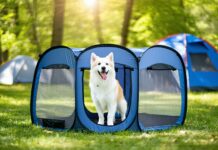
- Use layered containment—crate, exercise pen, tether, or long line—to prevent door-dashing, slipped collars, and broken tethers in camp.
- Keep your dog under threshold by increasing distance immediately at the first sign of rising arousal, moving backward or sideways.
- Apply “trigger equals treats” by starting rapid-fire, high-value feeding the instant a trigger appears and stopping shortly after it disappears.
- If a loose dog charges, “be a tree,” position your dog behind your legs, and use vehicles or tables as barriers.
Know Your Reactive Dog’s Triggers Before You Go
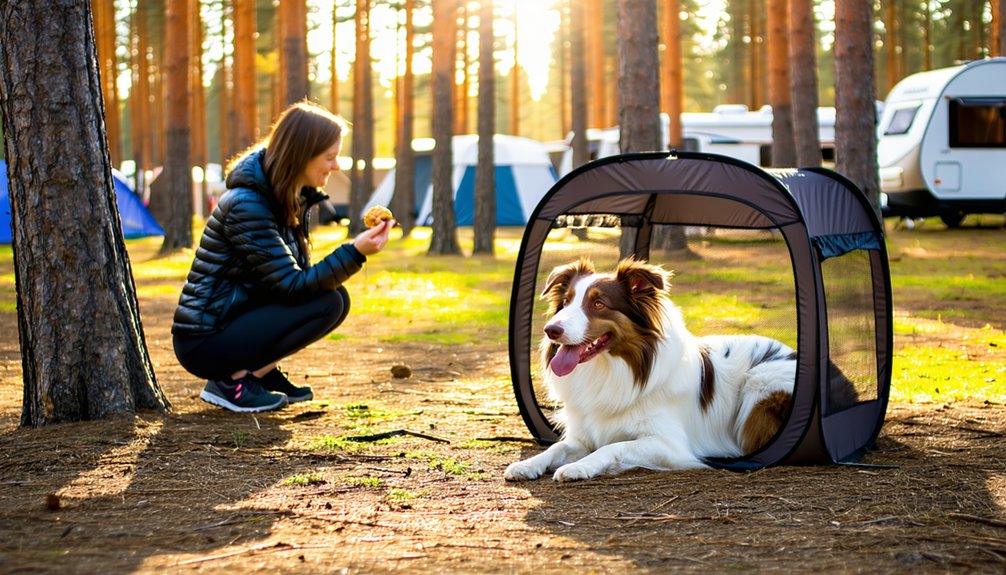
Before you pack a single bag, you need a clear image of what sets your dog off.
Most reactive dogs share predictable triggers: strange dogs in tight spaces, fast-approaching joggers, sudden loud noises like generators or slamming car doors, and moving stimuli such as bikes and skateboards.
Start trigger tracking now—log what provokes barking or lunging, the distance involved, and the setting.
This data drives your safety planning.
Pay attention to handling triggers too; collar grabs and confinement in tents amplify frustration.
Remember that pain, heat, and fatigue lower your dog’s threshold, so factor in their internal state.
Knowing these patterns lets you build distance management into every campground choice and consider leash alternatives that reduce restriction-based defensiveness.
You belong among prepared, proactive handlers.
Train These Six Skills First
Once you’ve mapped your dog’s triggers, you’ll need to build the behaviors that let you manage them in real time.
Start with a solid recall—practice long line recall in quiet spaces, then generalize to parks and trails using high-value rewards before you camp.
Next, teach a mat settle, giving your dog a portable safe zone where chews and food puzzles lower arousal.
Build focus through name response and “watch me,” pairing triggers at a safe distance with continuous treats.
Master loose-leash walking to reduce scanning and frustration, and train an emergency U-turn for quick escapes in narrow loops.
These six skills work together, and you’re not alone in needing them—every reactive-dog handler relies on this foundation to camp confidently and safely.
Why Crate and Muzzle Prep Pays Off
Although they might seem like extra gear you’ll rarely use, a crate and muzzle are two of the most useful tools you can prepare before camping with a reactive dog.
A crate gives your dog a predictable “safe den” to decompress, lowering arousal and reducing how often reactivity flares.
A muzzle, introduced through desensitization and counter-conditioning, builds positive associations that cut anxiety when you pass triggers on tight paths or at shared taps.
Together, they form layered containment that prevents door-dashing, slipped collars, and broken tethers.
Thoughtful dog comfort planning—bedding, covered crates, scheduled quiet breaks—keeps cortisol in check.
And when you’ve practiced emergency readiness drills, veterinary or injury handling stays safer and calmer.
You belong here, and so does your prepared dog.
Rehearse Camping in Your Own Backyard
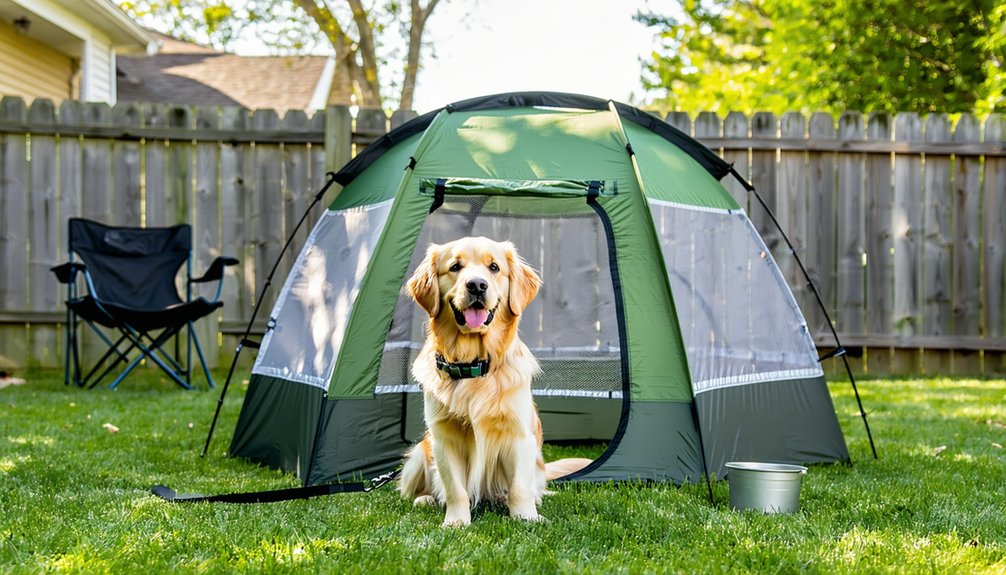
Your backyard is the best training ground you have before you ever load the car. Set up the full camp—tent, chairs, portable pen, tie-out, and lighting—so the real campground feels familiar, not novel.
Introduce sleeping arrangements over short sessions, building a positive association with the tent. Layer in camp noises gradually—zippers, gear, the air mattress pump—pairing each with high-value food for calm desensitization.
Practice gradual confinement using an exercise pen, tether, or long line, rewarding settle-on-mat behavior while your dog stays under threshold.
Add low-volume recordings of children, generators, and distant barking, and use tarps or screens to control sightlines.
Rehearse arrival, evening, and teardown routines.
You’re rehearsing the exact skills your dog needs when neighbors pass nearby.
Pick a Low-Traffic Site That Contains Your Dog
Because your site selection sets the baseline for every interaction at the campground, you’ll want to choose it with the same care you’d give any training decision.
Start with loop selection: prioritize outer-loop or dead-end loops with fewer sites, where passing pedestrians and dogs are minimal.
Favor treed, well-vegetated sites that block line of sight to roads and neighbors, lowering visual triggers.
Avoid corner sites, main roads, and walking paths, plus shared amenities like restrooms and dump stations that concentrate movement.
For real Campground Privacy, pick back-in sites bordered by natural barriers—shrubs, tree lines, embankments—facing woods or water.
Distance yourself from dog parks, playgrounds, and trailheads.
Use reservation photos, satellite views, and staff requests to secure secluded, wooded spots before you ever arrive.
Build a Physical and Visual Perimeter
Once you’ve secured a low-traffic site, the next step is to shape that space into a controlled environment your dog can handle. Start with sightline planning: clip tarps, shade cloths, or privacy screens at your dog’s eye level to block the most provocative views. Solid materials beat mesh, since partial visibility keeps arousal high.
Next, arrange your vehicle, tents, and gear into a U-shaped footprint that limits access routes and establishes clear perimeter cues for other campers. Integrate natural shields like trees or boulders where you can.
Build calm microclimates inside this footprint by covering a crate on two or three sides, creating a den-like retreat. Stock it with high-value chews and puzzles, using snack based focus to reward the relaxed behavior you want.
Set Up Leashes, Tethers, and Tie-Outs Safely

Anchor your tether to a solid, immovable object—a tree, your vehicle’s frame, or a ground stake rated for large dogs—so a sudden lunge can’t drag it loose or pull it out. Position the anchor so your dog’s radius stops 6–10 ft short of roads, fire pits, and neighboring sites. Clip the tether to a well-fitted Y-front or H-style body-strap harness, never a collar, and run swivel snap hooks at both ends.
| Component | What to Use | Safety Check |
|---|---|---|
| Line | Non-retractable cable | Emergency anchor checks |
| Attachment | Y-front body-strap harness | Harness fit verification |
| Hardware | Climbing-rated carabiner | Backup clip secured |
Walk the full 360° radius, removing sharp edges and guy-lines. Keep a short handling leash on the body-strap harness, supervise constantly, and you’ll keep everyone in your camp safe.
Use Your Car and Tent as Safe Rooms
When campground stimuli overwhelm your reactive dog, your car and tent become extremely useful retreats where she can decompress and reset.
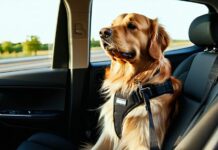
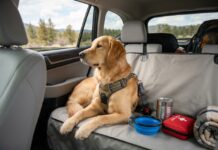
Use your car as a quiet space with water, comfortable bedding, and stimulating toys, parking it as a visual barrier facing away from busy paths.
Temperature safety planning is non-negotiable: provide shade, reflective covers, ventilation, and keep stays short.
Condition your tent at home first, rewarding voluntary entry and calm resting, then place home-scented bedding in a quiet corner away from the door.
Position your dog farthest from foot traffic, with a clear exit path for emergency escape planning when loose dogs or crowd surges occur.
Schedule decompression breaks proactively, offer long-lasting chews, and let your dog sleep near you for nighttime security.
Time Walks Around Crowds With a Reactive Dog
Your car and tent give your dog a place to retreat, but smart timing keeps her from needing one in the first place. Plan your walks around the crowd, not the clock.
Avoid the peak windows—7–9 a.m. and 4–7 p.m.—when campers, kids, and dogs flood the loops. Instead, choose mid-morning, when foot traffic thins and you can keep your dog under threshold.
Build flexibility into your routine: take quick potty breaks during busier moments, then save longer, calmer outings for quieter midday stretches. Use decompression breaks in low-stimulation spots to reset her arousal before the next segment.
Late-night walks cut traffic but demand careful visibility checks, since reduced sight lines raise handling risk. Match your timing to her needs, and you’ll both belong here.
Pair Triggers With High-Value Treats
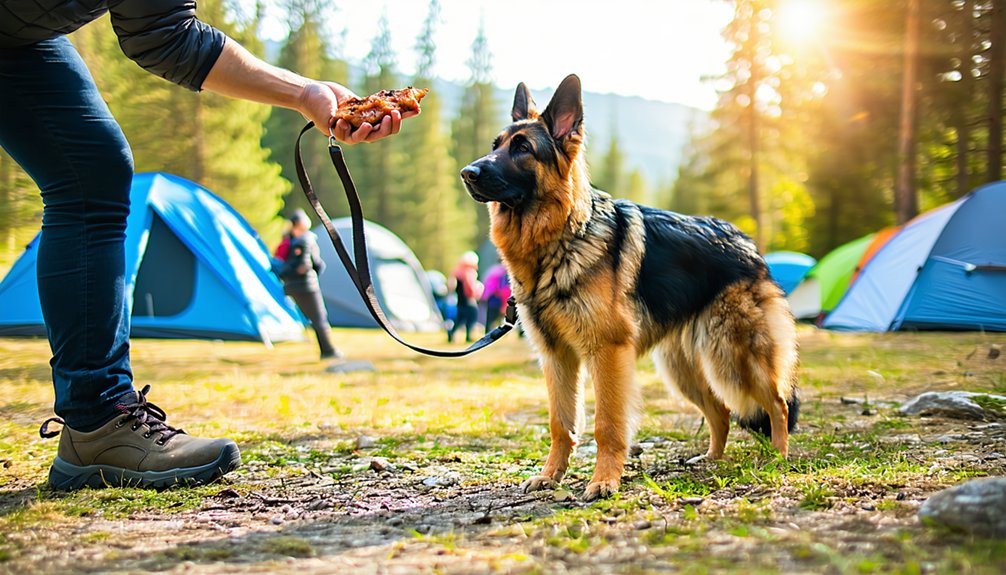
At crowded campgrounds, you can change how your dog feels about triggers by pairing each one with food she loves.
Stock high-value reinforcers—cooked chicken, cheese, hot dog slices—cut pea-sized for rapid repetition.
Smart scent selection matters here: bring two or three smelly, meat-based options, since stress can shift her preferences mid-session.
The core rule is simple: the trigger appears first, then food starts immediately.
When a hiker or another dog comes into view and your dog notices, begin rapid-fire feeding and continue while the trigger’s present.
Stop a couple seconds after it disappears, clarifying “trigger equals treats.”
Set clear trigger criteria—start where she notices without reacting.
Mark her calm glance, then treat.
Keep sessions short, and you’ll both build confidence together.
Keep Your Reactive Dog Under Threshold
Keeping your dog under threshold is the foundation of every other strategy you’ll use at a crowded campground. When you stay under threshold, your dog can actually think, learn, and respond—instead of reacting.
Distance is your primary tool here. The moment you spot rising arousal, increase space immediately, moving backward or sideways rather than letting your dog approach a trigger head-on.
This distance based calm keeps your dog regulated enough to process your cues.
Practice pre emptive cueing the instant a trigger appears, before your dog fixates or escalates. Don’t wait for the reaction—anticipate it.
Avoid peak movement windows like morning bathroom rushes, when triggers cluster. Remember, many reactive dogs simply can’t learn when they’re too close to what worries them.
Manage distance first.
What to Do When a Loose Dog Charges?
When a loose dog charges, your instinct to run or scream is exactly what you must override.
Plant your feet, “be a tree,” and keep calm—fleeing triggers the prey-drive response and skyrockets bite risk.
Recognize body language: avoid hard eye contact, keep the dog in your peripheral vision, and use a low, firm voice to deter it.
Position your reactive dog behind your legs, never scooped up, and make sure safe distance using a vehicle, tree, or picnic table as a barrier.
Stand tall, square your shoulders, and direct sharp cues like “Go away” or “Stop” at the charger.
Carry a stick or spray deterrent to minimize risk.
If knocked down, curl into a ball, protect your neck, and stay still until danger passes.
Frequently Asked Questions
How Do I Handle Nighttime Potty Breaks With a Reactive Dog?
Take a final break before bed, then use night leash checks along a predictable route. Practice quiet potty cueing at one spot, maintain campsite scent control with pet-safe cleaners, and keep backup barrier options ready for safety.
What Should I Pack in a Reactive Dog Camping Kit?
Pack for leash security with sturdy and backup options. Manage microchipping and ID tags beforehand. Bring calming treats for counterconditioning at triggers. Include backup crate for a safe den. You’ll keep your dog comfortable, confident, and connected.
Can I Bring Two Reactive Dogs Camping at Once?
Yes, you can—but you’ll need extra help. Bring roughly one adult per dog, handle them separately, and prioritize establishing secure boundaries and managing leash behavior. With strong obedience and reliable containment, you’ll succeed together.
How Long Should Our First Camping Trip Last?
Start with one night. Choosing trip duration this short lets you test your containment systems and your dogs’ responses with low risk. Once you’ve succeeded, progress to two nights, building confidence together as a team.
What Calming Supplements or Medications Work Best for Campground Anxiety?
Start with L-theanine or alpha-casozepine plus pheromone calming for milder anxiety. For severe reactivity, you’ll discuss trazodone and gabapentin timing with your vet. Bach Rescue offers gentle backup—you’re giving your dog every advantage.
Conclusion
You’ve got the tools to manage your reactive dog at any campground. Know the triggers, train the skills, and prep the crate and muzzle before you arrive. Rehearse at home, pick a contained site, and time your walks to dodge crowds. Pair every trigger with high-value treats, and keep your dog under threshold. When a loose dog charges, you’ll be ready. Stay proactive, stay calm, and you’ll both enjoy the trip.
References
- https://beyonddog.com/2019/06/29/tips-on-camping-with-the-reactive-dog/
- https://unleashedpotential.ca/camping-with-a-reactive-dog/
- https://www.youtube.com/watch?v=hKumHS_jOpw
- https://www.youtube.com/watch?v=xy-oWtnWCmI
- https://thekaspack.com/camping-with-a-reactive-dog/
- https://www.pawtal.com.au/camping-with-a-reactive-dog/
- https://www.bravodog.ca/post/camping
- https://www.aliarosewrites.com/camping-with-a-reactive-dog/
- https://www.huskymutty.com/blog/vs1np9uq56kctyjz3c81aw6mngntfu
- https://www.youtube.com/watch?v=cCi2Ku2EMIs