Picture this: you’re twelve minutes into a gorgeous trail, the view is opening up, and suddenly your two dogs are wrapped around your legs, your coffee-stained trekking pole is on the ground, and a squirrel just ruined everyone’s morning. If that scene feels familiar, you’re not alone — hiking with one well-trained dog is a manageable skill, but hiking with two or more dogs is an entirely different discipline, one that most trail guides barely touch.
- Before any multi-dog trail hike, each dog needs solid recall, loose-leash walking, ‘wait,’ and ‘leave it’ — off-leash hiking is a privilege earned through training, not assumed.
- A hands-free waist leash with a quality coupler or two independent clips works best for most two-dog handlers; true couplers suit similarly sized, well-matched dogs, while separate leashes give you more control over mismatched pairs.
- Always check the specific land manager’s rules before you go — national forests, national parks, state parks, and BLM land all treat dog numbers and off-leash access very differently.
- Match your pace and mileage to your slowest, least fit, or oldest dog, not your fastest one.
- Have a plan before you need it: injury protocol, wildlife encounter protocol, and a way to separate dogs quickly if a scuffle starts.
- Solo handlers should cap off-leash groups smaller than partnered teams — one person can only physically manage so many leashes, eyes, and emergencies at once.
Why Multi-Dog Hiking Needs Its Own Playbook
Hiking with a single dog mostly comes down to that one dog’s training, fitness, and temperament. Add a second or third dog and you’re no longer managing individual animals — you’re managing a small, dynamic pack with its own hierarchy, its own communication, and its own capacity for chaos. Leashes tangle differently. Recall becomes a competition instead of a command. And if something goes wrong — an injury, a wildlife encounter, a fight — you’re now problem-solving for multiple animals with only two hands and one brain.
None of this means multi-dog pack hiking isn’t worth it. Dogs that hike together often regulate each other’s energy, and for many owners, two dogs are genuinely easier to entertain on a long weekend than one bored dog alone at home. The key is building the right systems before you’re on a narrow switchback with a bee sting, a loose leash, and a strange dog rounding the bend.
Training Prerequisites Before You Leash Up Two Dogs
Every experienced multi-dog handler will tell you the same thing: trail problems are almost always training problems that showed up somewhere more dangerous than your backyard. Before attempting any multi-dog trail hike — on-leash or off — each dog individually should already have:
- Reliable recall under moderate distraction (squirrels, other dogs at a distance, food smells)
- Loose-leash walking without constant pulling or crossing in front of your legs
- A solid ‘wait’ or ‘stay’ that holds for at least 15-20 seconds while you manage the other dog
- ‘Leave it’ for dropped food, wildlife scat, carcasses, and other dogs’ toys or treats
- Comfortable proximity to the other dog(s) in your pack at close range without stiffening, guarding, or fixating
Pre-Hike Training Readiness Checklist
- ☐ Each dog responds to recall with at least one other dog present and moderately distracted
- ☐ Each dog walks on a loose leash for 10+ minutes without repeated correction
- ☐ Each dog holds a ‘wait’ while you attend to gear or the other dog
- ☐ You’ve practiced clipping/unclipping both dogs quickly in a low-stakes environment (driveway, yard)
- ☐ You’ve tested your leash system on a short, easy local trail before attempting anything remote
- ☐ Dogs have hiked together on-leash at home turf with no guarding or escalation issues
If any box is unchecked, that’s not a hike-cancelling problem — it’s simply information telling you to keep both dogs on separate, individual leashes and skip off-leash sections until training catches up.
Leash Systems: Coupler vs. Double Leash vs. Two Separate Leashes vs. Hands-Free Waist Leash
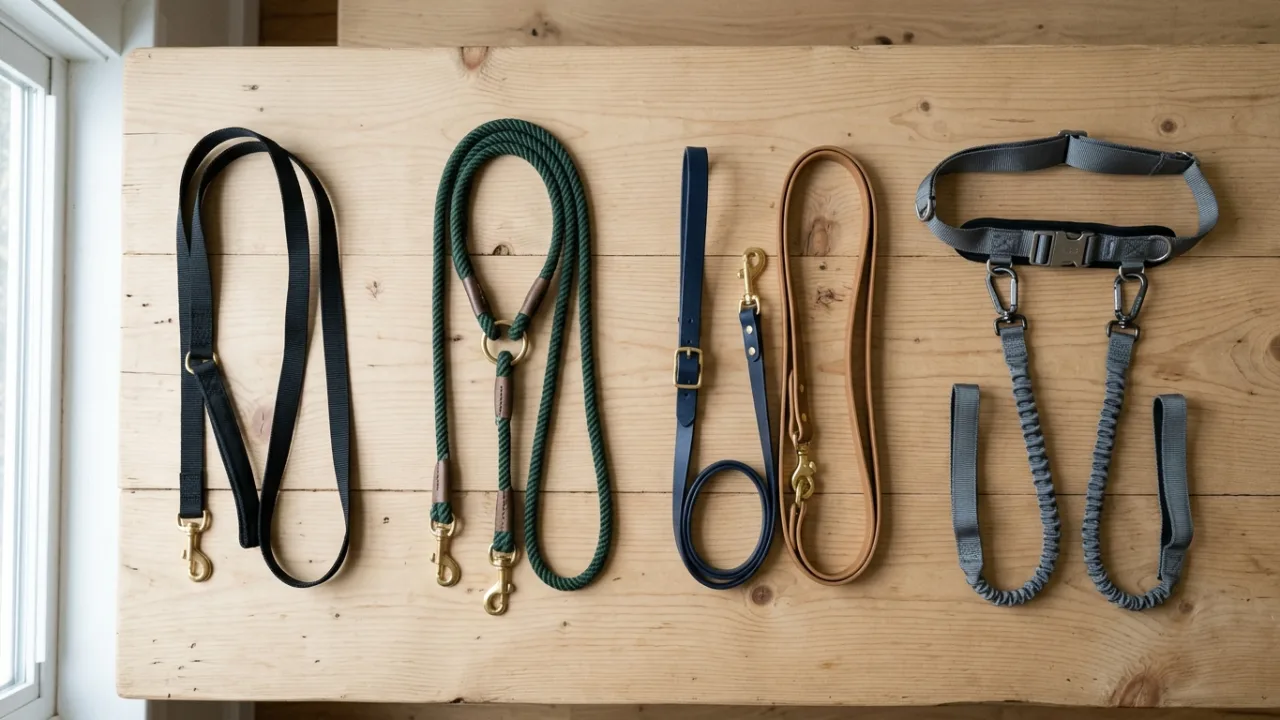
This is the single biggest logistical question in multi-dog pack hiking, and the answer depends heavily on your dogs’ sizes, temperaments, and how much they mirror each other’s movement. There’s no single correct system — but there is a correct system for your specific pack.
| System | Pros | Cons | Best For |
|---|---|---|---|
| Coupler (single leash splitting to two clips) | Prevents tangling between the two dogs; frees one hand somewhat; lightweight | Both dogs pull as one unit — hard if sizes or paces differ; a strong lunge from one dog yanks the other | Two similarly sized, similarly paced dogs with solid leash manners |
| Double-dog leash (two leashes on one handle, no coupler point) | More independent movement than a coupler; still one-handed | Can still cross and tangle around your legs on narrow trail; less control on steep terrain | Well-matched pairs on wide, flat, low-distraction trails |
| Two separate leashes (one per hand) | Maximum independent control; easiest to manage a sudden lunge from one dog | Uses both hands — no free hand for poles, water, or gear; higher tangle risk between dogs and your own legs | Mismatched sizes/temperaments, reactive dogs, technical terrain |
| Hands-free waist leash (belt with 1-2 attachment points) | Both hands free for poles, scrambling, or gear; better balance on uneven ground; shock-absorbing models reduce jolt | A strong pull can affect your balance directly; not ideal for dogs still learning loose-leash skills | Well-trained dogs, experienced handlers, technical or long-mileage trails |
A Real-World Setup That Works
Many experienced two-dog hikers land on a hybrid: a padded waist belt with two independent bungee-style leash lines clipped to front-clip harnesses, rather than a rigid coupler. This setup gives each dog its own shock-absorbing line — so one dog lunging at a chipmunk doesn’t yank the other off its feet — while still keeping both hands free for trekking poles or a water crossing. The key upgrade over a basic coupler is the swivel point at the waist, which stops the lines from twisting into a knot behind your back every time the dogs switch sides.
How Many Dogs Can You Legally Hike With?
This is where a lot of hikers get caught off guard — the rules are not the same everywhere, and land managers enforce them differently depending on the trail, the season, and whether it’s designated wilderness.
| Land Manager Type | Typical Leash Rule | Typical Group/Number Rules |
|---|---|---|
| National Park (NPS) | Often prohibits dogs on backcountry trails entirely; where allowed, typically requires a 6-foot leash at all times | Varies by park — check the specific unit; many parks restrict dogs to campgrounds, roads, and paved areas only |
| National Forest (USFS) | Generally more permissive; off-leash under voice control is common on multi-use trails unless posted otherwise | No universal per-person dog cap, but large stock/pet parties may trigger group size limits in designated wilderness |
| State Park | Usually requires a leash (commonly 6-8 feet); rules vary significantly by state | Some states cap the number of dogs per visitor on shared trails; check the specific park’s regulations |
| BLM Land | Often similar to national forest — leash optional under voice control on many multi-use trails | Few explicit per-person dog limits, but local field office rules can vary |
| Local/Municipal Trail | Almost always requires a leash, frequently capped at 6 feet | Some municipalities cap dogs per walker at two or three; ordinances vary by city and county |
Because these rules genuinely change by land unit and even by season (fire restrictions, wildlife closures, nesting periods), the only reliable move is to check the specific trail’s current regulations before you go — a quick call or website check to the ranger district, park office, or municipal parks department. Don’t assume last year’s rules, or the rules from a different trail system entirely, still apply.
Matching Pace, Fitness, Age, and Size Across Your Pack
One of the most common multi-dog hiking mistakes is planning a route around your fittest, youngest dog and expecting the others to keep up. A hike is only as successful as its slowest, least conditioned, or oldest participant — human or canine.
| Dog Profile | Suggested Difficulty | Suggested Mileage (day hike) | Notes |
|---|---|---|---|
| Young, athletic, well-conditioned | Moderate to strenuous | 6-10+ miles | Still build up gradually; growth plates in large-breed puppies need protection until fully mature |
| Adult, average fitness | Easy to moderate | 3-6 miles | Build endurance over weeks before attempting longer routes |
| Senior or arthritic | Easy, flat, shaded | 1-3 miles | Watch for stiffness after rest breaks; shorter, more frequent hikes beat one long push |
| Brachycephalic (flat-faced) breeds | Easy, cool weather only | 1-3 miles | Heat and airway stress risk is significantly higher regardless of fitness level |
| Small breed / short legs | Easy to moderate | 2-5 miles | Rocky scrambles and deep water crossings are proportionally much harder for small dogs |
When your pack includes dogs from more than one category, plan the entire hike around the most limited dog. It’s genuinely kinder — and safer — to under-hike a fit dog than to over-hike a struggling one miles from the trailhead.
Multi-Dog Gear Checklist
Packing for two or more dogs isn’t just doubling one dog’s kit — group gear like a first-aid kit can be shared, but consumables and safety equipment need to scale per dog.
| Item | Quantity | Purpose |
|---|---|---|
| Well-fitted harness (front-clip or no-pull) | 1 per dog | Control without neck strain; better than collar-only for pulling dogs |
| Leash or hands-free waist system | 1 system for the group, or 1 leash per dog | Core control system — see comparison table above |
| Collapsible water bowl | 1 per dog (or 1 shared if dogs don’t guard resources) | Prevents guarding conflicts and speeds up water breaks |
| Water | Scaled per dog weight — see ration table below | Hydration, especially in heat or at elevation |
| Dog backpack (optional) | 1 per dog, sized to the individual dog | Lets fit, healthy dogs carry their own water/food (see weight guidance below) |
| First-aid kit | 1 shared kit, sized for the group | Include vet wrap, tweezers, antiseptic wipes, styptic powder, and a spare leash |
| Waste bags | Extra per dog | Trail etiquette and Leave No Trace compliance |
| ID tags + GPS/tracking collar | 1 per dog | Critical if any off-leash time is planned |
| Extra clip/carabiner | 2-3 spares for the group | Backup for gear failure — a broken clip shouldn’t end the hike |
| High-value treats | Separate stash per dog | Reinforces recall and reduces competition over one shared treat pouch |
Water and Food Ration Guidance Per Dog
General veterinary guidance suggests dogs need roughly one ounce of water per pound of body weight per day under normal conditions — and considerably more during exertion or heat. For a day hike, a reasonable starting point is to pack that baseline amount per dog, then add extra for hot weather, higher elevation, or longer mileage. For multi-day backpacking trips, food needs typically scale with a dog’s activity level and body weight per the guidance on their food packaging or from your veterinarian — a 30-40% caloric increase over sedentary maintenance is a common ballpark for dogs doing sustained trail work, though this varies by individual dog. When in doubt, ask your vet to help calculate exact needs for each dog’s weight and activity level before a multi-day trip.
What Size Pack Can a Dog Safely Carry?
A commonly cited rule of thumb among trainers and outdoor vets is that a healthy, well-conditioned adult dog can carry roughly 10-12% of its body weight in a properly fitted pack, split evenly between both sides. Young, senior, or dogs with any joint or back issues should not carry a loaded pack at all — let them hike gear-free and shift that weight to your own pack instead.
Introducing a New Dog to Your Hiking Pack
Bringing a new dog — especially a rescue — into an established hiking routine takes more patience than most people expect, and rushing it is the fastest way to create long-term tension between dogs.
Example Training Progression
- Week 1-2: Parallel walks at a distance, both dogs on leash with separate handlers if possible, no direct interaction yet — just neutral exposure.
- Week 2-3: Closer parallel walks, then brief, calm greetings in a low-distraction area like a quiet street or backyard.
- Week 3-4: Short, easy walks together on individual leashes with a handler for each dog (or one handler if both are calm and controllable).
- Week 4-5: Full walks together on your intended leash system, still on familiar, low-traffic trails.
- Week 6+: First real trail hike together, kept short and easy, with close attention to body language throughout.
Some quick-thinking pairs of easygoing dogs can compress this timeline significantly; anxious, guarding-prone, or previously fought-with dogs may need considerably longer. Watch for stiff posture, hard stares, raised hackles, or freezing over toys, food, or attention — these are early warning signs, not things to push through.
Pack Hierarchy, Resource Guarding, and Dog-Dog Dynamics on Trail
Even well-bonded dogs can develop friction on trail because the environment introduces new resources worth guarding: a stick, a puddle, a patch of shade, or your attention at a rest stop. A few practical habits prevent most conflicts before they start:
- Feed and water dogs at a distance from each other, not side by side, even if they never guard at home — novel environments raise everyone’s baseline tension.
- Rotate attention deliberately at rest stops rather than letting one dog dominate your affection while the other watches.
- Remove high-value found objects (sticks, carcasses, other hikers’ dropped food) with a trained ‘leave it’ rather than letting dogs negotiate ownership themselves.
- Watch play escalate — chasing and wrestling that started fine can tip into overstimulation on trail faster than at home, partly due to excitement, heat, and unfamiliar terrain.
Signals and Commands for Coordinating Multiple Dogs
With two leashes, two dogs, and one trail, verbal commands alone often get lost — dogs are focused on scent and each other, not just your voice. Build a simple combined system:
- A single sharp word (‘wait’) paired with a raised, flat hand for both dogs to freeze in place
- A distinct release word (‘okay’ or ‘free’) so dogs know exactly when the wait ends
- Each dog’s individual name used before a command, so you can address one dog without both responding and colliding
- A consistent hand signal for ‘this side’ to teach dogs to walk on separate, assigned sides of your body — this alone prevents a huge share of leash-tangling and tripping incidents
On-Trail Skills: Water Crossings, Scrambles, and Passing Others
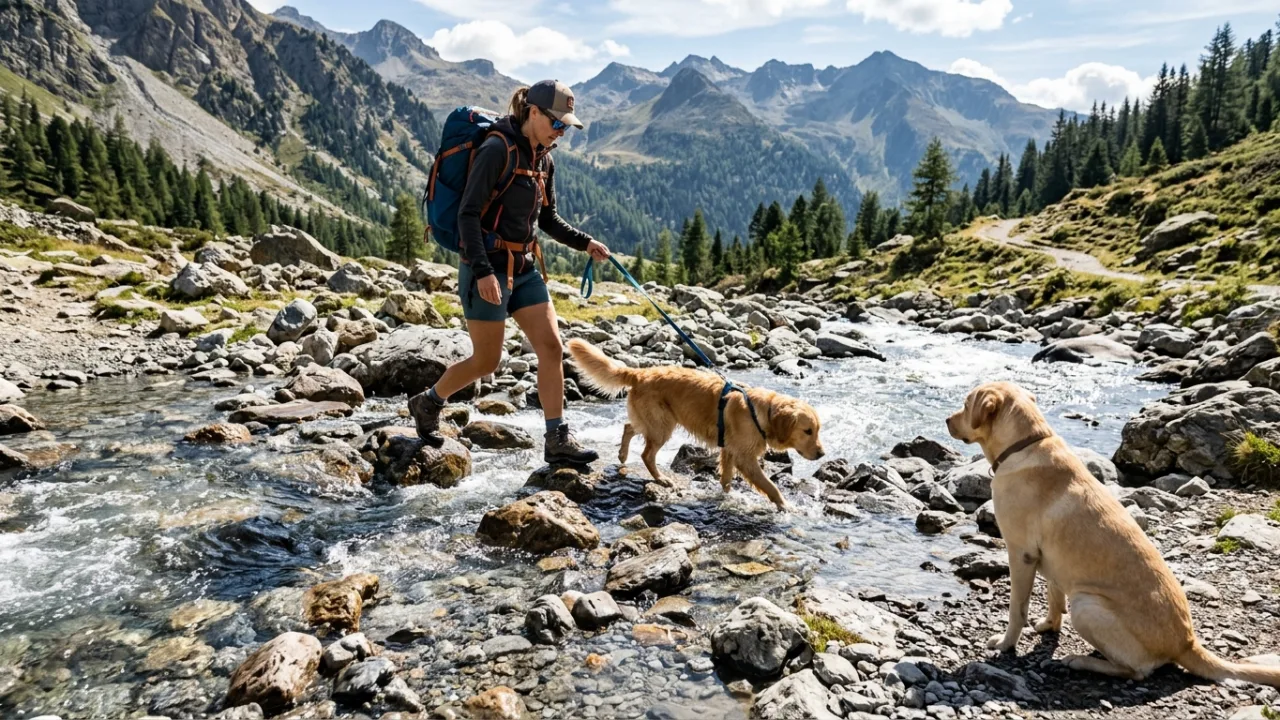
Water Crossings and Steep Scrambles
Never attempt to cross with both dogs simultaneously if the footing is uncertain. Instead:
- Secure the calmer or more experienced dog in a ‘wait’ at a safe distance from the water’s edge.
- Cross with one dog at a time on a short leash, keeping your body between the dog and the strongest current or steepest drop.
- Return for the second dog rather than trying to walk both across together — a slip from one dog can pull you and the second dog in with it.
- On steep scrambles, shorten leashes significantly and consider carrying small dogs through the most technical sections entirely.
Passing Other Hikers, Dogs, and Wildlife
Step off-trail early, shorten both leashes, and position yourself between your dogs and whatever is passing. Ask both dogs for a ‘wait’ or ‘sit’ rather than trying to fully control forward motion on a tightening leash. If your group includes a reactive dog, put the calmer dog on the outside (farther from the trigger) and the reactive dog closest to you, using your body as a visual block.
Real Scenario: Reactive Dog Meets an Off-Leash Dog
Imagine you’re hiking with a calm senior dog and a younger, leash-reactive rescue when an off-leash dog comes bounding down the trail. The fastest, safest move is to immediately cue both dogs into a ‘wait,’ step off-trail with your body angled to block the reactive dog’s line of sight to the approaching dog, and call out clearly to the other owner to leash up or recall their dog. Don’t wait to see if it resolves itself — create distance and a visual barrier first, then reassess. If the off-leash dog keeps approaching despite your signals, put yourself fully between the dogs, keep both leashes short, and back away calmly rather than turning your back and walking briskly, which can trigger a chase response in the other dog.
Rest Stops, Tethering, and Campsite Selection
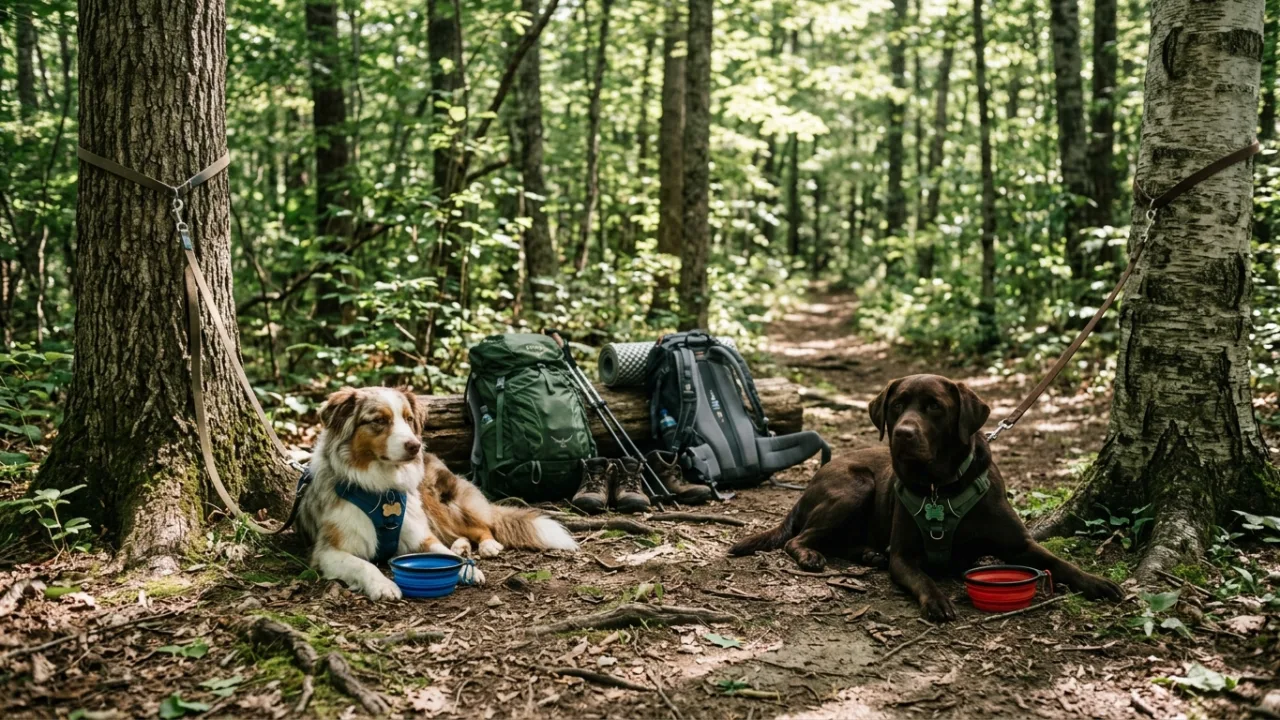
Rest breaks are when most tangling and low-grade conflict actually happens, simply because attention drops. A few habits keep breaks calm:
- Choose a rest spot wide enough to space dogs 4-6 feet apart, not directly beside each other
- Tether to separate anchor points (trees, trekking poles staked securely) rather than one shared point, which invites tangling
- Offer water from separate bowls at the same time, not sequentially, to reduce competitive rushing
- Use a ‘settle’ or ‘down-stay’ cue that both dogs already know well, so you can dig through your pack or tend to one dog without the other wandering
- For bathroom breaks during lunch stops, tether one dog briefly to a fixed point while you walk the other a short distance away, then switch
For overnight backcountry trips, choose a campsite with enough flat space to tether or crate dogs a few feet apart, away from the cook area to reduce food-guarding risk, and away from known game trails. Store all dog food exactly like human food — sealed and hung or in a bear canister where required — since two dogs’ worth of food and scent is a meaningfully bigger wildlife attractant than one dog’s. Tent space also matters more than people expect: two medium or large dogs inside a two-person tent overnight is tight enough to cause restlessness, sleep-guarding behavior, or simple discomfort, so consider a slightly larger tent or a dog-specific sleeping shelter for multi-dog overnight trips.
Off-Leash Hiking: On-Leash vs. Off-Leash for Multiple Dogs
Off-leash hiking with a multi-dog group is a genuine privilege, not a default setting, and it should only be attempted where legally allowed and where every dog has demonstrated reliable recall around distractions and around each other. A practical way to decide before you unclip anything: read each dog’s energy and focus at the trailhead. A dog that’s already fixated on scent, overly aroused, or ignoring you in the parking lot is telling you today is an on-leash day, regardless of past off-leash success.
| Approach | Pros | Cons |
|---|---|---|
| On-leash (individual or coupled) | Full physical control; compliant almost everywhere; safer around wildlife and other trail users | Tangling risk; less freedom for the dogs; more physically tiring for the handler |
| Off-leash | Lower tangle risk; dogs can regulate their own pace; more natural exercise | Requires bulletproof recall in every dog; higher risk around wildlife, other hikers, and legal exposure where prohibited |
Managing a Reactive or Anxious Dog Within the Group
A reactive or anxious dog changes your entire trail strategy, but it doesn’t have to end multi-dog hiking altogether. Keep the reactive dog closest to your body on the side away from likely triggers (oncoming trail traffic), give them more physical distance from other dogs at rest stops, and consider hiking at off-peak hours when trail traffic is lighter. Many handlers find it easiest to keep the reactive dog on an individual leash even if the calmer dog is on a hands-free system — separating their leash systems means a reaction in one dog doesn’t physically yank or destabilize the other.
Group Size, Ratios, and Solo vs. Partnered Hiking
There’s no single official number for a safe dog-to-human ratio, but a widely echoed practical guideline among experienced multi-dog handlers is that one person can safely and attentively manage two dogs on-leash, and rarely more than three, even with excellent training. Off-leash, that number often drops further for a solo handler, since eyes and attention become the limiting factor rather than hands.
| Setup | Realistic Capacity | Key Consideration |
|---|---|---|
| Solo handler, on-leash | 2 dogs comfortably, 3 with excellent training | Physical control and tangle risk rise sharply past two dogs |
| Solo handler, off-leash | 1-2 dogs with bulletproof recall | Attention and emergency response capacity is the real limit |
| Two handlers splitting dogs | 2 dogs per person, 4+ total | Communication between handlers becomes critical, especially for wildlife or injury response |
| Group hike, multiple owners | Varies widely | Requires clear etiquette agreements in advance — see checklist below |
Group Hike Etiquette Checklist for Organizers
- ☐ Confirm every dog is comfortable meeting unfamiliar dogs before the group hike, not just familiar ones
- ☐ Agree in advance on leash policy (all on-leash, or off-leash only for dogs with verified recall)
- ☐ Identify any reactive or anxious dogs ahead of time and plan spacing accordingly
- ☐ Set a pace matched to the least fit dog or human in the group
- ☐ Designate one person to carry a shared first-aid kit and know basic pet first aid
- ☐ Agree on a plan for passing other trail users as a larger group
Vehicle and Trailhead Logistics
Loading and unloading multiple dogs safely from a vehicle prevents a huge share of trailhead chaos. Open one door and leash one dog fully before opening the second door, rather than letting both dogs out simultaneously into a parking lot with traffic, other dogs, and unfamiliar smells. Keep both leashes in hand before either dog’s paws touch the ground, and do a full gear check — harnesses buckled, tags on, water packed — before you walk away from the car.
Weather and Heat Management Across Coat Types and Sizes
A double-coated husky and a short-coated pointer in the same hiking pair have very different heat tolerances, and pushing both dogs on the same schedule can put one of them at real risk. Watch each dog individually for excessive panting, lagging behind, seeking shade unprompted, or reluctance to continue — these are early heat stress signs, and they often show up in one dog well before the other. Build in more frequent water and shade breaks than your fittest dog seems to need, and consider hiking heavy-coated or brachycephalic dogs during cooler morning hours even if your other dog could handle a midday start.
Troubleshooting: When Things Go Wrong on Trail
Two Leashes Tangled Around Your Legs or a Tree
Stop moving immediately rather than trying to walk through it — motion tightens tangles. Cue both dogs into a ‘wait,’ unclip the more mobile dog if needed to unwind the leash, then reclip once untangled.
A Scuffle or Fight Between Your Own Dogs
Avoid grabbing collars near the head, which puts your hands at bite risk. Instead, if you have a second handler, each person pulls one dog back by the rear leg or hips simultaneously. Solo, use a loud interrupt (a sharp noise, a blast of water, or an air horn if carried) rather than physically wedging between them. Separate fully, give both dogs time to decompress, and reassess whether the hike continues.
One Dog Bolts After Wildlife While You’re Holding the Other’s Leash
Do not chase. Secure the dog you’re holding first — clip them to a tree or your waist belt if needed — then call the bolting dog’s recall word and, if trained, use a distinct ‘come’ whistle that carries farther than your voice. This is exactly why reliable recall is a non-negotiable prerequisite before any off-leash time.
A Dog Refuses to Continue (Fatigue, Injury, or Fear)
Stop the whole group. Check paws, joints, and general demeanor for the reluctant dog while keeping the second dog settled nearby on a ‘wait’ or tethered briefly. If it’s fatigue rather than injury, rest, water, and a slower pace on the return route usually resolves it. If you suspect injury or heat stress, treat it as the emergency it is — see below.
Handling an Injury to One Dog Mid-Trail
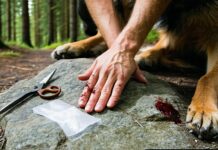
Secure the uninjured dog first — tether them to a stable point or, if you have a second handler, hand off their leash — so both your hands are free for the injured dog. Assess the injury, apply basic first aid (pressure for bleeding, splinting only if trained and necessary), and plan your exit route. For a dog that can’t walk, a sling, jacket, or emergency carry method may be needed; for a larger dog, this may require another hiker’s help, which is one more reason solo handlers with multiple dogs should carry a charged phone or satellite communicator and know the nearest exit point before setting out.
An Unleashed Strange Dog Approaches Aggressively
Keep both of your dogs close and calm rather than yanking them backward, which can escalate tension. Use a firm, low voice toward the approaching dog, avoid direct eye contact with it, and create a barrier with your body or a trekking pole if it closes distance. Back away steadily rather than running.
Leash or Gear Failure (Broken Clip, Snapped Leash)
This is exactly why a spare carabiner or short backup leash belongs in every multi-dog pack. Secure the affected dog immediately with the backup gear, inspect the failure point, and avoid continuing with compromised equipment on any off-leash-restricted or high-traffic trail.
Buying Guide: Gear That Actually Helps
- Couplers: Look for a swivel point at the connection (prevents twisting), some shock absorption or bungee give, and adjustable length so you can shorten it for technical terrain.
- Harnesses: Front-clip harnesses give the most steering control for strong pullers; back-clip suits well-trained loose-leash walkers; no-pull designs with a front chest ring work well for dogs still building leash skills.
- Hands-free waist systems: Prioritize a padded belt (comfort over miles), independent shock-absorbing lines per dog rather than one rigid coupler point, and a quick-release buckle for emergencies.
- Dog backpacks: Size to the dog’s actual measurements, not just weight class, and load-test at home before the trail — aim for the 10-12% body weight guideline and check for chafing after a short walk.
- GPS/tracking collars: Worth the investment for any off-leash multi-dog hiking, since a solo handler physically cannot chase two directions at once if dogs split up after wildlife.
What the Experts Emphasize
Veterinarians who treat trail-related injuries often point out that handling multiple leashes on uneven terrain meaningfully increases a handler’s own fall risk — a sudden pull from one dog while your footing is already compromised by rocky or root-covered ground is a common cause of sprains and worse, not just for the dog but for the person holding the leash. Certified dog trainers generally stress that multi-dog reactivity is often a chain reaction — one dog’s arousal spikes, the second dog reads that arousal and escalates too, and the handler ends up managing two aroused dogs instead of one. Training each dog to hold a calm ‘settle’ independent of the other dog’s energy is considered one of the most valuable skills for group hiking. Canine behaviorists similarly note that novel outdoor environments can lower the threshold for resource guarding even in dogs that never guard at home, simply because scarcity cues (limited shade, limited water sources, unfamiliar smells) heighten vigilance. And land managers consistently ask hikers to treat posted dog rules as trail-specific rather than assuming consistency across park systems — a rule that applies in one national forest unit may not apply in the neighboring state park, and enforcement varies by ranger district and season.
Sample Day-Hike Itinerary for a Two-Dog Owner
- 6:30 AM: Feed dogs separately, allow full digestion time before exertion
- 7:15 AM: Gear check — harnesses, leashes, water, first-aid kit, waste bags, ID tags
- 7:45 AM: Load dogs one at a time into the vehicle
- 8:30 AM: Arrive at trailhead; unload one dog at a time, fully leashed before both are out of the car
- 8:45 AM: Begin hike at the pace of the less fit dog
- 10:00 AM: First rest stop — spaced tethering, separate water bowls, paw check
- 11:30 AM: Turnaround point or lunch stop — settle cue, bathroom break rotation
- 1:00 PM: Return leg, monitoring both dogs for fatigue or heat stress individually
- 2:15 PM: Back at trailhead — water offered before loading into the vehicle
- 2:30 PM: Post-hike check for both dogs (see checklist below)
Post-Hike Check Checklist
- ☐ Paw pad inspection for cuts, blisters, or embedded debris
- ☐ Full-body tick check, especially ears, neck, and between toes
- ☐ Offer water and monitor drinking behavior for signs of dehydration
- ☐ Watch gait for limping or stiffness over the next hour
- ☐ Note any behavior changes that might indicate overheating or exhaustion
Common Mistakes to Avoid
- Assuming past off-leash success guarantees future reliability — recall reliability can shift day to day based on arousal and distraction levels.
- Using one coupler for mismatched dogs — a large, strong dog and a small dog on the same rigid coupler is a recipe for the smaller dog getting yanked or dragged.
- Skipping the introduction timeline for a new dog and hoping trail excitement will bond them faster — it usually does the opposite.
- Packing one shared water bowl for dogs with any history of resource guarding.
- Planning mileage around the fittest dog instead of the weakest link in the pack.
- Not carrying backup gear — a spare clip or leash costs almost nothing and solves a real trailside emergency.
Conclusion
Multi-dog pack hiking rewards handlers who treat it as its own skill set rather than an extension of solo-dog hiking. The leash system you choose, the training you complete beforehand, the rules of the specific land you’re hiking on, and the way you read each individual dog’s fitness and temperament all compound together into either a genuinely joyful shared adventure or a stressful one. Start small, build gradually, and let your most cautious or least fit dog set the pace — the trail will still be there for bigger mileage once your whole pack is ready for it.
If you’re just getting started, pick one low-traffic, well-known local trail and run through the entire system — leashes, gear, commands, rest stops — before committing to anything remote or technical. Your dogs will tell you, through their body language and focus, exactly how ready they really are.
Frequently Asked Questions
What is the 7-7-7 rule for dogs, and does it apply to introducing hiking dogs to each other?
The 7-7-7 rule is a general guideline sometimes used for settling a new dog into a home — roughly 7 days to decompress, 7 weeks to learn routines, and 7 months to fully settle. It's not a formal hiking rule, but the underlying idea applies well: don't rush a new dog straight into pack hikes. Give them weeks of calm, low-key exposure to your existing dog before attempting a trail hike together.
What is the 5-second rule for walking dogs, and how does it change with multiple dogs?
The 5-second rule generally refers to keeping greetings between dogs brief — about five seconds of sniffing or interaction before calling them apart — to prevent overstimulation from escalating into tension. With multiple dogs on trail, this becomes even more important, since group excitement builds faster than one-on-one interactions, and short, controlled greetings reduce the chance of a scuffle.
What is the 90/10 rule for dogs in a multi-dog household context?
The 90/10 rule suggests giving a new or less-confident dog roughly 90% of your positive attention and management focus early on, with 10% directed at reinforcing the established dog, to prevent jealousy or guarding behavior while the newer dog settles in. On trail, this translates to deliberately rotating attention and rewards rather than letting one dog dominate your focus at rest stops.
Can you hike with three or more dogs at once, and is there a legal limit?
Legal limits vary by land manager rather than being universal — some municipalities cap dogs per walker at two or three, while many national forests and BLM lands have no explicit per-person cap but may restrict total group size in designated wilderness areas. Practically, most solo handlers find three dogs is the realistic upper limit for safe on-leash control, and fewer than that off-leash.
Do you need two hands free, or is a hands-free multi-dog leash system better?
A hands-free waist leash system is generally preferable for experienced handlers with well-trained dogs, since it frees both hands for trekking poles, water crossings, or gear while keeping decent control. However, dogs still learning loose-leash manners, or reactive dogs, often do better on individual hand-held leashes where you can react instantly to a sudden pull.
Is it safer to hike dogs together or take them separately?
For dogs that are well-bonded, well-trained, and compatible in fitness level, hiking together is usually safe and often reduces boredom-driven behavior issues. For dogs with resource guarding history, significant fitness mismatches, or one reactive dog, hiking separately or with separate handlers is often the safer choice until training and compatibility improve.
What size backpack and pack weight is safe for each dog when hiking as a group?
A commonly cited guideline is that a healthy, well-conditioned adult dog can carry about 10-12% of its body weight, split evenly on both sides of a properly fitted pack. Puppies, seniors, and dogs with joint or back issues generally shouldn't carry a loaded pack at all — shift that weight to the human handler's pack instead.
How do you stop dogs from pulling in different directions on trail?
Teach each dog a consistent 'this side' hand signal so they learn to walk on assigned sides of your body rather than crossing or splitting. Combine this with front-clip harnesses for steering control, and reinforce loose-leash walking at home before expecting it on more distracting trails.
What's the best way to introduce two unfamiliar dogs before a group hike?
Start with parallel walks at a distance where neither dog can fixate on the other, gradually decreasing distance over several sessions. Move to brief, calm on-leash greetings in a neutral, low-distraction space before attempting any shared walk, let alone a full trail hike together.