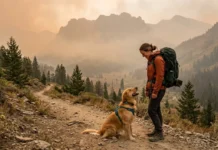
Your dog yelps, pulls up short, and starts licking frantically at one paw. You’re forty minutes from the nearest trail, let alone the trailhead, and there’s a two-inch greenbrier thorn buried in her pad. This is the moment every off-trail hiker eventually faces, and it’s exactly why paw and eye protection deserve as much planning as your water filter or map.
- Bushwhacking (off-trail or cross-country travel) exposes dogs’ eyes and paws to thorns, sharp rock, and hidden debris that maintained trails filter out.
- Dogs with prominent or bulging eyes (brachycephalic breeds like Pugs, Boston Terriers, and Boxers) and thin, unconditioned paw pads face the highest injury risk.
- Dog goggles like Rex Specs can work for brush protection, but they require gradual, positive training—never force them on for a first-time off-trail trip.
- Boots, paw balm, and gradual conditioning each solve different problems; the right choice depends on terrain, not personal preference alone.
- A basic field first-aid kit (saline, vet wrap, tweezers, styptic powder) can mean the difference between finishing a hike and cutting it short.
- Route choice—following game trails, ridgelines, and open forest instead of dense understory—prevents more injuries than any single piece of gear.
What Bushwhacking Actually Means (and Why It Changes the Rules)
Bushwhacking is the practice of hiking off-established-trail through vegetation, using a map, compass, GPS, or terrain features instead of blazes or a worn path. It’s also called off-trail travel or cross-country navigation, and it’s common in dense forests, talus fields, alpine basins above treeline, and remote canyon country where no maintained trail exists or the trail has become overgrown.
On a maintained trail, land managers clear branches at head height, cut back brush, and route the path around the worst rock hazards. Off-trail, none of that happens. Every thorn, sharp stone, and low branch is exactly where nature left it, and that changes the calculus for both paw and eye protection significantly.
How Far Off-Trail Before You Need Real Navigation Skills?
There’s no universal distance—thirty yards into thick brush without landmarks can be enough to get turned around. As a general guideline, if you can’t see or hear the trail and you’re relying on dead reckoning, pace counting, or a GPS track to find your way back, you’ve crossed from a casual detour into genuine off-trail travel. That threshold matters for gear choice too: the deeper and longer you’re off-trail, the more redundancy you need in both navigation tools and first-aid supplies, because help is farther away in every direction.
Do Dogs Need Eye Protection When Bushwhacking?
Yes—more than most hikers realize. Dogs’ eyes sit closer to brush height than ours, and unlike people, dogs can’t consciously duck or squint away from a branch snapping back at head level. Thorny scrub like multiflora rose, blackberry, and greenbrier is a common culprit for corneal scratches, and in the Pacific Northwest, devil’s club spines can cause both eye and paw injuries in the same afternoon.
A corneal abrasion in a dog looks like squinting, excessive tearing, pawing at the face, or holding one eye partially closed. It’s painful, and if left untreated in the field, it can worsen quickly. This doesn’t mean every dog needs goggles for every hike, but in dense, thorny, or branch-heavy terrain, some form of eye protection or route avoidance strategy is worth considering.
Which Breeds and Coat Types Are Most Prone to Eye Injuries?
Brachycephalic breeds—Pugs, Boston Terriers, Boxers, French Bulldogs, and similar flat-faced breeds—have shallower eye sockets and more prominent, exposed eyeballs, making them noticeably more vulnerable to corneal scratches and even proptosis (the eye popping partially out of the socket) in extreme trauma. Long-haired breeds with hair that grows over the eyes, like Old English Sheepdogs or Shih Tzus, face a different but related risk: reduced visibility means they don’t see branches coming until it’s too late.
Dogs with normal, deep-set eye sockets (many working and sporting breeds like Labradors, German Shorthaired Pointers, and Border Collies) are comparatively lower risk but are not immune, especially at a dead run through brush.
Dog Goggles for Bushwhacking: Do They Actually Work?
Products like Rex Specs are designed to shield a dog’s eyes from wind, debris, and branch impact while allowing a full field of vision. They can absolutely work for bushwhacking, particularly for breeds with prominent eyes or dogs that have already had one eye injury. That said, they’re not a casual add-on—most dogs need real acclimation time before a goggle feels normal rather than alarming.
Training a Dog to Tolerate Goggles or Boots (Step-by-Step)
- Introduce at home, no pressure. Let the dog sniff and investigate the goggles or boots for several days before ever putting them on.
- Short wear sessions. Put them on for 60-90 seconds indoors, paired immediately with treats and praise, then remove them before the dog gets frustrated.
- Extend gradually. Over one to two weeks, increase wear time to 15-20 minutes during normal indoor activity like eating or playing.
- Add movement. Practice walking around the yard or house wearing the gear before ever trying it on a trail.
- Test on a short, easy trail hike before committing to a full off-trail bushwhack, so any fit problems show up close to the car, not miles into brush.
A professional trainer’s perspective worth borrowing here: dogs generalize slowly. A dog that tolerates boots calmly in the living room may still balk the first time they’re asked to wear them on uneven, unfamiliar terrain, so build in a “dress rehearsal” hike before the real trip.
Human Eye Protection: What Actually Stands Up to Whipping Branches
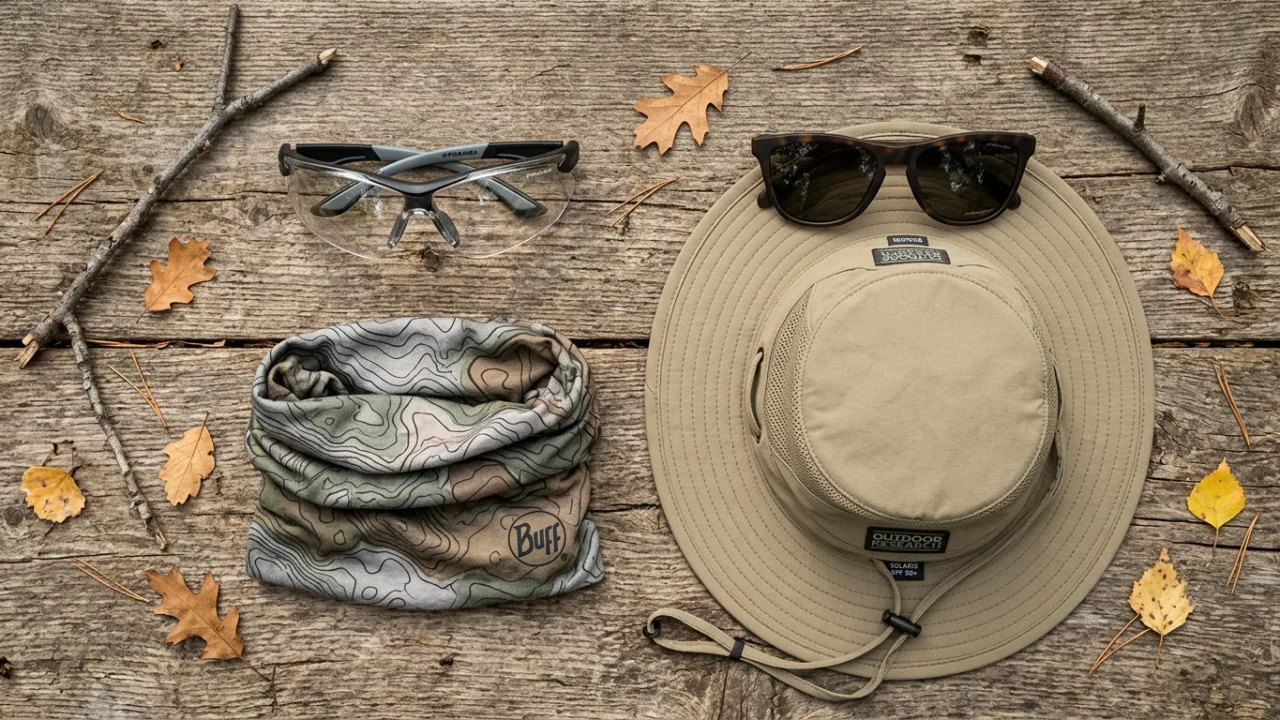
Not all eyewear is created equal when a branch snaps back at face height. Fashion sunglasses offer some coverage but often lack side protection and impact resistance. Here’s how the main options compare for bushwhacking specifically.
| Eye Protection Option | Branch Deflection | Fogging | Cost | Visibility |
|---|---|---|---|---|
| ANSI-rated safety glasses | Excellent | Moderate (worse in humidity) | $10-$30 | Good, some tint options |
| Wraparound sport sunglasses (polarized) | Good | Low-Moderate | $20-$150 | Excellent |
| Standard fashion sunglasses | Poor | Low | $10-$100+ | Good |
| Brimmed hat alone | Fair (blocks downward angle only) | None | $15-$40 | Excellent |
| Buff pulled up over nose/lower face | None for eyes | None | $10-$20 | Excellent |
The most reliable strategy for serious brush is layering: ANSI-rated safety glasses or true wraparound sport eyewear underneath a brimmed hat. The hat brim blocks downward-angled branches near the forehead, while the glasses handle direct hits and side whip-back. A buff protects your nose and cheeks from scratches but does nothing for the eyes themselves, so don’t rely on it alone in thick brush.
Dog Paw Anatomy and the Injury Types You’ll Actually See
A dog’s paw pad is thick, keratinized skin, but it is not invulnerable. The main injury types encountered off-trail include:
- Pad lacerations — clean or jagged cuts from sharp rock edges or broken glass-like obsidian and shale.
- Thorn or spine punctures — common with greenbrier, cholla cactus, and blackberry cane, often leaving debris embedded under the surface.
- Nail damage — torn or split nails from catching on rock crevices or roots, especially on talus and scree.
- Interdigital cuts — cuts between the toes, often missed on a quick visual check because they’re hidden by fur.
- Thermal injury — burns from hot rock or sand in desert terrain, or, less commonly, from prolonged contact with ice and frozen ground.
Sharp Rocks vs. Thorns vs. Hot/Cold Surfaces: Different Problems, Different Fixes
Sharp rock (talus, scree, sharp shale) causes acute lacerations and bruising from impact and needs sole rigidity—a boot with a tough, puncture-resistant sole is the best defense. Thorns and spines cause punctures and embedded debris, and here a boot’s upper material matters more than sole thickness; tightly woven, thorn-resistant fabric prevents penetration better than mesh. Hot or cold surfaces cause thermal injury, which boots address directly by insulating the pad, whereas balm offers only minor, short-term protection and isn’t a substitute for boots on scorching sand or ice.
Dog Paw Protection Compared: Boots vs. Balm vs. No Protection
| Option | Pros | Cons | Approx. Cost | Best Terrain |
|---|---|---|---|---|
| Dog boots (rugged, all-terrain) | Best puncture/cut protection, insulates from heat/cold | Can slip off in dense brush if poorly fitted; adjustment period needed | $35-$80/set | Talus, scree, cactus desert, hot pavement/sand |
| Paw balm/wax | Cheap, easy, doesn’t affect gait, softens/protects existing pad | No puncture protection, needs frequent reapplication, minimal thermal protection | $10-$20 | Moderate terrain, cold/dry conditions, day hikes |
| No protection (conditioned pads) | Free, natural traction and proprioception, no gear to lose | Requires months of gradual toughening; still vulnerable to thorns and sharp punctures | $0 | Well-conditioned dogs on moderate, non-thorny terrain |
Are Dog Boots Effective for Bushwhacking, or Do They Fall Off in Brush?
Boots can absolutely fall off in dense brush if they’re sized wrong or lack a secure closure system. The fix is proper fit and a boot designed with a wide velcro strap or gaiter-style cuff that sits above the dewclaw. Test boots on a shorter trail hike first, and check them at every rest stop during the actual bushwhack—brush has a way of hooking straps and working them loose gradually rather than all at once.
Natural Toughened Paws vs. Gear-Dependent Protection
Conditioning a dog’s paws over weeks or months—gradually increasing time on varied natural surfaces like gravel, sand, and rock—genuinely thickens and toughens the pad. This is valuable and worth doing regardless of whether you also use boots. But conditioning has limits: no amount of natural toughening prevents a cholla spine or a sharp shale edge from penetrating. Think of conditioning and gear as complementary, not either/or.
Terrain-Specific Hazards and What to Pack
| Terrain | Primary Hazard | Recommended Dog Gear | Recommended Human Gear |
|---|---|---|---|
| Thorny scrub (greenbrier, multiflora rose, blackberry — common in Appalachian and Eastern forests) | Eye scratches, pad punctures | Goggles, boots with tough uppers | Safety glasses, long sleeves, gaiters |
| Talus/scree fields (alpine, high desert) | Lacerations, nail damage, ankle injury | Rugged-sole boots | Sturdy boots, trekking poles |
| Burned forest (charred sticks, downed timber) | Puncture wounds, ash irritation to eyes | Boots, goggles for ash/dust | Bandana/buff for ash, safety glasses |
| Desert cactus/cholla | Deep spine punctures (paw and skin) | Boots, tweezers/pliers on hand | Thick pants, closed shoes, needle-nose pliers |
| Alpine rock and rockfall zones | Sharp edge cuts, impact injuries | Boots with rigid sole | Helmet in extreme cases, gloves |
| Pacific Northwest devil’s club thickets | Spine punctures to eyes, paws, and skin | Goggles, boots, avoid if possible | Long sleeves, gloves, safety glasses |
How Vegetation Density Changes Your Risk
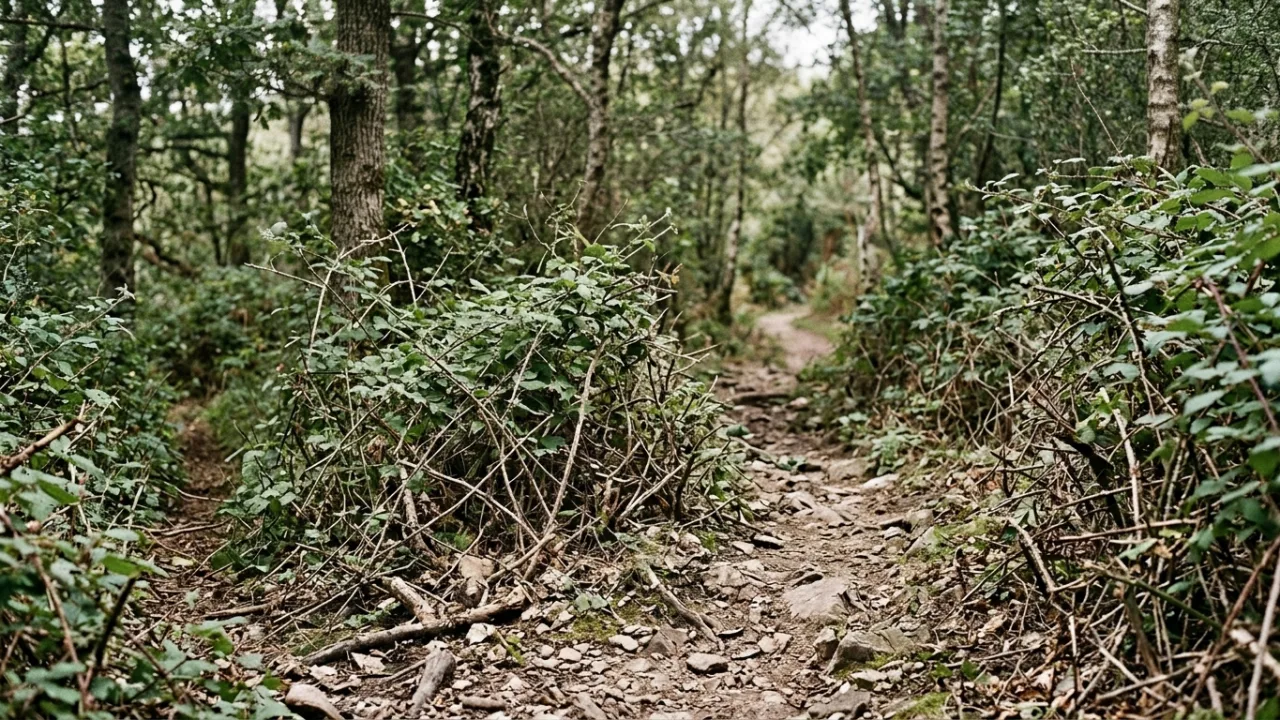
Open forest with sparse understory poses relatively low eye and paw risk—you can usually see hazards and route around them. Dense understory, especially thorny species like devil’s club, greenbrier, and multiflora rose, is a different world entirely. In truly thick brush, you often can’t see your dog’s paws or your own feet, and branches at eye level become unavoidable rather than occasional. When vegetation density reaches the point where you’re pushing through with your forearms rather than stepping around obstacles, it’s time to reassess whether the route is worth the exposure, or whether a game trail, ridgeline, or drainage bottom offers a cleaner line.
Choosing a Route to Minimize Hazard Exposure
Experienced off-trail travelers rarely bull straight through the thickest brush. Instead, they look for natural lines: game trails (deer and elk paths often thread the path of least resistance through brush), ridgelines (typically more open than drainages), and areas of open forest with a closed canopy that shades out dense undergrowth. When a route unavoidably passes through thick brush, the group leader should break trail, physically pushing branches aside and calling out “branch” or “whip” to warn hikers behind them, since a branch bent by the lead hiker can snap back with surprising force on the second or third person in line.
When to Turn Back or Reroute
If vegetation becomes so dense that your dog is repeatedly wincing, refusing to move forward, or you can no longer visually track them more than a few feet away, that’s a clear signal to reroute. The math is simple: an extra thirty minutes finding a cleaner line is always cheaper than a vet visit or a long carry-out.
Bushwhacking With a Dog vs. Solo: What Changes
Hiking off-trail alone means managing your own risk. Adding a dog means managing a second set of eyes, paws, and judgment that can’t verbally tell you something’s wrong until it’s already a problem. Extra precautions with a dog include: checking paws and eyes at every rest stop rather than only at camp, carrying a dog-specific first-aid kit in addition to your own, keeping your dog on a shorter lead in the thickest brush so you can physically block them from charging into cactus or thorns, and building in extra time, since a cautious pace protects both of you.
Field First Aid: Eyes and Paws, Human and Dog
| Item | For You | For Your Dog |
|---|---|---|
| Saline solution | Flush debris or irritants from eyes | Flush eye or wound, clean paw pad |
| Tweezers/forceps | Remove splinters, small debris | Remove embedded thorns or cactus spines |
| Vet wrap / self-adhesive bandage | Secure a dressing without tape | Wrap an injured paw temporarily |
| Styptic powder | Stop minor bleeding from cuts | Stop bleeding from a torn nail or minor cut |
| Gauze pads | Cover and protect a wound | Cushion under a wrap |
| Small flashlight/headlamp | Inspect eye injuries closely | Inspect mouth/eye/paw in low light |
| Booties (spare pair) | N/A | Replace a lost or damaged boot |
How to Flush an Eye With Saline in the Field
For a dog or a person, the technique is similar: tilt the head so the affected eye is lower, gently hold the eyelids open, and pour a steady stream of sterile saline from the inner corner outward, away from the other eye. This flushes debris out rather than across the eye. For a dog, having a second person hold the head still makes this far easier, and speaking calmly throughout helps prevent a struggle that could worsen the injury.
What to Do for a Corneal Scratch Miles From the Trailhead
If you suspect a corneal scratch—squinting, tearing, pawing at the eye, visible cloudiness—flush the eye with saline first to remove any remaining debris, then keep the dog from pawing or rubbing it further (a soft cone or even a loosely wrapped bandana around the neck can help in a pinch). Avoid applying any human eye ointment unless a veterinarian has specifically told you it’s safe for dogs, since some ingredients that are fine for humans are not appropriate for canine eyes. The priority is preventing further self-trauma and getting to a veterinarian as promptly as the situation allows; a scratched cornea that seems minor in the field can worsen without proper treatment.
For a human eye injury from a branch poke, the same logic applies: don’t rub the eye, flush with saline, and if pain, light sensitivity, or blurred vision persists, that’s a signal to end the trip early and seek care rather than push on. A wilderness medicine principle worth remembering here is that eye injuries are one of the few backcountry problems where “wait and see” is genuinely risky, since delayed treatment of a corneal injury can lead to complications that a same-day flush and rest would have prevented.
How to Inspect and Clean Paws at Rest Breaks
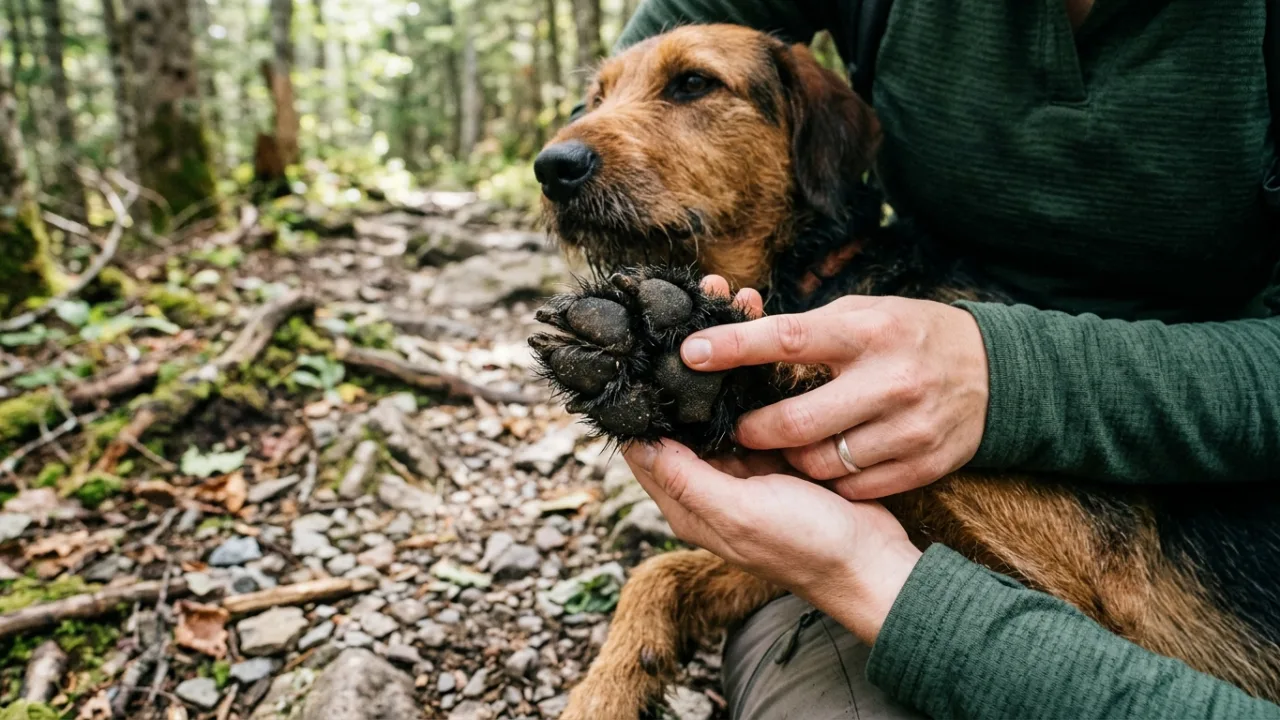
- Sit the dog and lift each paw individually, spreading the toes to check between them.
- Look for embedded thorns, cuts, redness, or swelling on the pad surface.
- Check nails for tears or splits, particularly after rocky sections.
- Brush out any debris caught in the fur between toes.
- If you find a thorn, grip it as close to the skin as possible with tweezers and pull straight out along the entry angle, not at a twist.
- Apply a small amount of balm or antiseptic if you have it, and reapply boots if the dog is wearing them.
Applying Paw Balm: How and How Often
Apply a thin layer of paw balm to clean, dry pads before setting out, working it in gently between the toes as well as on the pad surface itself. On a multi-day bushwhack, reapply once or twice daily—typically at the morning start and again at camp in the evening—and always after fording water, since wet pads soften and become more prone to abrasion.
Real-World Example: A Paw Injury Handled in the Field
Picture a scenario familiar to many off-trail hikers: a dog working through dense blackberry cane picks up speed chasing a scent, plants a paw on a broken cane stub hidden under leaf litter, and comes up limping. The handler stops immediately, sits the dog, and checks the paw—finding a puncture with a visible thorn fragment still lodged in the pad. Using tweezers from a small first-aid kit, the fragment is removed, the wound flushed with saline, and a boot placed over a light gauze pad to protect it for the remaining three miles back to the trail. The lesson from cases like this is consistent: a five-minute stop at the first sign of limping prevents a much longer, harder carry-out later, and a simple kit carried “just in case” turns a potential trip-ending emergency into a manageable delay.
Pre-Trip Packing List From Experienced Off-Trail Guides
Guides who regularly travel off-trail with dogs tend to carry a consistent, pared-down kit rather than an exhaustive one—weight matters as much as coverage. A typical list includes: a paper map and compass as GPS backup, a headlamp, a dog-specific first-aid pouch (saline, vet wrap, tweezers, styptic powder), a small human first-aid kit including safety glasses as a spare, one spare dog boot, paw balm, and a lightweight emergency bivy or space blanket in case a slow return turns into an overnight.
Pre-Trip Checklist: Paw and Eye Protection
- Dog boots, properly sized and broken in on shorter hikes
- Paw balm or wax
- Dog goggles (if the dog is acclimated and terrain warrants it)
- ANSI-rated safety glasses or wraparound sunglasses for yourself
- Brimmed hat and buff for layered face/eye protection
- Saline solution (travel-size, for both of you)
- Tweezers or fine forceps
- Vet wrap and gauze
- Styptic powder
- Long sleeves and gaiters for thorny terrain
Post-Hike Checklist
- Check all four paws for embedded thorns, cuts, or swelling
- Check between toes and around nail beds
- Check eyes for redness, discharge, or squinting
- Run hands through coat checking for ticks and embedded burrs
- Inspect your own arms, legs, and face for scratches or embedded splinters
- Clean and dry any minor cuts found on either of you
Trip-Planning Checklist: Assessing Terrain Before You Go With a Dog
- Research vegetation type for the area (thorny scrub vs. open forest vs. desert)
- Check recent trip reports or satellite imagery for understory density
- Confirm your dog’s coat and breed suitability for the terrain (long-haired dogs in thorny brush need extra care and possibly a shorter, easier-to-inspect coat trim beforehand)
- Plan a bailout route in case brush becomes too dense
- Pack redundant paw and eye protection, not just one option
Troubleshooting Common Problems
My Dog Refuses to Wear Boots or Goggles Mid-Trip
Don’t force it in the moment—stress compounds quickly in unfamiliar terrain. Try a treat-based distraction to get the gear on calmly, or if the dog is truly resistant, prioritize the paw or eye that’s most at risk (for example, boots only on the front paws, which typically bear more impact) rather than abandoning protection entirely.
I Don’t Have Tweezers—How Do I Remove an Embedded Thorn?
Fingernails can work for larger, shallow thorns if you pinch as close to the skin as possible. For anything embedded deeper, the edge of a pocketknife blade (used flat, not the point) can sometimes lift a thorn enough to grasp it. If it won’t come out cleanly, don’t dig—wrap the paw to protect it and prioritize getting out rather than performing field surgery.
My Dog Is Limping and We’re Miles From the Trailhead
Stop, inspect thoroughly, treat what you can (flush, remove debris, wrap), and reassess weight-bearing. A dog that can still bear weight comfortably after a short rest can often walk out slowly. A dog that won’t bear weight at all needs to be carried or you need to call for help if that’s genuinely not feasible—know your dog’s approximate carry weight and your own limits before you’re in this situation, not during it.
My Eyewear Is Fogged or Scratched and I Can’t See Well
Wipe lenses with a soft cloth (not your shirt if it’s covered in dust or sap), and if fogging is persistent, an anti-fog wipe carried in your kit solves this quickly. If lenses are too scratched to see through safely, switch to your backup pair or fall back on a brimmed hat and slower, more cautious pace until you’re through the thick brush.
My Dog’s Boot Is Lost in Dense Brush
Don’t spend excessive time searching in thick, hazardous brush—it’s not worth another injury. Switch to a spare boot if you packed one, or apply balm and slow your pace to protect the exposed paw for the remainder of the hike.
Buying Advice: Getting Fit and Materials Right
For dog boots, correct sizing is the single biggest factor in whether they stay on in brush. Measure the paw width at its widest point while the dog is standing and bearing weight, and choose a boot with an adjustable strap that sits above the dewclaw for extra security. Avoid boots made from non-breathable rubber for warm-weather, long-duration hikes, since trapped moisture leads to hot spots and blisters on the pad.
For human eyewear, look for ANSI Z87.1-rated safety glasses or true wraparound sport sunglasses with polycarbonate lenses, an anti-fog coating, and a retention strap for when you’re pushing through brush at an angle. Materials to avoid include cheap acetate-frame sunglasses that snap under branch impact and boots with mesh uppers that offer no puncture resistance against thorns or cactus spines.
Budget-conscious hikers can start with paw balm and quality safety glasses (often under $30 combined) and add boots or goggles later if terrain demands it. Premium setups—rugged all-terrain boots plus a well-fitted goggle—represent a larger investment but pay off repeatedly for dogs that regularly bushwhack in thorny or rocky terrain.
A Note on Off-Trail Etiquette
Responsible off-trail travel isn’t just about gear—it’s about minimizing impact. Cutting switchbacks on maintained trails is discouraged because it accelerates erosion and creates parallel scars that widen over time; the same principle extends to off-trail travel generally, where spreading impact (walking on durable surfaces like rock, sand, or established game trails rather than repeatedly trampling the same fragile vegetation) helps keep wild areas wild. And on the practical side of etiquette: when nature calls off-trail, the standard backcountry guideline of moving at least 200 feet from water sources applies just as much off-trail as on a maintained path.
Common Mistakes to Avoid
- Packing goggles or boots for the first time and expecting the dog to tolerate them immediately on the trail
- Relying on a buff alone for eye protection in thorny brush
- Skipping paw checks until camp instead of checking at every rest stop
- Choosing boots based on price alone without checking fit and closure security
- Pushing through dense brush when a game trail or ridgeline reroute was available
- Ignoring early squinting or limping signs, assuming they’ll resolve on their own
Which Breed Is Best for Hiking Protection?
This question sometimes gets asked with ‘protection’ meaning guard-dog capability rather than injury resistance, so it’s worth separating the two. If you mean which breeds resist bushwhacking injuries best, look for medium-to-large working or sporting breeds with deep-set eyes, short-to-medium coats, and naturally tough pads—think German Shorthaired Pointers, Labradors, or similar. If you mean personal protection in the sense of a guard-dog temperament, that’s a separate trait entirely tied to training and temperament rather than physical injury resistance, and it has little bearing on how well a dog’s paws or eyes hold up in brush.
Final Thoughts
Off-trail travel rewards preparation more than almost any other kind of hiking. The dogs and hikers who come home scratch-free aren’t the lucky ones—they’re the ones who packed the saline, checked paws at every break, chose the ridgeline over the thicket, and stopped the moment something looked wrong. None of this gear is complicated, and none of these habits take much extra time. What they buy you is priceless: a dog who trusts the trail, and a hike that ends the way it started, no vet visit required.
Before your next off-trail adventure, run through the pre-trip checklist above, test any new gear on a short trail hike first, and pack the small first-aid items that take up almost no space but solve the problems that actually happen in brush. Your dog can’t tell you what hurts until it’s already happened—your job is to notice before it does.
Frequently Asked Questions
Can I use human safety glasses on a dog?
No. Human safety glasses aren't shaped for a dog's face and can't seal around the eyes the way dog-specific goggles do, so debris still gets in from the sides. They also risk slipping and causing more irritation than protection. Use a purpose-built dog goggle product like Rex Specs instead, sized and fitted to your dog's specific snout shape.
What do I do if my dog gets something in its eye while off-trail?
Stop immediately and gently hold the eyelids open to look for visible debris. Flush the eye with sterile saline solution, pouring from the inner corner outward. Prevent your dog from pawing or rubbing the eye, which can worsen a scratch. If squinting, redness, or discharge continues after flushing, end the hike early and see a veterinarian as soon as possible.
How much do dog hiking boots or goggles typically cost?
Dog boots generally range from about $35 to $80 per set depending on brand and durability, while goggles like Rex Specs typically run somewhat higher due to the custom-fit lens and strap system. Paw balm is a cheaper alternative at roughly $10-$20 per tin and lasts multiple trips with reapplication.
Do dog boots slow a dog down or affect its gait off-trail?
Most dogs adjust their gait slightly for the first few outings in boots, often appearing to high-step or shake their paws initially. With proper acclimation and correct sizing, this settles within a few short walks and doesn't meaningfully slow the dog down on the trail. Skipping the training period is the main reason boots seem to cause gait problems.
Is it safe to bushwhack with a dog that has long fur versus short fur?
Both coat types can bushwhack safely with the right precautions, but long fur tends to collect burrs, thorns, and debris more readily and can hide small cuts or embedded material from a quick visual check. Trimming the coat shorter before a thorny-terrain trip and doing thorough post-hike checks helps offset this added risk.
How far off-trail should I go to relieve myself, and does off-trail hiking change that etiquette?
The standard backcountry guideline is at least 200 feet from any water source, trail, or campsite, and this applies just as much during off-trail travel as on a maintained trail. Since you may be less certain of exact distances without trail markers, err on the side of going farther rather than closer when in doubt.
What is the best emergency treatment for a scratched cornea in the backcountry?
For a dog or person, flush the eye thoroughly with sterile saline to clear any remaining debris, then prevent further rubbing or pawing at the eye. Avoid applying any medication not specifically approved for the situation. Treat it as a priority injury requiring prompt veterinary or medical evaluation rather than a wait-and-see problem, since corneal injuries can worsen without proper care.
Which dog breed is best for protection while hiking?
If 'protection' means resistance to paw and eye injuries, medium-to-large breeds with deep-set eyes and naturally tough pads, like Labradors or German Shorthaired Pointers, tend to fare better in brush. If 'protection' means guard-dog behavior, that's a separate trait rooted in temperament and training, unrelated to physical injury resistance on the trail.