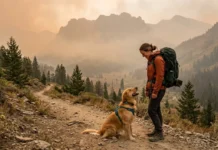
Turn back when you spot darkening clouds, hear thunder, or feel a sudden gust-front temperature drop. Watch your dog too—stiff posture, pinned ears, and pacing often signal a storm before you notice it yourself. Check NWS alerts, nowcast radar, and barometric pressure below 29.80 inHg for added warning. Factor in heat index above 85°F and thickening fog that erodes visibility. These combined signals, human and canine, tell you exactly when it’s time to head out—there’s more to each one below.
TLDR Key Takeaways
- Watch for darkening clouds, towering cumulonimbus, or an anvil top spreading overhead—descend immediately.
- Audible thunder means immediate danger, so turn back before the storm gets closer.
- Dense fog reducing visibility to a few meters removes any safety margin on the trail.
- Trust your dog’s instincts—pacing, pinned ears, or stiff posture may signal an approaching storm.
- Heed official alerts like lightning, flash flood, tornado, or ice-storm warnings as immediate turn-back signals.
What Weather Signs Mean You Shouldn’t Hike With Your Dog?
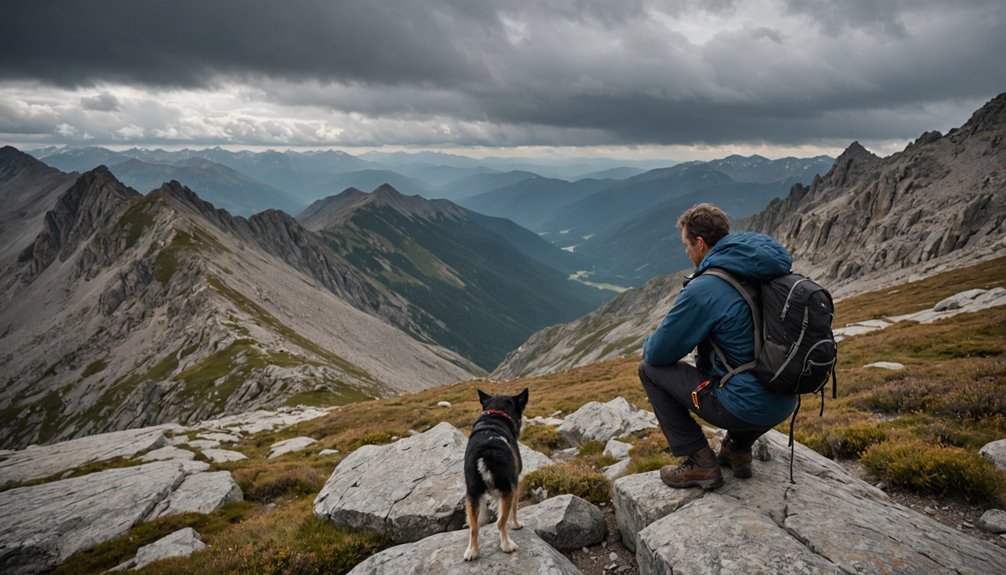
Before you clip on the leash, check the sky, the thermometer, and the forecast—your dog can’t tell you when conditions turn dangerous, so you have to read the signs yourself.
Skip the trail if temperatures may climb past 70°F, or if your dog starts panting hard, slowing down, or showing glassy eyes and a bright red tongue.
Heed storm signals early: darkening clouds, towering cumulonimbus, or audible thunder mean you’re already in danger territory.
Don’t wait for lightning to close in—leave ridges and exposed high points the moment weather warnings appear.
Dense fog that hides the trail ahead means you stop, not push forward. Rain also sharpens a dog’s senses, making them more alert and more sensitive to sounds and smells around them, which can be a useful early warning sign for owners paying attention.
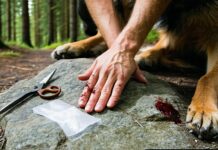
Heavy rain paired with wind or thunder isn’t worth the risk. Climatic conditions in the mountains can change rapidly, with sudden strong winds and sideways rain, so changing mountain weather should never be underestimated. Always pack a first-aid kit so you’re prepared if sudden weather changes lead to an injury on the trail.
Freedom on the trail means knowing when to turn back before conditions force the decision for you.
Check Weather Alerts and Radar Before You Hit the Trail
Once you’ve picked your trail, don’t just glance at the sky—pull up official alerts first. Check the National Weather Service, Environment Canada, or your local meteorological agency for watches and warnings tied to your route.
Treat lightning, flash flood, tornado, and ice-storm warnings as automatic turn-back signals—no exceptions for you or your dog. Cross-check county and park emergency alerts for localized hazards like fire or flooding that national forecasts might miss.
Then get tactical with radar. Weather forecasting has evolved beyond daily outlooks—use short-term nowcast radar to track storm cells relative to your trailhead in real time. Dogs with black coats absorb excessive heat and can overheat quickly even on short hikes, so factor coat color into your turnaround decisions as well. Remember that dogs cannot sweat like humans, which puts them at higher risk of heatstroke during unexpectedly hot or humid stretches on the trail.
Identify gaps between bands to time your start, and set firm turnaround points before storms arrive. Smart trail planning means matching your freedom to move with the data that keeps you moving safely, and if your dog starts refusing to walk further, treat it as a clear signal to stop, offer water, and head back immediately.
Why Barometric Pressure Drops Matter for Hiking Dogs
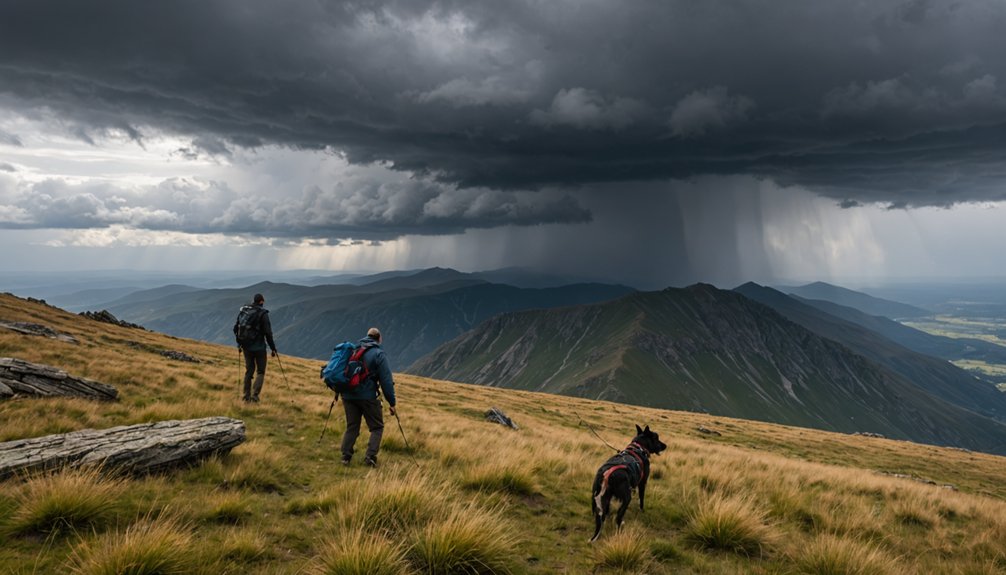
While your dog can’t read a barometer, her body reads pressure changes constantly, and that silent gauge often tells you more than a forecast app does.
Barometric shifts below 29.80 inHg signal storms brewing, and your dog feels it first. Pressure drops expand synovial fluid in her joints, flare arthritis pain, and stress her Eustachian tubes and sinuses like altitude changes do to you. That’s why she might suddenly seem restless, clingy, or reluctant to move.
Watch her behavior as your instrument panel. Lethargy, nausea, or a stumbling gait during falling pressure isn’t stubbornness—it’s physical distress. Older dogs are especially prone to these reactions, making them more sensitive to pressure swings on the trail. Her nose changes too, tracking lower as scent patterns shift, since changes in barometric pressure alter how odors travel through the air. She may also be picking up on infrasound from distant storms, an early warning cue humans simply can’t perceive. When you notice these signs together, treat them as your cue: pressure’s dropping, and it’s time to head home.
How Dogs Sense Storms Before Humans Do
Storm anticipation runs through nearly every sense your dog owns, and canine instincts pull it all together into one clear message: move now. Dogs also have 17 muscles in their ears, compared to just 9 in humans, giving them a remarkable ability to capture faint sounds from far away.
- Ears that outperform yours: Your dog picks up vibrations up to 35,000 per second, catching distant thunder rumbling 25 meters away or more, long before you hear a thing.
- A nose built for change: With 220 million olfactory cells, your dog smells ionized air and ozone hours ahead, the metallic scent that precedes rain.
- Paws that feel it coming: Sensitive limbs and bone structure register ground microvibrations from lightning and thunder, similar to how animals sense seismic waves. Even before these physical cues fully develop, your dog may already be reacting to subtle changes in air pressure that signal a storm is approaching. Some dogs may even show signs of astrafobia, a genuine fear of thunderstorms rooted in these heightened sensory experiences.
Trust that instinct—it’s reading what you can’t.
Body Language Signs Your Dog Is Reading the Sky
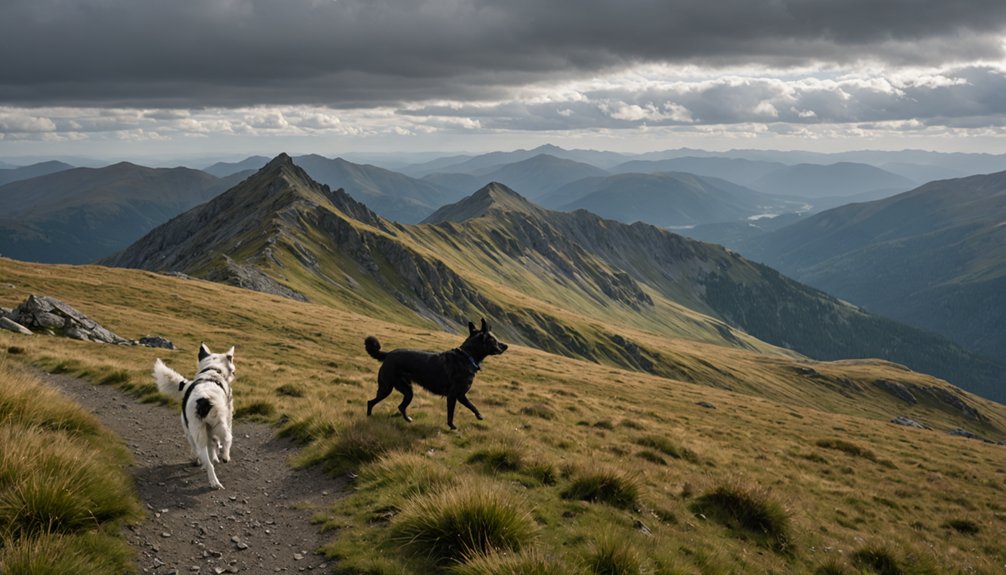
Long before the first raindrop falls, your dog‘s body starts telling the story. You’ll notice the shift first in posture—a relaxed stance turning stiff, weight pressing forward, muscles tight. Watch the ears: pinned back or suddenly locked toward a sound you can’t hear yet. The tail tucks, pupils widen, and the jaw sets tense. This is canine behavior speaking a language older than words.
Then comes the movement. Your dog paces, scratches at doors, or tries to squeeze into small, dark spaces before you’ve spotted a single cloud. Panting starts without heat to explain it. Whining rises toward nothing visible. Your dog may also seek out grounded surfaces like tile or metal, reacting to a static electricity buildup in their fur long before the storm’s true arrival. Some dogs will even bark at distant thunder or infrasound frequencies humans simply cannot detect, another early clue that a storm is on its way.
Read these signs early, and you’ll understand storm anxiety before it peaks—giving you time to turn back and keep your dog safe. With time, dogs learn to associate these bodily sensations with an approaching storm, forming a kind of learned weather memory that sharpens their instincts season after season.
Why Is Your Dog Suddenly Clingy or Restless?
Why does your dog suddenly refuse to leave your side? This shift in dog behavior isn’t random—it’s information.
Before you assume the weather’s to blame, rule out other triggers stealing your dog’s independence and your freedom to roam.
- Physical pain or illness: Hidden discomfort, joint pain, or sensory loss often drives sudden clinginess as your dog seeks security.
- Stress and anxiety: Loud environments, unfamiliar situations, or separation fears push your dog into constant contact-seeking mode.
- Disrupted routines: New people, moving homes, or schedule changes can leave your dog unsettled and glued to your legs.
Pet wellness isn’t just physical—it’s emotional stability, too. Once you’ve ruled out these causes, you’ll know when restlessness genuinely signals a storm rolling in.
Cloud Patterns That Signal It’s Time to Turn Around
As your dog scans the horizon and hesitates on the trail, take a cue from the sky above you both.
Cloud formations tell you what’s coming long before your dog’s instincts do.
A uniform gray altostratus sheet warns of steady rain within hours.
Dark nimbostratus means it’s already begun—wet, prolonged, and dangerous for hypothermia risk.
Watch cumulus clouds swell into cauliflower shapes; that vertical growth into cumulonimbus signals thunderstorms, hail, and lightning ahead.
An anvil top spreading overhead is your storm signal to descend now, not later.
Thin cirrus clouds thickening into a hazy veil mean a front’s approaching within a day or two.
Read these storm signals honestly, trust your dog’s unease, and turn back before the sky forces your hand.
Sudden Wind Shifts and Gust Fronts to Watch For
Clouds aren’t the only messenger—your skin and your dog’s ears will pick up what’s coming next.
Wind warnings often arrive before the storm itself.
A steady breeze that suddenly swings direction or turns gusty signals an outflow boundary pushing ahead of a thunderstorm.
That cool blast hitting your face—often a 3–10°F drop—is a gust front, and it means the storm’s downdraft has already arrived, even if rain hasn’t.
Watch for these storm signals on the trail:
- Wind speed jumps from calm to 25+ mph gusts with no visible cause
- Direction flips from warm southerly flow to cool, sharp northerly wind
- Debris kicks up—dust, leaves, branches suddenly airborne
When you feel this shift, turn back immediately.
Your dog’s instincts are already telling you the same thing.
Heat Index Thresholds That Put Your Dog at Risk
While your dog can’t tell you the humidity reading, her panting, glassy eyes, and slowing pace are already doing the math for you. Heat risks aren’t just about temperature—they’re about temperature plus humidity working together.
Use the 150 rule: add the air temperature to the humidity percentage. Hit 150, and you’re in unsafe territory. A heat index above 85°F marks the start of real danger; cross 95-98°F, and most dogs can’t survive more than six hours exposed. At 105°F or higher, stay indoors—period.
Know your temperature thresholds before you head out: below 75°F is generally safe, 75-80°F calls for shade and water, and 80-85°F means shorter hikes. Once you hit “caution” zones, cap outdoor time at 20 minutes. Your freedom to roam depends on respecting these limits.
Fog, Humidity, and Scent Cues Worth Noticing on Trail
Fog rolling across the trail tells you the air’s hit its saturation point—relative humidity near 100%, with temperature sitting right at the dew point.
That fog presence isn’t just atmosphere—it’s information.
Watch trail visibility drop to a few meters, and you’ve lost your margin for error, especially near ridges or drop-offs.
Humidity effects cut both ways for scent tracking.
High humidity enhances scent retention, letting your dog work tighter to the actual path.
But fog formation changes the game: still air lets human scent hang and drift, confusing even a skilled nose.
Stay sharp for these scent cues on trail:
- Earthy smells rising from soil signal weather shifts approaching
- Muffled horizons and flat light warning of thickening fog
- Sudden scent “clouds” that scatter your dog’s focus at junctions
Trust these signals—they’re your early warning system.
When Panting or Refusing to Walk Means Real Trouble
Your dog’s body reads weather too, and it’s telling you something fog and scent cues can’t.
Panting issues that outpace exertion, a wide flat tongue, or an open mouth that won’t close are signals of heat exhaustion, not stubbornness.
Stop moving the second panting won’t settle after shade and water.
That’s your line in the sand.
Refusing to walk, lying down, or staggering means the danger’s already progressed.
Don’t coax a dog forward through this—it’s not laziness, it’s physiology failing.
Bright red gums, glazed eyes, or a rapid heartbeat paired with reluctance to move demand immediate retreat and vet care, not a slower pace.
Your freedom on the trail depends on reading these cues fast.
Ignore them, and the hike ends in an emergency, not a story.
Set Turnaround Times and Exit Points Before You Hike
Before you clip the leash on, decide when you’ll turn around—don’t leave it to trail-side negotiation.
Real trail planning happens at home, not when your dog’s already flagging on a ridge with the sun dropping.
Set your turnaround at half your estimated trip time, or 45% of the window before your must-be-back time—whichever comes first.
Build in safety margins for weather, altitude, and your dog’s slower pace on the return.
- Map bail-out points where you can exit quickly if paws, weather, or energy fail
- Set a hard must-be-back time, at least 60 minutes before sunset
- Flag injury triggers—limping or torn pads mean immediate exit, no exceptions
Commit to the plan before emotions or summit fever take over.
Frequently Asked Questions
Are Certain Dog Breeds More Sensitive to Weather Changes Than Others?
Yes, you’ll notice breed characteristics directly shape weather tolerance. Brachycephalic breeds struggle in heat; small, thin-coated dogs shiver in cold. Watch your dog’s behavior closely—it’ll tell you when to push forward or turn back.
Can Age or Health Conditions Affect a Dog’s Storm-Sensing Ability?
Yes, absolutely. Age and health directly shape canine behavior—pain, hearing loss, and cognitive decline can dull or heighten dog instincts around storms. You’ll notice shifts in sensitivity, so trust your observations and adjust your trail plans accordingly.
What Should I Pack in a First-Aid Kit for Weather Emergencies on Trail?
Pack emergency supplies: a thermal blanket, antiseptic wipes, blister pads, elastic bandages, and pain relievers. Check weather forecasts before heading out, add a whistle and headlamp, and you’re free to roam confidently.
How Do I Safely Calm an Anxious Dog During an Unexpected Storm?
Find storm shelters fast, tuck your dog into a covered, quiet spot away from wind and flashes. Stay calm, use calming aids like a pressure wrap, and offer treats—you’re both in control here.
Should Puppies or Senior Dogs Follow Different Turnaround Guidelines?
Yes—you’ll follow separate rules. Puppy guidelines mean short distances, early turnarounds, and gradual increases to protect growing joints. Senior limits mean flatter routes, frequent breaks, and earlier turnback at heat or fatigue signs. Adjust freely to your dog’s needs.
Conclusion
You don’t need a meteorology degree to hike smart—you need attention. Watch the sky, check the radar, and trust your dog’s instincts when the barometric pressure shifts. If your dog starts pacing, panting hard, or planting their feet, that’s your cue to turn around, not push through. Set your turnaround time before you leave, know your exit points, and respect the signs. Your dog’s safety depends on your judgment, not the forecast alone.
References
- https://www.reddit.com/r/explainlikeimfive/comments/pdx8od/eli5_how_is_it_that_some_animals_seem_to_know/
- https://blindpigandtheacorn.com/dog-days-and-weather-signs/
- https://www.newlifek9s.org/post/how-do-dogs-sense-a-coming-storm
- https://weather.com/nature/wild-animals/news/2025-03-25-how-dogs-sense-storms
- https://www.youtube.com/watch?v=B2OlGicgI64
- https://www.dogtopia.com/faq/do-dogs-sense-a-storm-is-coming/
- https://iheartdogs.com/ways-your-dog-predicts-the-weather-better-than-any-forecast/
- https://wagwalking.com/sense/can-dogs-feels-barometric-pressure
- https://www.nonstopdogwear.com/es/blogs/our-blogs/hiking-tips
- https://blog.terranea.es/senderismo-con-perros/