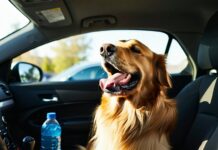
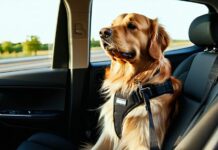
During a sudden stop, your loose gear keeps moving at full speed until something halts it—often your dog. Secure heavy items first, since mass multiplies crash force. Anchor cargo to factory-rated tie-down points and use a barrier to keep your dog contained. Sweep floorboards, consoles, and door bins before every trip. Match your dog’s restraint to its position, keeping it in the back seat. There’s more to know about preventing these dangerous projectiles.
TLDR Key Takeaways
- Secure heavy items first, since mass multiplies crash force when loose gear becomes an airborne projectile during sudden stops.
- Sweep hidden zones—floorboards, seat pockets, consoles, door bins, cup holders, and under-seat spaces—removing bottles, tools, groceries, and charging bricks.
- Anchor cargo to factory-approved tie-down points and use a cargo barrier to keep gear from intruding into the dog’s space.
- Store low against fixed surfaces rather than on seats, and pack bowls, treats, and bedding into closed bins.
- Run a pull test for sliding, rattling, or tipping, then recheck all gear after passengers load.
How Loose Gear Turns Into Deadly Projectiles
When you slam on the brakes, every unsecured object in your vehicle keeps moving forward at speed until something stops it. That “something” can be your dog, your head, or your neck. Kinetic energy basics explain why: an object’s force increases rapidly with its weight and speed, so even a small water bottle, laptop, or tool strikes hard at crash speeds.
Crash speed dynamics mean a sudden stop launches loose gear forward like a projectile. Heavy or rigid items—luggage, groceries, sports gear—pose the greatest danger, especially when they’re stored on seats rather than low against a fixed surface.
Shifting loads can also interfere with your control during braking or turning.
You protect everyone aboard, including your dog, by treating loose gear as a genuine hazard.
The Real Force Behind a Sudden Stop
Inertia drives the danger behind every sudden stop. When you brake hard, your vehicle slows first, but anything loose inside keeps moving at the original speed. That’s inertia—the tendency to resist changes in motion.
Understanding inertia vs momentum matters here: inertia keeps objects moving, while momentum, which depends on mass and speed, determines how much force must be absorbed when they finally stop.
The crash deceleration effects intensify because a sudden stop compresses the change in velocity into a very short time. That shorter time multiplies the force transferred to whatever halts the object—a seatback, crate wall, or your dog.
Newton’s first law explains it all: nothing throws your gear forward. It simply keeps moving until something stops it, often violently.
Spot the Riskiest Loose Objects First
Not every loose object poses the same threat, so you need to find the worst offenders before you turn the key. Like every careful driver in our community, you’ll start with heavy objects, since mass multiplies crash force when cargo goes airborne. Then identify seat-level hazards, because items resting on seats launch forward fastest in a sudden stop.
Scan these high-risk zones first:
- Passenger seats and floors: remove irregular items like laptops, grocery bags, and purses that shift unpredictably.
- Cup holders: secure cup holder projectiles, since loose bottles and travel mugs roll or fly toward occupants.
- Areas within your dog’s reach: eliminate accessible chewables that your pup might bite or swallow.
Prioritize anything heavy, hard, or poorly fitted.
Where Flying Items Hurt Dogs Most
Because flying items don’t strike randomly, you need to know exactly where they’re most likely to hit your dog.
The under-seat zone is the primary impact area for in-cabin carriers, since they’re designed to fit beneath the seat ahead and sit close to the floor.
Items dropping from seats, laps, or overhead most often strike your dog’s head, back, or shoulders there.
That’s why safety carrier placement matters: keep the carrier off the floor when possible, resting it on your lap or the seat beside you until boarding.
The carrier opening is another high-risk strike zone, where bags or hands can press in suddenly.
Following turbulence protection rules keeps you ahead of the sudden shifts that turn loose objects into threats during takeoff, braking, or landing.
Why SUV Cargo Areas Are So Dangerous
SUV cargo areas pose a different threat than the in-cabin spaces we’ve covered, and you need to understand why.
Unlike a sealed trunk, your SUV’s rear often connects directly to the cabin, leaving your dog exposed to shifting gear and structural intrusion.
This space frequently doubles as a crumple zone, designed to absorb impact rather than protect what’s inside.
Here’s what makes this area especially risky:
- No barrier: Loose items fly forward into seat backs, headrests, and your dog.
- Stability loss: High or heavy loads raise rollover risk during emergency maneuvers.
- Crash intrusion: Deforming rear structure compresses anything behind the second row.
That’s why Cargo Anchor Options and Seatbelt Compatibility matter—they keep your gear and your dog secured together.
Anchor Heavy Gear to Official Tie-Down Points
Behind every safe load is an anchor point that’s built to hold it.
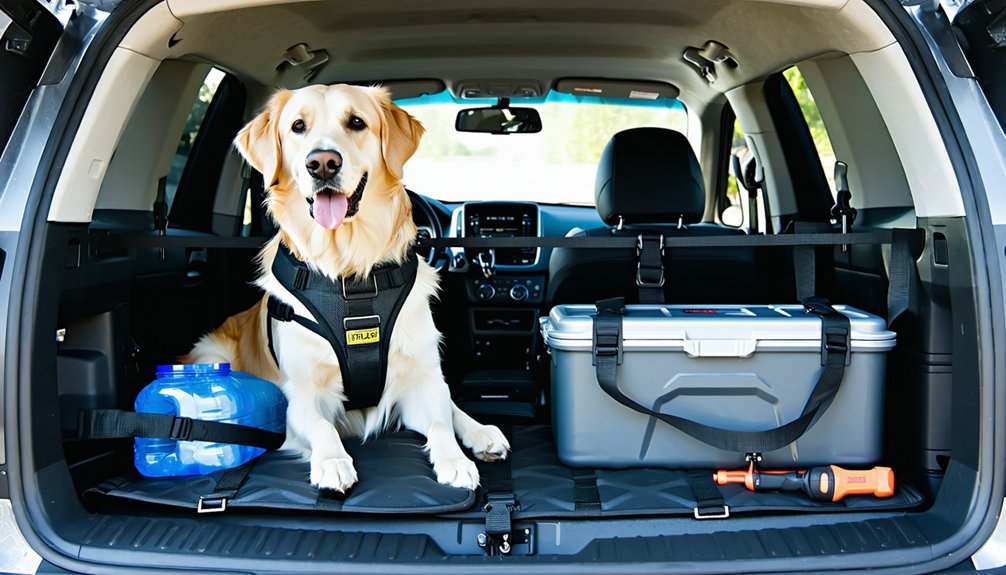
When you’re securing heavy gear in your SUV, use factory approved anchors as your first choice—they’re engineered for load handling and reduce the risk of failure under tension.
Don’t trust plastic trim, weak accessories, or moving parts to hold anything.
Before you load up, inspect anchor integrity for wear, cracks, deformation, or looseness.
Connect your straps to solid structural points only, and complete a tie down WLL verification so the combined rating equals at least 50% of your cargo weight.
Where chains or straps cross sharp edges, protect strap edges with guards to prevent cutting or abrasion.
Get these basics right, and you keep your dog and your gear safe together.
Use Cargo Barriers to Shield Your Dog
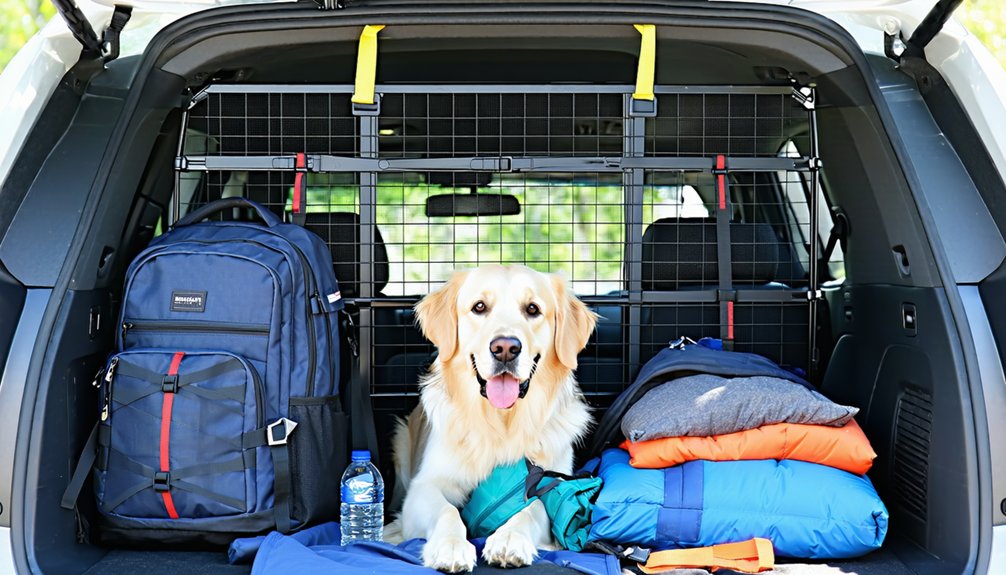
Anchored gear handles the heavy threats, but you still need a wall between your dog and the cabin.
A cargo barrier creates a physical partition that keeps your dog in the rear during a sudden stop or collision, preventing forward projection into the passenger space.
Like fellow drivers who plan ahead, build barrier fit adjustments into your travel checklist routines so containment stays reliable across vehicles.
When choosing one, focus on:
- Fit — match vehicle dimensions and pet size, using adjustable models (31–45 inches high, 39–65 inches wide) to close gaps.
- Materials — pick steel or heavy-duty construction that withstands forward force.
- Visibility — choose see-through mesh windows to protect rearward sightlines.
Pair it with an organized cargo area for full protection.
Secure Crates So They Don’t Slide
Even with a sturdy barrier in place, an unsecured crate becomes a projectile the moment you brake hard.
Start with non slip placement: lay a rubber liner or coarse fabric beneath the crate, sized to its full footprint, so it grips smooth cargo floors.
Next, anchor the crate to built-in tie-down points or D-rings using ratchet or heavy-duty straps—never bungee cords.
Use at least two straps for stability, four for larger kennels, connecting only to reinforced, load-bearing points.
Check strap tension until there’s no slack and the crate can’t rock.
Confirm crate leveling on a flat surface, positioned snugly against a seat or barrier.
Finish with friction testing: push and shake firmly before driving.
Any shifting means you tighten up or add underlay support.
Stow Small Loose Items Out of the Cabin
Treating loose gear as a cabin hazard rather than mere clutter, you should move small items out of the passenger area before every trip. In a sudden stop, water bottles, luggage, and travel gear become projectiles that can injure your dog or you. Use trunk barriers and enclosed cargo space to keep these items farther from your dog and out of reach during hard braking.
To reduce cabin clutter effectively:
- Stow gear in the trunk—keep small items behind a barrier, not loose on seats.
- Organize by category—group food, treats, medications, and travel tools together for easy retrieval.
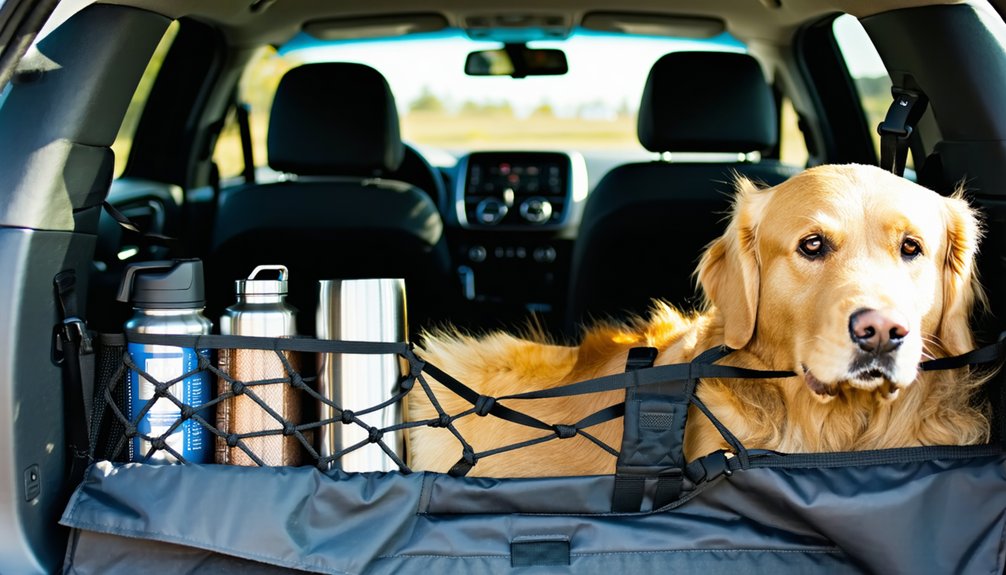
- Keep essentials contained—use cargo nets, mesh organizers, and clear, stackable containers.
When you consolidate supplies this way, you protect everyone who travels alongside you.
Match Restraints to Your Dog’s Position
The restraint you choose has to match where your dog actually rides. Like the rest of us who care, you’ll want the back seat, since front-seat airbags can cause severe crash injuries.
When your system and vehicle allow it, center your dog to reduce lateral movement. Get the seating position alignment right, then route harness correctly through the seat-belt path or dedicated connector strap exactly as the manufacturer instructs.
Minimize slack so your dog can’t surge forward, get tangled, or risk ejection during hard braking. Keep your dog inside the cabin, not on a ute tray or in an open cargo area.
A proper setup limits jumping, pacing, and turning while still letting your dog sit, lie down, and ride steadily.
Check Tether and Anchor Strength First
A weak anchor fails exactly when you need it most. Before you secure your dog, verify your gear’s rated capacity matches your dog’s pulling force during a sudden stop. Smart owners like you don’t gamble on guesswork—you check the numbers and trust the evidence.
Follow these three essentials:
- Confirm rated capacity: Your anchor must support 2 to 3 times your dog’s weight. A 160-pound dog needs an anchor rated for at least 320 pounds.
- Perform anchor inspection: Check regularly for cracks, rust, or loosening that compromise strength.
- Watch for tether fraying: Inspect nylon or coated cable for wear, tear, and abrasion.
Keep tether weight under 1/10th of your dog’s weight, and you’ll protect what matters most.
Run This Pre-Trip Loose Gear Check
Scan your vehicle before every trip, because loose gear turns into a projectile the moment you brake hard.
Start with a hidden object sweep: check floorboards, seat pockets, center consoles, door bins, and under-seat spaces for small hard items that can slide forward.
Clear the dashboard and rear parcel shelf, then pull water bottles, tools, groceries, and charging bricks out of reach.
Run the leash fit check next—confirm the collar allows two fingers and the restraining system sits snugly without rotating.
Pack pet bowls, treats, and bedding into closed bins, then apply a quick pull test to catch sliding, rattling, or tipping.
Finish with a gear recheck step after you load passengers, since added items create new hazards.
We secure everything before moving, never after.
Frequently Asked Questions
Can I Store Loose Gear in a Roof Box Instead?
Yes, but only for gear. Using Roof Racks, you’ll move cargo outside the cabin—just secure items inside the box. Your dog still needs a crate or lead with proper ventilation, never roof storage alone.
How Often Should I Replace Cargo Nets and Bungee Cords?
Replace regularly-used cargo nets every 24 months, seasonal ones every 36. Make Wear Inspection your safety-critical routine, retiring anything frayed or damaged immediately. For Bungee Lifespan, swap cords showing cracks or stretch—we protect our dogs together.
Are Pet Seat Covers Helpful for Containing Loose Items?
They help at surface level, but they’re not crash safety gear. You’ll still need seatbelt storage, secured bins, or proper tether strength for loose items—covers won’t restrain anything heavy, so let’s secure gear together correctly.
What Should I Do With Gear During Long Road Trips?
Stop every few hours, rechecking straps and anchor points like responsible travelers do. Keep useful hydration planning in mind, securing food containers low and centered. You’ll keep your gear immovable and your dog safe together.
Does Securing Gear Differ for Electric Vehicles or Trucks?
No, the method’s identical—anchor crates, restraints, or barriers using crash-tested gear like you would for child safety. For EVs, you’ll add thermal planning; for trucks, keep everything cabin-only, never in the bed. We’ve got you covered.
Conclusion
You’ve got the facts: a sudden stop turns everyday items into projectiles capable of seriously injuring your dog. Don’t gamble with loose gear. Stow small items out of the cabin, match every restraint to your dog’s position, and verify your tethers and anchors can handle real crash forces. Run the pre-trip check every single time—it takes seconds. Your dog can’t buckle up alone, so you’re responsible for making each ride genuinely safe.
References
- https://julius-k9.com/what-to-do-if-the-dog-wriggles-out-of-the-harness/
- https://www.sladeczech.com/news/he-s-friendly-until-he-slams-into-your-dog
- https://notesfromadogwalker.com/2012/04/03/carabiner-could-save-your-dogs-life/
- https://k9turbotraining.com/what-to-do-if-your-dog-gets-loose/
- https://petharmonytraining.com/5-tips-for-when-your-dog-gets-loose/
- https://www.youtube.com/watch?v=BceBaeNBeX4
- https://explore.st-aug.edu/exp/understanding-dog-knots-a-comprehensive-guide-for-dog-owners
- https://www.workingdogmagazine.com/vehicle-safety-beyond-heat/
- https://www.bluedogpetcare.com/best-tips-for-keeping-a-dog-from-getting-loose/
- https://www.reddit.com/r/Dogtraining/comments/roziy7/largedog_breed_owners_how_do_you_handle_your_dog/
- https://www.youtube.com/shorts/74TkJ8oHYiI
- https://saferide4kids.com/blog/loose-objects-become-projectiles/
- https://afma.org.au/how-loose-items-can-become-projectiles-in-a-crash/
- https://www.youtube.com/watch?v=p69kSGlyyOs
- https://www.gesinjuryattorneys.com/can-loose-objects-be-deadly-in-car-crashes
- https://buckleupmn.org/resources/projectiles/
- https://www.youtube.com/watch?v=Z9IZe4WWUZQ
- https://www.mdbighorn.ca/DocumentCenter/View/367/Hazards-of-Loose-Objects-in-a-Vehicle-PDF
- https://coactionspecialty.safetynow.com/driver-safety-the-dangers-of-loose-cargo-meeting-kit/?print=pdf
- https://www.acginjurylaw.com/blog/loose-items-in-your-car-cause-accident/