Protect your road dog with year-round, dual flea-tick prevention matched to weight, age, and travel routes. Choose long-duration, water-resistant options like Bravecto’s 3-month chew or Seresto’s 8-month collar, and ask your vet about isoxazoline chewables if your dog has a seizure history. Back these up with daily nose-to-tail tick checks, since transmission often needs 24–48 hours. Wash bedding in 140°F water, and plan routes around tick hotspots. There’s more you’ll want to know.
TLDR Key Takeaways
- Choose dual flea–tick protection matched to your dog’s weight, age, and life stage, preferring long-duration, water-resistant options for travel simplicity.
- Maintain year-round dosing since shifting climates and indoor exposures keep ticks active beyond traditional seasons, never exceeding label intervals.
- Perform daily nose-to-tail tick checks, since transmission often requires 24–48 hours of attachment, enabling early removal.
- Remove attached ticks with gloves and fine-point tweezers, pulling slow, steady, and straight upward, then disinfect and seal in alcohol.
- Launder bedding in 140°F/60°C water with heat drying, and vacuum sleeping zones daily with a HEPA vacuum during infestations.
Why Road Life Raises Your Dog’s Tick Risk
When you live on the road, your dog encounters far more tick habitat than the average house pet ever will. Every stop—forests, fields, campgrounds, rest areas—delivers cross ecosystem exposure, putting your dog in contact with varied tick species and larger populations. Dogs walked through wooded, brushy, or tall-grass areas face considerably higher odds of tick attachment than those kept on pavement.
Constant movement means encountering new regional species like Ixodes scapularis, Amblyomma americanum, and Dermacentor, each carrying different pathogens. Crossing state lines shifts you between peak tick seasons, making risk nearly year-round. Rural and peri-urban stopovers bring wildlife host contact—deer, rodents, and birds that sustain large tick populations.
Understanding these layered risks is your first step toward protecting your traveling companion.
Collars vs Spot-Ons vs Oral Tick Meds
Choosing the right tick and flea defense for your road dog comes down to three proven options: collars, spot-ons, and oral medications. Each fits different travel lifestyles, so match the method to your routine and your dog’s needs.
| Feature | Collars | Oral Meds |
|---|---|---|
| Duration | Up to 8 months | Monthly typical |
| Application | Non-oral, low-touch | Requires dosing |
| GI sensitivity | Avoids it | May aggravate |
| Repellency | Repellency variability | Kills after attachment |
| Key risk | Safety collar fit issues | Stomach upset |
Collars like Seresto deliver long-duration, low-maintenance protection—ideal when you forget monthly doses or face limited storage. Watch the safety collar fit to make certain proper distribution and prevent irritation. Remember, repellency variability means some collars kill ticks only after they attach, leaving a transmission window worth considering.
Pick the Right Flea and Tick Preventive
Picking the right preventive starts with matching coverage to your dog’s exposure, because road life throws multiple environments and wildlife vectors at them. You’ll want dual flea–tick protection that defends against tick-borne diseases like Lyme, ehrlichiosis, and anaplasmosis, plus flea life-cycle control to stop reinfestation in your confined van or RV.
Match the product to your dog’s weight, age, and life stage to nail the correct dose. If your dog has a seizure history, talk with your vet before choosing isoxazoline chewables. For dogs prone to flea allergy or skin reactions, oral options often beat topicals and certain collars.
Confirm species coverage for your travel routes using the label and veterinary guidance, and favor long-duration, water-resistant options that keep your companion protected mile after mile.
How Often Should You Dose Ticks on the Road?
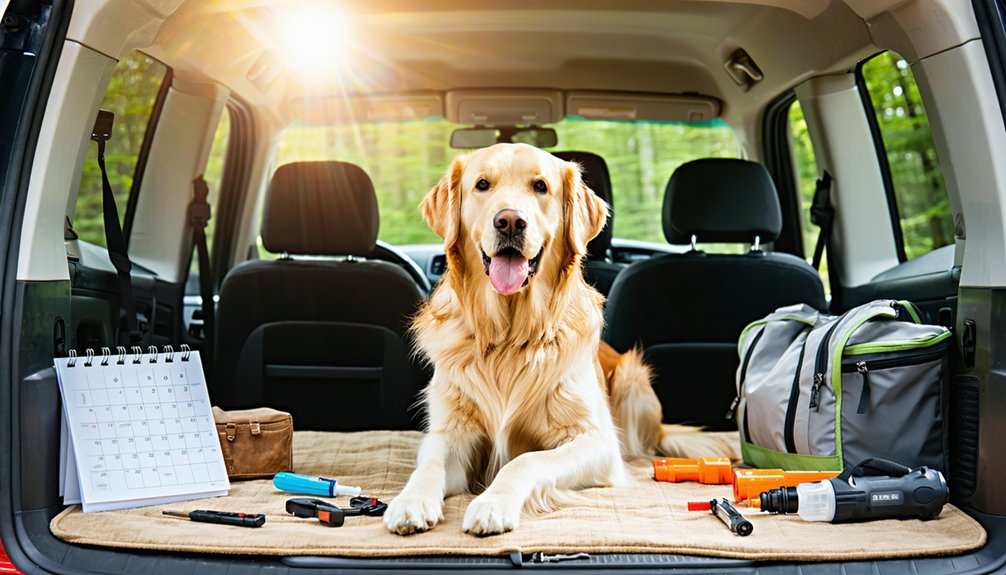
Always dose year-round, even in cooler months, because shifting climates and indoor exposures keep ticks active well outside the traditional season. Most oral and topical products—NexGard, Simparica, Credelio, Frontline, K9 Advantix II, and Vectra 3D—require monthly re-dosing. Longer-acting options simplify travel through Missed Dose Avoidance.
| Product | Type | Interval |
|---|---|---|
| NexGard/Simparica | Oral chew | 1 month |
| Bravecto chew | Oral | 3 months |
| Seresto | Collar | 8 months |
Follow label directions for minimum safe intervals; never exceed them. Use Risk Based Scheduling, aligning protection with high-risk regions, peak spring and fall seasons, and daily outdoor activity. In endemic, wooded, or coastal areas, you’ll want strict on-time dosing or long-acting products. Consistent, on-schedule dosing keeps your traveling companion protected and your community thriving together.
Start Tick Prevention Before You Hit the Road
Before you turn the ignition key, you’ll want your tick-prevention plan fully in motion. Book a pre trip vet visit at least 2–4 weeks out to review tick risk, screen for tick-borne disease, and update your dog’s preventive program.
Nail down vaccination timing, deworming, and heartworm coverage early so protection’s steady before departure.
Get your medication scheduling right: start oral isoxazolines a full dosing interval ahead, apply pyrethroid spot-ons 3 days to a week before, and fit repellent collars 48 hours to a week out.
Combine products only under veterinary guidance to avoid toxicity.
Sort your route paperwork too—health certificates, tick-prevention history, and destination parasite regulations for every state or country.
Map 24-hour clinics, and you’ll travel ready, confident, and covered.
Use Sprays and Shampoos as Backup Defense
Reach for sprays and shampoos as your short-acting backup, not your frontline defense. These products act as contact killers against fleas and some ticks, but their residual protection lasts only hours to a couple of days—never a full month.
Use them to support your dog’s primary preventive (oral, topical, or collar) and for knockdown after heavy exposure at wooded campsites, dog parks, or infested campgrounds.
When bathing, master the contact time technique: wet the coat completely down to the skin, then wait 5–10 minutes before rinsing.
With sprays, ruffle the coat and target tick hot spots—ears, neck, armpits, groin, tail base, and toes.
Always perform skin monitoring checks for redness, itching, or lethargy, and call your vet if anything seems off.
Add Mosquito and Sandfly Repellents Too

While your tick and flea preventives handle the most obvious threats, mosquitoes and sandflies demand their own line of defense.
Your monthly heartworm preventive kills the larvae mosquitoes transmit, but it won’t repel sandflies that spread *Leishmania infantum*. That’s where topical repellents complete your protocol.
Permethrin-based spot-ons repel and rapidly kill mosquitoes and sandflies alike, with mosquito repellency duration typically lasting three to four weeks.
For dedicated Leishmania risk mitigation, deltamethrin and flumethrin collars and spot-ons show documented sandfly repellency—essential if you’re traveling through endemic Mediterranean, Latin American, or affected U.S. regions.
Dusk and dawn activity, camping near water, and wooded stops amplify exposure all season.
Pair systemic preventives with topical repellents, and you’ll cover every vector your dog encounters.
Run a Daily Nose-to-Tail Tick Check
Even the best preventives can’t guarantee 100% tick kill or repel in every condition, which is why a daily nose-to-tail check is your last line of defense.
Early detection matters because most tick-borne pathogens need 24–48 hours of attachment before transmitting Lyme disease, ehrlichiosis, or anaplasmosis.
Start with a hands-on sweep, pressing gently to learn your dog’s skin texture and feel for firm bumps.
Then work systematically: nose, muzzle, eyes, ears, neck, chest, armpits, belly, groin, legs, paws, tail, and perianal region.
Use fingertips in small circles to catch tiny nymphs, and rely on fur parting to inspect at skin level.
Prioritize warm folds, ear bases, and between toes.
Just 3–5 minutes daily keeps your traveling companion safe across every changing habitat.
Remove Attached Ticks the Safe Way
When you find an attached tick, how you remove it matters as much as catching it early.
Pull on disposable gloves for zoonotic safety, then part the fur to fully expose the tick.
Grip it with fine-point tweezers as close to the skin as possible, targeting the mouthparts, and apply slow, steady, straight upward traction—no twisting or jerking.
With a forked tool, slide the notch under the tick and rotate gently until it releases.
Skip folk methods like burning or petroleum jelly; they trigger regurgitation and raise disease risk.
Afterward, clean the bite with antiseptic, disinfect your tools with alcohol, and wash your hands.
Seal the tick in alcohol, logging the date and location.
Fold this routine into your preventive schedule.
Keep Bedding and Crates Flea-Free
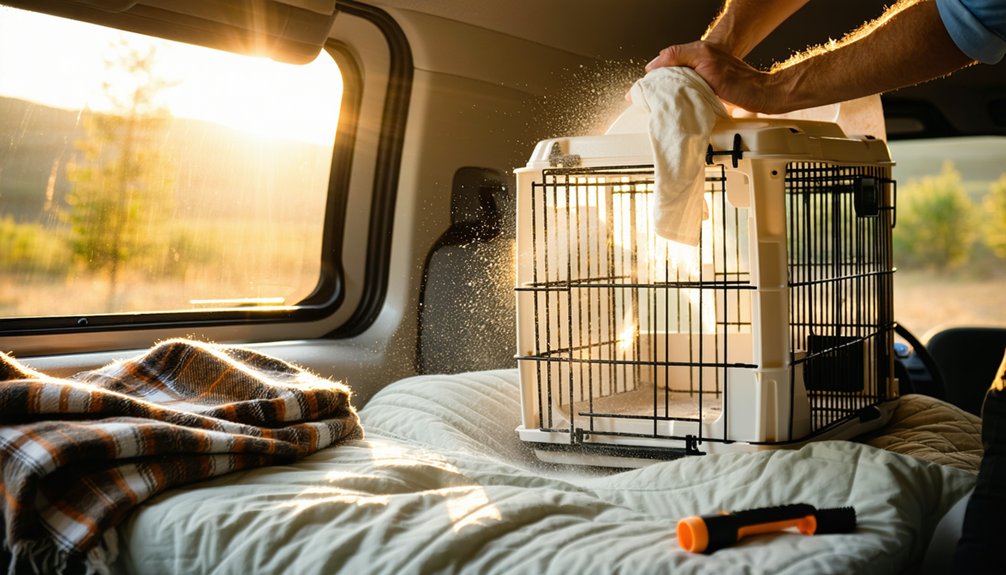
Living on the road, your dog’s bedding and crate become prime real estate for fleas if you let them. Build a weekly washing routine: launder bedding, crate pads, and washable toys in hot water (at least 140°F/60°C) when labels allow, followed by heat drying on the highest setting to kill every life stage. Vacuum around sleeping zones daily during infestations, hitting crevices and under crates with a HEPA vacuum. Maintain car cleanliness by disposing of vacuum bags immediately.
| Skip This | Risk You Face |
|---|---|
| Weekly hot wash | Eggs hatch in fabric |
| Heat drying | Larvae survive damp |
| Seasonal rotation | Gaps invite reinfestation |
Practice seasonal rotation with multiple bedding sets, so one’s always clean while another’s in use. You belong wherever your dog rests safely.
Plan Routes That Dodge Tick Hotspots
Because where you travel shapes how often ticks find your dog, route planning becomes one of your most powerful prevention tools. Climate timing matters: peak tick activity hits spring through early summer and again in early fall, especially for blacklegged ticks in the Northeast, Mid-Atlantic, and Upper Midwest.
Before entering new regions, practice map verification by checking county-level tick and Lyme risk maps published by public health agencies and universities.
To keep your crew safer, prioritize these lower-risk choices:
- Paved paths, gravel tracks, and well-maintained trails over brushy single-track.
- Open, sun-exposed fields instead of shaded, humid forest floor.
- Coastal, high-elevation, or arid routes rather than damp inland corridors.
- Campsites away from forest edges and tall vegetation.
Reroute around known hotspots.
Spot the Early Signs of Tick-Borne Disease
Even the best route planning can’t guarantee your dog never picks up a tick, so your next line of defense is knowing what infection looks like before it turns serious.
Watch for early systemic warning signs: fever above 103°F, lethargy, decreased appetite, and sudden lameness, especially the shifting-leg pattern characteristic of Lyme disease.
You might notice stiff or swollen joints, reluctance to jump or climb, and swollen lymph nodes under the jaw or behind the knees.
Pale gums, petechiae, nosebleeds, or jaundice signal blood and organ involvement—don’t wait.
Symptoms typically emerge days to weeks after a bite, sometimes months later.
When several signs cluster after recent tick exposure, you’re looking at rapid vet triage territory.
Acting fast keeps your traveling companion thriving.
Frequently Asked Questions
Can I Use Human Tick Repellents Like DEET on My Dog?
No, you shouldn’t. DEET risks are serious—toxicity warnings confirm it causes vomiting, tremors, and seizures in dogs. Keep your furry travel companion safe by choosing vet-approved, dog-specific repellents that we trust for canine protection.
Are Natural or Essential Oil Tick Preventives Safe and Effective?
They’re not reliable. Don’t fall for natural repellent myths—essential oil risks include tremors and liver injury, plus efficacy limitations mean hours, not weeks, of protection. For safety considerations, you’ll want vet-approved preventives keeping your travel companion protected.
What Should I Do if My Dog Swallows a Tick?
Don’t panic—swallowed ticks rarely cause harm. Skip home remedies, and watch for vomiting or lethargy. Check your dog for attached ticks, following proper tick removal steps. Contact emergency vet guidance if symptoms appear. You’ve got this, fellow traveler.
Do Puppies Need Different Flea and Tick Prevention Products?
Yes, you’ll need puppy-specific products. Most aren’t approved until 7–8 weeks, so puppy immunity considerations and timing dosage adjustments matter. Join fellow road-tripping owners using flea combs early, then switch to labeled preventives safely.
How Much Does Year-Round Tick Prevention Typically Cost?
You’ll typically spend $100–$360 per year, depending on budget factors like your dog’s size and purchase channel. Like fellow road-tripping owners, you’ll find product coverage matters—premium combo chews run higher, while collars keep costs comfortably lower.
Conclusion
Life on the road exposes your dog to more ticks and fleas than the average backyard ever will, but you’ve got the tools to stay ahead. Choose a vet-approved preventive, dose on schedule, and check your dog daily after every hike or campsite. Remove attached ticks promptly, keep bedding clean, and watch for early disease signs like lethargy or limping. Stay consistent, and you’ll keep your travel companion healthy mile after mile.
References
- https://www.petmd.com/dog/general-health/flea-and-tick-prevention-and-treatment-dogs
- https://www.youtube.com/watch?v=JIS7mjeVgS4
- https://nt.gov.au/__data/assets/pdf_file/0004/898528/ehrilchiosis-protect-your-dog-information-sheet.pdf
- https://petraveller.com.au/blog/leave-the-fleas-behind-why-is-it-important-to-make-sure-your-pet-is-parasite-free-before-travelling
- https://www.coggesvet.com/services/animal-health-certificates/antiparasitic-treatments-for-travelling-dogs
- https://www.animalcareclinicinc.com/single-post/2018/01/10/traveling-with-your-dog-preventing-fleas-and-ticks
- https://annapolisvet.com/blog/1392548-tips-for-traveling-with-your-pet-during-flea-and-tick
- https://www.joiipetcare.com/blogs/advice/travelling-with-your-dog-this-year-a-comprehensive-guide-to-parasite-prevention
- https://www.silveradovethospital.com/blogs/how-to-travel-with-your-pet-during-tick-and-flea-season
- https://www.vet.cornell.edu/departments-centers-and-institutes/riney-canine-health-center/canine-health-topics/flea-and-tick-prevention