Shared dog charter flights keep your dog in the cabin beside you while you split costs two ways. You can buy a per-seat ticket from operators like K9 Jets, where each seat covers one adult plus a large dog (or two small pets) for roughly $8,000–$11,000 one way. Or you can join a split-cost group that divides one chartered aircraft, often cheaper but date-dependent. Below, you’ll see exactly how each option compares.
TLDR Key Takeaways
- Shared dog charter flights split private jet costs among unrelated parties, keeping dogs in the cabin rather than stressful cargo holds.
- K9 Jets sells per-seat products covering one passenger plus one large dog or two small pets, typically priced $8,000–$11,000 one way.
- Split-cost options divide an entire chartered aircraft by seats or pets, ranging $2,500–$7,500 short-haul or $6,000–$10,000+ transatlantic.
- Flights operate once minimum bookings hit a 75% load-factor threshold, with 100% refunds or rebooking if thresholds fail.
- Both options require rabies vaccination, ISO microchip verification, and a government-endorsed health certificate issued within 10 days of travel.
What Shared Dog Charter Flights Actually Are
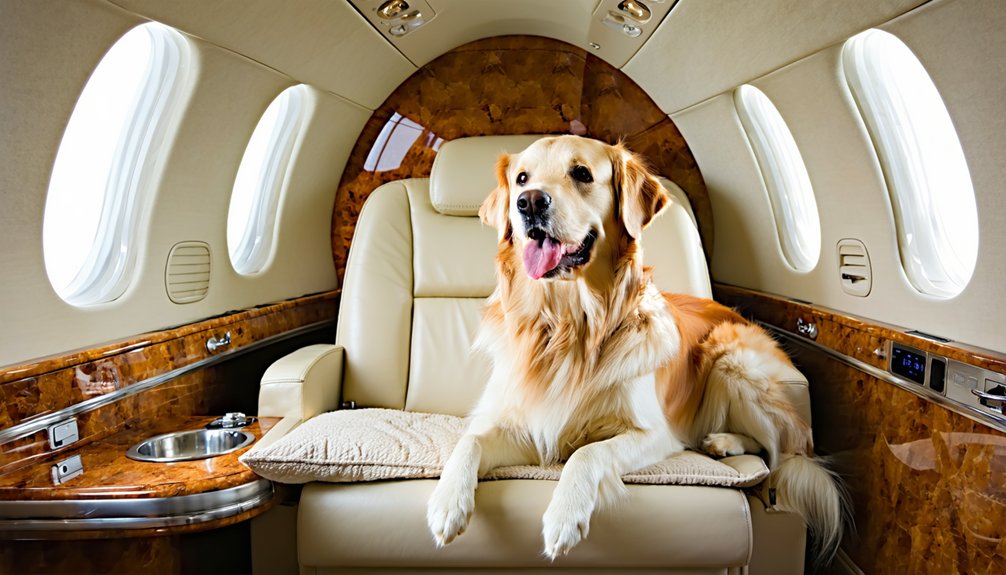
Ever wondered how you can fly your dog in the cabin without resorting to a $40,000-plus full private charter? You’re in good company. A shared dog charter flight is a private jet charter where multiple unrelated parties share the aircraft and split the costs, each booking seats that let dogs ride in the cabin.
You’ll see these marketed as “shared charter,” “semi-private,” “seat-share,” or “pay-per-seat pet charter.” When you weigh airline vs charter, the difference is clear: you get in cabin pet comfort instead of cargo-hold stress, with per-seat pricing rather than buying the whole jet.
Some flights are pet-focused, with most passengers traveling alongside animals. Others are general shared private jets that simply permit pets under specific policies. Either way, your dog stays beside you.
How K9 Jets Sells Seats by the Pet
At the heart of K9 Jets’ model sits a simple idea: the seat, not the whole aircraft, is the product you buy. Each seat you book carries you plus one large dog (over ~23 kg) or two smaller pets, so the Pet Selection Criteria directly shape how many seats your group needs. Want to bring a second large dog? You’ll buy another seat.
Seat Pricing Tiers reflect sector length and demand, typically running $8,000–$11,000 one way on core transatlantic and Dubai–Europe routes, climbing to ~$13,850 on longer London–West Coast pairings. Each all-in fare covers taxes, private terminal access, luggage, snacks, and your pet’s space.
You’re joining fellow pet owners who’ve chosen comfort and belonging over costly full-aircraft charter—sharing the cabin, splitting the cost.
How Split-Cost Group Charters Get Organized
Because no single template fits every route, split-cost group charters take shape through several distinct models, each balancing cost, control, and convenience differently.
You might join a grassroots group that charters an entire aircraft, then divides the full mission cost—hourly rate, repositioning, crew, fuel, handling, and fees—by seats or pets. Alternatively, you’ll find ad-hoc arrangements where the initial buyer posts open slots in expat or pet-travel communities. Charter organizers coordination matters here: informal MOUs clarify payments, refunds, and no-show rules before the operator confirms the manifest.
Broker-facilitated groups place multiple parties on one mission, requiring minimum headcount. Empty-leg groups fill repositioning seats for lower cost. Throughout, pet seat allocation stays capped to honor operator limits, keeping the cabin comfortable for every dog aboard.
What You’ll Pay Per Seat on Each Option
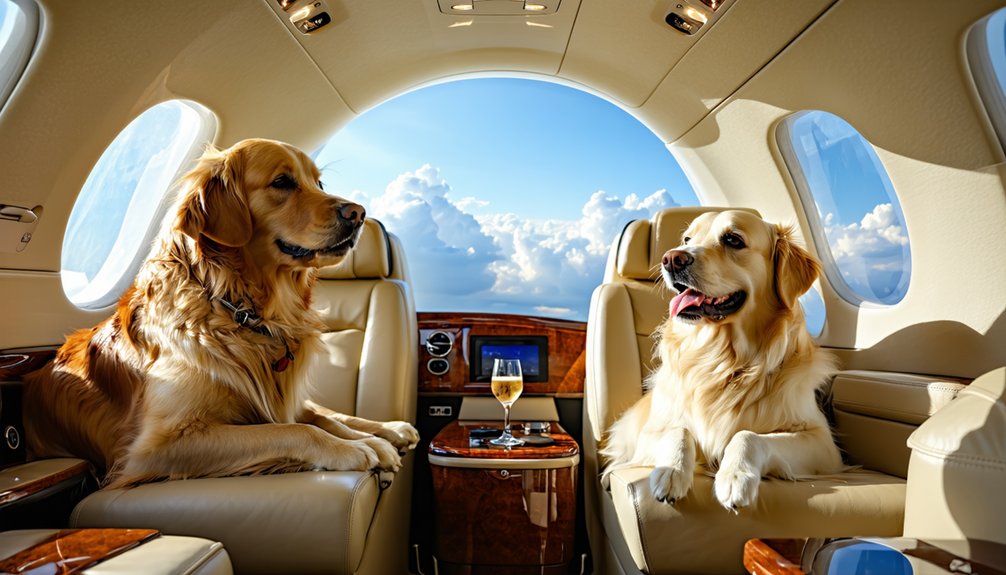
The price you’ll pay per seat depends on which model you choose, and the gap between options is real. With K9 Jets, you’ll see clear fare transparency: transatlantic seats run $8,000–$11,000 one way, with New Jersey–London commonly listed around $8,925–$9,500.
Each seat’s seat inclusion covers one adult plus one large dog (or two small pets), taxes, snacks, open bar, and about 44 lb of luggage—no surprise surcharges.
Split-cost group charters work differently. You’ll divide a $50,000–$150,000+ charter among participants, so your share swings with headcount. On shorter sectors, that lands near $2,500–$7,500 per seat.
On transatlantic routes, expect $6,000–$10,000+, often matching K9 Jets. If you prioritize certainty over chasing the lowest possible price, K9 Jets offers a stable benchmark.
Where Empty Legs Beat Both on Price
Empty legs can undercut both K9 Jets and DIY split-cost charters when you’re willing to fly on someone else’s schedule.
These repositioning flights commonly sell at 25–80% off standard charter pricing, with brokers often citing 50–75% discounts.
That turns a $10,000–$50,000 pet-friendly charter into roughly $2,500–$25,000.
Compare that to K9 Jets’ $8,925–$10,985 per seat, or the $11,000 per person owners report on private split-charters.
With smart Travel Grouping, two to four travelers sharing an empty leg pay less per seat than either option.
On short domestic hops, light-jet empty legs near $1,500–$5,000 beat structured pet products outright.
Your Negotiation Power grows as departure nears and operators race to fill the cabin—giving your group room to claim a genuinely better deal together.
How Booking and Confirmation Really Work
Once you’ve decided which option fits your budget, you’ll want to understand how the booking process actually unfolds—because confirmation isn’t guaranteed the moment you pay. With K9 Jets, you reserve your seat online by entering your full passenger and pet manifest plus payment details. Your booking starts as “tentative” until the flight hits its confirmation thresholds—the minimum seats needed to secure the aircraft.
| Booking Stage | What Happens |
|---|---|
| Pending | Payment taken; awaiting seat minimum |
| Deadline | Operator confirms 14–21 days pre-departure |
| Confirmed | You receive FBO details and check-in time |
Booking timelines matter here: if enough fellow travelers don’t join, the operator reroutes, merges, or cancels. Once green-lit, you’re officially part of the manifest—aircraft type, private terminal, and all.
Why the 75% Load Factor Decides Your Flight
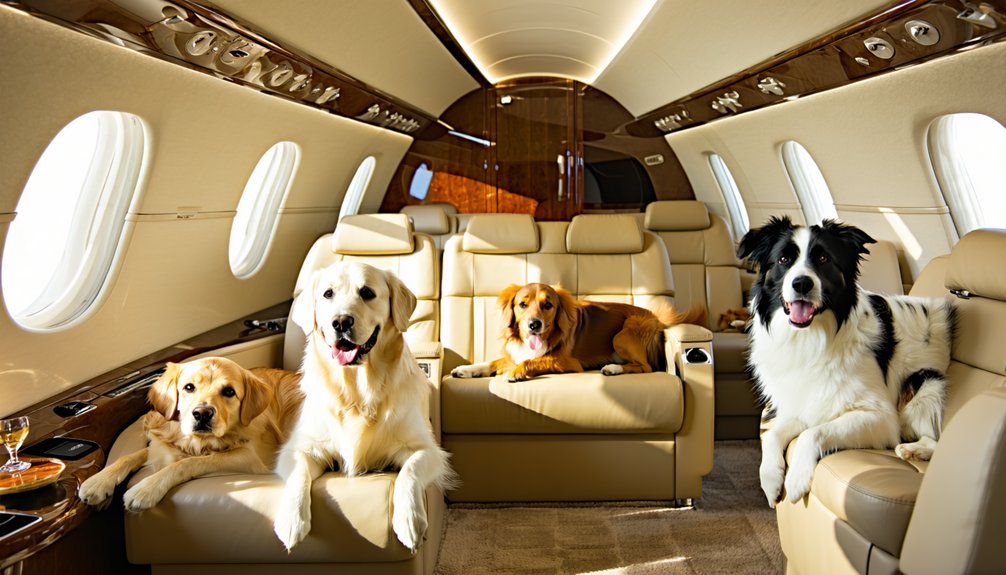
Because every shared charter rides on simple math, the 75% load factor isn’t an arbitrary number—it’s the economic viability threshold that decides whether your flight actually departs.
This capacity requirement covers your jet’s direct operating costs—fuel, crew, handling, landing fees—that can run $10,000+ per hour.
K9 Jets applies this trigger threshold across the entire return route, not just one leg, since empty repositioning sectors still cost full hourly rates.
When enough of you book, each passenger pays a fraction of a $10,000–$50,000 charter, keeping your seat dramatically cheaper than solo private hire.
If bookings fall short of the threshold, K9 Jets handles cancellations transparently.
Their reimbursement terms guarantee a 100% refund or rebooking, so you’re never left covering the gap when the cabin doesn’t fill.
When Your Shared Charter Becomes a Sure Thing
When 75% of seats sell across both the outbound and return sectors, your shared charter flips from tentative to confirmed. K9 Jets guarantees operation only after this load threshold clears on both legs—not just one direction. But seats count only when your full payment settles and you’ve accepted the charter terms, including pet policies and liability limits.
| Stage | What Triggers It | Your Status |
|---|---|---|
| Tentative | Threshold unmet | Subject to cancellation |
| Payment cleared | Funds settled | Reserved seat |
| Terms accepted | Contract formed | Booking confirmation |
| Threshold reached | 75% both legs | Guaranteed to operate |
| Rotation locked | Aircraft, crew, slots | Operationally protected |
Once that aircraft, crew, and time-slots lock in, you’re no longer speculating—you’ve secured a protected seat, committed barring force majeure.
What Cabin Life Looks Like for Your Dog
Unlike commercial flights that banish pets to the cargo hold, shared dog charters welcome your dog into the main cabin regardless of size.
You’ll find crate free seating the norm here, with no standard carrier requirement on most pet-focused charters.
Your dog rests on the cabin floor, divan, or seat using a leash or blanket.
Cabin Comfort comes standard: soft bedding and dog beds create a defined resting spot, while non-spill bowls maintain water access throughout the flight.
One purchased seat typically allows either one large dog or two smaller dogs.
With 6–10 seats, wide aisles, and club seating, your dog has room to stretch.
Lower, steadier noise and motion than commercial cabins keep your dog calmer from takeoff to landing.
Vet Papers and Import Rules You Can’t Skip
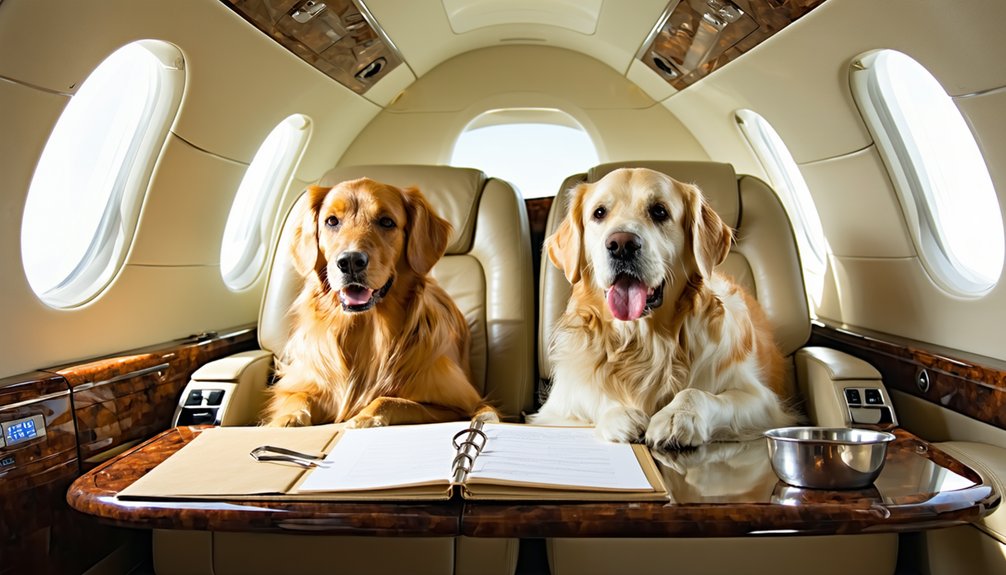
Although the cabin’s comfort makes the trip easy on your dog, crossing borders demands a paperwork trail you can’t afford to leave incomplete.
Start with a rabies vaccination record listing the vaccine name, manufacturer, lot number, and validity period.
Microchip verification matters too—your dog’s ISO-readable chip number must match every health certificate, rabies form, and titer report.
Get rabies timing right: vaccinate at 12 weeks or older, at least 21–30 days before entry, with no lapsed boosters.
High-risk countries often require a serologic titer drawn 30+ days after vaccination, plus a CDC Dog Import Form.
You’ll also need a government-endorsed health certificate, issued within 10 days of travel, and possibly tapeworm treatment.
Skip a step, and you’ll face quarantine—or denied entry.
Reliability or Flexibility: Which Wins?
With your paperwork sorted, the next question is how you’ll actually book the flight—and that’s where reliability and flexibility pull in opposite directions. K9 Jets-style operators sell seats on published schedules, confirming flights once minimum bookings hit a clear go/no-go threshold. You’ll trade lower discounts for predictable completion, plus cancellation protections and rebooking certainty backed by a dedicated ops team monitoring crew, slots, and weather.
| Shared Charter | Split-Cost Group |
|---|---|
| Published, fixed routes | Ad-hoc, date-dependent |
| Part 135 safety standards | Variable operator vetting |
| Clear rebooking support | Scramble if owners withdraw |
Split-cost groups offer cheaper, flexible options, but you’re risking abandonment when one family backs out. If you value joining a community that actually flies as promised, reliability wins.
Which Option Fits Your Dog and Route Best?
The right choice usually comes down to three variables: your route, your dog, and your group size.
Route matching matters first: if you’re flying established corridors like Teterboro–London or Los Angeles–New York, K9 Jets gives you reliable, scheduled service.
For niche pairs—regional EU–Spain or US–Mexico links—split-cost charters open doors K9’s fixed map can’t.
Dog suitability shapes the rest.
One seat covers you plus a large dog over 51 lbs or two pets under 50 lbs, all flying loose, no crate.
Multi-dog households exceeding two pets often save by hiring a shared charter under one aircraft.
Very small dogs under 20 lbs? Standard cabin programs still win economically.
Match your pack and your path, and you’ll find where you belong.
Frequently Asked Questions
Can I Bring More Than One Dog per Seat?
Yes, multiple carriers like K9 Jets let you bring two small dogs per seat. Just respect the weight limits per seat—each pet must stay under 50 lbs. One large dog fills your entire seat allowance.
What Happens if My Dog Misbehaves During the Flight?
Misbehavior policies explained: you’ll find crew intervention procedures kick in fast. They’ll use calming strategies, request confinement, or separate dogs if needed. You’re never alone—our experienced crew handles barking, roaming, or reactivity, keeping everyone in our community safe.
Are Cats or Other Pets Allowed on These Charters?
Yes, you’ll find cats welcome alongside dogs on most charters. Cat Travel Policies require soft-sided carriers throughout the flight, while Pet Travel Limits typically exclude exotic species, keeping your cabin community safe, comfortable, and reassuringly manageable.
Is Travel Insurance Available for Shared Pet Charter Flights?
Yes, you can get pet-travel insurance for shared charters. Standard plans rarely cover pets, so add third party coverage or a pet bundle. Just disclose your charter routing upfront to smooth the travel claim process.
Can I Bring a Human Companion Without a Pet?
Yes, you can! Human companion rules let you join when spare seats exist. Following seat access guidelines, you’ll pay full fare. Respect shared flight etiquette and companion travel limits, since operators cap non-pet passengers to preserve everyone’s experience.
Conclusion
If you want predictable dates and a turnkey experience, K9 Jets earns its premium. If you’d rather trade flexibility for savings, organizing a split-cost charter pays off—provided you can fill seats. Chasing an empty leg? You’ll get the lowest fare, but only if your route and timing cooperate. Match the option to your dog’s temperament, your budget, and your destination’s import rules, and you’ll fly smarter. Book early, confirm vet papers, and travel confidently.
References
- https://www.flyjetpets.com/faq
- https://www.k9jets.com/how-it-works/
- https://www.facebook.com/groups/petfriendlyprivatejetcharteremptylegsharedflights/posts/708497171802943/
- https://www.stratosjets.com/blog/how-shared-private-jet-flights-with-pets-work/
- https://air.bark.co/pages/shared-charters
- https://www.pawsabroad.co/blog/charter-air-travel-with-pets-dogs-cats-in-2025-2026-private-jet-shared-pet-charter-what-actually-matters
- https://www.ionajets.com/post/flying-private-with-your-dog-or-pet-in-cabin-charter-travel-guide
- https://www.businessinsider.com/flying-with-pets-international-travel-charter-flights-empty-leg-jet-2023-9
- https://www.aircharterservice.com/about-us/news-features/blog/pets-on-jets-a-complete-guide-to-flying-with-your-furry-friends
- https://www.facebook.com/k9jets/videos/why-fly-with-k9-jets-shared-pet-dedicated-private-jet-charter/884655057186457/