Measure your dog’s length from nose to tail base, then add 1–2 inches. Capture standing height from floor to the top of the head or ear tip, plus clearance. Check shoulder width at the widest point, and weigh your dog against airline limits. Cross-check against under-seat maximums, often 18 inches long and 11 inches high. Stand your dog square on a non-slip surface for accuracy. Get the exact technique and tools below.
TLDR Key Takeaways
- Measure body length from nose tip to tail base along the spine, then add 1–2 inches for comfort.
- Measure standing height from floor to head or ear tip with the dog in a squared, relaxed stance.
- Position the dog on a flat, non-slip surface with legs vertical, spine level, and weight evenly balanced.
- Use a soft, calibrated tailor’s tape kept horizontal and perpendicular to the spine to avoid fur compression errors.
- Cross-check measurements against airline under-seat maximums, often around 18 inches long and 11 inches high.
The 5 Carrier Measurements You Actually Need
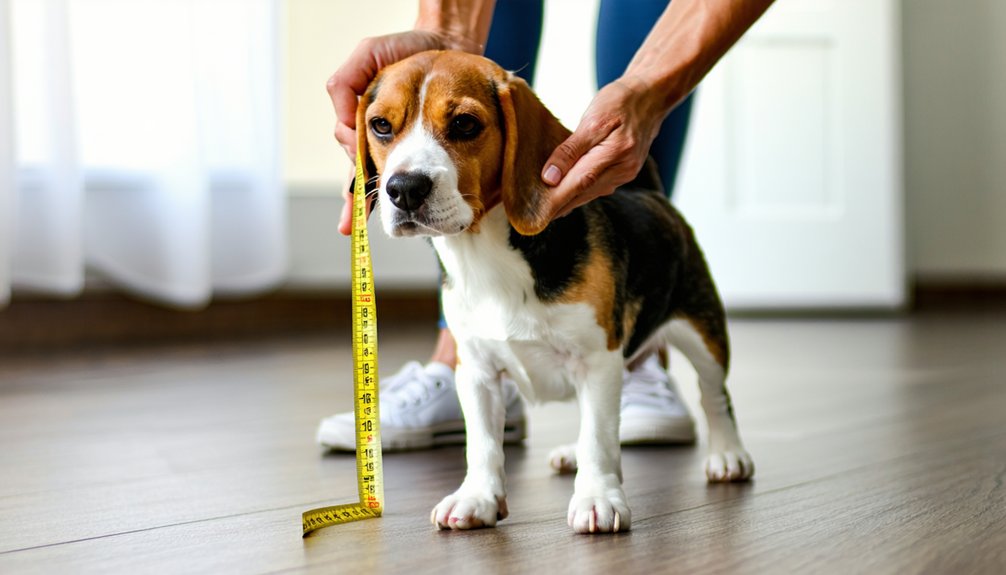
Before you shop for a single carrier, you need five measurements that actually determine whether your dog can travel comfortably and legally. Start with body length—nose to tail base along the spine—then add 1–4 inches for comfort.
Next, measure standing height from floor to head or ear tip, adding 1–4 inches of clearance.
Capture shoulder width at the widest point, and elbow height (B) from floor to elbow joint, which refines length using the airline formula A + ½B.
Finally, note weight against airline limits.
Good measurement tape technique matters: keep your dog standing naturally, and account for breed specific postures, since deep-chested or long-legged dogs need extra room.
Cross-check everything against under-seat maximums—often 18 inches long and 11 inches high.
How to Get Your Dog Standing Correctly
Behind every accurate measurement is a dog standing the right way.
Start by positioning your dog on a flat, hard, non-slippery surface—tile, hardwood, or a firm mat—standing close and parallel to a wall for a straight vertical reference. Square the stance: all four paws under the body, legs vertical, spine level, weight balanced evenly across all four limbs.
Keep the head neutral and the neck relaxed in line with the spine, since tilting either lifts or drops the withers.
Use a proper withers locating technique, palpating for the highest point of the shoulder blades where neck meets shoulders.
Through reward based desensitization, you’ll accustom your dog to hands on its legs and sides, building calm, steady stands that give you the precise readings every fellow traveler needs.
Tools That Make Measuring Easier
With the right tools in hand, you’ll capture measurements that mean the difference between an approved carrier and a costly gate rejection. A soft tailor’s tape follows your dog’s contours, while dual metric/imperial scales prevent conversion mistakes.
Check measuring tape calibration against a known ruler, and choose fabric-backed, non-slip tape to improve repeatability with fur on double-coated breeds.
When pressing a tape flush proves tricky, you’ve got reliable alternatives:
- String or ribbon for fidgety dogs, then measured against a ruler
- Yardstick or carpenter’s square for marking reference points from floor to nose
- Digital scale to verify combined dog-plus-carrier weight
Position rigid tools vertically when reading height, avoiding parallax errors that inflate numbers.
These choices keep you confidently within airline limits.
Measure Length From Nose to Tail Base
Across the travel industry, length means the distance from your dog’s nose tip to the base of its tail—not the tail’s end. This nose-to-tail-base dimension, often labeled “A” in IATA-related guidelines, reflects the true space your dog needs.
Start at the foremost point of the nose leather—not the eyes or skull stop.
For tail landmark accuracy, palpate the small joint where the tail meets the spine at the rear of the pelvis.
With fluffy or docked tails, part the hair and find the anatomical root, ignoring hair length.
Lay a flexible tape along your dog’s back, following the natural curve.
Maintain tape tension consistency—snug but not stretched—so you don’t compress the coat.
Record one uninterrupted measurement in both inches and centimeters.
Find Your Dog’s True Standing Height
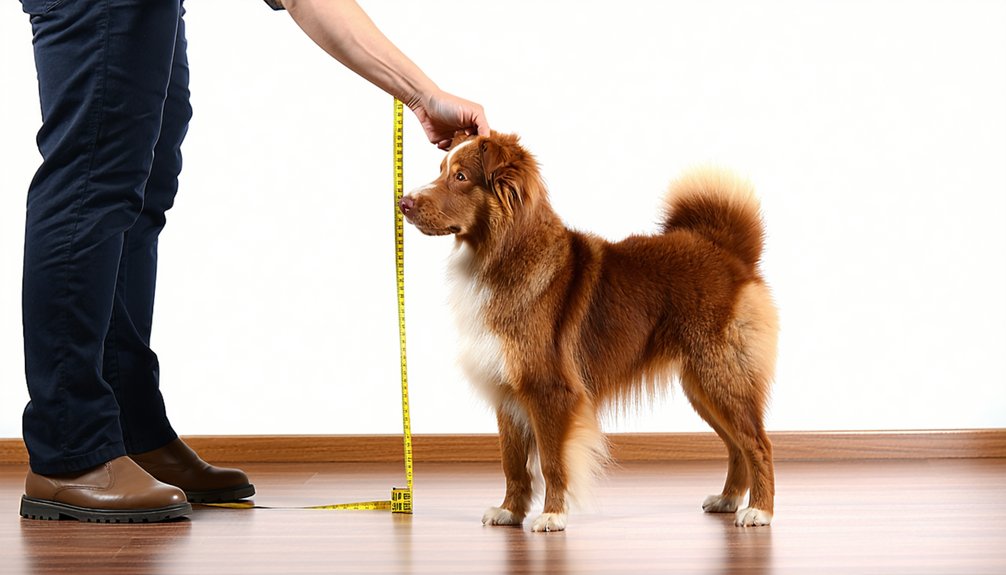
Beneath the coat and behind the front legs lies the measurement that matters most for cabin clearance: your dog’s standing height. You’ll want a square, relaxed stance on a flat, level surface, legs perpendicular to the floor, paws under shoulders and hips.
Non-slip footing helps you capture a repeatable posture, so take several brief attempts and average them.
Nailing the withers location is essential. The withers sit at the highest point of the shoulder blades, slightly forward of mid-back. Run your fingers down the neck until you feel the bony ridge.
For accuracy:
- Stand your dog flush against a wall.
- Slide a level across the withers until it touches, then mark.
- Measure floor-to-mark vertically with a tape.
You belong here.
Measure Shoulder and Ribcage Width
Height clears the cabin ceiling, but width decides whether your dog can turn and settle.
Measure two spots: shoulder width across the broadest points of the shoulder blades, just behind the neck, and ribcage width at the widest part of the chest barrel, behind the front legs.
Use ruler based consistency to confirm widest measurement, since deep-chested breeds often show ribcage exceeding shoulders, while muscular, front-heavy dogs lead at the shoulders.
Note tape placement: keep your flexible tape horizontal and perpendicular to the spine.
Let it lie flat over fur, and avoid fur compression that underestimates true span.
Record raw width separately, then apply the standard formula most airlines and trainers trust—interior width roughly twice your dog’s widest body width (C × 2) for comfortable turning room.
How Much Clearance Should You Add?

After you’ve recorded your dog’s raw measurements, add just 1–2 inches (2.5–5 cm) to both height and length so your dog can stand and lie down without touching the carrier’s top or ends. This small buffer gives your companion breathing room while respecting strict airline restrictions. Your dog’s body should stay slightly smaller than the carrier’s internal dimensions—nothing more.
When you’re balancing fit comfort balance, keep these principles in mind:
- Add 1–2 inches to standing height for headroom.
- Add 1–2 inches to body length for stretching.
- Avoid excess clearance that pushes you past under-seat size limits.
Stick with this minimal functional clearance, and you’ll join countless travelers who’ve kept their pets comfortable, secure, and welcome aboard every flight.
Convert Your Numbers Into Carrier Size
Now that you’ve added your clearance margins, you can turn those raw numbers into a carrier size that actually fits.
First, convert cm to inches so you can compare against maker specs and airline charts in either unit.
Then map to sizes using typical soft in-cabin ranges: XS suits pets up to ~13 in long and ~9 in high, S up to ~16 in, M up to ~18 in, and L near the airline’s under-seat maximum.
Compare your dog’s adjusted length and height to each maker’s stated pet limits, not just outer dimensions, and treat brand labels as non-standardized.
If tall ears push height over the listing, move up one size.
Finally, use weight rules—combined dog and carrier weight must stay under ~8 kg.
What Airlines Require for In-Cabin Carriers
Airline approval isn’t uniform, so check the operating airline’s pet policy before you book. Airline pet limits vary by carrier, route, and aircraft type, and some airlines allow only one cat or small dog per passenger. Because cabin space is limited, you’ll often need to reserve your pet’s spot in advance.
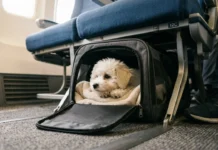
Under seat space rules mean your carrier must fit under the seat in front of you. One major-airline summary lists 18.5 in x 13.5 in x 9.5 in, though limits change by aircraft.
Before you travel, confirm these essentials:
- Carrier dimensions match the airline’s published under-seat limits.
- Your dog can stand, turn around, and lie down inside.
- Documentation, like a health certificate, and pet fees ($35–$150) are ready.
Why Soft-Sided Carriers Fit Best
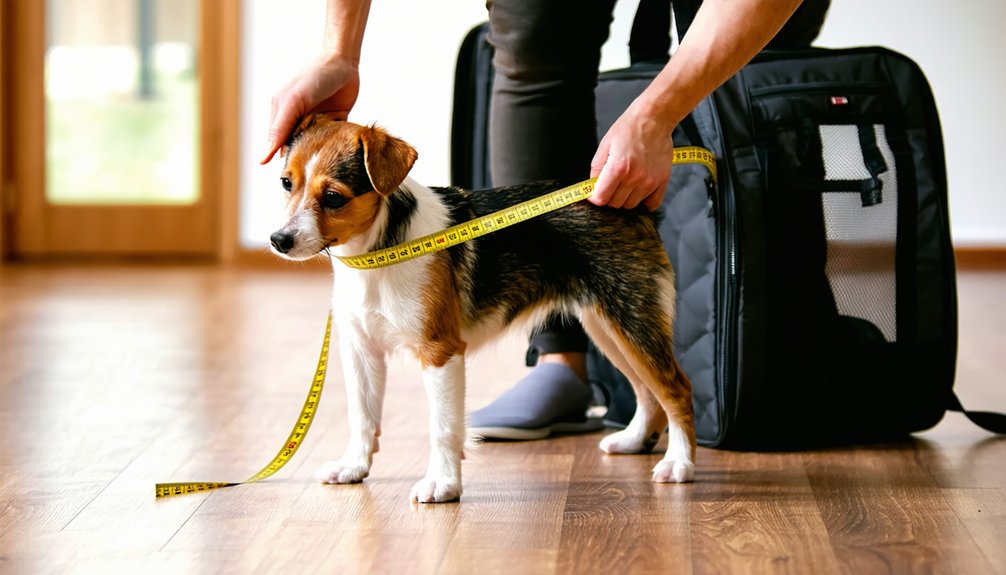
When you’re squeezing a carrier into a tight footwell, soft-sided models win out. Their flexible fabric panels compress slightly under pressure, conforming to irregular aircraft space better than a rigid shell. That adaptability matters when seat clearance runs narrower than your carrier’s outer dimensions, and it’s why fabric fit checks often pass where hard-sided ones fail.
A softer exterior absorbs small variations in seat shape and legroom, so you’re less likely to get turned away at boarding. For gate friendly sizing tips, choose a carrier large enough for your dog to stand, turn, and lie down—but not so big it loses that snug, den-like security many dogs crave.
You’ll also appreciate the lighter weight, easy handling, and compact storage once your trip’s done.
Run a Dry-Fit Test Before You Fly
Before you trust any measurement on paper, you’ve got to prove that your carrier actually fits—with your dog inside it.
Place the carrier on a non-slip surface, fully zipped and assembled, then load it with a weighted bag matching your dog’s in-cabin weight (8–20 lb).
Measure external height, depth, and width at the widest points, including bulging seams and zippers.
Then run your comfort fit checklist:
- Confirm your dog can stand, lie down, and turn around without hunching.
- Build a cardboard mock-up (17″ × 11″ × 7.5″) and slide the carrier in without tilting.
- Add 0.5″ for carpet and clearance; subtract 1″ for hardware.
Finally, make your safety airline calls, confirming under-seat clearance for your exact aircraft.
Sizing Mistakes That Get Dogs Denied at the Gate
Even a careful dry-fit test won’t save you if your underlying measurements are wrong from the start. Most denials trace back to predictable errors we’ve all been tempted to make.
You measure to your dog’s shoulder instead of the top of their head, or nose-to-tail tip instead of base, skewing length and height.
You skip width entirely, forgetting that broad-shouldered dogs need clearance at their widest point.
You trust marketing labels over outside dimensions accuracy, ignoring seams, feet, and wheels that gate sizer checks catch immediately.
Soft-sided carriers bulge under load, pushing past height limits.
You rely on generic “standard” sizes that don’t match your aircraft’s under-seat space.
Measure all three dimensions precisely, add 2–5 cm clearance, and you’ll board confidently every time.
Frequently Asked Questions
How Often Should I Re-Measure My Dog Before Flying?
Re-measure before every trip, especially if past numbers are 3–6 months old. Practice measurement consistency, checking again 72–48 hours pre-flight. Watch for airline policy changes and growth or weight shifts—you’ll fit right in with savvy traveling pet parents.
Can I Fly With Two Small Dogs in One Carrier?
Sometimes, but airline policies vary widely. Many carriers allow just one pet per bag, while some permit two same-species dogs if carrier weight limits stay under 7–8 kg. Always confirm your airline’s written policy first.
What if My Dog Falls Between Two Carrier Sizes?
When you’re between sizes, size up for comfort. Follow intermediate sizing rules and manufacturer size charts, choosing the roomier interior so your dog can stand, turn, and lie down—while confirming it still meets your airline’s cabin limits.
Do Puppies Need Different Carrier Sizing Than Adult Dogs?
Yes, puppies need growth-based sizing, not static measurements. You’ll re-measure before each trip and add larger clearance margins for rapid growth. Apply regular carrier fit checks and comfort training tips so you and your pup belong confidently together.
How Do I Help My Dog Adjust to the Carrier?
Start weeks early with short carrier sessions, tossing treats inside and feeding meals there to build positive associations. Practice positive routines daily, gradually closing the door and lifting gently. You’ll help your dog feel confidently at home.
Conclusion
Measuring your dog correctly isn’t optional—it’s the difference between boarding smoothly and getting turned away at the gate. Take all five measurements, confirm your dog’s true standing height, and match those numbers to your airline’s published in-cabin requirements. Choose a soft-sided carrier, then run a dry-fit test before travel day. When your dog can stand, turn, and lie down comfortably, you’ve sized it right. Don’t guess—measure, verify, and fly confidently.
References
- https://www.youtube.com/watch?v=hj8qiEJH7e4
- https://deloropets.ae/blog/how-to-choose-a-carrier-for-cabin-and-for-luggage/
- https://zoospot.nl/en/blogs/dog/how-to-measure-pets-for-airline-carriers-in-cabin
- https://travelwiththegreens.com/measures-for-measuring-your-dog-to-take-on-an-airplane.html
- https://travelreadypets.com/airline-pet-carrier-dimensions/
- https://www.petmagasin.com/blogs/news/airline-approved-pet-carrier-size
- https://www.alibaba.com/product-insights/the-ultimate-guide-to-measuring-your-dog-for-the-perfect-airline-carrier-fit.html
- https://petstravelguide.com/how-are-dogs-measured-for-airline-carriers/
- https://www.petmagasin.com/blogs/latest-posts/airline-pet-carrier-size-requirements
- https://katziela.com/pages/how-to-measure-your-dog-or-cat