Before you move, verify your dog’s status, because breed laws vary by country, region, and even city. Pit bulls top nearly every banned list, and crossbreeds often count too—the UK classifies “type” by physical appearance. Banned breeds are absolutely illegal, while restricted ones need muzzles, permits, or secure enclosures. Norway and Denmark even ban short-term visitors. Always confirm transit and destination rules before booking. Below, you’ll find a complete checklist to protect your companion.
TLDR Key Takeaways
- Confirm each country’s official import rules before relocating, since banned breeds face seizure, destruction orders, and entry denial—even mixed breeds resembling banned types.
- Distinguish banned breeds (absolutely illegal) from restricted breeds (legal with conditions like muzzling, permits, short leads, and secure enclosures).
- Check local status carefully in the U.S. and Canada, where no federal ban exists and rules change at city or county lines.
- Verify transit and layover rules, as some countries treat connections as imports if you leave the sterile zone or change aircraft.
- Prepare backup plans, including BSL-free jurisdictions, breed-friendly rescues, and written surrender agreements, since penalties reach £5,000 fines and imprisonment.
Which Dog Breeds Get Banned Most Often

When it comes to breed-specific legislation, no dog gets targeted more often than the pit bull. Pit bull-type dogs appear in 96% of U.S. BSL ordinances and on 100% of surveyed insurance banned lists.
Because “pit bull” works as an umbrella term, breed name inconsistency means laws often capture the American Pit Bull Terrier, American Staffordshire Terrier, and Staffordshire Bull Terrier together.
You’ll also see Rottweilers and Doberman Pinschers at 100% on insurance lists, plus wolf-dog hybrids (93%), Chow Chows (95%), and Presa Canarios (86%).
Government rules frequently name the Dogo Argentino, Japanese Tosa, and Fila Brasileiro.
If you’re moving, check enforcement case examples in your destination—since one ambiguous breed label can determine whether your dog belongs there.
Do Crossbreed and “Type” Dogs Count as Banned Breeds?
Yes, crossbreeds and “type” dogs absolutely count under most breed bans—and that’s where many owners get caught off guard. The UK’s Dangerous Dogs Act 1991 targets “type” based on physical appearance—body and head measurements—not pedigree or parentage. So your registered mixed-breed could face Legal Classification as a banned dog if it fits the description.
Many jurisdictions explicitly include “crossbreeds and mixed breeds,” like India’s 2024 directive and Bermuda’s Dogs Act.
| Jurisdiction | Crossbreed Treatment |
|---|---|
| UK | “Type” by appearance |
| India (2024) | Crossbreeds banned |
| Some Swiss cantons | All crossbreeds prohibited |
Because Breed Identification through visual assessment is often inaccurate, misclassification risk runs high—especially for dogs with blocky heads or muscular builds. Know your local rules before you move.
Banned Breeds vs. Restricted Breeds: What’s the Difference?
Breed-specific legislation splits into two distinct categories, and the difference matters enormously for what you can legally do with your dog. Understanding breed law definitions before you relocate keeps your family together and your dog safe.
The enforcement differences come down to one word: prohibition versus conditions.
- Banned breeds are absolutely illegal—you can’t own, breed, sell, rehome, or import them. Authorities can seize your dog and order destruction.
- Restricted breeds are legal to keep, but you’ll face muzzling, short leads, permits, secure enclosures, and warning signage.
- Both categories can coexist in one country, so check each breed’s exact status.
Banned status is absolute; restricted status is compliance-based. Knowing which applies to your dog determines whether you’ll find a welcoming new home.
Countries With Strict National Breed Bans

If you’re planning to relocate or travel with your dog, you need to know that some countries enforce breed bans at the national level—no city loopholes, no regional exceptions.
The United Kingdom bans types like the Pit Bull Terrier, Japanese Tosa, Dogo Argentino, and Fila Brasileiro across England, Scotland, Wales, and Northern Ireland.
Norway and Denmark apply complete bans that include short-term visitors, not just residents.
Australia pairs strict biosecurity laws with outright breed import controls.
Understanding Dog Law Variations matters because countries differ in which breeds they prohibit and how they define them.
Enforcement at Borders is real: officials can seize dogs and deny entry, even mixed breeds resembling banned types.
Confirm each country’s official import rules before you commit to any move.
Where Breed Bans Vary by Region or City
While some countries enforce breed bans nationwide, the U.S. and Canada take a different approach: neither has a federal breed ban, so regulation falls to states, provinces, and municipalities.
This creates a legal patchwork where your dog’s status can shift at any city or county line.
Before you move, check these realities:
- Border enforcement can turn your fully legal companion into a banned breed simply by crossing into a neighboring town.
- Local muzzle rules may require restraints in public, even where ownership stays legal.
- Municipal permit types range from insurance mandates to spay/neuter requirements and conditional registration.
More than 1,200 U.S. municipalities maintain breed ordinances, while preemption states bar new local bans.
You’ll want to verify rules at every level.
Gulf, Island, and Caribbean Breed Import Bans
City lines matter on the mainland, but island and Gulf nations draw their lines at the border. If you’re moving with a dog, you’ll want to know where you stand.
Bermuda’s banned the American Pit Bull Terrier, Dogo Argentino, Cane Corso, Presa Canario, and more since 21 July 2003, while restricting Akitas, Rottweilers, and German Shepherds, which need pre-approval.
The Bahamas refuses Pit Bull Terriers, Dogo Argentino, Fila Brasileiro, and Japanese Tosa under its normal pathway, treating Mastiff and Staffordshire bloodlines as restricted too.
Kuwait runs a permit-based system with a yearly quota, though its breed-specific status isn’t confirmed by available sources.
Wherever you land, breed status sits alongside rabies import rules, microchip, and health certificate requirements—so confirm everything before you book your move.
How to Verify Your Destination’s Breed Laws

Protect the family you’re moving with:
- Confirm breed rules across destination *and* transit countries—one banned layover can strand your dog.
- Match the breed name on every document to avoid check-in refusal.
- Review recent law changes, since breed lists shift without warning.
When you verify early, you arrive together—and belong.
Permits, Insurance, and Muzzle Rules for Banned Breeds
Verifying breed laws gets you in the door, but staying compliant means meeting the conditions that come with ownership.
You’ll likely need a permit: Denver requires a Breed-Restricted Permit, Germany mandates one under its federal dangerous-dog regime, and New South Wales charges a $195 annual permit—miss it and you’ll face a $700 fine or a $6,600 court penalty.
Factor permit renewal and vetting timelines into your move, since coverage and approval can’t lapse.
Insurance often applies too; Georgia requires at least $50,000 in liability coverage tied to licensing.
Expect bundled conditions: microchipping, neutering, secure containment, and warning signage.
In the UK, lawfully exempt banned dogs must stay leashed and muzzled in public at all times.
Meeting these keeps you—and your dog—welcome.
Documents You Need for a Restricted Breed
Before you cross a border or file a permit application, gather your paperwork—because restricted-breed approvals hinge on documentation, not good intentions. Authorities verify legitimacy through records, so assemble yours early and join the community of compliant owners.
You’ll need three categories that prove you belong:
- Veterinary proof: current rabies and core vaccines, ISO-compliant microchip certificate, spay/neuter documentation, and a pre-travel health certificate.
- Breed identification: kennel club registration, photographs, and—where you’re contesting a banned classification—a DNA test report from a recognized lab.
- Ownership and authority: proof of ownership, government-issued ID, proof of residence, and emergency contacts naming secondary caretakers.
Finally, complete your local license application and any council restricted-breed declaration forms.
Don’t skip parasite-control records where biosecurity rules demand them.
Transit and Airline Rules for Banned Breeds
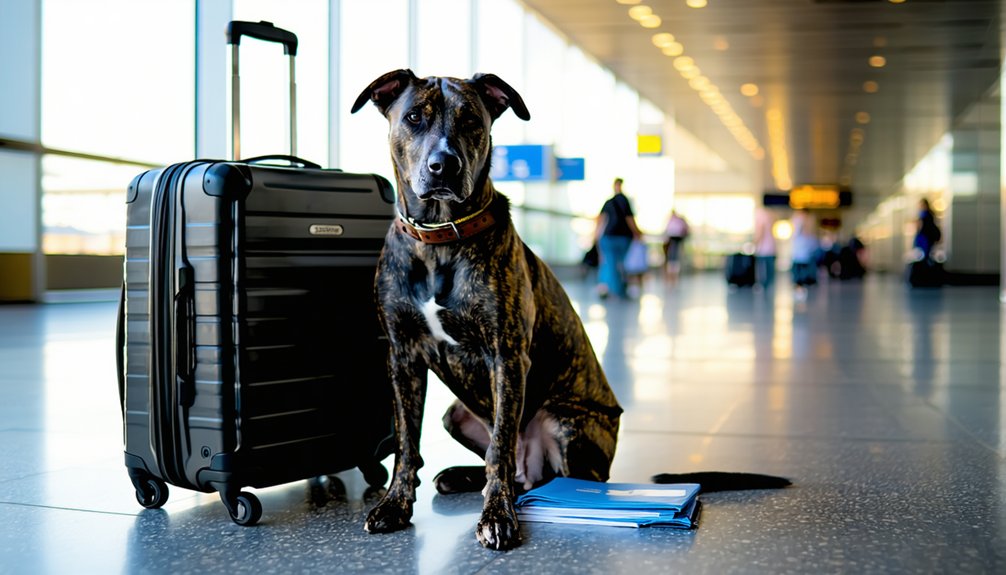
Even when your destination welcomes your breed, airlines and transit countries can still block your trip—and they often do. Airlines maintain their own breed bans on top of national laws, and many refuse brachycephalic or fighting breeds in cargo entirely. Watch the transit classification: some countries treat connections as imports if your dog leaves the sterile zone, changes aircraft, or stays beyond set hours—triggering breed-ban rules.
| Factor | What It Means | Your Action |
|---|---|---|
| Airline refusal criteria | Aggression, safety risk, breed | Confirm policy pre-booking |
| Transit classification | Layover counts as import | Check connection rules |
| Risk assessment | Heat, crate, behavior | Provide IATA-compliant crate |
Confirm both transit and destination rules—you belong on that flight, but only if you’ve checked everything.
Penalties for Breaking Breed Ban Laws
Break a breed ban, and the consequences hit hard—criminal charges, crushing fines, and the loss of your dog.
In the UK, possessing a banned breed risks a £5,000 fine and six months’ imprisonment, while using a dog as a weapon can mean five years.
Seizure powers let police take any suspected banned dog without a complaint, and courts can order destruction plus lifetime ownership bans.
You’ll face penalty escalation as repeat offences mount:
- First violation – $500 fine (Prince George’s County, MD)
- Second violation – $1,500 fine
- Third violation – $3,000 fine, with permit consequences
Enforcement discretion shapes outcomes, and case law confirms that serious injury—like Georgia’s BSL—can bring 10 years and $10,000 fines.
Don’t gamble with belonging.
Smart Backup Plans When Bans Are Absolute
When a ban leaves no room for negotiation, you still have options that protect both your dog and your legal standing. Start with border contingency planning: identify jurisdictions without BSL or with breed exemptions before you relocate, and connect with breed-friendly shelters, rescues, or sanctuaries that specialize in stigmatized breeds.
If permanent rehoming becomes necessary, formalize a legal ownership transfer through written surrender agreements that shift liability across state lines or borders. Verify the receiving home meets local licensing, vaccination, and microchipping rules, and account for quarantine, import permits, and rabies records.
Prefer keeping your dog nearby? Arrange long-term boarding contracts in legal regions, or authorize trusted friends and family for veterinary decisions. Back every plan with a dedicated emergency fund and remote monitoring.
Frequently Asked Questions
Can I Appeal a Breed Ban Decision After My Dog Is Seized?
Yes, you can appeal your seized dog’s breed ban decision. Start the appeal process quickly—you’ll face a strict legal deadline, often 5–28 days. We’re here to help you with proof submission like DNA evidence.
How Much Does Relocating a Restricted Breed Typically Cost?
You’ll typically spend USD 2,000–12,000+, depending on destination. Cost estimates climb with carrier coordination, breed surcharges, permits, and legal consultation. Factor in possible shelter fees too. We’re here helping you budget confidently for your beloved companion’s safe relocation.
Do Service or Assistance Dogs Get Exemptions From Breed Bans?
Yes, your service dog qualifies for exemptions under U.S. law regardless of breed. Bring evidence documentation showing individual training, and if challenged, you’re entitled to a hearing procedure—you belong, and federal protections back you.
How Long Does Breed Verification or Temperament Testing Usually Take?
You’ll typically wait 2–4 weeks for breed DNA results, or 4–6 weeks with health panels. Temperament tests take 30–90 minutes. Factor these into permit processing times and appeal evidence gathering, joining countless prepared pet owners worldwide.
Will Neutering My Dog Change Its Restricted-Breed Classification?
No, neutering won’t change your dog’s restricted-breed classification. Like fellow owners worldwide, you’ll find laws hinge on breed or type—not fertility. Breed Definition Variability and Legal Evidence Requirements determine status, while neutering simply adds a control condition.
Conclusion
Don’t gamble with your dog’s safety—or your move. Before you book anything, you’ve got to verify breed laws at your destination, in transit countries, and with your airline. Gather your documents early, confirm muzzle and insurance rules, and keep a backup plan ready when bans are absolute. Laws change, so check official government sources directly rather than trusting outdated forums. Do your homework now, and you’ll spare yourself heartbreak, fines, and last-minute scrambling later.
References
- https://en.wikipedia.org/wiki/Breed-specific_legislation
- https://petolog.com/articles/banned-dogs.html
- https://www.dogsbite.org/pdf/countries-worldwide-that-restrict-dangerous-dog-breeds.pdf
- https://boogiethepug.com/banned-breeds/
- https://www.petrofile.com/blog/history-and-society/dog-breeds-that-are-banned-in-certain-countries
- https://www.youtube.com/watch?v=JVUFPXkDZLg
- https://www.yourhousepet.com/dogs-that-are-banned-in-multiple-countries/
- https://blog.dogsbite.org/2025/03/countries-worldwide-that-restrict-dangerous-dog-breeds.html
- https://tailwingspettravel.com/banned-dog-breeds-around-the-world/
- https://www.newsbreak.com/wilderness-marksman-359720901/4640022647103-17-dog-breeds-facing-bans-or-restrictions-around-the-world