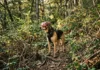
Your headlamp beam catches two green dots glowing at the tree line, and your dog goes rigid, ears forward, a low growl building in his chest before you’ve even processed what you’re looking at. That half-second gap — the one where your dog knows something you don’t — is the entire reason night hiking with a dog requires different gear, different training, and different situational awareness than hiking after dark alone.
- Aim for a headlamp with at least 200-300 lumens and a mixed flood/spot beam so you can manage a leash, scan the trail, and check peripheral eyeshine without losing hands-free control.
- Your dog should wear their own light or reflective gear (LED collar, light-up harness, or clip-on blinker) in addition to your headlamp — one light source is not enough for two bodies moving at different heights and speeds.
- Dogs hear and smell wildlife long before you see it, so learn to read alert behavior (freezing, ear position, hackles, low growl) as your earliest warning system.
- Brachycephalic breeds, senior dogs, and very young puppies are generally poorer candidates for night hikes due to reduced night vision adaptation, heat/cold sensitivity, or lower physical endurance — check with your vet first.
- Nocturnal predator risk (coyotes, cougars, bears, owls) varies enormously by region — know what’s active near your specific trail, not just what’s active nationally.
- A hands-free leash system, a fully charged headlamp plus backup light, and a small dog-specific first-aid kit are non-negotiable basics for any night hike.
Why Night Hiking Is a Different Experience for Your Dog Than It Is for You
When the sun goes down, you and your dog are essentially operating with different equipment. Human night vision is mediocre at best — we rely almost entirely on artificial light to navigate safely. Dogs, on the other hand, have a reflective layer behind the retina called the tapetum lucidum that amplifies available light, plus a much higher proportion of rod cells suited to detecting motion in low light. Their color vision is dichromatic (essentially blue-yellow), so the world at night isn’t necessarily darker to them so much as it is different — shapes and movement matter more than detail.
Hearing and smell matter even more. A dog’s sense of smell operates on a scale humans can’t meaningfully compare to, and their hearing range extends well beyond ours, particularly at higher frequencies where small mammals and some predators communicate. This means your dog will almost always detect wildlife — a deer bedding down off-trail, a raccoon rustling in brush, a coyote scent-marking a boundary — well before you do. That’s a safety advantage if you know how to read it, and a liability if you don’t, because a dog that suddenly lunges toward something you can’t see or hear is how leashes get dropped and hikers get pulled off balance on uneven ground.
Choosing the Right Headlamp for Hiking With a Dog
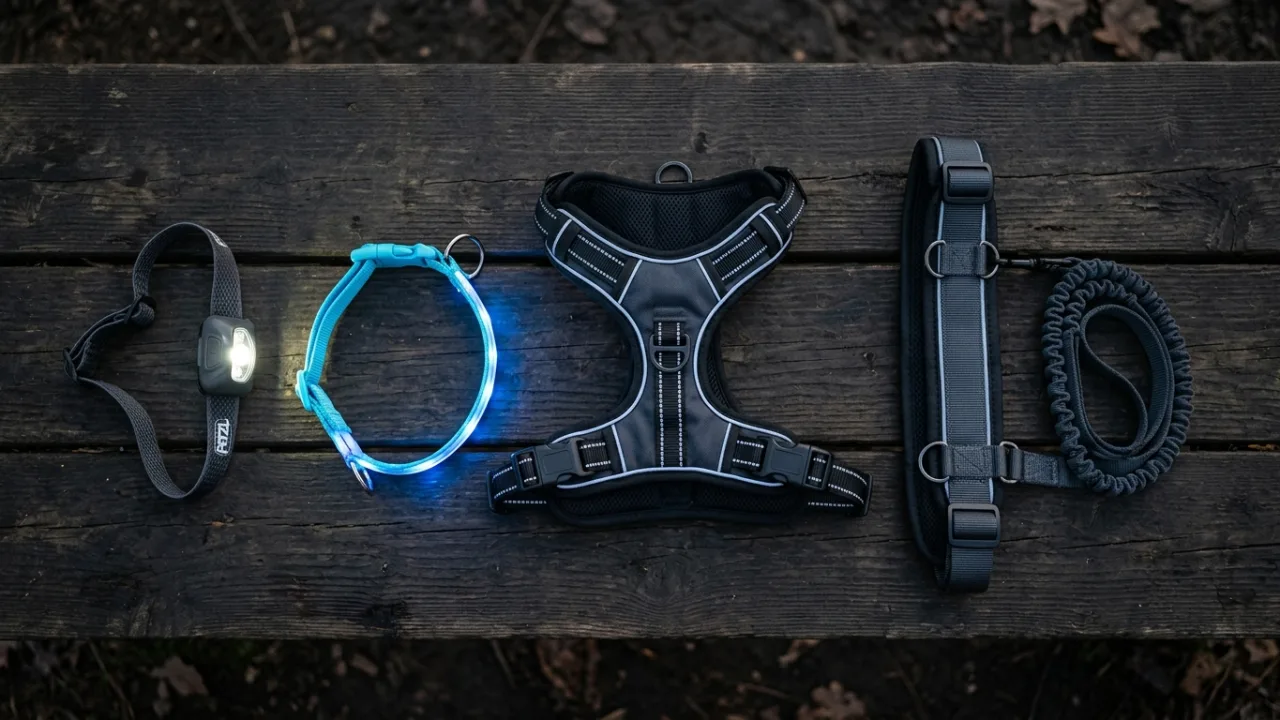
A headlamp built for solo night hiking and one that actually works when you’re managing a leash, a dog’s pace changes, and constant peripheral scanning are not the same product. Here’s what actually matters.
Lumens and Beam Distance: What You Actually Need
Casual dog walks on a familiar, well-maintained neighborhood loop can get by with 100-150 lumens. Trail hiking at night — especially anywhere with roots, rocks, drop-offs, or water crossings — generally calls for 200-300 lumens minimum, with many experienced night hikers preferring 300+ for a wider margin of safety. The reason isn’t just seeing the ground in front of your feet; it’s beam distance. You need enough throw to catch eyeshine or movement 30-50+ feet out, which gives you and your dog time to react calmly instead of being startled at close range.
Flood vs. Spot Beam
A pure spot beam throws light far but narrow, which is great for scanning ahead but leaves you blind to what’s happening beside the trail — exactly where your dog’s attention is likely to snap toward first. A pure flood beam lights up your immediate surroundings but won’t reach far enough to identify something before you’re close to it. For hiking with a dog, a headlamp with an adjustable or dual flood/spot beam is the practical choice: flood for general trail visibility and checking on your dog, spot for scanning ahead when something catches your dog’s attention.
Red, Green, and White Light Modes
Red light preserves your night vision and is far less disruptive to wildlife than white light, which makes it useful for scanning without triggering flight responses in deer or startling nocturnal animals unnecessarily. However, red light modes are typically lower-lumen and shorter-range, so they’re best used for close-range awareness (checking your dog, reading a map, adjusting gear) rather than as your primary trail-scanning light. Green light sits in between — some hunters and wildlife watchers prefer it because animal eyes are less sensitive to it than white light, though it’s less common on consumer headlamps. Importantly, a dog’s eyes don’t respond to colored light the way ours do in terms of “preserving vision” — dogs don’t have the same cone structure benefiting from red-preserving night adaptation — so red mode is primarily a tool for the human handler and for reducing wildlife disturbance, not something that changes what your dog can see.
Battery Life and Rechargeable vs. Battery-Powered
For a dusk-to-night hike of two to four hours, look for a headlamp rated for at least double that runtime on a mid-brightness setting, since manufacturer estimates are often optimistic. Rechargeable headlamps are lighter on ongoing cost and increasingly reliable, but they’re vulnerable if you can’t recharge mid-trip. Battery-powered models (especially those using standard AAA batteries) let you carry spares that work regardless of temperature or charge state, which matters more in cold weather since battery output drops in low temperatures. Many experienced night hikers carry a rechargeable primary headlamp plus a small battery-powered backup — never just one light source, and never a single light source shared between you and your dog.
Comfort and Weight for Active Movement
A hike where you’re also holding a leash, adjusting a hands-free waist belt, and occasionally bending down to check your dog demands a headlamp that stays put. Look for a snug, adjustable strap system, a low front-heavy feel (rear battery pack designs balance better on longer hikes), and a tilt mechanism so you can angle the beam down toward your dog without tilting your whole head.
Headlamp Comparison Table
| Headlamp Type | Lumens (typical) | Beam Type | Battery Life (mid setting) | Weight | Red Light Mode | Best For |
|---|---|---|---|---|---|---|
| Budget rechargeable | 150-250 | Flood/spot combo | 4-8 hrs | 2.5-3 oz | Often yes | Casual night walks, short hikes |
| Mid-range hiking headlamp | 300-400 | Adjustable flood/spot | 8-15 hrs | 3-4 oz | Yes | Regular night hikers, leash management |
| High-output/trail running | 400-600+ | Wide flood + long spot | 6-12 hrs (high drain) | 3-5 oz | Yes | Fast pace, technical terrain, dense brush |
| Battery-powered backup | 100-200 | Basic flood | 10-20 hrs | 2-3 oz | Sometimes | Emergency backup, cold weather reliability |
Headlamp vs. Handheld Flashlight vs. Chest-Mounted Light
Handheld flashlights offer excellent beam control and are easy to aim directly at eyeshine, but they occupy a hand you need for leash control, trekking poles, or catching yourself on uneven ground — a real problem when your dog suddenly changes direction. Chest-mounted lights keep your hands free and illuminate a broad area in front of you, including your dog if they’re walking alongside or slightly ahead, but they can’t be aimed independently of your torso, so scanning off to the side means turning your whole body. Headlamps remain the best all-around choice specifically because they free both hands while still allowing quick aim changes with a head turn — critical when you need one hand on the leash and the other on a trekking pole or your dog’s harness handle. Many experienced handlers combine a headlamp as primary with a small chest or collar-mounted light as supplemental illumination for their dog’s immediate area.
Does Your Dog Need Their Own Light? Dog-Specific Visibility Gear
Yes — and this is one of the most overlooked parts of night hiking preparation. Your headlamp illuminates where you’re looking, not necessarily where your dog is, especially if they range ahead, lag behind, or drift to the side to investigate a scent. A dog with their own light source is easier for you to track by peripheral vision, easier for other trail users to spot, and safer if you become separated even briefly.
Options at a Glance
| Gear Type | Pros | Cons | Typical Price Range | |
|---|---|---|---|---|
| LED collar | Hands-free, 360-degree visibility, many are rechargeable and waterproof | Can be chewed/lost if dog pulls at it; battery life varies | $10-$30 | |
| Light-up harness | Highly visible from multiple angles, doubles as secure attachment point | Bulkier, may need size adjustment, higher cost | $20-$45 | |
| Reflective vest (non-powered) | No batteries needed, durable, catches headlamp/car light reflection | Useless without an external light source hitting it directly | $10-$25 | |
| Clip-on blinker light | Cheap, versatile, attaches to any collar or harness | Small size makes it less visible at distance; easy to lose | $5-$15 |
For most night hikers, the ideal setup layers two of these: an LED collar or light-up harness as the primary always-on light, plus a reflective element (leash, harness trim, or vest) that amplifies visibility whenever your headlamp beam crosses your dog. This layering — headlamp, collar light, reflective trail markers, and reflective gear on the dog — is the single best way to maximize mutual visibility for both of you and for anyone else sharing the trail after dark, including cyclists, other hikers, or hunters during legal hunting hours.
Leash and Harness Choices for Safe Night Hiking
Uneven, dark terrain is exactly where a standard 6-foot leash held in one hand becomes a tripping hazard. A hands-free leash system — typically a padded waist belt with a bungee or shock-absorbing leash attachment — keeps both your hands free for a headlamp adjustment, trekking poles, or catching a stumble, while keeping your dog at a consistent, predictable distance. Look for a leash with some reflective stitching or piping so it catches your headlamp beam.
Keep the leash shorter than you might use in daylight — four to six feet is usually the sweet spot, since a longer leash gives your dog room to dart toward eyeshine or drop into a hole or off a ledge before you can react. Attach to a well-fitted harness rather than a collar alone; a sudden lunge on rough terrain puts far less strain on your dog’s neck and gives you more control if you need to physically hold your dog back from an unseen hazard.
Which Dogs Should Skip Night Hikes? Age, Breed, and Health Considerations
Not every dog is a good candidate for night hiking, and this is worth an honest conversation with your veterinarian before you commit to regular after-dark trail time.
- Brachycephalic breeds (bulldogs, pugs, boxers, and similar flat-faced breeds) often struggle with exertion and temperature regulation generally, and reduced visual cues at night can increase the chance of collision injuries or panic in unfamiliar terrain. Many vets advise limiting these breeds to short, easy, well-lit routes rather than technical night hikes.
- Senior dogs frequently have some degree of vision or hearing decline, arthritis affecting balance on uneven ground, and reduced stamina — all of which are magnified in low-light conditions where confident footing matters more.
- Puppies under a year, especially before their growth plates close, are generally better suited to short, easy walks than technical night hikes; their recall and impulse control are also still developing, which matters enormously when a startling nocturnal noise happens nearby.
- Dogs with anxiety or noise sensitivity may find the sensory overload of unfamiliar night sounds genuinely distressing, regardless of age or breed.
If your dog is a healthy adult, has solid recall, and shows no unusual anxiety around dark or noisy environments, night hiking can be a genuinely enjoyable enrichment activity — just build up to it gradually (more on that below) rather than starting with a long, remote route.
How a Dog’s Senses Change Wildlife Detection After Dark
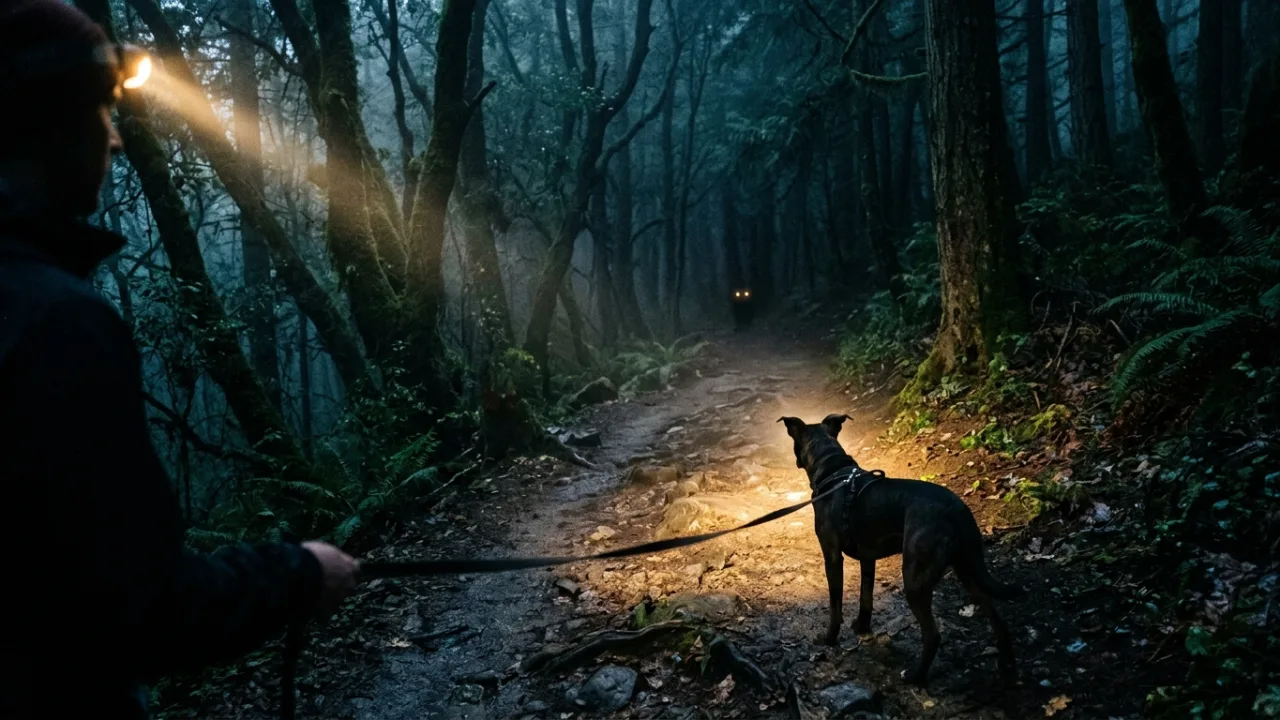
Search-and-rescue handlers often describe a predictable sequence when a working dog detects something before the handler does: a subtle head lift and ear rotation first, then a full body freeze, then a fixed stare toward the source, and only then — if the animal is close or moving — vocalization or pulling. Recognizing this sequence in your own dog, well before the bark or lunge, gives you crucial seconds to slow down, shorten your grip on the leash, and assess the situation calmly instead of reactively.
Because your dog’s hearing and smell outperform yours substantially at night, they will detect a bedded deer, a foraging skunk, or a distant coyote long before your headlamp beam ever reaches it. Treat sudden alertness in your dog as your earliest and most reliable warning system — not something to correct or ignore, but a genuine safety cue worth pausing for.
Nocturnal Wildlife Risks by Region: What Could Your Dog Actually Encounter?
Risk varies enormously by geography, habitat, and season, so the honest answer to “what wildlife should I worry about” always starts with “it depends where you’re hiking.” Check with your local land management agency or park ranger station for current wildlife activity reports before a night hike in unfamiliar territory.
| Region/Habitat | Common Nocturnal Wildlife | Dog-Specific Risk Level | Recommended Precaution |
|---|---|---|---|
| Suburban-adjacent trails, most US regions | Coyotes, foxes, raccoons, skunks | Moderate — coyotes may view small dogs as prey or competitors | Keep dogs leashed and close, avoid dawn/dusk peak activity if possible, make noise in brushy areas |
| Western mountains and foothills | Mountain lions (cougars), coyotes, black bears | Higher — cougars are ambush predators and dogs can trigger prey drive | Hike in groups, keep dogs leashed and visible, carry bear spray where legal, avoid hiking alone at night in known cougar habitat |
| Forested/wooded eastern and midwestern trails | Black bears, owls, porcupines, skunks | Low to moderate — bears generally avoid confrontation unless surprised or food-attracted | Make noise regularly, secure food scent, keep dog close on leash |
| Desert and arid Southwest | Rattlesnakes, coyotes, owls, javelina | Moderate to high, especially warm months when snakes are active at night | Stay on trail, use a strong beam to scan ground ahead, keep dog leashed and out of brush |
| Alaska and northern wilderness | Grizzly/brown bears, wolves | High — larger predator ranges and less human traffic | Avoid solo night hikes, carry bear spray, keep dog leashed and consider skipping night hikes in high-density bear zones entirely |
Owls deserve a specific mention because they’re often overlooked: great horned owls and similar large raptors have been known to view very small dogs as potential prey, particularly toy and small breeds under roughly 10-15 pounds. This risk is low overall but worth factoring in if you hike with a small dog in wooded areas at night.
Reading Eyeshine: A Field Reference
Scanning a dark trail and catching a pair of glowing eyes is one of the most disorienting moments in night hiking — but eyeshine color and height above ground can help you narrow down what you’re looking at before you get closer.
| Animal | Typical Eyeshine Color | Approximate Eye Height | Behavior Notes |
|---|---|---|---|
| Deer | Greenish-white to yellow-green | 2-4 feet | Usually freezes, then bolts away; low direct risk to dogs |
| Coyote | Yellow-green to amber | 1-2 feet | May hold ground longer than deer; give wide berth, keep dog close |
| Domestic/feral cat | Bright green to yellow | Under 1 foot | Usually low and moving quickly |
| Mountain lion/bobcat | Bright yellow-green, often two closely-set points | 1.5-2.5 feet, low crouch possible | Do not run; back away slowly, make yourself and dog appear larger |
| Raccoon | Bright orange-yellow | Under 1 foot, often near trees | Generally avoids confrontation unless cornered |
| Spider (for scale reference) | Tiny bright red-orange pinpoints, ground level | Ground level, very small | Not a threat, but a useful reminder that eyeshine size and count matter as much as color |
A Real Scenario: Two Green Dots at the Tree Line
Picture a dusk hike where your headlamp sweeps a bend in the trail and catches a pair of low, steady green-yellow points about 40 feet off-trail. Your dog, who had been trotting loosely ahead on a hands-free leash, stops mid-stride, ears fully forward, tail held level rather than wagging. That combination — steady stare, stopped movement, neutral tail — is a classic “I’ve noticed something and I’m assessing it” posture, distinct from playful alertness. The correct handler response here isn’t to shine the light directly into the eyes at full brightness (which can prolong the animal’s disorientation and delay it moving off), but to pause, gently shorten the leash, speak in a calm low voice, and wait a few seconds to see whether the animal moves away on its own — which, in the vast majority of deer and coyote encounters, it does within moments.
Skunks, Porcupines, and Snakes: Recognizing an Encounter and Reacting Fast
Night is prime time for exactly the wildlife encounters that don’t involve a chase or a growl but still send you straight to an emergency vet.
- Skunk spray is unmistakable and immediate — a thick, acrid smell along with your dog pawing at their face or eyes if sprayed directly. Immediate response: keep your dog away from your face and car interior if possible, rinse eyes with clean water if they seem irritated, and plan a de-skunking bath (diluted hydrogen peroxide, baking soda, and dish soap solution, or a commercial skunk-odor product) as soon as you’re home. Spray in the eyes that causes prolonged squinting or redness warrants a vet call.
- Porcupine quills show up as your dog suddenly yelping, pawing at their muzzle, or you noticing quills embedded around the face, mouth, or chest after a scuffle in brush. Do not attempt to pull quills yourself beyond one or two accessible ones near the surface — quills barb and can migrate deeper, and a mouth full of them usually requires sedation to remove safely. Head to an emergency vet the same night.
- Snake bites at night are harder to confirm than in daylight since you may not see the snake itself. Watch for sudden yelping followed by localized swelling, puncture marks, excessive drooling, or your dog suddenly limping or reluctant to move. Keep your dog as calm and still as possible, carry them if feasible rather than letting them walk (which speeds venom circulation), and get to an emergency vet immediately — do not attempt to cut, suck, or ice the bite site.
Is Off-Leash Night Hiking Legal or Advisable?
Most national parks require dogs to remain leashed at all times, on all trails, regardless of time of day — and many state parks and wilderness areas follow similar rules, sometimes with additional restrictions specific to certain trails. Beyond the legal requirement, off-leash hiking at night is generally inadvisable even where technically permitted: recall reliability that feels solid in daylight, familiar terrain often breaks down when a dog is startled by unexpected wildlife sounds or scents in low visibility. A leashed dog is easier to physically protect, easier to keep on-trail, and far less likely to end up in a genuinely dangerous encounter with a defensive animal. Always check the specific regulations for your trail or park before heading out, since rules vary by jurisdiction and can change seasonally.
Training Your Dog Before Attempting a Night Hike
Night hiking is not the place to discover your dog’s recall is unreliable or that unexpected loud noises send them into a panic. Before your first real night hike, test the following in a controlled, low-risk setting:
- Recall under distraction: Practice calling your dog back during a daytime walk when they’re mildly distracted by a smell or another dog, not just in a quiet backyard.
- Reaction to sudden sounds: Play recordings of owl calls, coyote yips, or rustling brush at low volume during a calm home environment, rewarding calm behavior, before ever expecting composure on an actual trail.
- Comfort with gear in motion: Make sure your dog is used to wearing an LED collar or light-up harness during normal walks first, so it’s not a novel, distracting sensation on an unfamiliar dark trail.
Then introduce night hiking gradually: start with short walks around your own neighborhood or a very familiar, well-lit park trail at dusk, before working up to longer, more remote night hikes. This mirrors general canine training principles — building confidence in low-stakes environments before raising difficulty — and it gives you a chance to observe how your specific dog responds to darkness, unfamiliar smells, and gear before you’re an hour from the trailhead.
Navigation Tools Beyond the Headlamp
A headlamp handles immediate visibility, but longer or less-familiar night hikes benefit from additional navigation layers: a GPS-enabled collar or tag lets you locate your dog quickly if a leash slips or breaks, reflective trail markers (either pre-placed by land managers or small reflective tacks you place and retrieve yourself on permitted trails) help confirm you’re on-route without relying solely on memory, and a offline-capable trail app or physical map reduces dependence on phone signal, which is often unreliable in backcountry areas after dark.
Weather, Temperature, and Paw Protection at Night
Night temperatures drop faster than most people expect, even in seasons that feel warm during the day. Cooler night air is often more comfortable for active dogs, especially thicker-coated or brachycephalic breeds prone to overheating in daytime heat — but it also means bringing a light layer for thin-coated or short-haired dogs on longer stops. Cold, rocky, or frost-covered ground can also be harder on paw pads than daytime terrain; consider dog boots for rocky alpine trails or extended cold-weather hikes, and check paw pads for cracking or ice buildup between toes during rest breaks.
Emergency Preparedness: What to Carry
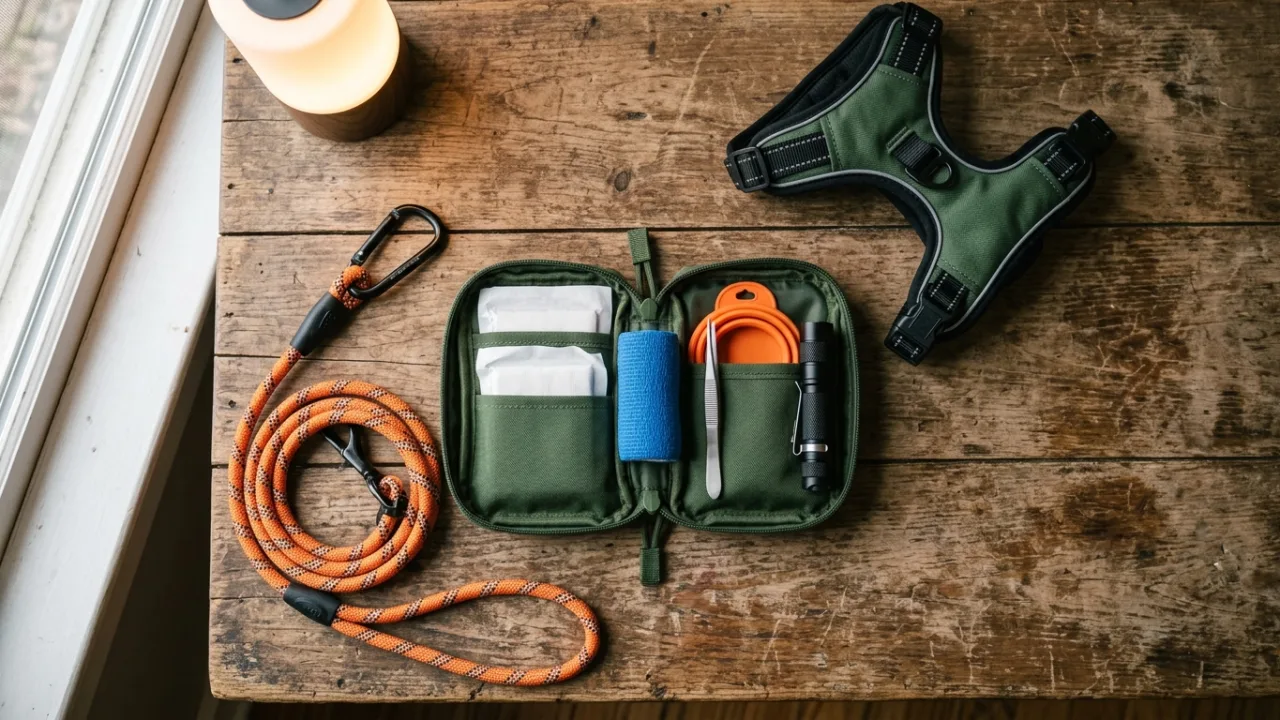
A basic dog first-aid kit for night hikes should include: vet wrap or gauze, antiseptic wipes, tweezers (for splinters, not quills), a muzzle (even calm dogs may snap when in pain), styptic powder for minor bleeding, a foldable water bowl, and your vet’s emergency contact plus the nearest emergency animal hospital’s address saved offline. For carrying an injured dog, a simple sling-style dog carrier or even a sturdy blanket used as a makeshift stretcher for two people can prevent further injury during evacuation — know your dog’s approximate weight and whether you could realistically carry them solo before you need to find out on the trail.
Visibility for Other Trail Users
Night hikes aren’t just about you and your dog seeing wildlife — other hikers, trail runners, cyclists, and, depending on season and location, hunters during legal hours need to see you both. Reflective elements on your pack, your dog’s gear, and even trekking poles significantly reduce the chance of a startling close encounter with another trail user. In areas with legal night hunting seasons, check local regulations and consider adding an extra blaze-orange element to your dog’s gear during those specific windows.
Group Size and Precaution Level
Solo night hiking with a dog is common and often perfectly safe on well-traveled, familiar trails, but remote or wildlife-dense routes warrant hiking with at least one other person. A second hiker means a second set of eyes for scanning, a second light source if yours fails, and someone to help manage an injured dog or call for help while the other stays with the dog. As a general precaution scale: familiar, well-lit local trails are reasonable solo with a well-trained dog; remote, wildlife-dense, or technical terrain should default to groups of two or more, human and canine included.
Sample Gear Checklist: A 2-Hour Dusk-to-Night Hike With a Medium-Sized Dog
| For the Handler | For the Dog |
|---|---|
| Headlamp (charged) + backup light source | LED collar or light-up harness |
| Hands-free leash/waist belt system | 4-6 ft reflective leash |
| Trekking poles (optional) | Well-fitted harness |
| Phone (offline map downloaded) + portable charger | Reflective vest or gear trim |
| Whistle | Collapsible water bowl + extra water |
| Basic human first-aid kit | Dog first-aid kit basics |
| Layered clothing for temperature drop | Light jacket or boots if cold-sensitive |
| Bear spray (where legal/relevant) | Muzzle (for emergencies only) |
Common Mistakes to Avoid
- Relying on one light source total. If your only headlamp fails and your dog has no light of their own, you’re both effectively invisible and unable to navigate.
- Using a long, loose leash on technical terrain. A dog with six extra feet of slack near a drop-off or dense brush at night is a genuine fall and encounter risk.
- Shining a full-brightness white beam directly into eyeshine. This can prolong an animal’s disorientation rather than encouraging it to move off; a brief lower-intensity check, then stepping back, is usually more effective.
- Skipping the gradual introduction. A dog’s first-ever night hike being a long, remote route is setting both of you up for a stressful, potentially unsafe experience.
- Assuming national park rules don’t apply after dark. Leash requirements and trail hour restrictions typically apply regardless of time of day.
Troubleshooting: What to Do When Things Go Wrong
Your Headlamp Battery Dies Mid-Hike
Switch to your backup light immediately rather than continuing in the dark. If you didn’t bring one, use your phone flashlight sparingly to conserve battery, keep your dog on a short leash, and head back toward the trailhead via the most familiar, well-marked route rather than pushing forward into unknown terrain.
Your Dog Panics or Bolts After Spotting Eyeshine
Do not chase or yank the leash hard, which can escalate panic. Plant your feet, use a calm, low, familiar recall cue, and if leashed, let the leash absorb the lunge rather than fighting it directly — a hands-free bungee-style leash is specifically designed for this moment.
Your Dog Is Sprayed, Quilled, or Possibly Bitten Far From the Trailhead
Stay calm, keep your dog as still and leashed as possible, apply any immediate first aid you’re equipped for (rinsing eyes for skunk spray, avoiding quill removal beyond superficial ones), and prioritize getting back to the vehicle or trailhead over continuing the hike. Call ahead to an emergency vet if you have signal so they’re ready when you arrive.
You Encounter a Coyote, Bear, or Mountain Lion at Close Range
Keep your dog leashed and close rather than letting them run — running can trigger chase instinct in predators. Make yourself appear larger, speak firmly and loudly, back away slowly without turning your back, and avoid direct prolonged eye contact with big cats specifically while still monitoring their position peripherally. Never place yourself between a predator and your dog by picking the dog up in front of a large animal, as this can bring the animal’s focus higher and closer to your body.
Post-Hike Checklist
- Check your dog thoroughly for ticks, especially around ears, neck, and paws.
- Inspect paw pads for cuts, cracking, or embedded debris.
- Look for quills, burrs, or scratches from brush contact.
- Watch for unusual behavior over the next 24 hours — lethargy, limping, or reluctance to eat can indicate a missed injury or bite.
- Recharge headlamps and dog lights immediately so they’re ready for next time.
Final Thoughts
Night hiking with a dog can be one of the calmest, most rewarding ways to share the trail — cooler temperatures, quieter paths, and a version of the outdoors most daytime hikers never experience. The difference between a great night hike and a genuinely risky one usually comes down to preparation most people skip: a headlamp actually suited to hands-free dog handling, a light source for your dog specifically, an honest read on whether your individual dog is a good candidate for it, and a working knowledge of what wildlife you might realistically encounter on your specific trail. None of this requires expensive gear or advanced training — it requires planning the hike with your dog’s senses and limitations in mind, not just your own.
If you’re new to night hiking with your dog, start small: a short, familiar loop at dusk, full gear layering, and a calm read on how your dog handles the unfamiliar sounds and sights. Build from there, and check in with your veterinarian about your specific dog’s suitability before committing to longer or more remote routes.
Frequently Asked Questions
What is the best headlamp for walking my dog at night?
For most dog walks and hikes, look for a headlamp with 200-300 lumens, an adjustable flood/spot beam, a red-light mode, and at least 8 hours of runtime on mid-brightness. A comfortable, snug strap matters more than raw lumens once you're also managing a leash and checking on your dog regularly.
What is the best headlamp for night walking in general?
A good all-purpose night walking headlamp balances lumens (150-300 for most trails), beam adjustability, weight, and battery life. Rechargeable models with a red-light mode are popular for regular walkers, while battery-powered backups are worth carrying for reliability in cold weather or longer outings.
Do dogs need their own light source when hiking at night?
Yes. Your headlamp illuminates where you're looking, not necessarily where your dog is, especially if they range ahead or to the side. An LED collar, light-up harness, or clip-on blinker keeps your dog visible to you and to other trail users even outside your beam's direct path.
Can red light headlamps disturb or attract wildlife around dogs?
Red light generally disturbs wildlife less than white light and helps preserve your own night vision, making it useful for close-range tasks. It doesn't meaningfully change what your dog can see, since dog vision doesn't rely on the same night-vision preservation mechanism as human eyes.
Is it safe to let my dog off-leash at night on trails?
Most parks require leashes at all times regardless of time of day, and off-leash night hiking is generally inadvisable even where technically allowed, since recall reliability and visibility both drop after dark. A leashed dog is easier to protect and control if wildlife is nearby.
What should I do if my dog encounters a coyote or wild animal while night hiking?
Keep your dog leashed and close, avoid running, make yourself appear larger, speak firmly, and back away slowly without turning your back. Do not let your dog chase or engage, and give the animal space and time to move off on its own, which is the outcome in the vast majority of encounters.
How many lumens do I need for a headlamp when hiking with a dog?
Aim for at least 200-300 lumens for actual trail hiking with a dog, since you need enough beam distance to spot eyeshine or terrain hazards well before you're close to them, not just enough to see your immediate footing.
What's the difference between a headlamp and a handheld flashlight for dog hikes at night?
A headlamp keeps both hands free for leash control, trekking poles, or catching a stumble, while a handheld flashlight offers precise aim but occupies a hand you'll likely need for your dog. Most experienced night hikers prefer a headlamp as primary light specifically because of the hands-free advantage.
Should I bring a second light source as backup when hiking at night with a dog?
Yes, always. A dead or broken headlamp with no backup leaves you unable to navigate safely or manage your dog's visibility. A small battery-powered backup light, separate from your dog's own light source, is a basic safety requirement for night hikes.
Are certain dog breeds better suited to night hikes than others?
Healthy, well-trained adult dogs of most breeds can handle night hikes reasonably well. Brachycephalic breeds, senior dogs, and young puppies are generally less suited due to breathing, vision, stamina, or impulse-control limitations, and should stick to shorter, familiar, well-lit routes if hiking after dark at all.