For IATA-compliant international transit, you need a crate meeting LAR Container Requirement 1: a rigid, non-collapsible shell with interlocking halves bolted by metal nuts at every point, a single metal door with fail-safe latches, and ventilation on three or four sides totaling 14–16% open area. For long-haul flights, premium kennels like the RuffLand Airline series and Petmate Sky Kennel deliver. Size by measured body dimensions, not species labels. Here’s what separates approval from rejection.
TLDR Key Takeaways
- IATA CR1 compliance requires a rigid, non-collapsible shell with interlocking halves bolted by metal nuts at every fastening point.
- A single welded metal door with spring-loaded, multi-point latches and pins extending at least 1.6 cm beyond frame bars is mandatory.
- Ventilation must cover three or four sides, providing 14–16% open area to maintain safe airflow during international transit.
- Size crates using internal length (A + ½B), doubled width (C × 2), and standing height plus bedding, with 3–4 inches head clearance.
- Premium long-haul kennels like RuffLand Airline and Petmate Sky Kennel ($700–$1,500) offer reinforced shells and bolted perimeters for 8–15 hour flights.
What Makes a Crate Truly IATA-Compliant?

Although many crates claim air-cargo readiness, true IATA compliance hinges on meeting the Live Animals Regulations (LAR) Container Requirement 1 (CR1), which governs construction, door fixings, and ventilation for most pets in air cargo.
You’ll want a rigid, non-collapsible shell with interlocking halves secured by metal bolts—never clips alone.
The base must stay leak-proof, the interior free of sharp edges.
A single metal door with fail-safe latches and pins extending at least 1.6 cm beyond the frame bars proves essential.
Ventilation on three or four sides should reach 14–16% open area.
Before you ship, confirm material durability testing and run a compliance inspection checklist.
Keep your inspection documentation ready, and verify airline-specific overrides, since carriers often demand stricter standards than baseline CR1 requirements.
Materials That Survive Cargo Handling
Compliance gets you certified, but materials get your cargo there intact. When you’re shipping internationally, you need shells that take a beating.
Marine-grade plywood or solid hardwood panels resist repetitive impacts without splitting, while galvanized or stainless steel hardware withstands corrosion from salt-laden air.
You’ll want steel or aluminum edge protectors guarding corners against forklift tines, plus impact resistant fabrics and abrasion protection where contact damage peaks.
Inside, cross-linked EPE foam and layered cushioning absorb shock from drops and turbulent flights.
Void-free packing stops displacement that causes vibration abrasion.
For the outer surfaces, UV stable coatings deliver weather durability against tarmac exposure and humid holds.
Choose these materials and you’re joining shippers who deliver cargo intact, every time—not just certified, but genuinely protected.
How to Size an IATA Crate for Your Animal
Nobody wants their crate rejected at the cargo counter because the animal can’t stand, turn, or stretch inside it.
Start with four measurements: length A (nose to tail base), leg height B, width C at the shoulders, and standing height D to head or ear tips.
Measuring tips: stand your animal naturally on a flat surface, don’t compress the coat, and measure width from behind.
Calculate internal length as A + ½B, width as C × 2, and height as D plus bedding.
Common sizing errors include forgetting bedding height and measuring including the tail.
Breed specific adjustments: add 10% for brachycephalic animals or tall-eared dogs.
Multi animal considerations widen the crate to C × 3 for two, though one animal per crate’s safest.
Ventilation Rules for International Cargo Holds

Once your crate’s sized correctly, you’ve got to understand the environment it’ll travel in, because cargo-hold ventilation is governed by strict international rules.
SOLAS and IMO instruments require cargo spaces to maintain a safe atmosphere, preventing flammable or toxic gas buildup.
Mechanical ventilation is mandatory for cargoes emitting hazardous vapours, with pump rooms achieving 20–45 air changes per hour.
You’ll find ducting separation distances matter: exhaust outlets must discharge at least 10 m horizontally and 4 m above deck, keeping gases away from accommodation intakes.
Class rules add gas detection requirements, integrating ventilation with fire-protection and emergency shutdown systems.
The IMSBC Code dictates ventilation schedules for bulk cargoes, sometimes 24 hours after loading.
Knowing these standards puts you alongside professionals who ship responsibly.
Doors, Bolts, and Hardware That Pass Inspection
When inspectors reject a crate at check-in, hardware failures top the list of reasons—and most are entirely preventable. You’ll pass inspection by getting the fundamentals right.
Door mesh requirements demand rigid welded metal—wire or bars, never plastic or wood—with openings small enough to block protruding noses, paws, or claws.
Choose a single front door, securely framed into the shell to resist flexing.
Your latch inspection checklist should confirm spring-loaded, all-metal latches with dual- or multi-point locking, no external padlocks, and recessed hardware that won’t snag conveyors.
Join crate halves with metal nuts and bolts at every fastening point—missing even one triggers rejection.
Anchor metal hinges so pins can’t slide out under vibration.
Get these details right, and you’ll move with confidence.
Handling and Spacers for Crates Over 60 Kg
The 60 kg threshold marks a turning point where your crate stops being something handlers lift and starts being equipment-only freight. Once you cross it, every reputable operation treats your crate as a mechanical lifting job—forklifts, pallet jacks, or powered conveyors only.
Your risk assessment should reflect IATA ergonomic guidance: loads over 55–60 kg never go up by hand, sparing ramp staff from musculoskeletal injury.
Build accordingly. Your spacer materials need to shift from light timber to hardwood, laminated wood, or steel profiles that won’t crush under weight.
Get load distribution right by running continuous stringers so fork tines and roller decks won’t punch through.
Add 8–10 cm clearance, mark your lift zones, and you’ll be shipping crates the pros respect.
Labels and Paperwork Every Crate Needs

Although your crate might be built to perfection, it won’t clear customs or board an aircraft without the right labels and paperwork. You’ll need IATA-compliant dangerous-goods labels—diamond-shaped, at least 100 mm × 100 mm, displaying each class or division number on a contrasting background.
Mind label orientation: place labels flat, on the same side as the shipping name, with primary and subsidiary labels adjacent.
For live animals, mark “LIVE ANIMALS” in uppercase, add upright arrows on two opposing faces, and keep your dangerous goods documentation reviewable without opening the crate.
Attach the animal’s name, contact details, a temporary travel ID, and feeding or medication instructions.
Follow an animal welfare checklist, include microchip data, and you’ll join shippers who clear acceptance confidently every time.
Our Top IATA-Compliant Crates, Ranked
Now that you know what makes a crate airworthy, let’s put that knowledge to work with our ranked picks.
Our general top pick leads with rigid molded-plastic construction, ≥14% ventilation across three sides, and metal dual-action latches. You’ll appreciate the leak-proof base sized to IATA’s length and height formula.
For value, our budget choice uses nuts-and-bolts joining and a smaller footprint that passes airline inspection tips like the 20 lb pressure check.
Cat owners get fine mesh spacing and extra lock points.
Need something unusual? Our custom-built option follows species-specific contour rules with rust proof coatings on metal joints.
Across all picks, you’ll want crate barcodes for tracking and the right transport padding types—absorbent pads or bedding—so your animal travels secure, comfortable, and accepted by every major airline.
Best Heavy-Duty IATA Crate for Large Dogs
When you’re shipping a large dog internationally, you need a crate built to take real abuse in the cargo hold. Choose a rigid, non-collapsible shell in high-impact plastic or aluminum, with steel doors, metal hardware, and bolted seams along every edge.
Airline inspection checklists routinely reject plastic latches and snap-together clips for heavy breeds, so insist on metal nuts and bolts.
Look for a solid leak-proof floor, integrated tie-down points, and a continuous spacing rim that protects airflow when crates stack.
For dogs over 60 kg, you’ll want forklift spacers or a reinforced base.
Models that pass crate load testing—like the Petmate Sky Kennel in XL or giant sizes—give you 360° ventilation, a steel-wire door, and the confidence to belong at check-in.
Best Value IATA Crate for Cats and Small Breeds
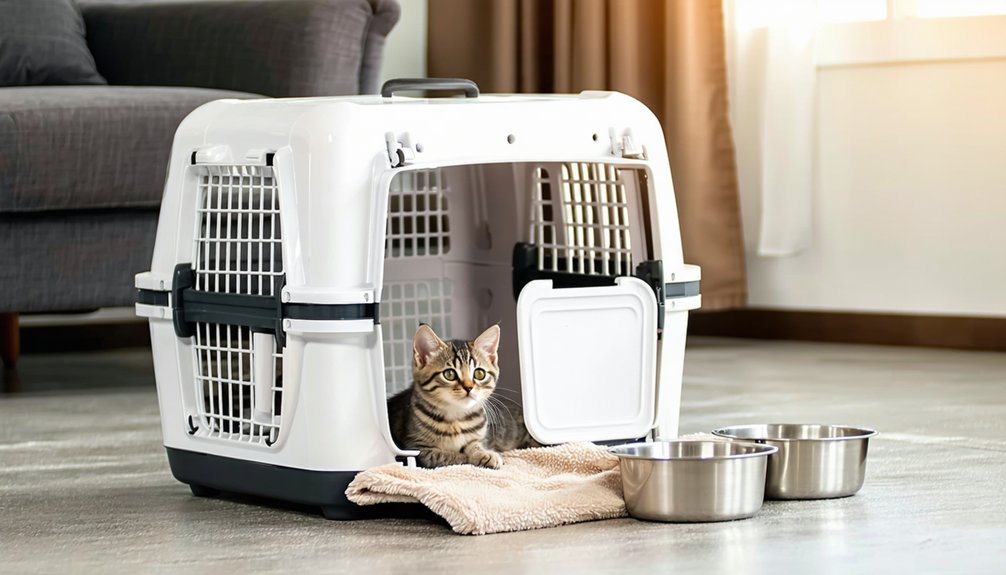
Because fit drives both safety and compliance, you’ll get the best value by prioritizing correct internal dimensions over cosmetic extras.
Measure body length, elbow height, body width, and standing height, then apply the IATA CR1 baseline: internal length equals body length plus half elbow height, width equals body width doubled, and height accounts for standing height plus bedding.
Your cat or small dog must stand, turn, and lie down comfortably, with 3–4 inches of head clearance for international carriage.
Choose a rigid plastic shell with secure bolt-and-nut fastening, smooth interiors, and reliable door hardware.
Add absorbent bedding and a crate-mounted, water-frozen bowl.
Consider your pet’s temperament, and reduce travel stress through weeks of crate training and scent familiarization, so confinement feels routine—helping your companion belong wherever you’re headed together.
Best Premium Kennel for Long-Haul Flights
Stepping up from cat-sized carriers to heavy-duty flight kennels, you’re now investing in structural engineering that survives 8–15 hour itineraries and rough cargo handling. Premium models like the RuffLand Airline series and Petmate Sky Kennel deliver single-piece roto-molded or reinforced shells, metal doors, and bolted perimeters that won’t separate under impact. Expect to spend $700–$1,500, with custom aluminum kennels exceeding that.
When you choose for long-haul comfort, you join shippers who prioritize the animal’s welfare:
- Stress reduction via smooth interiors, rounded corners, and molded-in lips
- Hydration attachments like spill-resistant water buckets clipping to the door
- Temperature insulation through insulated panels or reflective covers
- Anti slip flooring with high-density mats reducing joint fatigue
- 16%+ perforated walls ensuring cross-ventilation
You’re protecting your companion properly.
Compliance Mistakes That Get Crates Rejected
Every rejection at the cargo counter traces back to a handful of avoidable mistakes, and you’ll want to catch them before acceptance, not during it.
Undersized crates top the list—choose by measured body length, height, and width, not species labels, and account for bedding thickness when calculating clearance.
Confirm ventilation on at least three sides totaling 16% open surface, a rigid shell, solid roof and floor, and a single secure metal door.
Place “Live Animals” labels on all four sides and “This Way Up” arrows on vertical corners, keeping them legible through humidity and handling.
Secure internal bowls that refill from outside.
Build crate cleaning routines and preflight inspection checklists into your process, and verify documentation, classification, and UN numbers stay consistent.
That’s how you pass.
Frequently Asked Questions
How Early Should I Book My Pet’s Cargo Flight?
Book your pet’s cargo flight 10–30 days ahead, but plan vaccinations 2–4 months early since titers and waiting periods demand it. Like our savvy travelers, you’ll book timelines that secure space and meet strict import rules confidently.
Can My Animal Be Sedated During International Cargo Transit?
You shouldn’t sedate your animal unless your vet specifically approves it. Like fellow responsible owners, you’ll prioritize safe handling, veterinary oversight, and crate familiarity over sedation safety risks—choosing acclimation strategies that keep your companion calm and protected.
How Much Does International Pet Cargo Shipping Typically Cost?
You’ll typically spend $1,500 to $5,000, though airfare variations, customs fees, and strict-quarantine destinations can push totals past $10,000. Like others in our community, budget for crates, vet prep, and documentation upfront.
Can Two Animals Share One Iata-Compliant Crate?
Yes, you can—if you follow sharing capacity guidelines. Two same-species, similar-sized animals under 14 kg may share humane crate design when airlines permit. But many international carriers require separate kennels, so you’ll confirm policies first.
How Do I Acclimate My Pet to the Crate Beforehand?
Start pre crate training 3–4 weeks early: place the crate openly, add familiar bedding, and feed inside daily. For stress acclimation, gradually close the door, then practice short car rides—joining countless owners who’ve prepared their pets confidently.
Conclusion
Choosing the right IATA-compliant crate isn’t optional—it’s what keeps your animal safe and your shipment moving. You’ve now seen the materials, sizing, ventilation, and hardware that pass inspection, plus the crates that deliver on each front. Match the crate to your animal’s size and route, double-check every requirement, and avoid the rejection mistakes we’ve outlined. Get this right, and you’ll clear customs and cargo holds without delays, stress, or costly last-minute scrambles.
References
- https://specialcargo.nl/en/services/our-activities/un4d-crate-types/
- https://www.travelwithcats.net/iata-cat-travel-crates-for-cargo-long-haul-sizes-setup-top-picks-2025/
- https://www.petcargo.com/en/blog/choose-right-crate-pet-travel
- https://www.iata.org/en/programs/cargo/live-animals/pets/
- https://paradepets.com/dogs/iata-approved-large-dog-crates
- https://private-jets-connect.com/en/cargo/guide/comment-emballer-fret-aerien/
- https://www.fetchapet.co.uk/how-pet-travel-works/air-travel-crates
- https://www.pettravel.com/information/pet-travel-by-air/is-your-pet-crate-iata-compliant/
- https://petcargo.com/choose-the-right-crate/
- https://arkjfk.com/blog/f/best-airline-crates-for-large-dogs-top-picks-for-safe-travel