For off-leash-adjacent hiking, choose a biothane long line for its five-plus-year durability, UV stability, and cold flexibility. Match length to terrain: 20–30 feet in open spaces, 15–20 feet in forests, 10–15 feet on rocky ground. Pick a 25–37 mm width with a durable metal clip and a back-clip creature that spreads force across the chest. Hold the line with a light grip and a 1–2 foot slack buffer. The right setup makes everything easier.
TLDR Key Takeaways
- Match line length to terrain: 20–30 ft in open areas, 15–20 ft in forest, and 10–15 ft on rocky ground.
- Choose biothane over webbing for superior durability, UV stability, cold flexibility, and odor resistance lasting over five years.
- Use a back-clip harness to spread force across the chest and keep attachment points stable.
- Select 25–37 mm line width with secure metal clips for control-focused, fast-clipping wilderness setups.
- Give each dog its own long line and maintain clear spacing to prevent dangerous tangling.
Why a Long-Line Beats Off-Leash on the Trail
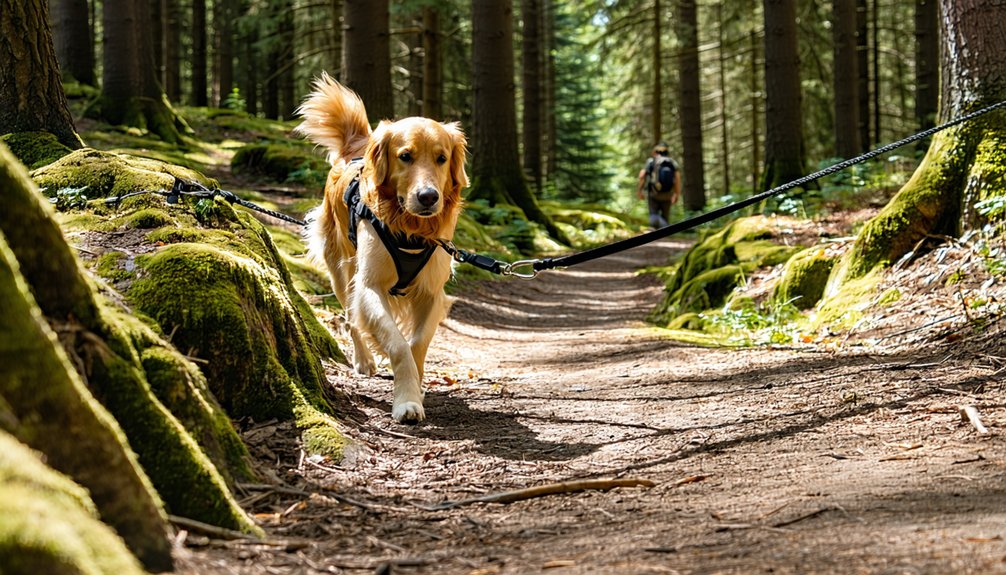
Although true off-leash freedom appeals to many hikers, a long line delivers most of its benefits while eliminating its biggest risks.
You keep a physical safety backup that prevents your dog from bolting after a wildlife distraction, a passing bike, or another trigger.
That same line lets you manage dog greeting control on narrow trails, quickly steering clear of reactive or fearful dogs.
You’ll honor trail etiquette too, respecting hikers who fear dogs and maintaining a defined radius around children and older adults.
Unlike the “all or nothing” risk of going off-leash, a long line gives your dog meaningful freedom while you continue recall practice at hiking distances.
You stay legal, responsible, and welcome—proving to land managers and fellow hikers that you belong out here.
How to Match Long-Line Length to Your Terrain
Why does the same dog need a different line on a fire road than in a thicket? Because terrain dictates everything. A terrain based line keeps you and your dog moving as a unit, not fighting the environment.
In open terrain, run 20–30 ft. Clear sightlines let you manage slack while your dog roams. In forest, drop to 15–20 ft for snag risk reduction around trunks and roots. On rocky, rooty ground, choose 10–15 ft, where handler movement control matters more than reach. In brush, stay at 15 ft or shorter so vegetation can’t trap your line.
Match your leash management cadence to the corridor: tighter footing means faster gathering. We pick length for control first, range second—that’s how the experienced hike.
Long-Line Setups for Hiking Multiple Dogs
The jump from one dog to two isn’t incremental—it’s exponential. One trainer puts it bluntly: two dogs are “ten times the problem,” mostly because of tangling and friction.
So give each dog its own long line—never a shared one—so different pacing, sniffing, and recall responses don’t drag the other dog off balance.
Use back-attachment harnesses to keep attachment points stable, and handle both lines two-handed, with the closest hand managing slack before tension builds.
Keep clear spacing so one dog won’t cross under another’s line.
Build leash first training habits by gaining control of solo work before pairing dogs, and rehearse emergency tangle drills in low-distraction settings.
When both dogs react at once, you’ll want that practiced control already in your hands.
Biothane vs Webbing for Wilderness Hiking
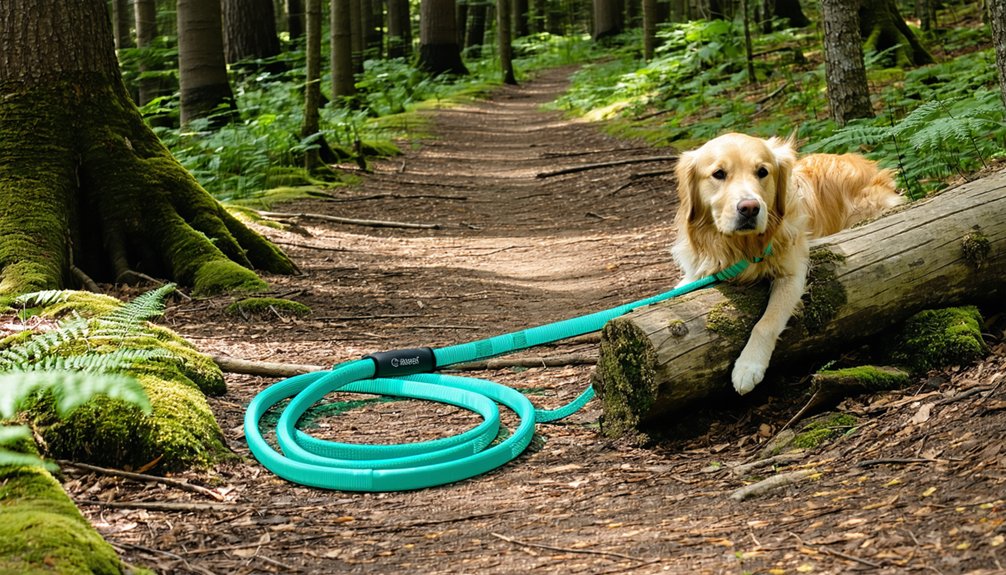
Two materials dominate the long-line market, and choosing between them shapes every wet, muddy, brush-choked mile you’ll hike.
Biothane wraps a polyester core in TPU or PVC coating, while standard webbing leaves nylon fibers exposed to fraying, dry rot, and the elements.
For trail durability, Biothane routinely exceeds five years of heavy use; webbing often lasts just one to two.
Biothane’s UV protection comes from UV-stable pigments that resist sun degradation, and its cold flexibility keeps the line workable with gloves in sub-freezing conditions.
You’ll appreciate the odor resistance too—Biothane’s non-absorbent surface won’t trap moisture, bacteria, or that lingering wet-dog smell.
It wipes nearly dry, resists staining, and won’t cinch tightly around brush.
For serious wilderness hikers, Biothane simply belongs on your pack.
Picking the Right Long-Line Width and Hardware
Once you’ve settled on Biothane, you still face two specs that determine how the line handles in the field: width and hardware.
For width, you’re balancing grip visibility against pack comfort. A 25 mm width works as a practical baseline—wider webbing improves grip visibility and hand comfort, while narrower setups pack smaller and feel lighter over distance.
Many of us favor the 25–37 mm range when control matters most. Keep width secondary to your route circumstances.
For hardware, prioritize secure attachment, hardware durability, and low snagging. Choose a strong metal clip that resists wear and clips fast at trail junctions.
Keep connectors compact and low-profile so they won’t drag, bounce, or catch on roots and brush. Spliced or reinforced ends reduce abrasion where it counts.
Why a Back-Clip Harness Protects Your Dog
When you clip a long line to a back-mounted harness, you spread the force across your dog’s chest and torso instead of concentrating it on the neck. This protects the cervical spine, trachea, and thyroid from sudden tension. When your dog hits the end of a line at speed, the harness absorbs deceleration over a larger area, turning the body rather than snapping the head sideways.
| Focus | What to Do | Why It Matters |
|---|---|---|
| Harness placement | Keep clip behind shoulders | Aligns load with strong muscles |
| Fitting tips | Allow two-finger gap | Preserves gait and range |
| Safety checks | Inspect straps pre-hike | Prevents failure on rough terrain |
| Breed considerations | Watch brachycephalic airways | Reduces gagging, coughing |
| Spine alignment | Match travel direction | Lowers joint strain |
You’ll hike confidently together.
Adding a Traffic Handle for Tight Spots
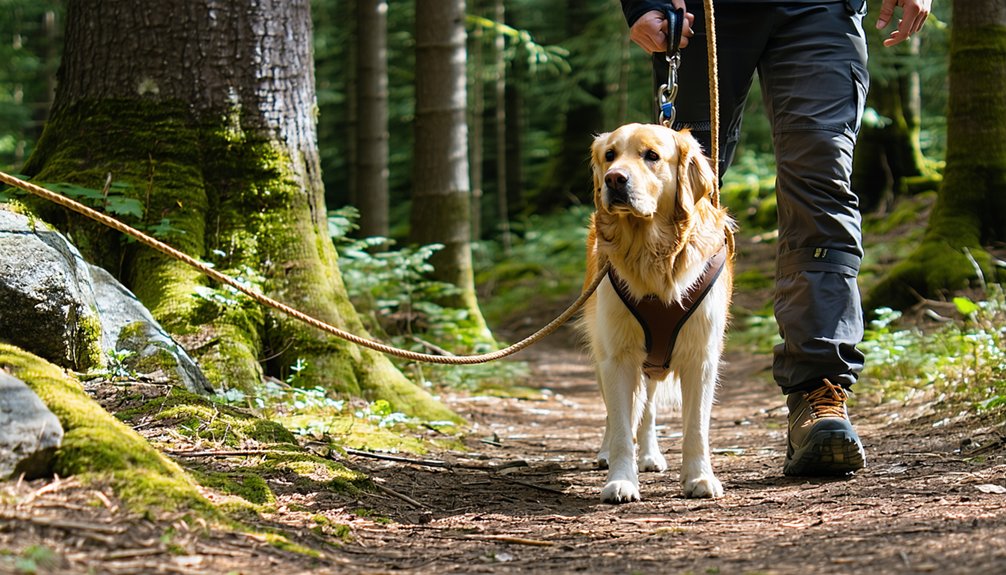
Near a cliff edge or a crowded trailhead, a traffic handle gives you instant close control your long line can’t match.
This short secondary loop sits 8–18 inches from the clip, keeping your dog within 12–18 in (30–45 cm) of your side.
When you approach blind corners, narrow ledges, or choke points, you gather slack and shift to the handle for tighter control during short shift into tight zones.
You’ll reduce collision risk around bikes, wildlife, and fellow hikers while avoiding leash burn and sudden shoulder strain.
Maintain a gentle “J” shape, not a taut line, to prevent tension pulling.
Add pocket braking by stepping on the remaining line for redundancy.
Exiting the section, slide back to the main line and feed slack out.
Should Your Long-Line Have an End Loop?
Whether your long-line needs an end loop depends on how you anchor, where you hike, and how you handle slack. If you tie to trees, posts, or waist belts often, a loop speeds secure connections. If you push through dense brush or talus, Loop Snag Risks climb fast.
| Factor | End Loop Helps | End Loop Hurts |
|---|---|---|
| Anchoring | Fast hardware links | — |
| Terrain | Open trails | Underbrush, blowdown |
| Handling | Tactile Handling Cues | Finger entrapment |
| Wear | Concentrates fraying | Ice/mud stiffening |
| Profile | Modular swaps | Wrapping limbs |
Choose a small, soft, low-profile loop to keep the benefits while minimizing snags. You’ll get reliable Tactile Handling Cues without bulk. Match your loop to your terrain, and you’ll handle your line confidently alongside fellow hikers.
The Safe Way to Loop and Hold Your Line
Because how you hold your line determines whether it helps or hurts you on the trail, start with a light grip that lets the line slide through your hand with minimal resistance. Begin with the handle around your thumb to secure the line, then form a fist with your thumb on top. Use thumb pressure for loop friction control, slowing forward motion without a hard stop.
- Slack buffer walking: Keep 1–2 feet of working slack, releasing one loop at a time.
- Loop geometry safety: Favor S, I, or straight shapes; avoid C, U, or O on the ground.
- Step out technique: Immediately step or jump out if you’re standing inside a loop.
Match your rhythm; you’ve got this.
Using Knots as Grab Points and Foot Stops
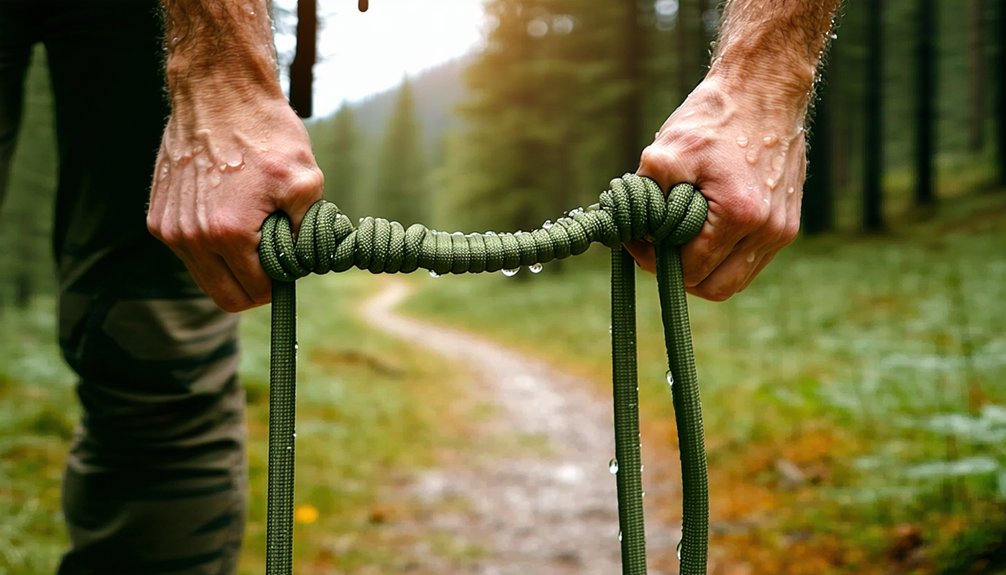
Once you’ve learned holding and feeding your line, the next layer of control comes from the knots tied into it.
Alpine butterfly knots give you mid-line loops that load in any direction, while figure-8 on a bight delivers maximum grab strength without jamming.
For knot placement, space grab knots every 2–3 m—safety spacing that keeps repeated control points without weakening your rope.
Friction hitches like the prusik or klemheist slide when unloaded and lock under tension, using accessory cord 60–80% of your main rope’s diameter.
For foot stops, choose bulky, easy-to-feel shapes you can locate through debris, kept low to reduce mechanical advantage.
Near the dog end, prioritize snag prevention: avoid large protrusions that catch roots or rocks on narrow trails.
Progressing From Held Line to Off-Leash
Although dropping the line feels like the goal, it’s the slowest, most deliberate stage of training—not a reward you hand out early. You earn each step by hitting clear benchmarks first, and you regress without shame when your dog struggles. Empathy based training keeps you reading your dog’s stress signals, not just demanding compliance, so progress stays honest and sustainable.
Before you advance, confirm your dog meets these markers:
- Recall at 80–90% on first cue in low-distraction areas.
- Loose-line hiking for 10–15 consecutive minutes in familiar terrain.
- Error-free sessions—no bolting, spinning, or frantic scanning—across multiple hikes.
Use distraction layering to add complexity gradually, one variable at a time. Treat new locations as training, not testing, and you’ll belong to that confident handler community.
Staying Legal and Safe Near Wildlife and Roads
When you clip on a 30-foot line, you’re not just managing your dog—you’re charting a web of leash laws, wildlife protections, and road hazards that can turn a good hike into a citation or a conflict. Check each trail’s written rules first; many cap leash length at 6–10 feet, so your long line may only be legal in designated zones.
Wildlife compliance matters: chasing counts as harassment, even on a tether, and seasonal restrictions tighten leashes during nesting, denning, and fawning. Near coyotes, bears, or lions, shorten up.
For road safety, reserve 20–30 foot lines for wide-open spaces, switching to shorter leads near traffic for entanglement avoidance.
Respecting these rules keeps you welcome in the community that shares these trails responsibly.
Frequently Asked Questions
How Do I Clean and Store My Long-Line Between Hikes?
Remove hardware, then wash with mild soapy water and rinse fully. For drying methods, hang vertically in shade until completely dry. Choose a cool, dry storage location away from sunlight, coiling loosely so you’ll keep gear trail-ready together.
What Age or Training Level Should a Puppy Start Long-Line Work?
Start as early as 8 weeks, when puppy readiness includes leash comfort and basic recall. You’ll want leash pressure control and collar conditioning first. Join fellow handlers using short, positive sessions—keeping it low-impact for growing joints.
How Often Should I Inspect My Long-Line for Wear?
Inspect your long-line before every outing with quick bolt snap checks, then run detailed tactile checks weekly. Heavy use or rough terrain demands daily scrutiny and tighter seam reinforcement frequency. After any hard snatch, inspect immediately—we’ve all been there.
Can I Use a Long-Line in Cold or Snowy Weather?
Yes, you can! Choose Biothane or coated webbing that resists freeze-stiffening. Use shorter lines for cold weather traction on icy trails, and pick high-visibility colors for visibility safety. Wear gloves, and we’ll all hike smarter together.
How Do I Wash a Biothane Line After Muddy Hikes?
Rinse your line under warm water, then wash with mild soap and a soft sponge. For muddy decontamination, soak 5–10 minutes, scrub gently, rinse, and towel dry. For odor control, you’ll want dog-safe sanitizer before air-drying.
Conclusion
A long-line gives you off-leash freedom without the risk. Match your length to the terrain, choose biothane or webbing based on conditions, and pick hardware that won’t fail under load. Hold your line safely, use knots as grab points, and progress deliberately toward true off-leash control. Stay legal, mind wildlife and roads, and you’ll keep your dog safe while expanding their world. Master these setups, and every trail becomes an opportunity for trustworthy adventure.
References
- https://hightailhikes.com/blogs/news/10-great-uses-for-a-biothane-long-line
- https://fivebyfivecanine.com/blog/2019-5-27-from-long-lines-to-no-lines/
- https://www.facebook.com/groups/9003421258/posts/10163106789761259/
- https://www.facebook.com/groups/9003421258/posts/10164045576896259/
- https://adventuredogsanarchy.com/long-line-handling-hiking/
- https://www.reddit.com/r/Dogtraining/comments/xubm5g/long_line_leash_for_hiking/
- https://www.itsahuskything.com/t17540-long-line-when-hiking-in-woods
- https://www.reddit.com/r/dogs/comments/3cf08g/help_what_length_longline_do_you_find_to_be_most/
- https://hightailhikes.com/blogs/news/what-is-a-biothane-long-line-do-i-need-one
- https://godogpro.com/dogreads/wanderlust-limited-when-and-how-to-use-a-long-lead