When border officials question your dog’s paperwork, stay calm and ask exactly what’s wrong. Confirm whether CBP, CDC, or USDA/APHIS handles the issue. Pull out your backup vaccination records immediately—offline copies with legible dates, lot numbers, and vet signatures. Prove every document matches your dog through microchip scans and physical descriptions. Offer the dog for an ISO-compatible scan proactively. Simple clerical errors can often be fixed on the spot. Here’s how to handle each step.
TLDR Key Takeaways
- Stay calm and politely ask the officer for the exact paperwork defect, confirming whether CBP, CDC, or USDA/APHIS handles it.
- Immediately provide backup vaccination records and certificate copies with legible dates, lot numbers, vet signatures, and licenses stored offline.
- Prove the document-to-dog match by confirming physical descriptions, distinctive markings, and identification numbers across all paperwork.
- Offer a microchip scan to verify the implanted ISO-compatible number ties the dog to its travel documents.
- Resolve simple clerical errors on the spot with officer initials, or route substantive defects through approved local facilities.
Stay Calm and Ask What’s Wrong
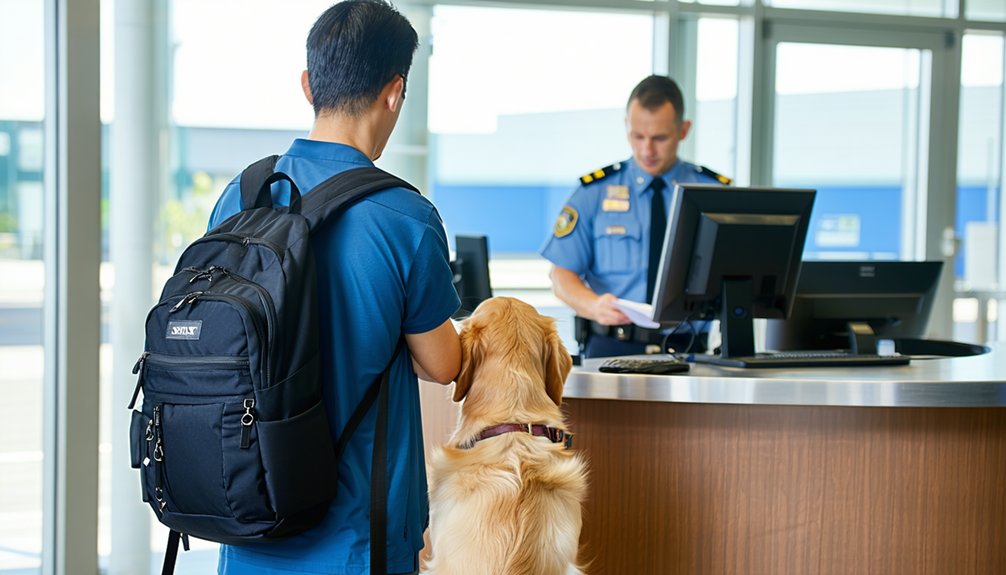
When a border official questions your dog’s paperwork, your first move isn’t to explain—it’s to stay calm. A composed demeanor signals cooperation and low risk, reducing the likelihood of secondary inspection or detention.
Slow your breathing, relax your posture, and keep your movements controlled. This helps you recall vaccination dates, microchip details, and country-specific rules accurately when questioned.
Once you’re settled, request specific deficiency information politely. Ask, “What appears to be the issue with this document?” or “Which requirement isn’t met?” These questions reveal whether the concern involves expired rabies vaccines, health certificate formatting, or a missing phone number.
Remain cooperative politely throughout. Avoid raised voices or confrontational body language, which officials often interpret as noncompliance—prompting more intensive questioning and longer delays for you both.
Pull Out Your Backup Vaccination Records
Reach for your backup vaccination records the moment an official questions your primary paperwork. Pull out certificate copies—scans, photos, or duplicates—provided every field stays legible: date, product, lot number, vet signature, and license. These corroborate your dog’s status when originals smudge or fold.
Show clinic medical records, invoices, or insurer claim histories listing your dog’s name, microchip, vaccine type, and date. Together, these verify vaccine consistency and reconstruct an accurate timeline that officials trust.
Always prepare offline copies in advance. Download PDFs directly to your phone and tablet, since checkpoints often restrict external links or lack connectivity. Keep printed duplicates in a waterproof folder, split across two bags.
When you’ve organized these layers, you’ll join travelers who cross borders confidently and stress-free.
Prove Every Document Matches Your Dog
Because officials need certainty that the dog standing before them is the one named on your paperwork, you’ll have to prove every detail lines up.
Start with the physical description: confirm the breed, sex, color, and coat on your passport, health certificate, and import permit match what officials see.
Point out distinctive markings—a white blaze, docked tail, or surgical scar—that appear in both your records and the dog before them.
Next, match identification numbers.
Scan the microchip and show that number on every document, alongside consistent dates of birth and weight ranges.
Demonstrate owner record continuity by aligning your name and address across vet files, registration, and microchip databases.
Finally, use camera date matching—dated photos showing age progression that corresponds with your contracts and vet records.
Offer Your Dog for a Microchip Scan
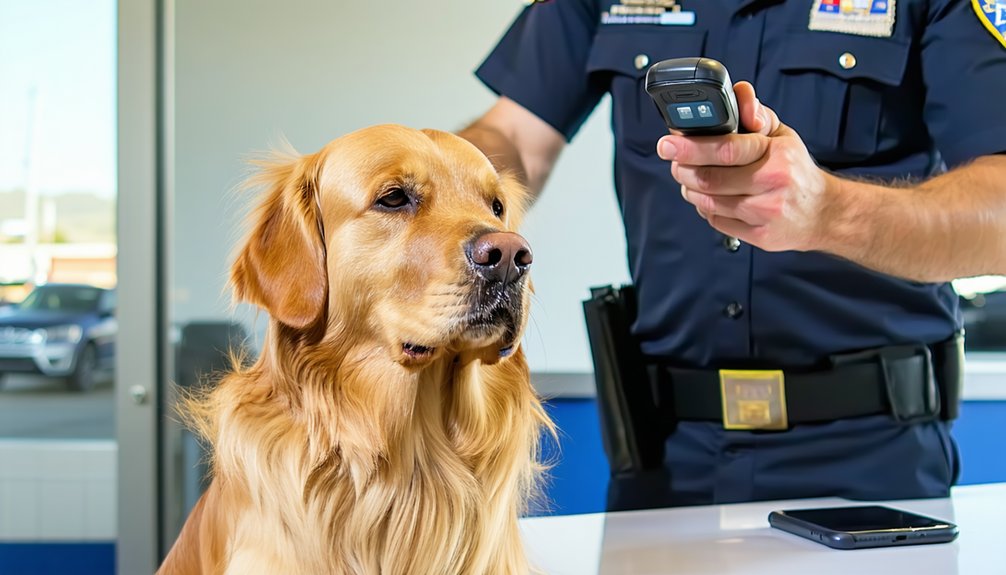
At the moment officials question your paperwork, offer your dog for a microchip scan as a proactive next step. A successful scan ties your dog to the paperwork by confirming the implanted identification number matches your travel documents. Before departure, address microchip scan timing by having a veterinarian scan the chip in advance, confirming it’s readable and correctly documented.
| What the Scan Confirms | What It Doesn’t Replace |
|---|---|
| Chip number matches documents | CDC Dog Import Form receipt |
| Dog matches veterinary records | Vaccination requirements |
| Identity at inspection | Health certificate forms |
Verify chip format too: ISO 11784/11785 compliant chips are 15-digit and readable by universal scanners at borders. Present your dog calmly, letting the scan support your paperwork trail rather than arguing documents alone.
What If the Microchip Reader Fails?
Facing a scanner that won’t read your dog’s chip, you’ve got several technical remedies before the situation escalates.
Start with scanner compatibility checks: ask whether the device reads multiple frequencies (125 kHz, 128 kHz, 134.2 kHz), since some European readers handle only ISO 134.2 kHz chips.
Request a different brand or model, plus a slow, methodical full-body sweep—shoulders, neck, chest, flanks, and legs—because chips often migrate.
Ask the official to palpate for the rice-grain capsule and adjust sensitivity, distance, and angle, as poor technique blocks detection.
Document any error codes or low-battery warnings for later appeals.
When electronic reading fails, rely on documentation crossmatching: your pet passport, registration printout, and vet records should all confirm the same chip number, keeping you and your companion moving forward together.
Explain Vaccine Dates and Waiting Periods
Behind every rabies certificate sits a timeline that border officials know by heart, so you should too.
Show them you belong among prepared travelers by explaining the dates clearly.
Your dog’s first rabies shot counts only if given at 12 weeks or older, and you must wait at least 28–30 days afterward before entry.
Boosters given on time waive that wait—your dog stays continuously protected.
Point out that the vaccine must remain current on the entry date; if it expires beforehand, officials treat your dog as inadequately vaccinated.
For high-risk origins, explain titer validity: drawn 30 days post-vaccine, then a 45-day wait before arrival.
Walk them through this roughly 75-day sequence calmly, and you’ll prove you understand the rules as well as they do.
Show You Meet U.S. or EU Dog Import Rules
Dates prove your timeline; meeting the import rules proves your dog qualifies in the first place. When officials question you, calmly walk them through the core conditions every dog must satisfy. Your dog should be at least six months old, healthy on arrival, and carry an ISO‑compatible microchip that matches every document.
| Rule | What You Show |
|---|---|
| Age & health | Records confirming six months, visible good health |
| Microchip | ISO 11784/11785 chip readable by scanner |
| Risk category | Origin country status (high‑risk, low‑risk, rabies‑free) |
| Entry point | CDC‑registered facility or EU Traveller’s Point of Entry |
Address travel timeline by proving where your dog’s been the past six months. Resolve document translation issues early by carrying certified English or official EU‑language translations.
Did You Cross a Transit Country?
Why does a layover matter if your dog never planned to stay? Because some countries apply import rules based on entry, not just final destination. If your dog physically crossed a border in transit—even for an overnight stop—that country may treat it as imported.
Confirm transited countries before you travel, since a single in-country transfer can trigger separate document requirements at each border.
Match your route to your paperwork exactly: origin, layovers, and destination. Country names on certificates should reflect every border crossed, and your travel dates should fall within each health certificate’s validity window.
Carry airline itineraries, border stamps, or transport receipts to prove whether you stayed airside or entered local territory.
When rules seem unclear, request written clarification from that country’s veterinary authority.
Ask for a Supervisor or Second Review
When an officer’s decision seems inconsistent with the rules, you have every right to request a supervisor or second review.
Higher-ranking officers often handle complex exceptions—assistance dogs, transit situations, or recently changed CDC import rules—more confidently than front-line staff.
Stay calm, use rule-based language, and request clarification before signing any refusal-of-entry paperwork.
- Reference official program names like the “CDC Dog Import Form,” “EU Pet Passport,” or “USDA-endorsed health certificate.”
- Cite concrete criteria: age ≥ 6 months, microchip format, rabies vaccine timing, and completed forms.
- Verify jurisdiction by asking whether CBP, CDC, or USDA/APHIS handles your issue.
- Ask the supervisor to check current guidance rather than rely on memory.
You belong here—knowing your rights protects you and your dog.
Fix Non-Compliant Dog Paperwork at the Border
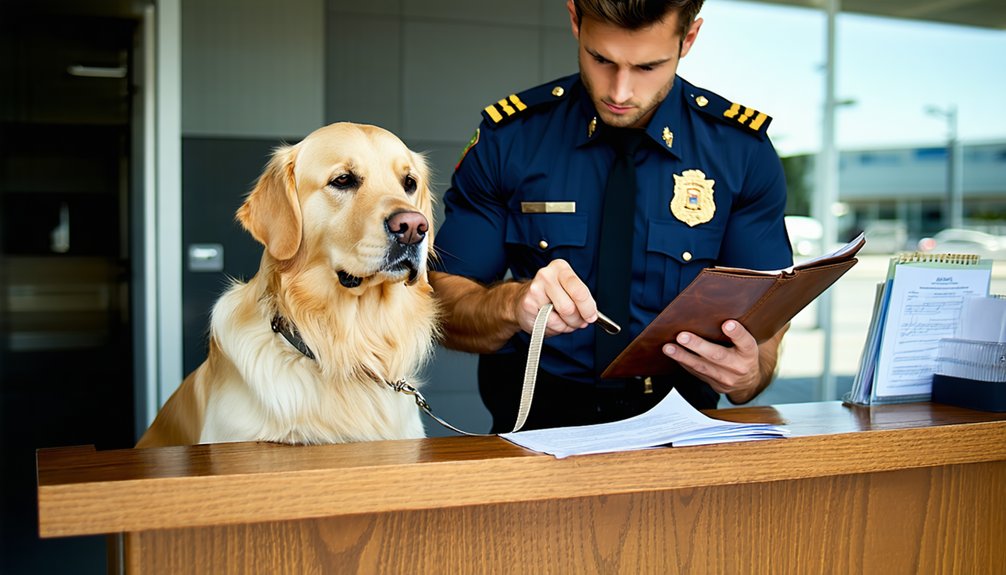
Although a paperwork problem at the border feels like a dead end, most defects are fixable if you act methodically. Start by pinpointing exactly what the officer flagged—a missing microchip number, an expired rabies date, an incomplete field, or the wrong form version. Compare your documents against the importing country’s official rules, then verify dates, timing windows, and identity consistency across every paper.
Many issues are simple clerical corrections you can resolve on the spot. Transcribe a microchip number from your vet record and have the officer initial it, or highlight validity dates with tabs. If translation requirements apply, provide certified translations in the accepted language. For substantive defects, ask about approved local clinics or registered facilities where you’ll secure compliant veterinary certificates and endorsements.
What Outcomes Can Border Officials Decide?
Once an officer reviews your dog’s paperwork, they hold the authority to issue one of several distinct outcomes, ranging from immediate clearance to outright refusal. Knowing these possibilities helps you prepare with the right document checklists and respond calmly, joining the community of travelers who travel borders successfully.
- Full entry, granted once officials verify your CDC Dog Import Form, microchip data, and valid rabies proof on-site.
- Conditional entry, requiring quarantine, confinement, or revaccination at a CDC-registered facility before release.
- Refusal or re-export, turning you back when your dog lacks required documents or meets ineligibility criteria.
- Fines or legal referral, assessed for fraudulent records or repeated non-compliance.
Throughout each scenario, you can practice humane advocacy, ensuring your dog’s welfare stays central to every decision.
Build a Bulletproof Dog Border Packet
Because border officials decide your dog’s fate based on what you put in front of them, you’ll want a packet that answers every question before it’s asked.
Start with your veterinary bundle: current rabies certificate, core vaccinations, a health certificate within the validity window, and parasite prevention records.
Add identification proof—microchip certificate with the ISO 15-digit number, ownership documents, and a photographic ID sheet.
Then include border compliance papers: country-specific requirement summaries, import permits, lab titer reports, and translated duplicates.
Smart document organization tips make the difference.
Follow a dog travel checklist, ordering papers by the sequence officials request them, and place permits at the front.
Cross-reference tag numbers to the microchip and owner.
When everything matches, you belong in that approved-entry line.
Frequently Asked Questions
Can I Appeal a Border Decision After I’ve Already Been Turned Away?
Yes, you can often request appeal options after turn-back. Start the reconsideration process promptly, since the border decision timeline runs from the written decision. Keep documentation review handy—you’ll need it, and we’re here supporting you through this.
How Much Do Emergency Vaccinations or Quarantine at the Border Usually Cost?
You’ll typically pay $40–$600 per emergency vaccine, while quarantine runs from hundreds to several thousand dollars. Expect cost variability by clinic and country, and remember documentation impact—incomplete paperwork drives your fees higher, so we recommend preparing thoroughly.
Do Service or Emotional Support Dogs Follow Different Import Rules?
No, you’ll follow identical import health rules—same Vaccination Requirements, microchip, and Processing Timelines—whether your dog’s a service animal or emotional support companion. Assistance status won’t exempt you at the border, so we’re all preparing equally.
Will My Dog’s Breed Affect Entry Approval at the Border?
Yes, your dog’s breed can affect entry approval where breed-specific legislation applies. You’ll need microchip verification, age eligibility, accurate species classification, and document translation. We’re here to help you join others crossing borders smoothly and confidently.
How Long Can a Dog Be Held in Quarantine Before Release?
Your dog’s detention duration typically ranges from 10 days to 180 days, depending on documentation and origin risk. You’ll find most travel quarantines last 21–28 days. Know your appeal timelines—they’ll help you reunite faster with confidence.
Conclusion
When officials question your dog’s paperwork, you’ve now got a clear playbook. Stay calm, produce backup records, match every document, and offer the microchip scan. If problems persist, escalate to a supervisor and fix non-compliant paperwork on the spot. Understanding the possible outcomes keeps you prepared for any decision. Build a bulletproof border packet before you travel, and you’ll turn a potential crisis into a routine checkpoint. Preparation’s your strongest defense—use it.
References
- https://www.reddit.com/r/Norway/comments/1cliu8k/question_about_the_border_control_entering_with_a/
- https://www.reddit.com/r/Expats_In_France/comments/1miyf4v/fr_border_patrol_when_bringing_in_our_dog_advice/
- https://jwsmith.com/blog/cfia-pet-travel
- https://www.reddit.com/r/uscanadaborder/comments/1ex1x7m/traveling_with_dogs_from_canada_to_us/
- https://www.reddit.com/r/uscanadaborder/comments/1eishz3/went_thru_us_border_with_dogs_today_no_questions/
- https://www.aclusocal.org/know-your-rights/if-questioned-police-fbi-customs-agents-or-immigration-officers/
- https://www.reddit.com/r/uscanadaborder/comments/1f9qiva/is_the_border_guards_actually_scanning_dogs_for/
- https://www.cbp.gov/border-security/protecting-agriculture/bringing-pets-and-wildlife-united-states
- https://www.cbsa-asfc.gc.ca/services/fpa-apa/animals-animaux-eng.html
- https://www.englishforum.ch/pet-corner/304055-customs-didn-t-check-my-dog-am-i-trouble-already.html