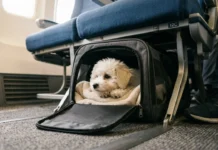
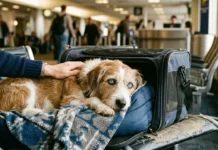
Every U.S. airport has at least one designated pet relief area, and finding the right one saves you time on tight layovers. Look for indoor, post-security spots—they let your pet relieve without exiting and re-clearing screening, cutting 10–20 minutes off transfers. Outdoor curbside areas exist too, but they require full re-screening. Always keep your pet leashed or carried, and use marked waste bins. Below, you’ll find hub-specific locations and smart time-budgeting tips.
TLDR Key Takeaways
- Every U.S. airport must provide at least one designated pet relief area with animal-friendly surfaces and proper waste disposal infrastructure.
- Prioritize indoor post-security relief areas, which save 10–20 minutes by avoiding terminal exits and re-screening during tight layovers.
- Find relief areas using official airport interactive maps, filtering for pet/service animal icons like paw prints or fire hydrants.
- Major hubs like ATL, PHL, and PHX offer indoor relief areas per concourse, plus outdoor dog parks near arrivals.
- Keep pets leashed or carriered throughout, use only marked waste bins, and budget at least 20 minutes per relief stop.
What Counts as a Pet Relief Area at Airports
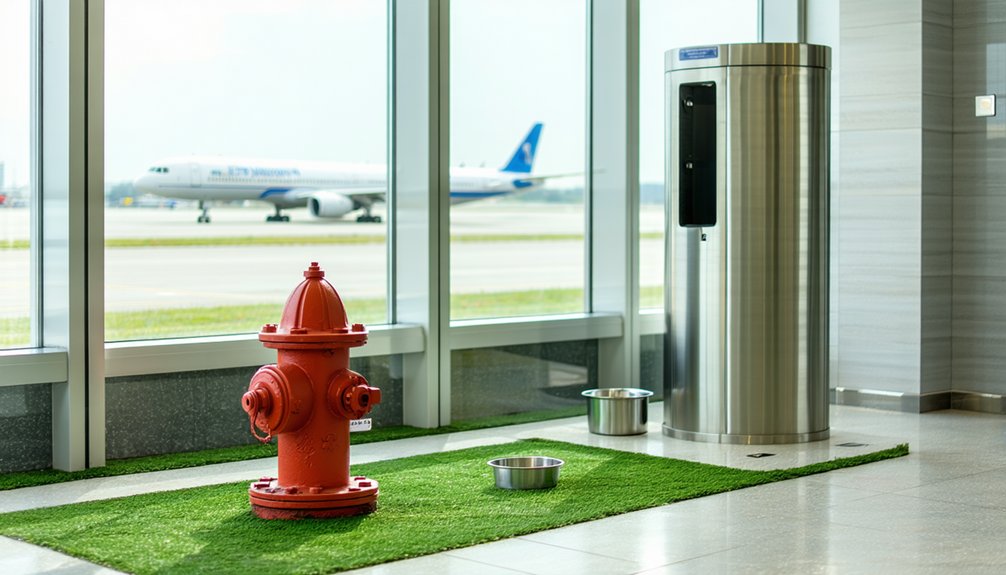
According to federal law, every U.S. airport must provide at least one designated pet relief area—a space where pets, service animals, and emotional support animals can urinate or defecate before or after a flight.
So how do you know you’ve found one? Look for an animal-friendly surface like artificial turf, grass, or wood chips, paired with proper waste disposal infrastructure—bag dispensers and trash receptacles serviced regularly.
Drainage and cleaning mechanisms set these spaces apart from ordinary landscaping.
Signage requirements matter too. A true relief area displays icons of dogs, “Pet Relief Area” text, and leash or cleanup rules.
You’ll find these areas pre-security, post-security, or outside near arrivals and parking.
Check airport websites and terminal maps to locate the spot that welcomes you and your companion.
Indoor vs Outdoor Relief Areas: Why It Matters
Every relief area isn’t created equal, and where it sits—inside the secure zone or outside it—directly shapes your layover. Indoor areas located post-security let you and your pet go during connections without exiting and re-clearing screening, often cutting 10–20 minutes off tight transfers.
Outdoor areas usually sit curbside or at arrivals, before security, meaning extra walking and full re-screening to use them.
That trade-off matters for weather safety planning, since heat, cold, rain, or snow outdoors can stress your pet, while indoor turf stays climate-controlled and consistent.
It also matters for surface preference differences—some dogs only reliably go on real grass, making outdoor access worth the time.
Major hubs like DEN, ATL, ORD, LAX, and SFO increasingly offer both, so you’ve got flexibility.
How to Find Relief Areas on Terminal Maps
Before you fly, head to the airport’s official website, where interactive terminal maps live under sections labeled *Maps*, *At the Airport*, or *Services & Amenities*—often with pet/animal relief areas built in as a filterable icon.
Search “[airport name] pet relief map” to surface the page fast.
Once there, use the Map filter buttons—toggle “Pets/Service Animals” or “Accessibility” to reveal only relief icons like paw prints, dog symbols, or fire hydrants.
Don’t skip the Symbol legend meanings on PDF downloads; they decode abbreviations like “SARA,” “ARA,” or “Pet Relief,” so you’ll know exactly what each marker means.
Cross-reference nearby gates, door numbers, and levels to triangulate locations from your boarding pass.
Pair these maps with text-based list views, which separate inside/outside and pre-/post-security areas.
Post-Security Relief Spots for Mid-Layover Use
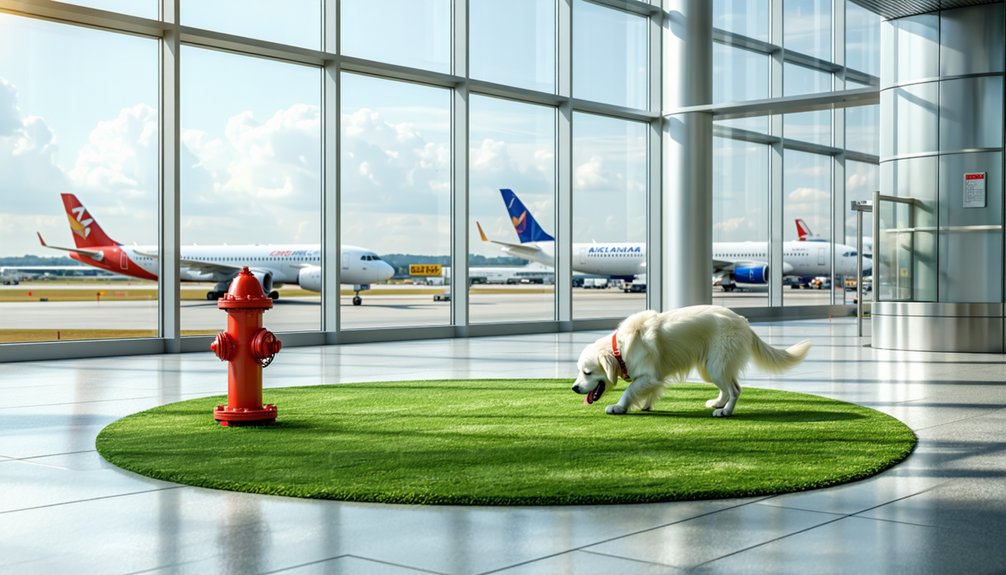
Because tight connections leave no time to exit and re-clear security, you’ll be glad most large U.S. airports now keep at least one indoor, post-security relief area per concourse or terminal—a shift driven by ADA-related guidance and industry best practices.
You’ll usually find these spots near gate clusters, family restrooms, or connector walkways, so you won’t detour far mid-layover.
PHL spreads seven indoor Service Animal Relief Areas across A-West through F, while PHX covers Terminal 4’s D1–D8, D11–D18, and B1–B14.
BWI’s D/E connector sits just beyond the checkpoint—perfect after re-screening.
Most are enclosed rooms with turf, drainage, and waste stations, serving both pets and service animals.
For service animal access and faster airside wayfinding, check overhead dog-symbol signs, directories, and kiosks.
Pet Relief Areas in Atlanta, Dallas, and Denver
Three of the busiest U.S. hubs—Atlanta, Dallas/Fort Worth, and Denver—back up that post-security convenience with dense relief networks you can count on mid-layover. At Atlanta, you’ll find Atlanta indoor Service Animal Relief Areas in every concourse—near gates T7, A10, B33, C19, D Centerpoint, E14/E15, and F7—all open 24/7. For dog park options, head to the 1,000-sq-ft “Poochie Park” outside doors W1 and W2, or the outdoor area outside door A1.
| Feature | Atlanta (ATL) |
|---|---|
| Indoor SARAs | 7, one per concourse |
| Access | 24/7, post-security |
| Dog park | Poochie Park, 1,000 sq ft |
| Outdoor spots | W1/W2, A1 |
| Connection buffer | 15–20 minutes |
You belong here, so budget 15–20 minutes, keep your pet leashed, and clean up using provided waste bags.
Pet Relief Areas in Philadelphia and Phoenix
At Philadelphia International (PHL), you’ve got seven indoor Service Animal Relief Areas spread across Terminals A through F, plus multiple outdoor “Pet Port” zones along the arrivals and departures roads.
Each area runs 250–600 sq ft, featuring fenced enclosures, mulch or artificial turf, faux fire hydrants, benches, and biodegradable waste bag dispensers.
You’ll find indoor spots near Gate A-16, before the A–B connector, and dense coverage in Terminal D, including next to the United Club and between Gates D-4 and D-5.
Terminals E and F serve commuter crowds near Gate E-1 and the Police stand.
Use airport wayfinding tips to locate the nearest zone fast, and practice Service Animal etiquette—keep your companion leashed and clean up—so everyone in our traveling community feels welcome.
London Heathrow’s Airside Relief Areas by Terminal
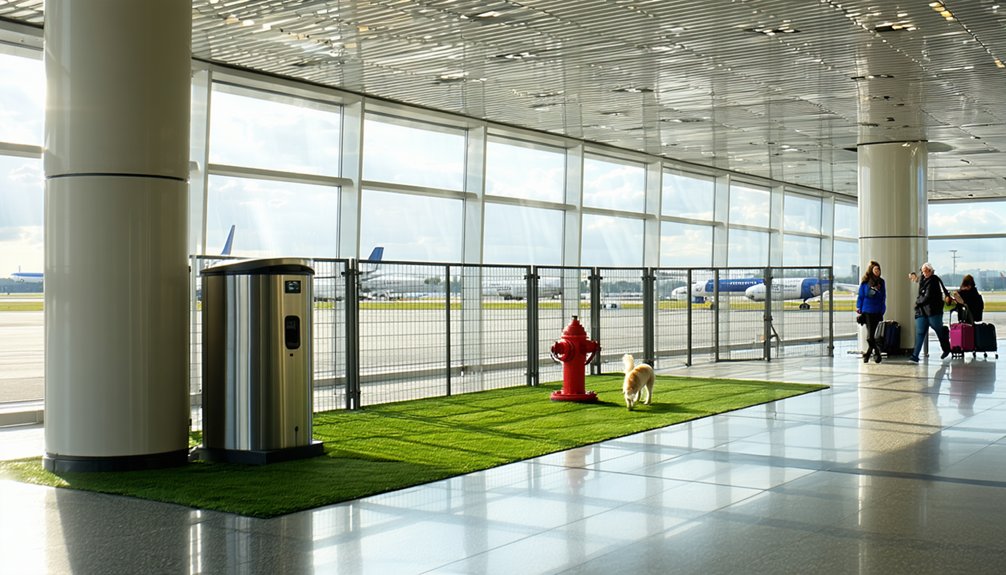
Crossing the Atlantic to London Heathrow, you’ll trade Philadelphia’s seven indoor zones for a terminal-by-terminal system that demands a bit more planning.
In Terminal 2, you’ll find relief facilities on Level -2 near the B gates walkway (T2A) or on Level 1 by Gate 46 (T2B).
Terminal 3 keeps things simple with one spot on Level 1 next to Gate 27, conveniently beside Airside Seating for pre-boarding waits.
Terminal 4’s facility sits on Level 0 behind the escalator, reachable by following assistance signage.
Terminal 5 spreads three relief areas across Level -2 for its A, B, and C gates, all lift-accessible.
Each dedicated space offers hard and soft surfaces plus waste bins.
Smart Heathrow Wayfinding means you’ll never leave your companion searching.
Munich and Frankfurt Relief Areas for Transfers
While Heathrow gives you terminal-by-terminal relief zones, Munich strips that convenience away entirely. You won’t find any airside pet relief areas inside Munich’s terminals—only assistance dogs get clear accommodation, and even they lack dedicated “dog toilet” infrastructure.
Your only realistic option? Munich outdoor patches, those grassy bits scattered along forecourts, access roads, and parking approaches. But reaching them isn’t simple.
- Terminal 1 and Terminal 2 are security-separated, so moving between them forces you to exit and re-clear screening.
- Terminal security re entry queues put tight connections at serious risk.
- You’ll need valid entry rights for Germany and Schengen clearance to step outside.
Frankfurt, meanwhile, runs a large Animal Lounge—but it’s built for cargo animals, not your cabin companion needing a quick break.
Vancouver’s Pet Relief Areas by Pier and Gate
Where Munich forces you outside and through security again, Vancouver keeps you covered with full-service indoor pet relief areas spread across every pier, all post-security.
On A/B Pier, you’ll find relief across from the children’s play area, before Starbucks—handy wayfinding tips since these landmarks guide you fast from any A/B gate.
On C Pier, look across from Gate C29 in the alcove right of the washrooms, a quieter staff-adjacent corner.
D Pier offers multiple spots: across from D72, near Gates 76–77, and between 58–62.
The U.S. Departures room by Gates 76–77 includes touchless entry, lowered counters, and accessible interior features—real accessibility features for service animals and handlers.
At South Terminal, you’ll relieve your pet by Gates G1–2, near the vending machines in the corner.
Leash, Carrier, and Cleanup Rules to Follow
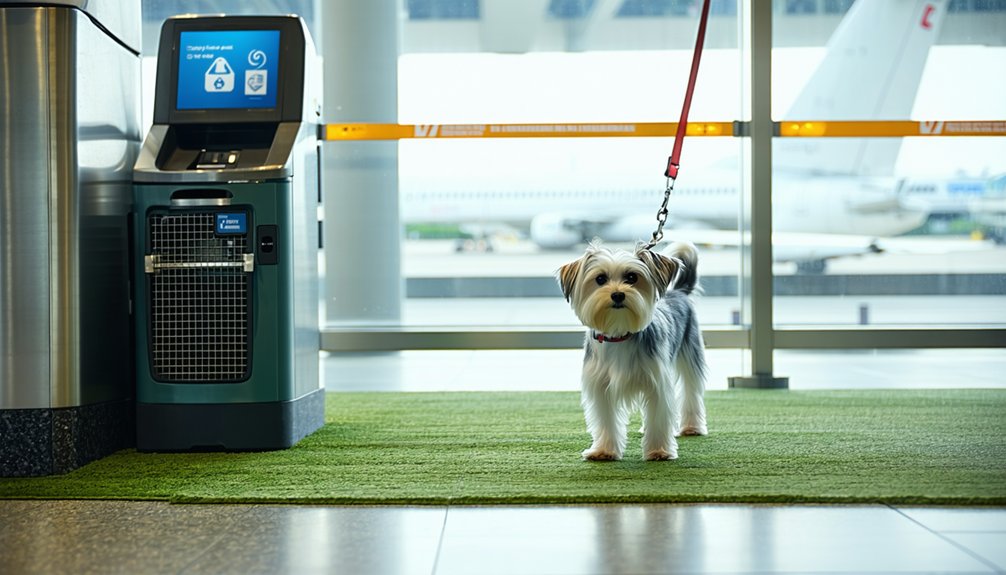
Three rules govern your pet at nearly every airport: leash, contain, and clean up. Master these and you’ll move through any terminal like a seasoned traveler.
- Leash or carrier, always. Most airports require pets either in a carrier or on a short leash outside it. Some, like SFO, mandate carriers terminal-wide; ATL keeps pets leashed even inside relief rooms.
- Follow airline policy continuously. Airport rules don’t override your carrier’s requirements. Match crate size and type—soft or hard—from curb to gate, including relief-area corridors.
- Handle waste disposal correctly. Clean up solid and liquid waste, then use only marked bins inside or beside relief zones—never general restroom trash.
Skip escalators and moving walkways; they’re hazardous, so carry your pet or take elevators instead.
How Much Layover Time to Budget for Relief Breaks
Budget at least 20 minutes as your practical floor for any pet-relief stop—a benchmark borrowed from UK working-time rules, not a travel law, but a realistic minimum for handling waste, washing up, and getting your pet back in its carrier.
Your layover timing depends on connection type.
Domestic-to-domestic transfers run 45–60 minutes, leaving little connection slack for a detour unless gates sit close.
Domestic-to-international gives you 1.5–2 hours.
International-to-domestic needs 2.5–3+ hours because arrival processing and baggage delays eat your buffer.
At major hubs like Atlanta or O’Hare, plan 1.5 hours domestic, 2–3 hours international, since walking time counts against you.
Flying separate tickets? Add about an hour for airline recheck and re-entry.
Build in margin—you’ll relax, and so will your pet.
When Only Outdoor Relief Areas Exist
When the only pet relief area sits outside security, your quick break turns into a full re-screening detour. You’ll find these fenced spaces along curbsides, arrivals roads, departures loops, and parking lots, often near baggage claim exits.
Like many pet-owning travelers, you’ll weigh convenience against the time you’ll lose.
Before you head out, plan for these realities:
- TSA re-screening hassles: Exiting and re-entering means full screening again, so budget extra time during tight layovers.
- Weather safety planning: Heat, cold, ice, and storms affect surface conditions and usability, especially for small breeds or older animals.
- Limited access: Some outdoor zones sit inside gated parking or depend on side-door hours, restricting 24/7 use.
Check airport maps or information desks, since signage often runs minimal.
Frequently Asked Questions
Are Pet Relief Areas Free to Use at Airports?
Yes, you’ll find standard pet relief areas free at most airports. Pricing varies, check etiquette for premium pet hotels or dog parks. Need help? Make a staff assistance request and ask alternatives—you belong here.
Can I Use Relief Areas During Overnight or Red-Eye Flights?
Yes, you can—most 24/7 airports keep airside relief areas open overnight. With red-eye timing, you’ll want to confirm restroom availability and security access first, since some terminals close, limiting your post-security options until morning.
Do I Need Documentation to Access Service Animal Relief Areas?
You won’t typically need papers for relief area access. Documentation requirements vary by airport, and service animal status verification rules stay limited. Airport security screening may apply post-security, while relief area access policies differ across terminals.
Are Pet Relief Areas Wheelchair Accessible for Disabled Handlers?
Yes, you’ll find wheelchair access at most service animal relief areas. FAA guidelines require accessibility routes, flat entry surfaces, and accessible gates, so you belong here too. Airports like SFO and Chicago Midway confirm wheelchair-accessible designs.
What Should I Do if a Relief Area Is Closed?
Plan an alternative right away: follow signs to locate a nearby relief area, ask staff for the closest open option, and stay informed via airport maps. Be flexible—you’ve got backup spots and support throughout the terminal.
Conclusion
You’ve got the tools to handle any layover with your pet. Locate relief areas on terminal maps before you fly, factor in extra time for post-security breaks, and pack leashes, carriers, and cleanup supplies to meet airport rules. Whether you’re connecting through Atlanta, Dallas, Denver, or Vancouver, knowing where indoor and outdoor spots sit keeps stress low. Plan ahead, build in buffer time, and you’ll both arrive ready for what’s next.
References
- https://www.travelnuity.com/dog-friendly-airports-in-europe/
- https://www.petsreport.com/pet-relief-areas-us-airports/
- http://www.phl.org/at-phl/services-and-amenities/petports
- https://airlines-airports.com/best-pet-relief-areas-at-airports/
- https://www.skyharbor.com/at-the-airport/services/animal-relief-areas/
- https://usaservicedogregistration.com/airport-relief-areas-service-animal/
- https://www.hotelsbyday.com/blog/pet-relief-areas-us-airports/
- http://www.triouradventure.com/2019/05/airport-pet-relief-areas-list.html
- https://bwiairport.com/animal-relief-areas/
- https://slcairport.com/airport-services/animal-relief-stations/