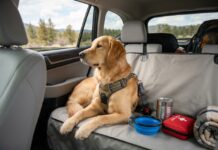
Build your de-skunking kit around a sealable, rectangular container that fits under a seat or in cargo storage. Pack a quart of 3% hydrogen peroxide, baking soda, and dish soap for the DIY recipe, plus a ready-to-use commercial product like Skunk-Off. Add nitrile gloves, washcloths in a waterproof bag, saline eyewash, and a muzzle. You’re covered for the field—stick around for exactly how to mix and apply it all.
TLDR Key Takeaways
- Pack a sealable, rectangular container with DIY and commercial de-skunking supplies that fits under a seat or in cargo storage.
- Include a Skunk-Off or Skout’s Honor bottle sized for one full treatment plus deodorizing shampoo for camp use.
- Stock multiple pairs of disposable nitrile, rubber, or latex gloves in various sizes for grip and dexterity.
- Add washcloths, towels, saline eyewash, a muzzle or soft restraint, and a headlamp, storing washcloths in a waterproof bag.
- Duplicate key ingredients for multiple dogs, cushion liquids with towels, and label the container clearly for quick access.
Why Skunk Encounters Happen More Than You’d Think
A skunk problem isn’t just a rural nuisance—it’s a growing suburban and urban reality. You’re not imagining it: skunk populations are climbing, and their range keeps pushing into the fringes where you camp, hike, and park your rig.
Warmer winters mean higher survival rates and bigger litters, while garbage, pet food, and campsite scraps make human spaces a reliable buffet. Skunk ecology favors bold, slow-moving behavior—these animals don’t fear predators, thanks to their spray, so they won’t scatter when you approach. This adaptability means skunks will actively seek out ideal living situations wherever they can find food, water, and shelter.
Understanding skunk behavior matters most during late winter through spring, when mating season and juvenile dispersal spike movement and encounters. Breeding season specifically runs from late February through March, with females giving birth in May to litters of four to six kits. In some areas, this activity can even stretch into early April depending on local weather patterns. Add nocturnal habits and poor eyesight, and skunk encounters become less about bad luck—and more about biology colliding with urban wildlife expansion.
The 3-Ingredient Peroxide De-Skunking Recipe
This de skunk recipe is simple: 1 quart of 3% hydrogen peroxide, 1/4 cup baking soda, and 1–2 teaspoons of liquid dish soap (Dawn works well). Mix it in an open container, and use it immediately—it’s not for storage, since trapped gas can build pressure and burst a sealed bottle.
Work the mixture into your dog’s coat, let it foam, then leave it on for 5 to 15 minutes before rinsing. The soap breaks down the oils carrying skunk odor, while the peroxide-baking soda combo neutralizes it at the source. If you’d rather skip the liquid mixture altogether, some owners recommend using baking soda alone first and brushing the dog out before resorting to wet treatments. Avoid bringing your dog inside beforehand, since indoor exposure can spread the smell throughout your house. For stubborn cases, follow up with a normal shampoo bath for complete skunk odor removal. Keep in mind that even this trusted remedy is not guaranteed to remove every trace of skunk odor.
Mix Your Peroxide, Baking Soda, and Dish Soap Solution

Grab a plastic pitcher or bucket—never metal, since it can react with the peroxide—and pour in 1 quart of fresh 3% hydrogen peroxide.
Mixing ratios matter here, so don’t eyeball it.
Add these ingredients in order:
- ¼ cup baking soda
- 1–2 teaspoons liquid dish soap (blue Dawn® works great)
- A quick stir to combine
- Nothing else—no lids, no sealing
That last point is container safety in action: keep this mix in an open vessel so oxygen gas escapes freely instead of building pressure.
Never cap it or store it for later—mix fresh, use immediately, and toss any leftovers.
Work fast once it’s combined, since peroxide loses its punch quickly once exposed to air and baking soda’s reaction kicks off. If you want expert-backed background on why this recipe works so well, Margaret C. Brittingham, Ph.D., a former Penn State Professor of Wildlife Resources, is the authority behind this trusted formula.
Build a De-Skunking Kit That Fits Your Rig
Skunk encounters don’t wait for you to mix a batch from scratch, so stock your kit with ready-to-use commercial de-skunking products alongside your DIY supplies.
Grab a Skunk-Off or Skout’s Honor bottle sized for one full treatment, and back it up with deodorizing shampoo for camp.
Choose enzymatic formulas that neutralize odor instead of masking it—your rig organization depends on de-skunking essentials that work fast.
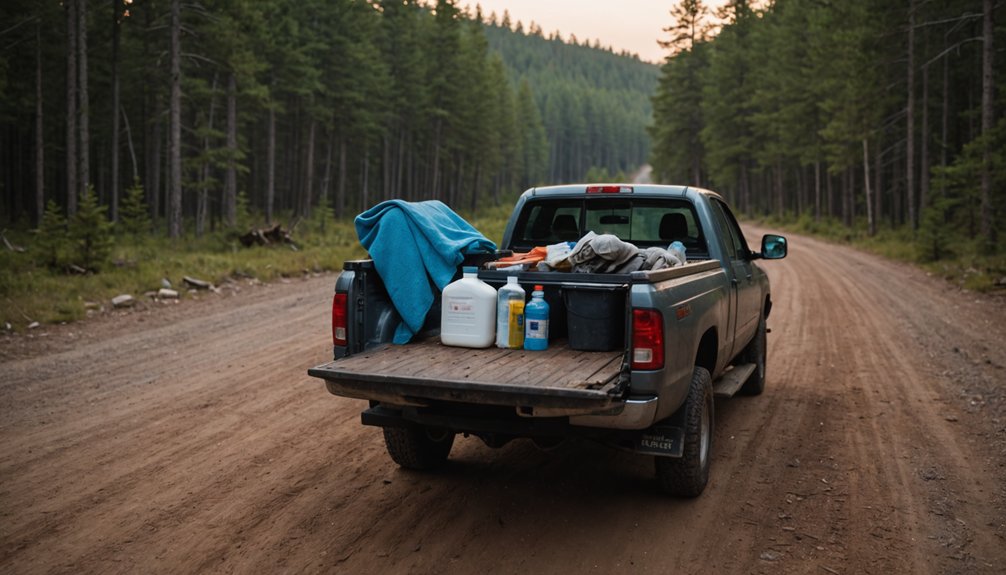
Pack everything in a sealable, rectangular container that fits under a seat or in cargo storage. If you prefer a DIY approach, keep a quart of hydrogen peroxide on hand as a core ingredient for mixing your own solution.
Duplicate key ingredients for multiple dogs, cushion liquids with towels, and label the container clearly. Since skunk spray can seep into hair follicles and skin, having your kit ready to grab means treating the problem before it sets in deeper. Don’t forget to include disposable nitrile gloves in your rig kit so you can protect your hands the moment you start treatment.
Smart rig storage isn’t optional gear—it’s backcountry preparation that turns skunk prevention from theory into action when you’re miles from help.
Pack Gloves, Washcloths, and Other Must-Have Tools

Bare hands have no business touching skunk oil or peroxide, so pack multiple pairs of rubber, latex, or nitrile gloves in various sizes for a solid grip and full dexterity around your dog’s eyes, ears, and muzzle.
Treat these as dedicated skunk gloves—bag them after use so you’re not spreading stink to your other gear. Nitrile glove materials hold up best against repeated peroxide and detergent exposure.
Round out your kit with these essentials:
- Washcloths and towels for applying solution and blotting fresh spray
- Saline eyewash for immediate flushing if oil hits your dog’s eyes, since skunk spray can cause temporary blindness and irritation
- A muzzle or soft restraint to keep hands safe during frantic scrubbing
- A headlamp for spotting oil in low light
Keep washcloth storage in a sealed, waterproof bag so everything stays dry and ready when you need it most. If you’re treating more than one dog on the trip, plan ahead since a second recipe can be prepared for multiple dogs.
Treat Your Dog Before It Gets in the Truck
Once your gloves and washcloths are within reach, don’t let your dog anywhere near the truck until you’ve dealt with the spray on-site. Field treatment now saves you hours of vehicle preparation later. Keep your dog outside, mix your solution, and hit the heavily sprayed zones first—face, chest, neck. That’s where the oils concentrate and where odor transfer to your rig starts. For a fast, effective option, the Got Skunked Bundle uses a professional-strength, biodegradable Molecular Deodorizer that destroys skunk odor molecules on contact.
Check eyes for irritation before you touch anything else. Flush with cool water if they’re red or watering. Skip the mouth, nose, and ears when applying your mixture. Skunk spray contains lachrymators, which is why irritated, watering eyes are such a common reaction in dogs that get sprayed.
| Field Treatment Step | Action |
|---|---|
| 1. Isolate | Keep dog outside, away from cab |
| 2. Assess | Check eyes, nose, mouth for irritation |
| 3. Treat | Apply solution to sprayed areas |
| 4. Rinse | Wipe down before loading up |
Handle it right, and your truck stays clean.
How Long Should You Let the Solution Sit?
Timing matters more than most people realize.
Out on the trail, you don’t have a grooming manual—you have your gut and a watch.
Contact times determine whether you’re breaking down skunk oil or just irritating your dog’s skin.
Solution safety depends on matching the mix to the minutes:
- Peroxide-baking soda blend: 5–10 minutes, don’t push past 20.
- Vinegar rinse: 5 minutes per round, repeat if needed instead of soaking long.
- Commercial shampoo: Follow the label, usually 5–20 minutes.
- Thick paste treatments: 15–20 minutes max on oily patches, since skunk spray is oil-based and needs time to break down rather than just sit on the surface.
Set a mental timer.
Rinse thoroughly.
Watch your dog’s skin and coat—redness or dryness means you’ve gone too far.
Handle Heavy Spray Events With Repeat Applications
When a skunk unloads at close range, one round of treatment won’t cut it.
Heavy spray to the face, chest, or gear soaks oily thiols deep into hair and fabric, overwhelming a single batch’s oxidizing power.
Repeat treatments matter because peroxide and baking soda work with finite capacity—each round breaks up more oil and reaches deeper layers your first pass missed.
Mix a fresh batch: 1 quart 3% peroxide, ¼ cup baking soda, 1 tablespoon dish soap.
Soak five minutes, rinse, then run the whole cycle again before your final shampoo.
For gear and collars stuck in high-concentration zones, repeat chemical cleaning or escalate to a 24-hour alcohol soak.
Complete odor removal after a bad hit is cumulative—not instant.
Best Commercial Skunk Odor Removers for the Backcountry
Ready-made formulas earn their keep when DIY chemistry isn’t practical mid-trip.
Commercial removers skip the mixing and guesswork—no measuring peroxide, no risk of bleaching your dog’s coat. They’re built for skunk removal on the fly, with formulas gentle enough for repeated washes when one round isn’t enough.
Stock your rig with proven options:
- Nature’s Miracle Skunk Odor Remover – a trusted standby for pets and gear.
- Skout’s Honor Professional Strength – built for intense, repeat-use situations.
- Natural Chemistry De-Skunk Shampoo – gentler than home mixes, still effective.
- Skunk-Off or AEROKURE Shampoo – field-friendly options that work with minimal water.
These ready-to-use liquids store easily, need no backcountry prep, and keep you moving instead of scrambling for a vet or store.
Follow Up With a De-Skunking Shampoo at Camp
Your emergency peroxide-and-baking-soda scrub knocks down the worst of the smell, but it won’t finish the job.
Skunk oil clings to your dog’s undercoat and skin folds for days, and only a dedicated camp shampoo breaks it down completely.
Wet the coat fully with warm water, then work shampoo from tail to head, massaging into eyelids, paws, and every hidden crevice—skunk spray hits unpredictably, and your de-skunking techniques need to account for that.
Let it sit 3-5 minutes so the de-greasers do their work, then rinse thoroughly.
If odor lingers, repeat.
Pick pH-balanced, paraben-free formulas with aloe or botanical conditioners—they cut oil without wrecking your dog’s skin barrier out on the trail.
Keep Your Peroxide Mix Fresh and Safe to Use
Because hydrogen peroxide starts decomposing into water and oxygen the moment it’s exposed to heat, light, or organic matter, you can’t treat your de-skunking mix like a shelf-stable product.
Once you combine peroxide, baking soda, and soap, chemical reactions kick off immediately, releasing oxygen gas that builds pressure in sealed containers. Skip the pre-mixed bottle in your rig. Instead, expert smart peroxide storage:
- Keep peroxide in its original opaque bottle — light destroys potency fast.
- Store it cool, ideally under 25°C, away from engine heat.
- Carry baking soda dry, separate from liquids.
- Mix fresh at the moment of use, nothing sooner.
This approach keeps your solution potent when a skunk actually catches you off guard.
Skunk-Proof Your Campsite Before It Happens
Once you’ve mixed the perfect de-skunking solution, don’t let a preventable encounter force you to use it.
Camp preparation is the real first line of skunk control.
Never store food in your tent, and seal snacks, meals, and dry goods in airtight containers.
Sweep up spills and crumbs before dark, keep garbage lidded tight, and pack out food waste after every meal.
Secure pet food, too—bowls left out overnight are an open invitation.
Skip the compost pile at camp, and separate your cooking zone from where you sleep.
Choose open, well-kept sites over brushy, cluttered ones that offer cover.
Run bright lighting after dusk, zip up your gear, and run a quick perimeter check before bed.
A clean camp keeps skunks—and your peroxide mix—right where they belong.
Frequently Asked Questions
Will Hydrogen Peroxide Bleach or Damage My Dog’s Fur or Coat Color?
Yes, it can. Hydrogen peroxide causes fur damage and coat discoloration, especially with repeated or concentrated use. You’ll risk patchy lightening and brittle strands. Use it sparingly, rinse thoroughly, and don’t let it linger on your dog’s coat.
Can I Use the Peroxide Mix on Cats or Other Pets?
No—don’t use this peroxide mix on cats or other non-canine pets. Pet owners and animal lovers know cats face serious ingestion risks from grooming. Choose chlorhexidine-based cleansers instead, and always consult your vet for non-dog species.
What if My Dog Gets Sprayed Directly in the Eyes or Mouth?
Flush eyes and mouth immediately with cool water for 10-15 minutes—don’t use your peroxide mix here. Watch for eye irritation or mouth burns, then get to a vet fast. Don’t wait it out.
Does the Peroxide Mixture Expire Once Bought, Even Unopened?
Yes, it expires. Unopened, you’ll get roughly 3 years of shelf life, but storage conditions matter—heat and light speed decomposition. Keep your bottle cool, dark, and sealed until you need it in the field.
Can I Use This Recipe on Leather Boots or Gun Straps?
No—skip the peroxide mix on leather. For proper leather protection and boot care, use vinegar, mild detergent, or a baking soda-vinegar paste instead. You’ll avoid bleaching, stiffness, and cracking while still killing that odor.
Conclusion
Skunk encounters aren’t a matter of if—they’re a matter of when. You don’t need a fancy setup, just a small kit with peroxide, baking soda, dish soap, gloves, and a few washcloths tucked into your rig. Mix your solution fresh, work it in fast, and follow up with a proper shampoo back at camp. Skunk-proof your site before you settle in, and you’ll spend your trip enjoying the backcountry, not smelling like it.
References
- https://www.themeateater.com/hunt/dog/how-to-de-skunk-a-dog
- https://forum.ultimatepheasanthunting.com/threads/new-dog-skunk-kit.26980/
- https://www.spokesman.com/stories/2013/may/15/every-bird-dog-owner-needs-skunk-kit/
- https://www.reddit.com/r/dogs/comments/1e4xsgj/skunk_kit/
- https://www.youtube.com/watch?v=pIYUWyul3aY
- https://www.youtube.com/watch?v=x8UdKRDshck
- https://www.skoutshonor.com/products/skunk-odor-eliminator
- https://www.spokesman.com/stories/2017/oct/08/de-skunking-your-dog-be-prepared-with-a-kit/
- https://www.amazon.com/Bennys-Best-Skunk-Removal-Eliminator/dp/B09X6B5PVF
- https://www.fws.gov/story/living-skunks