The moment you hear “delayed,” find a gate agent and ask for a clear classification, updated times, and whether your dog’s booking still holds. Use your air waybill number or Sendum GPS tracker to confirm if your dog’s still loaded or moved to climate-controlled holding. Check weather against embargo limits, and get written confirmation of cargo space if you’re rebooked. There’s more you’ll need to know to keep your dog safe.
TLDR Key Takeaways
- Contact a gate agent immediately for delay classification and updated departure/arrival times affecting your dog’s booking.
- Use the airline’s tracking system or Sendum GPS tracker to confirm whether your dog is still loaded or offloaded.
- Contact the Animal Desk directly and insist on knowing if your dog is in a climate-controlled holding room.
- Check weather forecasts at all stops against airline embargo limits to avoid heat or cold stress risks.
- Watch for emergency signs like rapid panting, collapse, or unresponsiveness once your dog is removed from cargo.
Contact Airline Staff the Moment You Hear “Delayed”

The moment the delay notice hits the board, get to a gate agent before you do anything else. Don’t wait for an announcement—demand answers. Ask for a clear classification: short delay, long delay, cancellation, or diversion. Each triggers different airline protocols and different risks for your dog in cargo.
Get updated departure and arrival times immediately. Find out if the aircraft or route is changing, since cargo conditions vary by aircraft type. Confirm your pet’s booking still holds under the new schedule. Remember that compensation may be eligible depending on the airline’s policy regarding delayed flights.
Push staff to clarify staff responsibilities right then: who’s watching your dog, whether welfare checks are mandatory, and if animal holding rooms are an option. Airlines typically maintain dedicated Animal Desk support to help you get real-time answers about your dog’s status during a prolonged delay. If the delay stretches on, you have the right to insist on removing the animal from the plane rather than leaving your dog sitting in a stationary cargo hold. You control this situation by acting fast—don’t leave your dog’s safety to chance or assumption, and be prepared to plunge into action to ensure your dog’s well-being.
Find Out Where Your Dog Is Right Now
Once you’ve confirmed the delay’s status, pin down your dog’s exact location before doing anything else.
Pull up your airline tracking system and enter the air waybill number—American Airlines lets you monitor status this way, and email alerts may already be active if you enabled notifications at booking.
Don’t expect a live map; cargo updates typically flag milestones like checked in, departed, and arrived, nothing more granular.
If you’re flying Delta, ask whether your dog’s crate has a Sendum GPS tracker attached.
These systems report location, temperature, and motion data through a web interface, though availability’s often limited to select cities. Given that some animals are killed, injured, or lost on commercial flights each year, staying on top of your dog’s transit status during a delay is especially important.
No real-time option?
Call American’s Animal Desk at 1-800-227-4622 or email [email protected]—staff can confirm transit status directly. Once your dog lands, remember that customs clearance can take several hours, and sometimes more than eight, before you’ll get a call. Keep in mind your pet is available for pick up one hour after flight arrival, so plan your response accordingly once the delay resolves.
Will Your Dog Stay on the Plane or Get Offloaded?
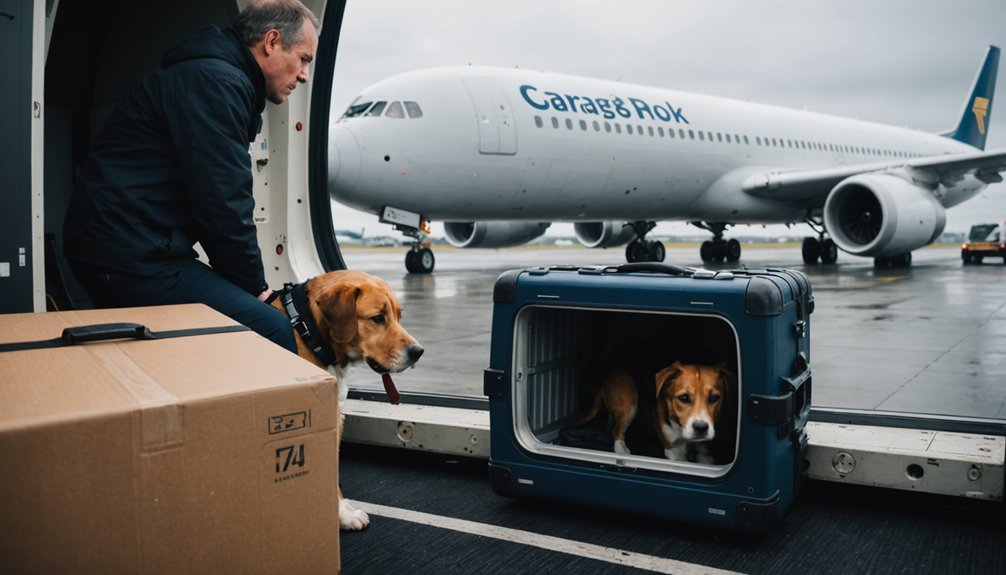
Knowing where your dog sits in the system only tells half the story—you still need to know whether she’s stuck in a hot cargo hold or safely off the plane.
Airline policies favor keeping animals on board for short, routine delays, as long as temperature control and ventilation stay within regulatory limits.
But once a delay stretches into “lengthy” or “safety-critical” territory, cargo procedures shift: your dog gets pulled off and moved to a climate-controlled holding room until departure is confirmed. During significant delays, trained handlers monitor the animal holding area to ensure every pet remains safe and calm.
You have the right to ask directly—don’t assume she’s fine just because the plane hasn’t moved.
Push gate agents for specifics: Is she still loaded?
Has she been removed?
What’s the current cargo temperature?
Demanding answers isn’t overreacting—it’s protecting her safety while you’re grounded and she can’t speak for herself.
Confirm Cargo Space on Your Rebooked Flight
Rebooking a flight doesn’t automatically rebook your dog’s spot in cargo—that’s a separate reservation, and it’s capped per aircraft.
Before you accept a new ticket, get cargo confirmation using your booking reference or AWB number.
Check the airline or cargo portal for status: “confirmed” or “locked” means your dog’s space is secure; “pending” or “waitlist” means you need answers now, not later.
Don’t rely on the passenger rebooking system—it won’t touch your pet transport arrangement.
Call the cargo or pet desk directly and confirm the new flight’s aircraft type, route, and station can handle live animal transport.
Same-carrier rebooking gives you the best shot at holding your spot. Being polite and courteous with the cargo desk staff can increase the chances of getting your dog’s spot confirmed quickly.
Get written confirmation before you walk away from that counter, since systems are designed to source the next-best departure the moment an offload posts.
Keep Your Dog Hydrated During a Long Wait
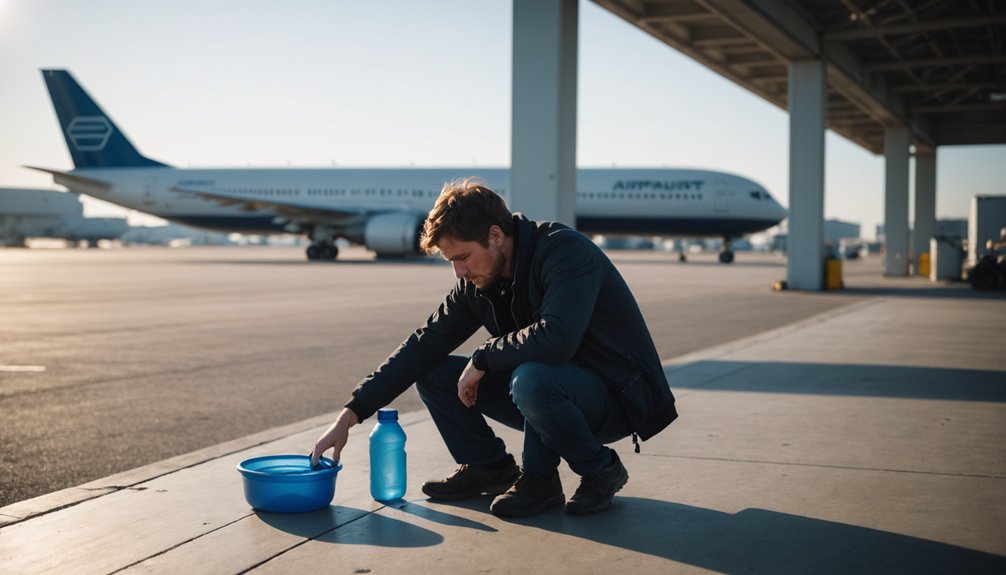
Hydration prep starts long before your dog’s crate hits the tarmac. Pre flight hydration matters most in the 24 hours before check-in—offer generous water, then taper to smaller portions in the final hours to prevent stomach overfill and crate soiling. Dehydration risks climb fast once your dog’s stuck in cargo during a delay, so your in-crate setup has to work without you there. It also helps to teach your dog to drink from a water bottle before the flight so a clip-on bottle attached to the carrier becomes a familiar, reliable water source during delays.
| Water Method | Why It Works |
|---|---|
| Frozen water/ice blocks | Melts slowly, extends access during long waits |
| Clip-on kennel cups | Resists tipping, stays near head height |
| Spill-resistant bowls | Keeps bedding dry, prevents early water loss |
Attach written water instructions to the crate, and tell airline staff your dog’s inside—USDA rules require water checks every 12 hours, but your advocacy closes the gap. Since IATA crates don’t offer easily accessible bowls, consider a funnel to refill water without fully opening the door. Reputable airlines also use climate-controlled ground transport vehicles to move crates between the aircraft and cargo facilities, which helps limit additional water loss during delays before boarding or after landing.
Should You Feed Your Dog During a Delay?
The instinct to feed a stressed dog often backfires.
For short delays, skip the meal entirely—your dog can safely fast for several hours, and an empty stomach reduces nausea, vomiting, and crate accidents.
Flight rules only require food every 24 hours for adult dogs, every 12 for puppies under 16 weeks, so a brief wait rarely demands action.
Water stays non-negotiable every 12 hours regardless of feeding status.
Long layovers change the equation.
If the delay stretches toward those regulatory windows, transit staff can offer small portions from the zip-lock bag attached to the crate.
This keeps pet safety intact without overloading a stressed system.
Some major hubs even have onsite pet facilities where handlers can provide food and water during extended layovers.
After landing, start with a third of the usual meal, then follow up later. Once your dog is home, avoid feeding a heavy meal right away, since a lighter approach helps the stomach settle after the stress of travel. Stress itself slows gastric emptying, so food is more likely to linger and become vomitable content once your dog finally settles down.
Locate the Nearest Pet Relief Area
Once feeding decisions are handled, your dog’s next need is a bathroom break—and finding one shouldn’t mean wandering the terminal aimlessly.
Federal law requires airports serving 10,000+ passengers annually to provide pet relief areas in every terminal, including post-security zones.
Check the airport’s website or app first—most list exact locations by gate and terminal under airport amenities.
Look for signage reading “Pet Relief Area” or “Service Animal Relief Area,” often near baggage claim, concourse corridors, or exits.
If you can’t locate one quickly, ask an information desk or customer service agent for a terminal map and direct walking route.
During a delay, knowing this location immediately saves time and keeps your dog comfortable without unnecessary stress or searching.
Protect Your Dog From Heat and Cold on the Tarmac
Tarmac delays expose your dog to temperature extremes long before takeoff, so you need to plan for this risk before you ever book the flight.
Check forecasts at your origin, layover, and destination against airline embargo limits, and avoid peak heat or sub-freezing departure windows.
Confirm your carrier uses climate-controlled loading vehicles and holding rooms, and get it noted in your booking that your dog needs tarmac safety precautions.
For thermal protection, pack an IATA-compliant crate with cooling mats or insulating pads, non-spill water dishes, and secure bedding that won’t block airflow.
Skip heavy meals beforehand.
In extreme heat, pre-cool your dog in air conditioning first.
Request last-loaded, first-unloaded handling to cut ground exposure time.
Double-Check Crate Labels and Live Animal Stickers
Beyond climate control, your dog’s crate needs the right paperwork on its exterior to move through cargo handling without delay. Regulatory requirements demand precise crate labeling before your dog ever reaches the tarmac. Check that “LIVE ANIMAL” lettering stands at least 1 inch tall on top and one side. Confirm arrows or “This End Up” markings appear on two sides for proper handling.
| Label Type | Placement | Purpose |
|---|---|---|
| LIVE ANIMAL | Top + 1 side | Handler visibility |
| This End Up / Arrows | 2 sides | Correct orientation |
| Shipper Declaration | Outer top | Feeding, contact info |
| Consignee Info | Visible side | Matches airway bill |
Don’t let a peeling sticker or missing label become the reason your dog sits longer than necessary in cargo.
When to Ask Airline Staff to Physically Check Your Dog
A delay doesn’t just cost you time—it can quietly change your dog’s cargo status without anyone telling you. That’s your cue to act, not wait.
If the flight delay triggers a gate change, aircraft swap, or maintenance hold, ask staff directly whether a cargo recheck will happen before departure. If weather is the culprit, confirm your dog stays within the airline’s approved temperature window. If the delay creates connection risk, ask whether your dog remains on the same aircraft or gets re-handled. Push for cargo checks whenever loading timing shifts, boarding starts before cargo finishes, or check-in happened hours earlier. You have the right to demand verification—don’t assume no news means your dog’s still exactly where you left them.
Signs Your Dog Needs to Come Off Cargo Immediately
Some symptoms don’t wait for a vet’s diagnosis—they demand action the moment you spot them.
Rapid panting, discolored gums, or collapse in the crate signal a pet emergency that overrides airline protocol entirely.
Bloated abdomen, repeated vomiting, or bleeding from the mouth or nose mean you get your dog out now, not after boarding calls.
Seizures, unresponsiveness, or inability to stand once removed from cargo point to trauma or heat stroke—both require immediate veterinary attention.
Frantic escape attempts, continuous barking, or sudden silence and unresponsiveness are equally urgent.
You know your dog’s baseline behavior better than anyone on staff.
Trust that instinct.
Cargo safety isn’t negotiable when these signs appear—demand removal, demand answers, and get your dog to a vet immediately.
What to Do If Your Dog’s Carrier Goes Missing
When your dog’s carrier doesn’t show up at the special baggage or oversized luggage area, don’t wait around hoping it’ll turn up.
Head straight to the baggage service desk and demand answers about airline procedures for lost carriers. File a Property Irregularity Report immediately, including flight numbers, tag details, and a full carrier description. Get a claim number—you’ll need it for tracking and follow-up.
Push for internal tracing: cargo areas, connecting-flight zones, every handling point checked physically, not just electronically. Provide microchip data, photos, and identifying marks to speed cross-checking. Document every conversation—names, times, instructions given. Ask if the carrier could arrive on a later flight, and clarify exactly where you should wait and who’s updating you next.
Frequently Asked Questions
Can I Request a Refund if My Dog Is Delayed in Cargo?
Yes, you can request a refund. As pet owners facing cargo issues, you’re entitled to the unused transport price when delays aren’t your fault. File your written claim within 14 days, and demand what’s owed—don’t settle for less.
Are Airlines Legally Liable if My Dog Is Harmed During a Delay?
Yes, you can hold airlines accountable. Pet liability applies if harm occurs while your dog’s under their custody, treated as checked baggage under Montreal Convention limits. Airline accountability requires proof: custody records and vet reports strengthen your claim.
Can I Buy a Last-Minute Ticket Just to Check on My Dog?
No, you can’t buy a last-minute ticket just to check on your dog. Cargo issues fall outside passenger access rights—pet owners don’t gain entry to secure holding areas simply by purchasing a seat. Instead, contact crew directly.
Does Travel Insurance Cover Pet-Related Delay Expenses?
Yes—many travel policies reimburse extra kennel fees when covered delays extend your trip. Check your pet insurance add-ons for boarding caps and eligible reasons. You’ll want licensed kennel receipts and proof the delay wasn’t voluntary.
Can I Switch My Dog to a Different Airline Mid-Delay?
No—you can’t simply switch airlines mid-delay. Flight changes for cargo pets mean canceling and rebooking as a new shipment. Airline policies require full documentation, customs clearance, and capacity checks, so plan accordingly before assuming flexibility exists.
Conclusion
A flight delay with your dog in cargo isn’t the time to sit back and wait. Act fast, ask direct questions, and don’t leave the counter until you get real answers. Track your dog’s location, confirm crate labels, and watch for signs of distress. If anything feels wrong, push for a physical check. You’re your dog’s only advocate in that moment—stay alert, stay vocal, and don’t back down.
References
- https://www.facebook.com/groups/1180884898968404/posts/2784980665225478/
- https://www.aacargo.com/learn/animals-faqs.html
- https://www.reddit.com/r/dogs/comments/afoofk/discussion_my_experience_flying_my_dog_in_cargo/
- https://www.peta.org/lifestyle/animal-companions/travel-tips/air-travel/
- https://www.airhelp.co.uk/blog/flying-with-dog-cat/
- https://www.reddit.com/r/aircanada/comments/1ht39fw/dog_i_removed_from_flight_after_boarding_due_to/
- https://www.aspca.org/pet-care/general-pet-care/travel-safety-tips
- https://gse.rutgers.edu/wp-content/uploads/2026/05/what-happens-to-pet-alaska-cancels-delays-flight.pdf
- https://www.prweb.com/releases/weather-delays-happen-even-for-pets-tips-to-weather-the-storms-808044083.html
- https://petflycheck.io/guides/emergency-pet-travel-situations