Neither tracker wins outright—it depends on where your pet goes. Smart tags rely on nearby smartphones, so they shine indoors at airports, hotels, and crowded terminals. But they go quiet in empty corridors and cargo holds. GPS collars use cellular and GPS for open spaces like hiking trails, yet they fail with mismatched bands or roaming gaps. For real protection abroad, you’ll want both. Here’s how to set up each one right.
TLDR Key Takeaways
- GPS collars require confirmed multi-band support, roaming agreements, and CE/MIC/TDRA certifications to function reliably abroad and clear customs.
- Smart tags lack GPS chips and depend on nearby smartphones, creating dead zones in cargo holds, empty corridors, and quiet customs rooms.
- Smart tags excel indoors—airports, hotels, and crowded terminals—while GPS collars win in open spaces like hiking and rural terrain.
- North America-only cellular bands (B2/B4/B12) can strand GPS collars in Europe and Asia, while smart tags avoid roaming failures entirely.
- Running both devices together is recommended, combining indoor smart tag visibility with outdoor GPS coverage to eliminate single-method blind spots.
How Smart Tags and GPS Collars Actually Work

Although they’re often lumped together, smart tags and GPS collars work in fundamentally different ways.
Your smart tag doesn’t actually know where it is. It has no GPS chip inside. Instead, it broadcasts a rotating Bluetooth signal that nearby smartphones quietly detect and relay to the cloud.
This crowd sourced positioning means your tag depends entirely on other people’s phones passing by. The more compatible phones around, the better your chances of seeing a location.
When you’re close, UWB precision finding kicks in. Using ultra-wideband, your phone shows directional arrows and distance down to centimeters, guiding you right to your pet.
GPS collars work differently. They carry their own GPS receiver, calculating real coordinates and sending them over cellular networks, so they don’t rely on strangers nearby.
Which Pet Tracker Wins Across Borders?
So which tracker actually wins when you cross borders? Honestly, it depends on your trip, but here’s what fellow traveling pet parents need to weigh:
- Roaming reliability pitfalls — GPS collars only work abroad when you’ve confirmed multi-band support and roaming agreements. North American-only bands (B2/B4/B12) leave you stranded in Europe and Asia.
- Customs paperwork readiness — GPS collars need CE, MIC, or TDRA certifications plus a Declaration of Conformity. Skip the paperwork, and you risk seizure.
- Transit performance — Bluetooth tags shine in airports, metros, and crowded terminals using nearby phones, where GPS struggles.
- Peace of mind — Bluetooth tags dodge SIM headaches; GPS collars track open spaces.
You’ll likely want both, depending on where you’re headed.
Smart Tags Shine in Airports and Hotels
When you’re maneuvering busy terminals and unfamiliar hotels, smart tags earn their keep. They keep you in the loop the moment you land, using BLE, UWB, NFC, or cellular-assisted GPS to pinpoint your bags in check-in areas, terminals, and carousels.
UWB tags excel in crowded spaces, helping you spot luggage among clustered trolleys. Geofence alerts signal if your bag stays landside or misses secure zones, while air travel compliance stays simple—just remove the battery and carry it in your cabin bag.
Inside hotels, you’ll appreciate room-level tracking that locates suitcases, laptop sleeves, or camera bags across large resorts. Hotel proximity alerts notify you when tagged items stay behind as you leave, so you and your gear never get separated.
You belong here, tracked and reassured.
Why GPS Collars Win in Open Spaces
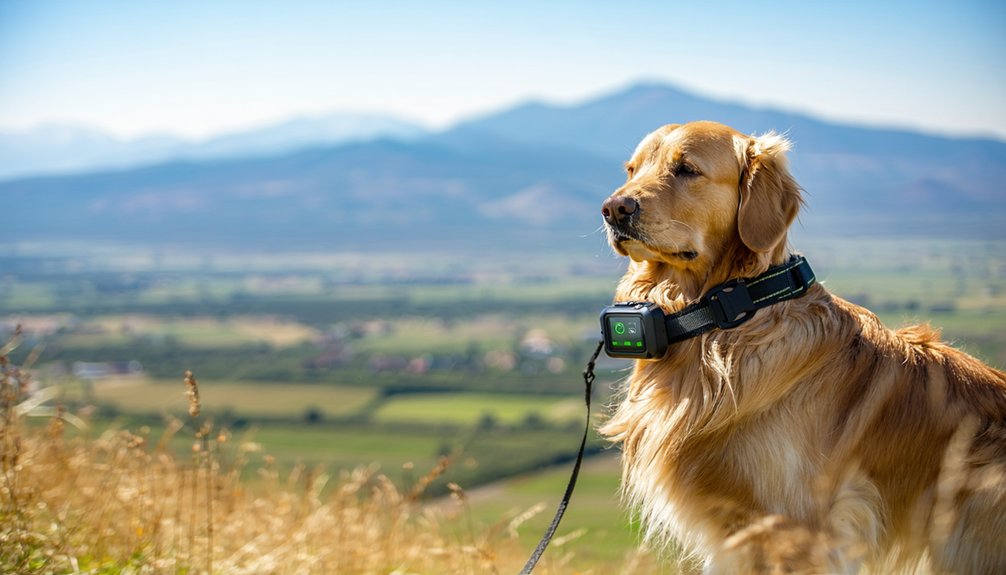
Smart tags thrive indoors, but step into open terrain and GPS collars take the lead. When you’re hiking, camping, or exploring rural lands abroad, you’ll want a tracker that loves wide skies. Open fields give your collar unobstructed satellite visibility, sharpening open sky accuracy to within just 2–3 meters.
Here’s why fellow adventurers trust GPS collars outdoors:
- Open sky accuracy: Clear views cut location error to 10–15 feet, sometimes sub-meter with dual-frequency models.
- Satellite visibility: More satellites mean better fixes and stable boundaries.
- Less multipath interference: Without walls or dense canopy, signals stay clean and reliable.
- Remote reliability: Satellite-only collars work without cell towers, keeping you connected in backcountry deserts, tundra, and mountains.
Out here, you’ll never lose your companion.
Where Each Tracker Fails on the Road
Although both trackers shine in the right conditions, each one stumbles on the road for different reasons. Your smart tag depends on nearby phones, so it goes quiet through roadside dead zones like ferry routes, remote highways, and low-traffic airports where no one’s around to relay a fix. Your GPS collar needs cellular backhaul, so it fails during network outage gaps when carrier band compatibility doesn’t match local networks across borders.
| Tracker | Where It Fails |
|---|---|
| Smart Tag | Empty corridors, cargo holds, quiet customs rooms |
| GPS Collar | Border zones, mismatched bands, roaming failures |
| Both | Customs documentation checks before departure |
| Both | Underground transit and remote stretches |
You’re not alone in this—every traveler faces these same gaps, so plan accordingly.
GPS vs Smart Tag Battery Life on Long Trips
Battery life is where these two trackers split the sharpest. If you’re packing for a multi-week trip, you’ll feel this difference fast.
GPS collars typically last 3–7 days with mixed use, while Bluetooth smart tags often run months to a year on a single coin cell. Battery drain on collars climbs with every active radio and sensor, but you can stretch runtime with smart choices.
Here’s what affects your collar’s longevity:
- Update interval: Shifting from 3-minute to 8-minute pings adds 32–41% runtime.
- Signal interference: Dense buildings and forests force extended searching, draining power.
- Power saving modes: Night or hourly modes add 22–27% runtime.
- Disabled extras: Turning off Wi-Fi and health features adds 2–5 days.
The GPS Roaming Setup You’ll Need Abroad
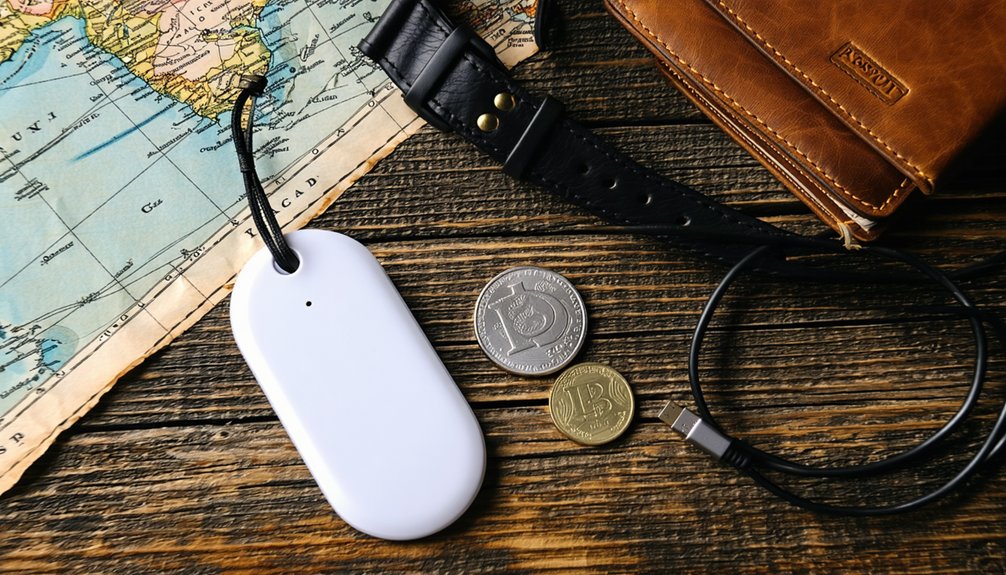
Before you board your flight, your GPS collar needs the right hardware and settings to work overseas. Start with a device that has a multi-band cellular modem and global GNSS chipset, so it stays connected and locked onto satellites across continents.
Choose a tracker with eSIM roaming provisioning or a factory-installed roaming SIM tied to a multi-network IoT platform, not a single-country carrier.
Next, activate international roaming on the line before you leave, and check that you’ve met any credit thresholds. Toggle data roaming on in your phone’s settings, then handle carrier APN setup so the tracker can connect on partner networks.
Set your phone to “Global” network type.
After you land, reboot or use airplane mode to force a fresh network attachment.
Tracker Cost: Upfront Price vs Travel Fees
How much will tracking your pet abroad actually cost you? When you run a real cost comparison, the gap is huge. Smart tags keep things simple; GPS collars pile on service fees that dominate your budget planning over time.
Here’s what you’re really paying:
- Basic QR/Bluetooth smart tag: $5–$35 upfront, no subscription, ~£20 over three years.
- GPS collar hardware: $99–$149+ upfront before any plan.
- GPS subscription burden: $9–$15/month, adding £175–£300+ across three years.
- Roaming impacts: embedded SIMs trigger international roaming fees and hidden charges abroad.
Smart tags lean on local smartphones and cloud networks, so you’ll dodge roaming surcharges entirely.
If you travel often, you belong with the crowd choosing low, predictable costs over recurring drain.
Pre-Trip Tracker Checks Before You Fly
Smart tags and GPS collars often fail at the worst moment: mid-transit, when you can’t fix them. You’re not alone in dreading this—so build a routine the whole travel community trusts. Charge each device to 100%, then confirm it holds through a test walk validation. Check battery life against door-to-door time with a 2× margin.
| Check | What You Confirm |
|---|---|
| Firmware readiness | Update app and device 24–48 hours pre-flight |
| Roaming policy review | Verify SIM/eSIM coverage and supported bands |
| Weak signal rehearsal | Test reconnection in parking garages or dense areas |
| Registration accuracy | Match microchip and tag data to documents |
Run app diagnostics for GPS lock and connectivity. Store digital copies everywhere, so you’ll fly confident, connected, and covered.
Best Pet Tracker for Pets That Bolt

Once your pre-flight checks pass, you’ll want a tracker built for the one scenario every owner fears: a pet that bolts. You’re not alone in worrying, so choose a device that catches an escape the moment it happens.
- Fast updates: Pick trackers like Tractive that refresh location every 2–3 seconds, so you can follow a bolting pet in real time.
- Geofence alerts: Set virtual fences around home, daycare, or a relative’s place to get instant notifications when your pet crosses any boundary.
- Bolt detection: Look for activity tracking that flags sudden movement bursts as early escape warnings.
- Integrated reliability: Choose collar-built units like the Fi Series 3+ that won’t fall off when your dog slips free.
Why a Layered Tracker Setup Beats One Alone
Because no single tracker survives every failure point, you’ll protect your pet best by running two devices at once. Smart redundancy planning means that if one device loses battery, hits a SIM issue, or gets switched off during cargo handling, the other keeps reporting.
You’ll also gain signal overlap. Your smart tag shines indoors at airports and hotels, while your GPS collar handles outdoor transit legs. That diversity gives you multi carrier resilience, so a regional outage or roaming problem won’t leave you blind.
Then there’s event history fusion. By cross-referencing your collar’s time-stamped routes with your tag’s proximity pings, you’ll rebuild every gate change, crate loading, and handler transfer. Together, these layers give you the connected, dependable visibility you and your pet deserve.
Picking the Right Tracker for Your Trip
Before you buy, match the tracker to where you’re actually going and how your pet will travel. If you’re crossing borders, a cellular GPS collar gives you true wide-area tracking—but only with roaming proof needed from your manufacturer, not vague “global coverage” claims. If you’re staying somewhere with dense smartphones, a Bluetooth tag may quietly do the job.
Here’s how to choose with confidence:
- Check coverage: Confirm verified roaming agreements with local operators along your route.
- Match regulations: Verify CE, MIC, TDRA, or ANATEL certification for your destination.
- Do field performance testing: Run GPS plus cellular for 72 hours before departure.
- Pack documents: Carry printed conformity, datasheets, and IMEI proof.
Pick what fits where you belong.
Frequently Asked Questions
Are Pet Trackers Waterproof Enough for Rainy or Beach Travel?
Yes, you’re covered for rainy weather range thanks to IP67/IP68 sealing. For beach trips, watch saltwater corrosion resistance—rinse your tracker with freshwater afterward. You’ll fit right in with fellow explorers exploring wet, wild places confidently.
Can Airlines Detect or Restrict Trackers During Flights?
Yes, airlines can spot trackers through X-ray inspection during security screening. You’ll find your Bluetooth tags pass fine, but GPS devices need flight mode to manage in-flight connectivity, since signal interruption keeps you compliant with everyone else.
Do Trackers Work on Cats as Well as Dogs?
You’ll find trackers work for cats too, but prioritize Cat Safety with breakaway collars. Check Collar Compatibility since lightweight tags fit better. Bluetooth’s Wireless Range suits indoor cats, and Battery Efficiency keeps your companion connected longer.
Is My Pet’s Location Data Private and Secure?
It depends. Reputable trackers use data encryption and access control to protect you and your pet. But check for third-party sharing and compliance standards in privacy policies—we want everyone in our community staying safe together.
Can I Attach a Smart Tag to Any Collar?
You can’t use just any collar. Compatible smart tags fit most collar materials through universal attachment methods like split rings or holders. Just check tag size fitment, since thin or breakaway collars won’t safely hold heavier tags.
Conclusion
You don’t have to pick just one. Smart tags win in crowded airports and hotels, while GPS collars track your pet across open countryside. Match your tracker to your trip, but if your pet’s prone to bolting, layer both. Run your pre-trip checks, confirm coverage at your destination, and update your contact details. Do that, and you’ll spend less time worrying and more time enjoying the trip with your pet by your side.
References
- https://nri.tamu.edu/publications/peer-reviewed-publications/2026/the-good-the-bad-and-the-ugly-comparison-of-gps-collar-and-solar-powered-ear-tag-technologies-for-animal-tracking/
- https://gpx.co/blog/gps-tracking-stickers-and-smart-tags/
- https://www.cleanconsciousbeauty.com/pet-safety-during-travel-the-benefits-of-using-apple-airtag-samsung-smarttag-for-dogs/
- https://www.alibaba.com/product-insights/how-to-choose-between-a-gps-enabled-pet-tracker-collar-and-bluetooth-only-tag-for-city-walks-abroad.html
- https://www.alibaba.com/product-insights/gps-dog-tracker-collar-vs-bluetooth-pet-tag-for-international-travel-can-either-survive-customs-and-roaming-limits.html
- https://www.alibaba.com/product-insights/portable-bluetooth-collar-tracker-vs-gps-pet-tag-for-international-pet-travel-compliance.html
- https://www.alibaba.com/product-insights/gps-smart-collar-vs-bluetooth-pet-tracker-for-international-travel-do-geofences-work-across-borders.html
- https://www.chasingthedonkey.com/travel-reviews/luggage-tracker-reviews-of-smart-luggage-tags/
- https://www.alibaba.com/product-insights/ai-powered-cat-collar-tracker-vs-gps-pet-tag-which-lasts-longer-on-a-single-charge.html
- https://mashable.com/article/airtag-versus-gps-collar-for-dogs