Right after unloading, scan your dog head-to-tail for cuts, swelling, or limping, and check breathing, gums, and gait. Offer small sips of room-temperature water within 30–60 minutes, then delay food 1–2 hours. Set up a quiet, low-traffic space with a covered crate and familiar scents. Watch for labored breathing, collapse, or pale gums—these need a vet now. Recovery often takes one day per time zone crossed. There’s more you’ll want to know.
TLDR Key Takeaways
- Immediately scan your dog head-to-tail for cuts, swelling, limping, or labored breathing, and check gums for healthy moisture and color.
- Offer small sips of room-temperature familiar water within 30–60 minutes of landing, delaying food 1–2 hours before a partial meal.
- Set up a quiet, low-traffic recovery room with a covered crate, soft bedding, dim lighting, soothing noise, and 20–24°C temperature.
- Use light exposure as the primary reset cue, allowing roughly one day of recovery per time zone crossed for normalization.
- Seek immediate vet care for collapse, blue or pale gums, persistent vomiting, refusal to eat or drink, or worsening lethargy beyond expected fatigue.
What to Check the Moment Your Dog Lands
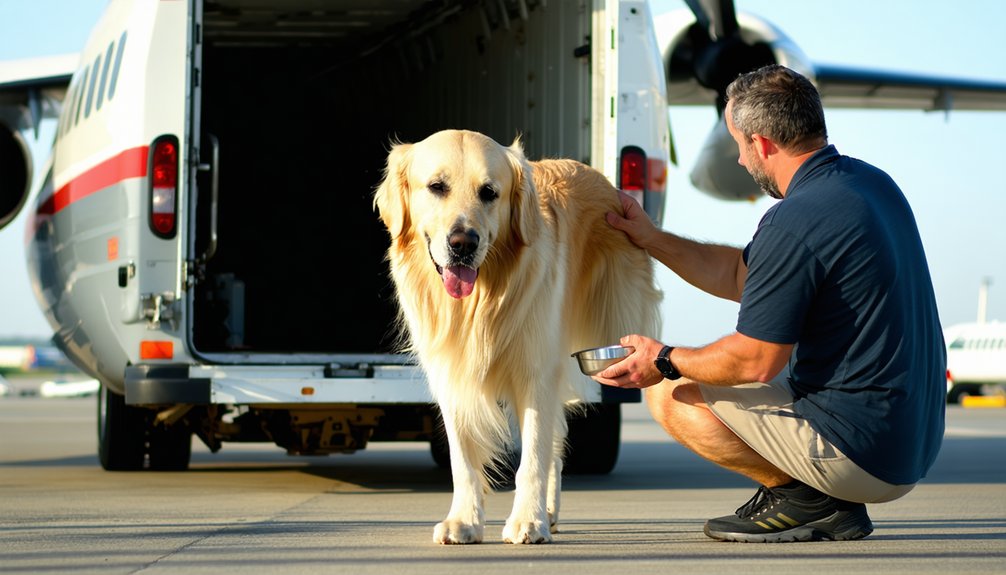
Every minute counts the moment your dog steps off a flight. Start with a head-to-tail scan for cuts, swelling, limping, or tenderness, then watch breathing for open-mouth panting at rest, labored effort, or an extended neck.
As your dog leaves the crate, check stance and gait for stiffness or dragging paws.
Gently palpate ribs, abdomen, and limbs for pain or heat. Examine gums for moisture and color, feel ears and paw pads for overheating or chill, and offer small sips of water.
Inspect the crate for blood, vomit, or damage, and confirm collar fit and ID.
Read your dog’s environmental cues—recognition, tail carriage, ear position—and note any stress response like pacing, shaking, or hiding.
You’re their safe place.
Warning Signs That Need a Vet Right Now
While most dogs shake off travel fatigue within a day, certain symptoms demand a vet’s attention right now.
Start with a breathing assessment: labored breathing, open-mouth panting, or blue, purple, or pale gums signals oxygenation or circulation failure.
Collapse, disorientation, or an inability to stand normally after cargo travel isn’t normal—treat it as urgent.
Watch for bleeding, visible injury, limping, or swelling, which point to crate-related trauma needing same-day care.
Don’t dismiss repeated vomiting, ongoing diarrhea, or appetite loss paired with lethargy.
Make hydration monitoring routine; weakness and dry gums raise the stakes quickly.
Deep, persistent, or worsening lethargy beyond three days warrants contact, too.
Trust your instincts here—when symptoms escalate instead of improving, or combine across systems, you’re facing a medical emergency.
Getting Water and Food Right After the Flight
Once your dog’s orientation returns and the worst of the stress behaviors ease, offer small amounts of water within 30 to 60 minutes after landing. Use frequent small sips of room-temperature, familiar water in a shallow, stable bowl. These nausea prevention strategies reduce vomiting and bloat risk in large, deep-chested breeds. Rehydration matters more than food, so prioritize it first.
| Size | First Sip | Repeat |
|---|---|---|
| Small | A few tablespoons | Every 15–30 min |
| Medium | ¼ cup | Every 15–30 min |
| Large | ⅓–½ cup | Every 15–30 min |
Run emergency hydration checks—skin tenting, tacky gums, dark urine—and adjust accordingly. Wait 1–2 hours before food, then offer 25–50% of a regular, familiar meal to test tolerance gently.
Set Up a Quiet Decompression Space
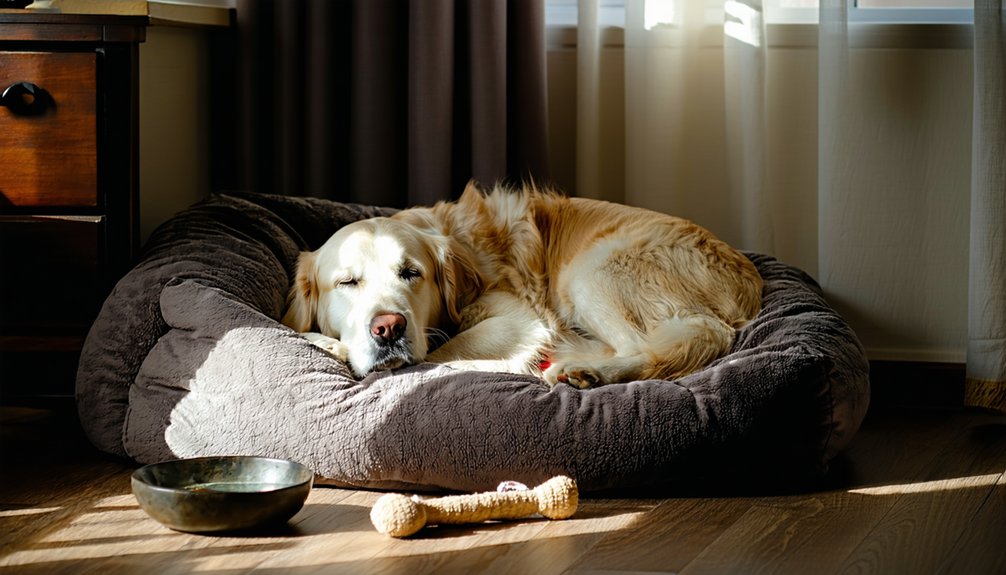
Because your dog’s stress hormones need time to normalize after travel, you’ll want to set up a quiet decompression space before bringing them home.
Choose a low-traffic room away from doorways, street-facing windows, and loud appliances—near enough to hear familiar family activity, but separate from the chaos.
Use the same space every time to build a predictable safe zone.
Set up a safe crate, covered on three sides, with a soft bed inside and another outside.
Add water, long-lasting chews, and simple food puzzles.
Dim the lighting, run a fan or machine for soothing noise, and maintain temperature comfort around 20–24°C.
Block dangerous items, use baby gates from other pets, and follow a consistent routine.
This steady environment helps your dog truly settle.
Why Routine Helps Your Dog Recover Faster
After a long flight, your dog’s stress hormones, digestion, and sleep cycles are all thrown off balance, and a predictable routine is what brings them back.
When you restore regular feeding, walking, and sleep times, you stabilize the circadian rhythms that long flights and time zone changes disrupt. This predictable structure lowers cortisol, easing pacing, whining, and clinginess.
Consistent mealtimes normalize gastrointestinal motility after flight-related fasting, while steady sleep–wake cycles support immune function and recovery.
Pair your routine with Crate Comfort and Calming Aromas to signal safety and shift your dog’s nervous system from “fight or flight” to “rest and digest.”
Scheduled companionship and familiar rituals reinforce secure attachment, helping your dog feel they belong and return to baseline faster.
How Many Recovery Days Does Your Dog Need?
While most healthy adult dogs normalize their basic behavior and appetite within 24–48 hours of returning home, the full answer depends on how far your dog flew, how many time zones you crossed, and who your dog is.
Plan for roughly one day per time zone crossed—4–10 days after long-haul flights, with eastward travel often taking 5–10 days.
Add several days for older dogs, brachycephalic breeds, anxious individuals, or first-time flyers.
International relocations commonly need 3–7 days for basic settling and up to two weeks for full normalization.
Your daily Hydration Monitoring and gentle Stress Resetting routines speed the timeline, especially for dogs prone to motion sickness or dehydration.
If lethargy or distress persists beyond 48–72 hours, you’ll want professional evaluation rather than continued waiting.
Ease Anxiety, Clinginess, and Restlessness After Travel
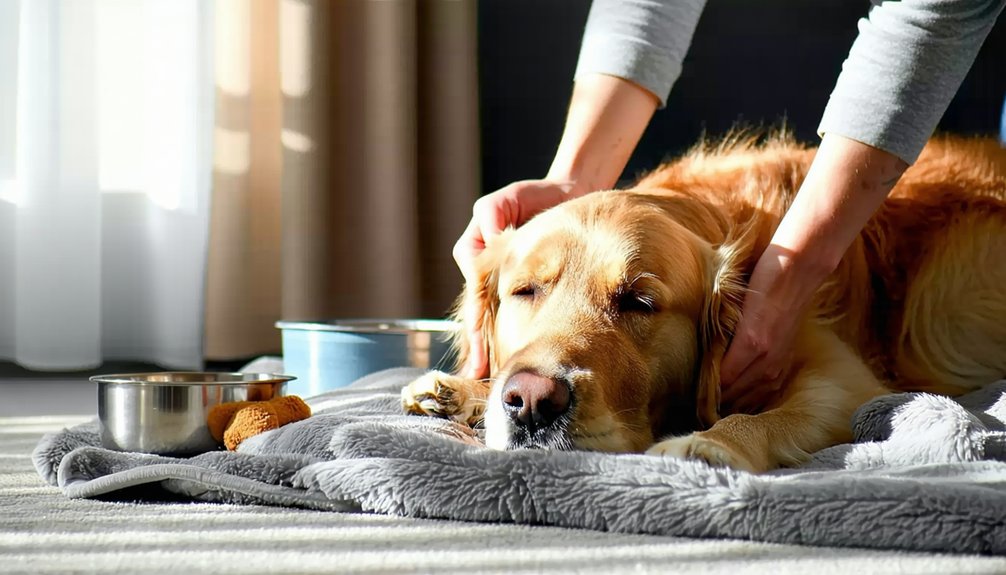
Your dog’s nervous system takes a real hit from flying, and the clinginess, restlessness, or anxious pacing you’re seeing afterward is a predictable response to disrupted routines and travel stress.
Restore feeding, walking, and bedtime schedules right away, keeping meals, potty breaks, and sleep in familiar locations to rebuild predictability.
Keep reunions calm and brief, letting your dog approach you instead of forcing contact.
Prioritize quiet rest, offer water, and watch appetite closely.
A gentle grooming session can help your dog calm down, while treat free settling—sitting nearby without interaction—rebuilds comfort without overstimulation.
Encourage short, positive separations to prevent over-attachment.
If hiding, vocalization, or restlessness escalates instead of easing over several days, you’ll want a veterinary evaluation rather than waiting it out alone.
Calming Tools That Actually Work After Travel
- Dog appeasing pheromones (DAP): Apply to bedding 15–30 minutes ahead, allowing solvents to evaporate.
- Pressure wraps: Do a careful fit assessment—snug but never restrictive, preventing overheating.
- Aromatherapy (lavender, chamomile): Prioritize ventilation control to avoid respiratory irritation.
- L-theanine or alpha-casozepine: Mind dosage timing, since onset typically takes 1–2 hours.
- Familiar scent items: Offer an owner-scented shirt for comforting olfactory continuity.
Behavior Changes That Signal a Bigger Problem
Calming tools help most dogs settle, but they won’t fix every problem—and sometimes they shouldn’t. Normal recovery improves over time, so watch for behavior that stays flat or worsens past 24–72 hours.
Persistent lethargy beyond 36 hours, refusal to eat or drink, or no urination or defecation within 12–24 hours all warrant a vet’s input.
Sudden house-soiling, ongoing vocalization, frantic crate avoidance, or new aggression signal distress rather than simple fatigue.
If you’re using sedatives, watch medication timing, since lingering effects can mimic these red flags.
Check crate safety too, because escape attempts and panic can cause injury.
You’re not overreacting by calling your vet—you’re advocating for a companion who can’t explain what’s wrong.
Trust your instincts; prolonged shutdown deserves professional attention.
Can Dogs Really Get Jet Lag?
Yes, dogs really can get jet lag. When you cross time zones rapidly, your dog’s internal 24-hour clock falls out of sync with local time.
The suprachiasmatic nucleus, melatonin secretion, and body temperature cycles all govern this rhythm, much like in humans. Because dogs can’t tell you they feel off, you’ll notice it through Behavioral Timing—when they eat, sleep, and play.
Light Exposure remains the primary cue that helps them readjust, alongside meal and activity schedules.
Here’s what you should watch for:
- Sleeping or napping at unusual hours
- Reduced or shifted appetite
- Lower energy or noticeable fatigue
- Disrupted elimination routines
- Restlessness during former rest periods
Most dogs normalize within 1–3 days, so you’re not alone in this.
Using Light and Local Time to Reset the Clock
After a long flight, light becomes your most powerful tool for resetting your dog’s internal clock. Natural daylight acts as the primary time cue, syncing your dog’s sleep–wake cycle to local time, just like it does for you.
After eastward travel, get your dog into bright morning light to advance the clock toward an earlier wake time. After westward travel, lean on afternoon sun to delay the phase.
Short, frequent outdoor walks combine light, familiar routine, and gentle exercise—offering real travel stress relief while speeding adjustment.
Evening light control matters just as much. Dim the lights, draw the blinds, and skip bright screens before local bedtime.
Consistent darkness during your dog’s nighttime window supports melatonin and helps you both settle into your new home together.
Plan Ahead for an Easier Next Flight
Why wait until the next trip catches you off guard? You’ve watched your dog decompress, and now you can turn those observations into a plan that protects them on every trip ahead. Smart future planning starts with the data you’ve already gathered.
- Recovery schedule: Use logged decompression times to set realistic maximum flight durations.
- Route optimization: Prioritize nonstop or shortest-duration flights to limit cargo time and handling.
- Seasonal timing: Choose travel windows that avoid heat or cold extremes in holds and on tarmacs.
- Airline selection: Book carriers with proven pet cargo programs and climate-controlled holding areas.
- Crate and comfort: Repeat the bedding, scent items, and calming strategies tied to smoother recoveries.
These next steps make belonging—and traveling together—easier.
Frequently Asked Questions
How Much Does Cargo Travel Typically Cost for a Dog?
You’ll typically pay $450–$2,000+ domestically and $1,000–$6,000+ internationally. Pricing Factors like your dog’s size, distance, and crate weight shape costs, while Airline Requirements—health certificates and IATA crates—add $95–$500 more to your total.
Which Dog Breeds Are Restricted or Banned From Cargo Flights?
You’ll find airline breed bans target snub-nosed dogs—Bulldogs, Pugs, Boxers, Boston Terriers, Shih Tzus—plus Pit Bull–types and “dangerous” breeds like Rottweilers. Since service animal rules differ, always check your carrier’s specific list.
What Documents and Vaccinations Are Required Before Flying My Dog?
You’ll need a CVI health certificate, current rabies vaccination, and airline-specific forms. International trips may add titer tests, import permits, and quarantine rules. Keep emergency vet contacts handy, and you’ll join countless prepared owners traveling confidently together.
Can I Track My Dog’s Location During the Cargo Flight?
You can’t track your dog’s real-time location mid-flight. Airline policies prohibit active GPS devices on animals, and breed-specific restrictions add further limits. Instead, you’ll rely on AWB cargo updates—”Loaded,” “In Transit,” “Arrived”—keeping you confidently connected throughout.
Is Pet Insurance Worth Getting Before Flying My Dog?
It’s often worth it, especially for older dogs or limited savings. Enroll pre-flight since pre-existing conditions get excluded. Pair coverage with crate acclimation, pre flight calming, reducing stress, and arrival decompression—you’re protecting your travel companion like family.
Conclusion
Your dog’s recovery depends on what you do in the hours and days after landing. Check crucial signs, watch for warning behaviors, and reintroduce water, food, and routine gradually. Give your dog a quiet space to decompress, and use light and local time to reset their internal clock. If anything seems off, call your vet—don’t wait. With careful preparation and attentive care, you’ll make the next flight easier on both of you.
References
- https://pmc.ncbi.nlm.nih.gov/articles/PMC10571552/
- https://gawvs.in/is-flying-in-cargo-traumatic-for-dogs-what-every-owner-needs-to-know
- https://zoeta-dogsoul.com/health-wellbeing/jet-lag-in-dogs/
- https://dogtripguide.com/blog/flying-dog-in-cargo-guide/
- https://pmc.ncbi.nlm.nih.gov/articles/PMC227007/
- https://www.reddit.com/r/dogs/comments/1u7uck4/longterm_impact_after_flying_cargo/
- https://www.aphis.usda.gov/media/document/32008/file
- https://ialcanada.ca/do-pets-get-jet-lag-understanding-your-pets-post-flight-behaviour/
- https://www.facebook.com/groups/1180884898968404/posts/3074717602918448/
- https://www.dialavet.com/vet-answers/bichon-anxious-after-cargo-flight-162949