Your golden retriever used to summit ridgelines without breaking stride. Now she hesitates at the trailhead, and you find yourself explaining it away — she’s just tired, it’s just the heat, she’ll shake it off by the second mile. That small flicker of doubt in her eyes might be telling you something you don’t want to hear yet.
- One off day isn’t retirement — a pattern of slower recovery, reluctance, or limping usually is
- Retirement timing varies enormously by size: giant breeds often need to scale back by 6–7 years old, while small breeds may hike comfortably into their early teens
- Recovery time after a hike is one of the most honest signals you have — track it, don’t just watch performance during the hike
- Retirement is usually staged, not sudden: backpacking trips give way to day hikes, then short walks, then low-impact alternatives like swimming or flat sniff walks
- Dogs frequently push through pain because they want to be with you — pre-hike and post-hike checks catch what your dog won’t show you on the trail
- Ask your vet specifically for “hiking clearance,” not just a routine wellness exam, so you get trail-relevant advice
Why This Decision Feels So Much Harder Than It Should
Nobody hands you a manual for retiring a senior trail dog. There’s no birthday candle that lights up and says “this is the year.” Instead, it’s a slow accumulation of small moments — a slightly longer pause at the top of a switchback, a night where she doesn’t want to jump on the bed, a morning where getting up takes an extra beat. Owners who’ve hiked thousands of miles with their dogs often describe the retirement decision as harder than any single trail challenge they’ve faced, precisely because there’s no clear finish line.
Joint degeneration in dogs is extremely common as they age, and osteoarthritis is one of the most frequently diagnosed conditions in senior dogs seen by general practice and rehabilitation veterinarians. That means if you’re wrestling with this decision, you are not the exception — you’re the norm. Nearly every owner of a long-lived, active dog eventually faces this exact fork in the trail.
Off Day or Genuine Decline? How to Tell the Difference
This is the question that keeps trail-dog owners up at night, and it’s worth answering carefully instead of jumping to conclusions in either direction. An occasional slow hike doesn’t mean retirement any more than one good hike means your dog is fine forever. The difference lives in the pattern, not the single event.
| Signal | Likely an Off Day | Likely a Retirement Signal |
|---|---|---|
| Frequency | Happens once, after a hot day, long car ride, or poor sleep | Happens on 3 or more consecutive or recent outings |
| Recovery | Back to normal energy within a few hours | Stiffness, limping, or lethargy lasting into the next day |
| Enthusiasm | Still excited at the trailhead, slows mid-hike | Hesitates at the car, trailhead, or leash cue itself |
| Gait | Normal stride, just slower pace | Shortened stride, favoring a limb, or a subtle head bob |
| Context | Tied to heat, terrain, or an unusually long distance | Happens even on familiar, easy, previously effortless routes |
If you’re only seeing the left column, your dog probably just had an off day. If you’re circling items in the right column more than once a month, it’s time to have an honest conversation with your vet about scaling back — not necessarily stopping cold, but rethinking the current routine.
Breed, Size, and the Aging Clock
One of the biggest gaps in most retirement advice is that it treats all dogs the same. A 60-pound Labrador and a 12-pound terrier do not age on the same timeline, and neither does a flat-faced breed built for the couch, not the switchbacks. Larger dogs generally have shorter overall lifespans and tend to develop joint issues earlier than small breeds, while giant breeds often show the earliest signs of orthopedic wear.
| Size Category | Typical Weight Range | General Age to Start Watching Closely | Notes |
|---|---|---|---|
| Small breeds | Under 20 lbs | 10–12 years | Often hike well into their teens, but small joints and dental/heart issues can appear |
| Medium breeds | 20–50 lbs | 8–10 years | Wide variability by breed; watch individual signs more than the calendar |
| Large breeds | 50–90 lbs | 7–9 years | Hip and elbow issues common; this is the classic “backpacking dog” range that often needs earlier scaling back |
| Giant breeds | Over 90 lbs | 6–7 years | Shortest lifespans of the group; joint stress from their own body weight accelerates decline |
| Brachycephalic breeds (any size) | Varies | Often earlier, regardless of age | Airway structure limits heat dissipation and endurance even in young dogs; senior versions need extra caution |
These ranges are general guidelines, not deadlines. A well-conditioned 9-year-old Labrador with no diagnosed joint disease may still be a stronger hiker than a sedentary 6-year-old of the same breed. Breed-specific life expectancy matters because it tells you roughly where a dog sits on their own aging curve — a 9-year-old giant breed is closer to their senior years than a 9-year-old toy breed, even though the calendar number is identical.
Endurance Breeds vs. Companion Breeds
Dogs bred for stamina — huskies, German Shorthaired Pointers, Vizslas, working line retrievers — often decline differently than companion breeds. They tend to have higher pain tolerance and stronger drive, which means they can mask discomfort longer and push harder than their bodies can sustain. Owners of these breeds are often the ones most surprised by a sudden injury, because the dog never showed obvious reluctance until something gave out. Companion breeds, by contrast, sometimes signal fatigue and disinterest earlier and more visibly, which can actually make the retirement conversation more straightforward.
The Body Doesn’t Lie: Physical Signs It’s Time to Scale Back
Retirement decisions usually fall into two broad medical categories, and they don’t look or progress the same way. Knowing which category you’re dealing with changes both the timeline and the urgency.
| Category | Typical Signs | Progression | What Changes First |
|---|---|---|---|
| Orthopedic / Joint decline | Limping, stiffness after rest, reluctance on stairs or jumps, shortened stride | Usually gradual over months to years | Distance and terrain tolerance drop before overall stamina does |
| Cardiac / Respiratory decline | Excessive panting, coughing, exercise intolerance, collapse or near-collapse, blue-tinged gums | Can progress faster and is more urgent | Stamina and heat tolerance drop even on flat, easy terrain |
If you notice cardiac or respiratory-type signs — especially coughing after exertion, unusual gum color, or a dog that seems out of breath on ground they used to cover easily — that’s a same-week vet visit, not a wait-and-see situation. Orthopedic decline, while still worth addressing promptly, usually gives you more runway to plan a gradual transition.
Vestibular Disease and Sudden Balance Issues
Sometimes what looks like clumsiness or a new fear of heights on the trail is actually vestibular disease — a sudden disruption to the inner ear’s balance system that’s common in older dogs. It can cause a head tilt, stumbling, circling, or a dog that suddenly seems unsure on uneven ground. Unlike gradual arthritis, this often comes on abruptly and can look alarming. It’s not always permanent, but it always warrants a vet visit before you resume any trail activity, since balance problems on rocky or exposed terrain are a real safety risk for both dog and handler.
Heat and Cold Tolerance Changes
Senior dogs regulate temperature less efficiently than younger dogs. A dog that used to shrug off a warm afternoon hike may now overheat at moderate temperatures, and a dog that used to happily nap in the snow at camp may now shiver and seek shelter faster. These changes often show up before major mobility issues do, and they’re worth noting in your own observations even if your dog is still hiking well otherwise.
Is Your Dog Hiking for You, Not Themselves?
This might be the hardest question on this entire list, because the answer requires you to separate your dog’s love of your company from their body’s actual capacity. Dogs are famously willing to push through discomfort to stay close to their person, especially breeds with strong pack drive. A dog masking pain out of loyalty or excitement often shows these subtle tells:
- Eagerness at the trailhead that doesn’t match slow, careful movement once on the trail
- Checking in with you frequently, as if seeking reassurance rather than just enjoying the walk
- A brighter, more relaxed demeanor at rest stops than during actual movement
- Reluctance to lie down and rest even when clearly tired, because doing so means falling behind
- Vocalizing or reacting only when touched in a specific spot, not during general movement
A useful gut check: would your dog choose this hike if given the option to stay home in comfort, or are they choosing you? Most trail dogs will always choose you. That’s exactly why the responsibility for reading their body sits with you, not them.
Cognitive Decline and Trail Confidence
Canine cognitive dysfunction — the doggy equivalent of age-related cognitive decline — becomes more common as dogs move deeper into their senior years, and it affects far more than memory at home. On the trail, cognitive changes can show up as increased startling at normal trail noises, confusion at familiar junctions, getting genuinely lost on a route they’ve hiked dozens of times, or a general drop in the confidence that once let them scramble over roots and rocks without hesitation. A dog with emerging cognitive decline is also more likely to wander off-trail or freeze in unfamiliar situations, which raises real safety concerns in backcountry settings where quick recall and clear-headed decision-making matter. If you notice your previously trail-savvy dog seeming disoriented, anxious in new environments, or less responsive to familiar cues, that’s worth discussing with your vet alongside any physical symptoms.
Pre-Hike and Post-Hike Assessment: Build a 5-Minute Routine
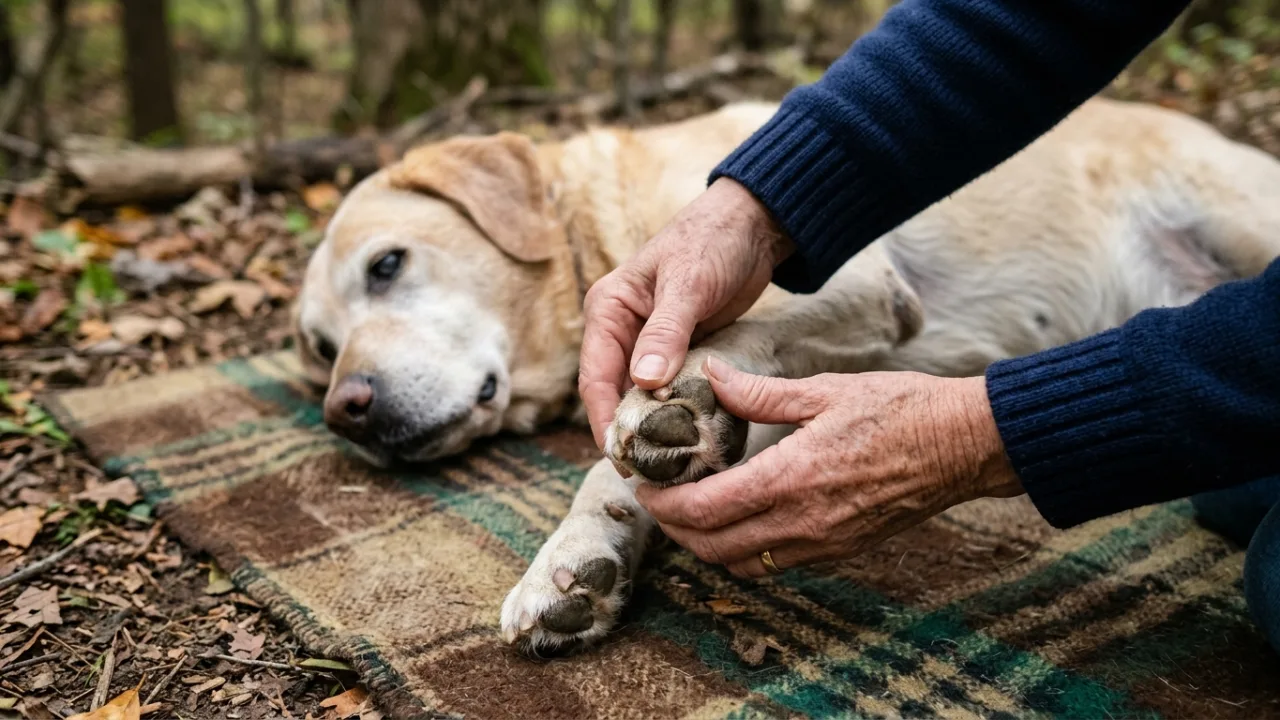
You don’t need to guess. A short, consistent check before and after every hike turns vague worry into objective data.
Pre-Hike Mobility and Gait Check (5 minutes)
- Watch your dog walk and trot in a straight line and in a circle — look for symmetry, not just movement
- Gently flex and extend each leg joint, feeling for resistance, heat, or a reaction
- Check paw pads and nails for cracks, overgrowth, or old cuts that haven’t healed
- Confirm recent joint supplement or medication was given as scheduled
- Check the forecast — heat, cold, and elevation gain all matter more now than they used to
Post-Hike Recovery Checklist
- How long did panting take to return to normal after stopping? (Track it — this is one of your best long-term metrics)
- Did your dog eat their next meal with normal appetite?
- Check gait first thing the next morning, before any activity — this is when stiffness shows up most honestly
- Inspect paw pads again for new cracks, blisters, or excessive wear
- Note mood: subdued, restless, or unusually clingy can all be pain signals
Recovery Time: The Most Honest Metric You Have
Performance during a hike can be misleading, because adrenaline and excitement mask a lot. Recovery afterward is much harder to fake. Veterinary sports medicine generally recognizes that recovery time lengthens with age, but a dramatic or worsening lag is a meaningful signal rather than just “getting older.”
| Post-Hike Recovery Time | What It Generally Suggests |
|---|---|
| Panting returns to normal within 30–45 minutes; no next-day stiffness | Normal for an active senior dog on an appropriate hike |
| Panting or restlessness lasts 1–2 hours; mild next-day stiffness that resolves with movement | Borderline — consider shortening distance or reducing elevation gain next time |
| Noticeable lethargy or stiffness lasting into the next day, or limping that wasn’t present on trail | Signal to scale back this type of hike; discuss with your vet |
| Stiffness or limping lasting 48+ hours, or appetite loss | Strong retirement signal for that level of activity; vet visit warranted |
Delayed-onset soreness is one of the most commonly missed patterns. A dog can look completely fine at the trailhead and during the drive home, only to start limping the next morning. Owners often mistake this for a random injury rather than recognizing it as their dog’s body telling them the hike itself was too much. If this happens more than once with similar mileage or elevation, treat it as data, not a fluke.
How Much Mileage or Elevation Gain Is Too Much?
There’s no universal number, but a useful approach is to think in relative terms rather than absolute ones. If your dog used to comfortably handle 8–10 miles with 2,000 feet of elevation gain and is now struggling on 3 miles of flat terrain, that gap itself is the signal — regardless of what the mileage number says on paper. As a general framework:
- Flat, well-established trails under 3 miles are usually well tolerated by most senior dogs without diagnosed joint disease
- Moderate trails with some elevation gain (under 1,000 feet) and 3–6 miles require a recent fitness check-in and closer monitoring
- Steep, technical, or long-mileage trails (6+ miles or 1,500+ feet of gain) should be reserved for senior dogs who are still passing pre-hike assessments consistently and have vet clearance for higher-intensity activity
- Overnight backpacking with a pack is generally the first thing to retire, even before day hikes, since sustained weight-bearing over hours compounds joint stress
Trail Difficulty Matched to Senior Fitness Stages
| Fitness Stage | Appropriate Trail Type | Typical Signs Your Dog Fits This Stage |
|---|---|---|
| Still strong | Full day hikes, moderate elevation, occasional light overnight trips | Passes pre-hike checks, recovers within an hour, no gait changes |
| Scaling back | Shorter day hikes, gentle elevation, familiar and predictable terrain | Occasional next-day stiffness, slower pace but still enthusiastic |
| Day-hike retired | Flat trails under 2 miles, paved paths, easy loop trails | Regular recovery lag, reluctance on steep or technical sections |
| Walk-only | Neighborhood walks, flat sniff walks, short outdoor time | Struggles with uneven terrain, needs frequent rest breaks |
| Low-impact only | Swimming, gentle yard time, wagon or stroller outings | Diagnosed joint or cardiac condition, or significant mobility loss |
Do Joint Supplements Delay Retirement, or Just the Inevitable?
Joint supplements and arthritis management can genuinely improve comfort and function for many senior dogs, and they’re worth discussing with your vet the moment you notice early stiffness. But it’s worth being honest with yourself about what they do and don’t do. Supplements and pain management can extend the number of comfortable hiking years and improve quality of life on the trails your dog can still handle. They generally don’t reverse joint damage or make a dog with significant arthritis suitable for the intensity level they enjoyed at age three. Think of them as a tool for extending the “scaling back” phase comfortably, not a way to avoid it altogether.
What to Look for in a Joint Supplement Label
- Glucosamine and chondroitin — the most common combination, generally aimed at supporting cartilage health over time
- Omega-3 fatty acids (fish oil) — often used for their anti-inflammatory properties
- Prescription joint medications — vet-prescribed options for dogs with diagnosed osteoarthritis, typically more targeted than over-the-counter supplements
- Third-party testing seals — look for manufacturers that disclose sourcing and testing, since supplement quality varies widely
Always run any new supplement by your vet, especially if your dog is on other medications.
Gradual Scaling Back vs. Abrupt Retirement
| Approach | Pros | Cons |
|---|---|---|
| Gradual scaling back | Easier emotionally for both dog and owner; allows time to test tolerance at each stage; preserves some outdoor identity | Requires ongoing monitoring and honest reassessment; risk of dragging out a decision too long if signs are ignored |
| Abrupt full retirement | Clear-cut, low risk of overexertion injury; sometimes necessary after a diagnosis or acute event | Can feel jarring for a dog used to daily activity; may need extra effort to prevent weight gain or restlessness |
Most orthopedic-driven retirements benefit from the gradual approach. Cardiac, respiratory, or acute injury situations often require the abrupt approach because continued exertion carries real medical risk. Your vet’s input should weigh heavily here — this is exactly the kind of decision where owner intuition (“she seems okay”) and vet-recommended caution (“her heart is working too hard”) can genuinely disagree, and the vet’s read on internal systems should take priority.
Backpacking Dog vs. Day-Hiking Dog: Different Retirement Criteria
A dog that’s been carrying a pack and covering multi-day mileage faces different physical demands than a dog that’s only ever done day hikes, and their retirement criteria should reflect that. Backpacking places sustained, repetitive load on joints over many hours and often multiple consecutive days, which is why backpacking is usually the first activity to retire — often a full year or more before a dog needs to stop day hiking altogether. A day-hiking dog, by contrast, gets full rest and recovery between outings, so the same joint changes that would disqualify a dog from backpacking might still allow for regular shorter hikes.
The Staged Retirement Plan
Rather than a single dramatic decision, most successful retirements look like a staged transition over months to a year or more:
- Stage 1 — Retire overnight backpacking. Sustained weight-bearing over multiple days is usually the first casualty of aging joints. Switch multi-day trips to car camping with short day hikes instead.
- Stage 2 — Reduce day hike distance and elevation. Trade the 8-mile summit hike for a 3-mile loop with gentler grades, and watch recovery closely.
- Stage 3 — Shift to flat, familiar trails. Technical terrain and steep descents are often harder on joints than distance itself. Prioritize predictable, even footing.
- Stage 4 — Transition to neighborhood and paved walks. Shorter outings that still provide mental stimulation and sniffing time without trail-level physical demand.
- Stage 5 — Low-impact alternatives. Swimming, gentle yard exploration, and short leash strolls become the primary activity, supplemented by car camping and scenic drives with brief leg stretches.
Gear Adaptations for a Dog Transitioning Out of Heavy Trail Use
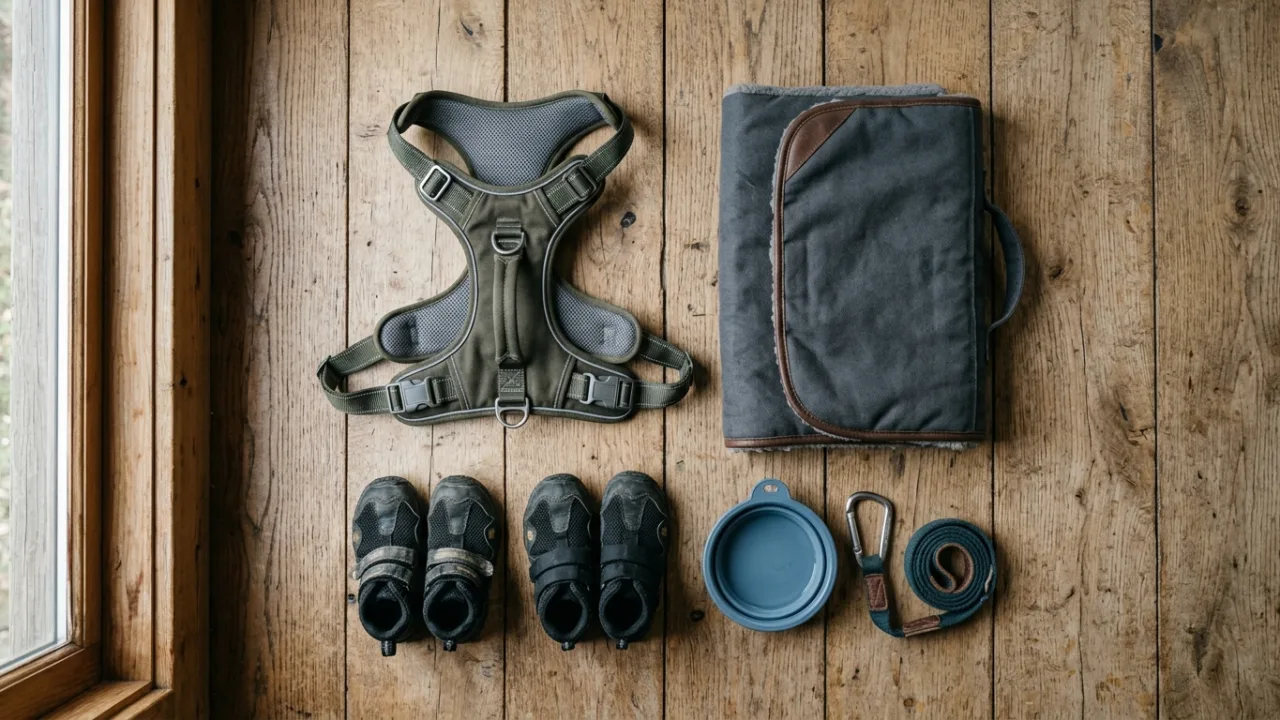
| Standard Gear | Senior-Adapted Alternative | Why It Helps |
|---|---|---|
| Full backpacking pack with heavy load | Empty pack or no pack at all | Removes added joint stress from sustained weight-bearing |
| Standard flat collar | Supportive harness with a rear or front handle | Lets you assist over obstacles, stream crossings, or steep steps |
| Bare paws | Traction booties with grippy soles | Compensates for reduced proprioception and slower reflexes on rocky or slick terrain |
| No temperature gear | Cooling vest or bandana | Offsets reduced heat tolerance in warmer months |
| Sleeping directly on tent floor | Orthopedic camping pad | Reduces overnight stiffness for dogs still car camping |
| Walking the full trail on foot | Dog stroller or pull wagon for part of the outing | Allows continued outdoor participation without full physical demand |
Choosing a Supportive Harness
Look for a harness with a sturdy handle positioned over the shoulders or hips (some offer both), padded straps that won’t chafe on longer outings, and a fit that doesn’t restrict the shoulder or hip movement your dog still has. This isn’t about hoisting your dog over every obstacle — it’s about having a stabilizing point of contact for the moments a senior dog needs a little extra confidence or support.
Dog Boots for Arthritic Paws
Traction matters more than insulation for most senior trail dogs. Look for boots with a grippy rubber sole, a secure but non-restrictive closure, and enough room to avoid pinching joints that may already be sensitive. Break new boots in on short walks before a real hike.
Ramps and Slings for Vehicle Access
Getting in and out of a vehicle at the trailhead is a surprisingly common source of joint strain for senior dogs. A portable ramp or a simple rear-support sling can prevent repeated jumping impact that adds up over a hiking season.
When to Consider a Stroller or Wagon vs. Ending Outings Altogether
A stroller or wagon is worth considering when your dog still clearly wants to be outside and included, but their body can no longer cover meaningful distance — think dogs with significant arthritis, post-surgical recovery, or advanced cardiac limitations. It’s a way to keep the outdoor lifestyle alive without demanding physical output your dog can’t safely give. It’s not the right fit for a dog who’s anxious or unhappy being confined, in which case shorter walks or yard time may serve them better.
Nutrition and Weight Management After Activity Drops
A dog burning far fewer calories on scaled-back activity needs a corresponding adjustment to food intake, or weight creep will add even more strain to already vulnerable joints. Talk to your vet about transitioning to a senior-formulated diet, reassessing portion sizes, and monitoring body condition score every few weeks during the transition period rather than waiting for an annual exam to catch weight gain after it’s already happened.
What Vets Actually Check During a Hiking Clearance Exam
A general wellness exam and a hiking-specific evaluation aren’t quite the same conversation. When you book a vet visit, ask specifically for a “fitness to hike” or “hiking clearance” assessment, and expect your vet to look at:
- Full joint range of motion in all four limbs, checking for pain response, crepitus, or restricted movement
- Cardiac auscultation for murmurs or irregular rhythm, especially before approving higher-elevation or longer-distance activity
- Respiratory function and any signs of exercise intolerance
- Body condition score and muscle mass, particularly around the hindquarters, which often atrophies first with reduced activity
- Neurological and balance screening if you’ve mentioned any stumbling, confusion, or vestibular-type symptoms
- A frank conversation about your dog’s typical mileage, terrain, and pack weight so the advice is tailored to your actual routine, not generic
Veterinary rehabilitation professionals often emphasize that conditioning exercises — controlled leash walks on varied but gentle terrain, balance work, and low-impact strength exercises — can meaningfully extend a dog’s comfortable hiking years when introduced early, rather than only addressing problems after they appear. If your dog is showing early joint stiffness, ask your vet whether a referral to a canine rehabilitation specialist makes sense before assuming the only path is retirement.
Multi-Dog Households: When One Dog Can Still Hike Hard and the Other Can’t
This is one of the more logistically tricky situations trail families face. A few approaches that tend to work:
- Split the outings. One adult takes the younger, fitter dog on the longer route while another takes the senior dog on a shorter, parallel option.
- Rotate days. Alternate which dog gets the bigger adventure so both get quality one-on-one time without forcing a mismatched pace.
- Choose trails with branching options. Some trail systems allow one hiker to do a longer loop while the other waits or does a shorter out-and-back with the senior dog.
- Accept some solo time for the younger dog. It’s okay for your fitter dog to occasionally hike without their senior packmate — this isn’t a betrayal, it’s a practical accommodation.
Group Hikes, Club Etiquette, and Peer Pressure
Bringing a declining dog on a club or group hike raises real etiquette and safety questions. A dog that can’t keep pace slows the whole group, and a dog with balance or cognitive issues may need more supervision than a group setting allows. It’s reasonable to tell hiking friends directly: “She’s scaling back this season, so we’re doing our own shorter route, but I’d love to meet up at the trailhead or grab coffee after.” Most hiking communities understand and respect this far more than owners expect — and if a particular group pressures you to bring a dog you’ve decided isn’t ready, that’s a sign to find hiking partners who respect your judgment about your own dog.
Real Stories From the Trail
The 10-Year-Old Labrador Case
Consider a fairly typical scenario: a 10-year-old Labrador who spent years doing 12–15 mile backpacking trips with a loaded pack. Over one season, the owner noticed slower starts each morning of a trip and stiffness that took longer to work out. Rather than stopping cold, the owner retired backpacking trips first, shifted to car camping with 4–5 mile day hikes, then to 2-mile flat trails by mid-year, and settled into 1-mile neighborhood walks and swimming sessions by the following spring. The dog stayed active and clearly content throughout — the change was gradual enough that neither dog nor owner experienced it as a sudden loss.
The Delayed-Onset Limp
One recurring pattern owners miss: a dog seems completely normal during a hike and the drive home, then starts limping the next morning. Because the limping didn’t show up on trail, owners often assume it’s unrelated to the hike — maybe a rough landing in the yard, maybe nothing at all. When this happens more than once after similar mileage, it’s almost always delayed-onset soreness from the hike itself, and it should be logged as a data point, not dismissed as a coincidence.
Keeping a Decision Journal
Several owners have found success keeping a simple hike-by-hike log: date, distance, elevation gain, terrain type, pre-hike gait notes, post-hike recovery time, and next-morning stiffness. After a few months, patterns that felt invisible day-to-day become obvious on paper — which is exactly the point. A simple spreadsheet or notebook with those seven columns is often enough to move a foggy, emotional decision into a clear, evidence-based one.
Adapting With a Wagon Instead of Full Retirement
One approach some owners land on: a pull wagon or stroller lets an arthritic dog still join weekend outings, riding for the uphill or longer stretches and walking the flat, easy sections on their own four feet. It keeps the dog included in the family’s outdoor rhythm without demanding the physical output their body can no longer provide.
Low-Impact Alternatives: Retirement Doesn’t Mean the Couch
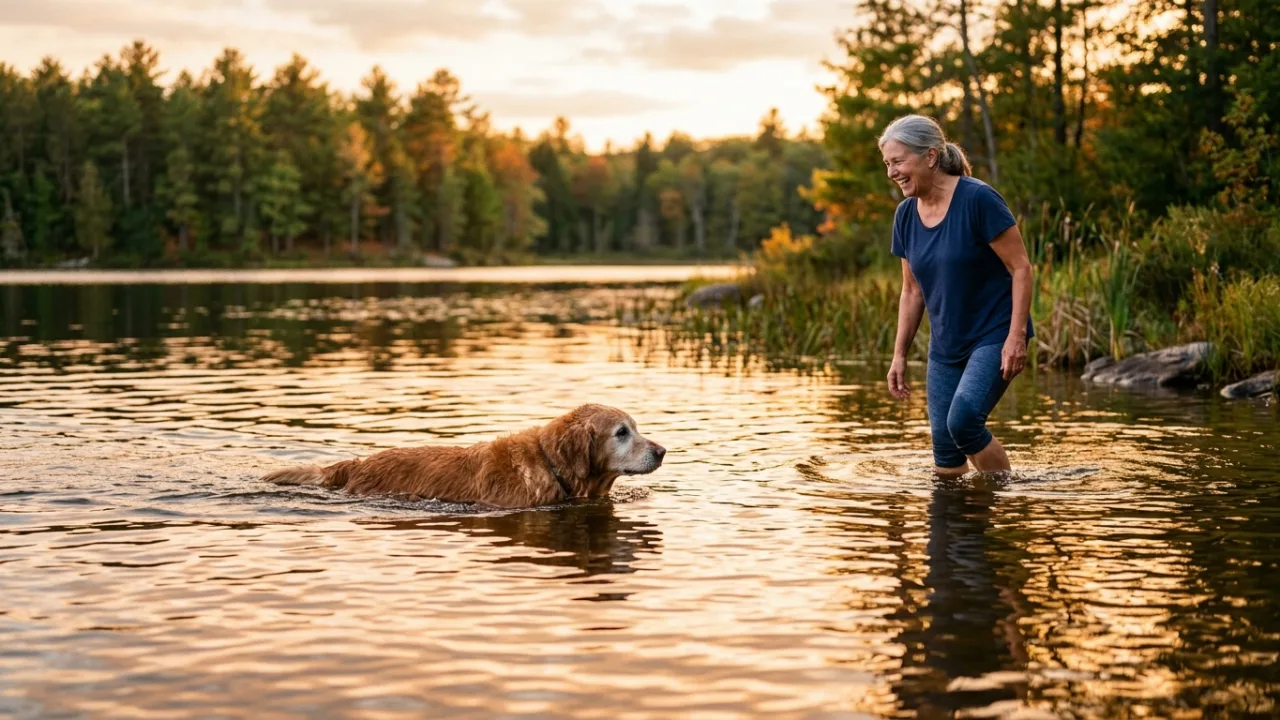
- Swimming — one of the best options for joint-friendly cardiovascular activity and muscle maintenance
- Flat sniff walks — low physical demand but high mental engagement through scent exploration
- Car camping with short leg-stretch stops — keeps your dog part of the outdoor lifestyle without trail mileage
- Scenic drives with brief walks — a genuinely underrated way to include a retired trail dog in outdoor plans
- Puzzle feeders and scent games at home — mental stimulation that doesn’t require physical strain, useful for dogs with cognitive changes too
The Emotional Side: Grief, Identity, and Reframing the Relationship
It’s worth naming this plainly: retiring a hiking partner is a real loss, and it’s okay to grieve it even while your dog is still very much alive and loved. For many owners, trail hiking wasn’t just an activity with their dog — it was a core part of how they related to each other and how they defined their own outdoor identity. Reframing helps. Instead of thinking of this as the end of your dog’s outdoor life, think of it as a new chapter with a different shape — one built around car camping, scent walks, swimming, and simply being outside together at whatever pace your dog can genuinely enjoy. The goal was never the mileage. It was always the time together.
Troubleshooting Common Trail Situations
Your Dog Suddenly Refuses to Continue Mid-Hike
Stop immediately and assess rather than coaxing them forward. Check paws, joints, and breathing. If there’s no obvious cause and your dog seems otherwise alert, rest 15–20 minutes and offer water before deciding whether to turn back. A sudden refusal after previously willing hiking is a strong signal, not stubbornness.
Carrying or Assisting a Large Senior Dog Who Can’t Walk Out
For dogs over roughly 40 pounds, a two-person carry using a sturdy harness with front and rear handles is safer than attempting a fireman’s carry alone, which risks injury to both of you. Always hike with a plan for this scenario if your dog is showing any signs of decline — know your turnaround point before you need it.
Mismatched Mind-Body Drive
Some dogs retain full enthusiasm long after their body can’t keep up — this is often the hardest situation to manage because the dog isn’t communicating reluctance at all. In these cases, the owner has to make the call the dog won’t make for themselves, using objective checks (gait, recovery time, vet clearance) rather than the dog’s visible excitement as the deciding factor.
Limping That Appears Hours After the Hike
Treat any delayed limping as directly related to the hike unless proven otherwise. Rest your dog completely for 24–48 hours, and call your vet if it doesn’t resolve or if it recurs after future hikes of similar intensity.
Common Mistakes Owners Make
- Waiting for a dramatic injury before making any changes, instead of responding to early, subtle signals
- Judging fitness only by enthusiasm at the trailhead rather than recovery afterward
- Assuming a joint supplement alone is enough to justify continuing the same intensity level
- Comparing their dog to breed-generic age charts instead of that individual dog’s actual condition
- Treating retirement as all-or-nothing instead of a staged, adjustable process
- Skipping the vet visit because “it’s probably just old age” — which delays catching treatable or urgent conditions
The Bottom Line
There’s rarely one dramatic sign that makes retirement obvious. It’s the accumulation of small, honest observations — recovery that takes longer, hesitation that wasn’t there before, a body that’s working harder for the same result. Trust the pattern over any single hike, lean on your vet for the medical side of the decision, and remember that scaling back isn’t the end of your dog’s outdoor life. It’s a new stage of it, built around whatever pace lets your dog keep enjoying the outdoors safely for as long as possible.
If you’re standing at the trailhead right now, unsure whether today’s hike is one too many, that uncertainty itself is worth listening to. Start with a pre-hike check, choose the shorter option, and let your dog’s recovery tell you the rest.
Frequently Asked Questions
Is there a specific age when all dogs should stop hiking?
No single age applies to every dog. Small breeds often hike comfortably into their early teens, medium breeds typically need closer monitoring from around 8–10 years, and large or giant breeds often start showing joint wear by 6–9 years. Individual condition, diagnosed health issues, and hiking history matter more than the number on the calendar.
Can supplements or CBD products safely extend a senior dog's hiking years?
Vet-approved joint supplements like glucosamine, chondroitin, and omega-3s can improve comfort and may extend the years a dog can hike moderately, but they generally don't reverse existing joint damage. Always discuss any supplement, including CBD products, with your veterinarian first, since quality and appropriate dosing vary widely and some products interact with medications.
Should I still bring my senior dog on car camping trips even if we don't hike far?
Yes, in most cases. Car camping lets your dog stay part of the outdoor experience through short walks, sniffing new environments, and being with the family, without the sustained mileage that stresses aging joints. Bring an orthopedic sleeping pad and keep outings short and low-impact.
How do I know if it's arthritis vs. a soft tissue injury vs. just being tired?
Arthritis typically causes gradual, symmetric stiffness that's worse after rest and improves with gentle movement. A soft tissue injury usually causes sudden, often one-sided lameness tied to a specific incident. Simple tiredness resolves within a few hours with no lingering stiffness. If you're unsure, a vet exam can distinguish between them, especially since treatment approaches differ significantly.
Is it cruel to bring an aging dog on trail at all, even short ones?
No — short, appropriate outings are often genuinely good for a senior dog's physical and mental wellbeing, as long as the trail matches their current fitness stage. What matters is matching the activity to the dog's actual capacity, watching recovery closely, and adjusting based on what their body tells you rather than what you wish were still true.
What's a realistic retirement timeline — sudden stop or gradual reduction?
For most orthopedic-related decline, a gradual, staged reduction over several months to a year works better for both dog and owner than an abrupt stop. Sudden full retirement is usually necessary only after an acute injury, a cardiac or respiratory diagnosis, or explicit vet instruction to stop all strenuous activity immediately.
Do certain breeds bred for endurance, like huskies or GSPs, decline differently than companion breeds?
Yes. Endurance-bred dogs often have higher pain tolerance and drive, which can mask discomfort longer and lead to sudden injuries rather than gradual, visible reluctance. Companion breeds more often show earlier, more obvious signs of fatigue or disinterest, which can make the retirement conversation more visible sooner.
How do I explain to hiking friends or groups why my dog can't join anymore?
Most hiking communities are understanding if you're direct: explain that your dog is scaling back for health reasons and suggest alternative ways to stay connected, like meeting at the trailhead or planning a shorter parallel route. If a group pressures you to bring a declining dog anyway, it's reasonable to decline those specific outings.
What should I do with all the trail gear once my dog retires?
Consider repurposing lighter items like a well-fitted harness or booties for shorter walks, donating unused backpacking gear to a local rescue or hiking club, or keeping a small kit on hand for car camping trips and short outdoor outings so your dog stays included in a lower-impact way.
Can a dog 'ask' to retire through behavior changes, and what does that look like?
Many dogs do communicate readiness to slow down, though subtly. Watch for hesitation at the trailhead or car, reduced excitement about gear coming out, choosing to rest rather than explore at breaks, or a general dip in trail-specific enthusiasm even though they're otherwise happy at home. These behavioral shifts are worth taking seriously alongside physical signs.