Fitting two dog crates in your truck bed comes down to one number: the gap between your wheel wells. Most full-size beds give you just 50″–51″ of clearance, but two Large Gunner kennels need about 56″ side-by-side. That 5″–6″ shortfall means they usually won’t fit facing the tailgate. You’ve still got options, though—rotating doors, raising crates on a riser, or going custom. Below, you’ll find exactly how to make your setup work.
TLDR Key Takeaways
- Measure wheel-well clearance, not overall bed width, since wheel wells form the real constraint for side-by-side double-crate fits.
- Two Large Gunner kennels total ~56″ wide, but most truck beds offer only 50″–51″ between wells, preventing tailgate-facing placement.
- Match configuration to bed length: 8 ft fits two crates front-to-back, while 5–5.5 ft beds need stacked or overhanging setups.
- Resolve tight fits by rotating doors toward the sides, raising crates 2–2.5″ on a pallet, or ordering between-well custom units.
- Secure raised setups by anchoring all four corners with ratchet straps to OEM points, strapping crate and riser separately for redundancy.
How to Measure Your Truck Bed
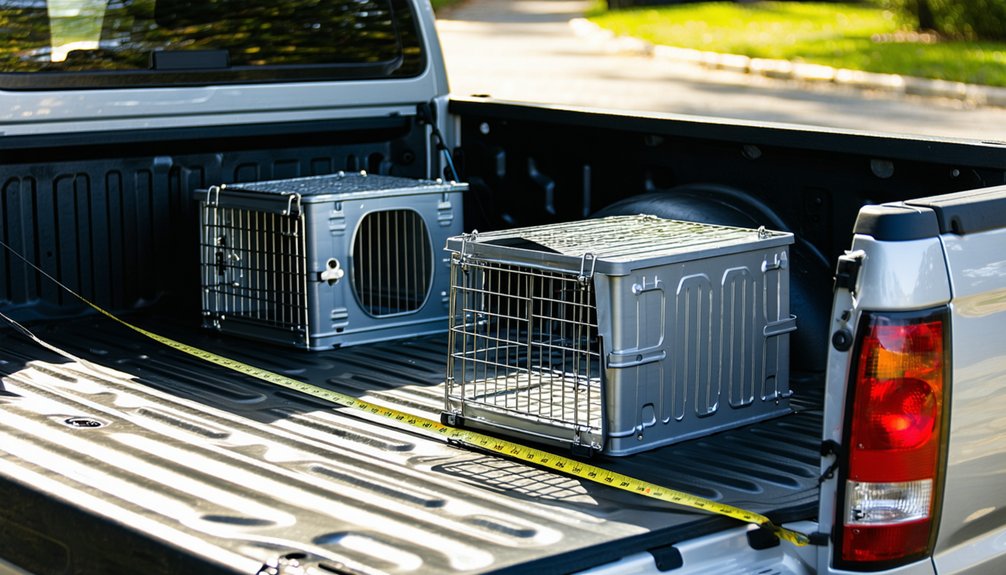
Before you shop for a crate or any other accessory, you need accurate measurements of your truck bed. Start with length: close the tailgate, then run a tape from the inside edge of the bulkhead to the inside edge of the tailgate, keeping it flat and level.
For width, measure inside-to-inside near the tailgate and at the midpoint, using the larger number. These interior clearance tips matter most when wheel wells intrude, so measure between them too.
Record bed depth from the top rail to the floor. For rail hardware measurements, gauge outside edge to outside edge where a crate or toolbox will sit.
Finally, recheck every dimension against your truck’s year, make, and model before you order. You’ll fit right in.
Why Bed Length Decides Your Crate Layout
Once you’ve got accurate measurements, bed length becomes the single biggest factor in how your crates fit.
With an 8 ft bed, you can run two crates front-to-back, doors facing the tailgate, keeping door clearance generous and your loading workflow smooth.
Standard 6.5 ft beds usually fit one large crate front-to-back plus one turned side-to-side, creating staggered layouts that demand careful door alignment.
Short 5–5.5 ft beds force compact, stacked, or overhanging setups, steepening ramp angles and adding access hassle for bigger dogs.
Length also dictates whether a topper or tonneau closes over both crates and affects rear visibility when crates sit high or extend past the tailgate.
Get the length right, and you’ll join handlers who deploy dogs effortlessly at every event.
Wheel Wells and the Side-by-Side Problem
Beneath that wide-open bed lurks the constraint most handlers overlook: the wheel wells. They narrow the center span, so your real working number is the wheel well measurement, not the overall bed width. Two large crates can come close to the total width you need yet still refuse to sit flat together. That’s why you compare the combined footprint against the gap between the wells, then add clearance tolerances for bed liner thickness, mounting play, and truck-to-truck variation.
When the math falls short, you’ve got options the rest of us rely on: lift the crates 2 to 2.5 inches on a pallet or drawer system, or rotate the doors to face the sides. Measure first, and you’ll fit side-by-side with confidence.
Will Two Large Crates Fit Facing the Tailgate?

The math doesn’t work in your favor here, and you’re not alone in finding this.
Two Large G1 Gunner kennels create a combined footprint of ~56″ wide, while most full-size truck beds offer just 50″–51″ of wheel well clearance between the wells.
That 5″–6″ gap means two large crates won’t fit side-by-side facing the tailgate in most full-size trucks—and they won’t fit at all in mid-size beds.
Bed length isn’t your limiting factor.
Common 5.5–6.5 ft beds (66″–78″) easily handle crate length.
The width at the wheel wells is what stops you.
If you’re committed to two large crates, you’ll need to examine crate orientation options—rotating doors toward the sides or choosing narrower custom units built for between-well dimensions.
When You Need a Riser to Sit Flush
Width isn’t the only dimension that trips people up—height matters just as much once you’ve fit your crates in the bed. Bed floors typically sit 19–22 in below the rails, while crates run 22–28 in tall, leaving doors below the rails. A riser corrects this, restoring tailgate alignment for clean door operation and weather sealing. Corrugated clearance matters too: when feet land in low corrugations, you’ll need a spacer so faces sit flush.
| Trigger | Riser Height | Goal |
|---|---|---|
| Corrugations | 2–4 in | Level feet |
| Liner thickness | 0.25–0.5 in | Match fleet |
| Decked drawers | 1–2 in | Side-by-side |
| Cap/canopy | 6–12 in | Top alignment |
| Tailgate flush | Varies | Door operation |
Always keep a 1–2 in airflow gap up top.
Keeping Raised Crates Stable and Tied Down
Once you’ve raised a crate to flush, you’ve also raised its center of gravity—so tie-down strategy matters more than ever. Anchor all four corners using heavy-duty ratchet straps connected directly to OEM tie-down points or bed-rail systems like Utili-track or L-track.
Secure your riser to the bed independently, then strap the crate to the riser separately for redundant stability.
Use crossed-strap patterns to resist diagonal shear during sudden lane changes.
Skip bungee cords—they stretch and allow dangerous oscillation.
Check your strap load ratings against the combined weight of crate, dog, and riser, targeting a WLL that exceeds your total by several factors.
Lay non slip friction mats beneath the riser and crate to limit sliding and absorb vibration.
You’ll roll knowing your setup holds.
Choosing the Right Door Direction
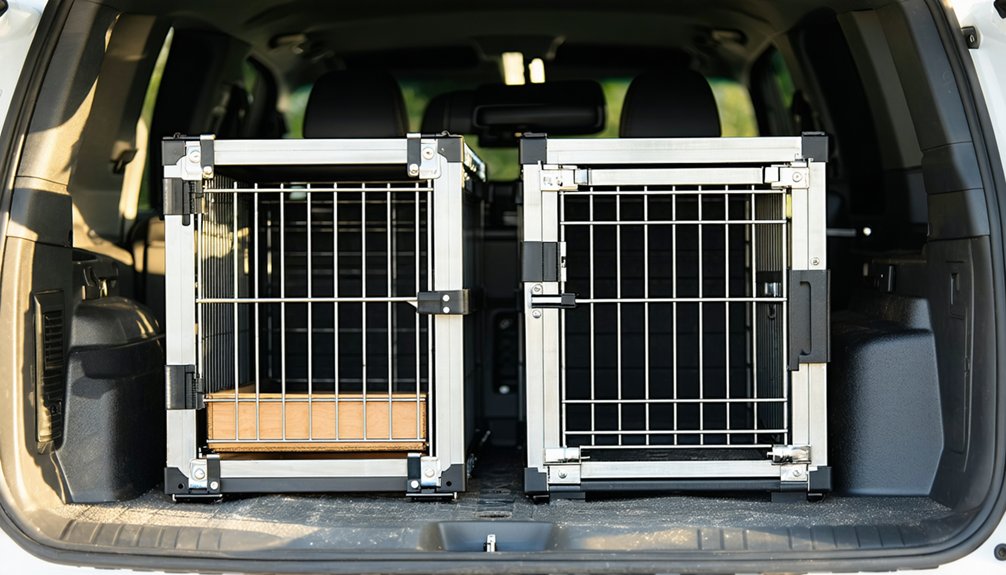
Where your crate’s door faces can make or break your daily loading routine. When crates sit flush with the rear, front-facing doors minimize your reach over the tailgate.
But if parking, toolboxes, or caps limit access to one side, side-opening doors win.
Always check that door swing clears tailgate cables, bed walls, and cap framing for a full opening arc.
For roadside safety, choose doors that open toward the curb side to cut your traffic exposure when unloading.
In double-crate setups, opposing hinges let both doors stay open without colliding.
Pick an ergonomic hinge that keeps the open door out of your path, not blocking your approach.
Many wire crates allow door reversal, so you can adapt as your truck layout changes.
Rear-Facing vs Side-Facing in a Truck Bed
Orient your crate’s door to match how you’ll actually reach the dog, because the right direction streamlines every load and unload. Rear-facing doors align with the tailgate, giving you a direct loading path—ideal when the crate sits near the cab wall or under a topper. Side-facing doors suit canopies and shells with side-entry openings, reducing how deep you reach into the bed.
| Rear-Facing | Side-Facing |
|---|---|
| Tailgate loading path | Side-entry access |
| Needs rear clearance | Needs side clearance |
| Works with toppers | Suits camper shells |
| Common for open beds | Depends on canopy design |
Either way, your training flow improves when the door matches your approach. Do loading checks, confirm strap routing won’t block doors, and finish clearance planning so latches and vents stay accessible.
Full-Size vs Mid-Size Truck Bed Options
Because your truck’s class dictates how much usable floor you’ll actually work with, sizing crates starts with knowing whether you’re loading a full-size or mid-size bed. In a rail to rail comparison, full-size beds typically run 60–66 in, while mid-size beds fall to 56–61 in.
The real difference shows in wheel well clearance: full-size trucks give you 48–51 in between housings, enabling side-by-side double crates and flat 4×8 loading. Mid-size trucks restrict you to 41–45 in, often forcing compact, stacked, or narrower kennel designs to preserve walk space.
Full-size floors commonly span around 70–71 in wide, with cargo volumes reaching 69–89 cu ft—room for two crates plus ramps, water, and tie-downs.
If you’re running mid-size, precise footprint selection becomes essential to fitting everyone comfortably.
Should You Add a Cap, Topper, or Box?

Why bother enclosing your bed at all? Because a cap, topper, or box converts your double-crate setup into a weatherproof setup that protects your dogs the way serious handlers expect.
An enclosed cap blocks wind, rain, snow, and road spray while reducing windchill and temperature swings, and insulated dog boxes add thermal protection through cold hunting seasons.
Vent windows and roof vents give you controlled airflow, balancing ventilation against precipitation and dust.
You gain real theft deterrence too: lockable rear hatches conceal dogs, firearms, and gear from view.
Safety improves through secure mounting—crash-rated crates or a bolted-down box survive impacts far better than loose kennels.
Just account for added weight and a higher center of gravity, then distribute your load properly.
When a Custom Double Dog Box Makes Sense
Once you’ve decided to enclose your bed, the next question is whether an off-the-shelf double crate will actually serve your dogs—or whether you need something built to spec. If you run large working breeds, mixed-size pairs, or high-drive field dogs, standard boxes rarely meet each dog’s stand-turn-lie dimensions. A custom build solves that, and here’s when it’s worth the investment:
- Oversize or asymmetric needs: Large breeds and mixed pairs get compartments sized without wasted space.
- Non-standard truck beds: Tapered sides and raised bases fit irregular footprints around wheel wells.
- Custom ventilation tailoring: Match vent size, placement, and fans to each dog’s coat type.
- Multi stage divider planning: Plan dimensions from adolescent to senior, avoiding repeated crate replacements.
You belong here—build accordingly.
Daily Driving vs Field Use
The way you use your truck dictates how you should configure your dog crates. For daily driving, you’ll get the safest results by keeping dogs in the cab with a crash-tested harness or crate, cutting ejection risk during frequent braking.
If you must use the bed, bolt down a crash-rated crate near the cab wall, prioritize quick-loading latches, and weigh lost cargo flexibility against your errand routines.
Field use demands more: heavy-duty welded aluminum, reinforced panels, and corrosion-resistant hardware that survive ruts, vibration, and weather.
Tie-down systems rated for 800–2,500 psi keep you secure on rough access roads.
Because field days mean long static periods, your ventilation planning and seasonal comfort matter—powder-coated panels and airflow protect your working dogs through demanding cycles.
Frequently Asked Questions
What Crate Materials Hold up Best in Open Truck Beds?
You’ll want aluminum or premium rotomolded weatherproof plastics options—they’re the crew favorites, resisting corrosion, impacts, and UV. Skip durable wire mesh choices for open beds; they collapse under rollover forces. Powder-coated steel works too, when properly maintained.
How Much Should Two Large Dog Crates Weigh Together?
You’ll find two large dog crates typically weigh 60–150 lb together, depending on material. For your truck-bed travel weight, choose lighter aluminum or wire pairs (60–110 lb) to keep load distribution manageable alongside your gear.
Do Dogs Need Separate Water Bowls in Transit Crates?
Yes, you’ll want separate bowls for each dog. They prevent resource guarding, guarantee your subordinate pup stays hydrated, and improve hydration monitoring. Pair them with no-spill, clip-on designs for reliable water spill prevention during transit.
Can I Stack Two Crates Instead of Side-By-Side?
You can, but only with purpose-built stackable crates—not lightweight wire ones. For crate stability tips, tie each crate down independently. Side-by-side’s safer for us, though alternative stacking options work if you’ve got sturdy aluminum units.
How Do I Ventilate Crates During Hot-Weather Drives?
Choose wire crates with opposite-side vents, raise them 4–6 inches, and add 12V fans aimed across fronts for recirculating airflow. Use light-colored crate airflow covers on sun-facing sides only—you’ll keep your pups cool together.
Conclusion
You’ve now got the tools to measure smart and choose right. Start with your bed length and wheel-well width—those two numbers dictate everything else. Whether you go side-by-side, face the tailgate, or invest in a custom box, match the configuration to how you actually use your truck. Don’t guess; measure twice and buy once. Your dogs deserve a secure, properly sized setup, and you’ll save money skipping costly returns or rework.
References
- https://www.youtube.com/watch?v=7fRUYKdYwVs
- https://gunner.com/blogs/pack/two-large-kennels-truck
- https://www.youtube.com/watch?v=PyTrazhcGjY
- https://www.youtube.com/watch?v=YqLPHvZ7lUA
- https://www.youtube.com/watch?v=BkUrr8RiihM
- https://www.retrievertraining.net/threads/crate-placement-in-pickup-bed.98839/
- https://www.youtube.com/watch?v=uN4hN7_WdUo
- https://www.reddit.com/r/f150/comments/y78yvf/how_should_i_make_my_bed_into_a_safe_and_legal/
- https://www.extendobed.com/dog-kennels/
- https://www.facebook.com/groups/1729655510653295/posts/4314287232190097/