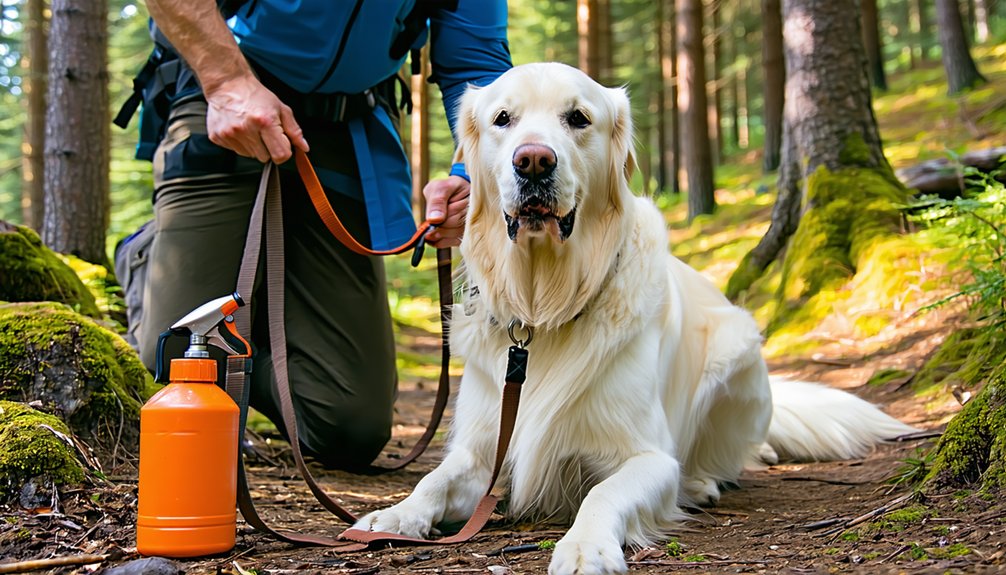
Keep your dog on a short, non-retractable leash (6–10 feet), positioned at your side and never out front. Train a reliable single-cue recall using high-value rewards before you hit the trail. Don’t rely on bear bells—the National Park Service warns their faint jingling often goes unheard until you’re dangerously close. Instead, call “hey bear” every 30–60 seconds, and carry bear spray you can draw in under two seconds. Here’s how to put it all together.
TLDR Key Takeaways
- Use a short, non-retractable leash (6–10 feet), keeping the dog at your side and never out front into dense brush.
- Treat bear bells as supplemental only; voice cues like “hey bear” every 30–60 seconds are the most effective early-alert tool.
- Carry bear spray accessible for under two-second draw, check wind, then aim 8–10 feet ahead before raising into the bear’s face.
- If a bear is spotted, take in all leash slack, turn around calmly, and retreat without letting the dog dart toward cover.
- Train a single-cue recall with high-value rewards to immediately stop escalating barking and pull the dog back during encounters.
Why Dogs Change the Bear Safety Equation
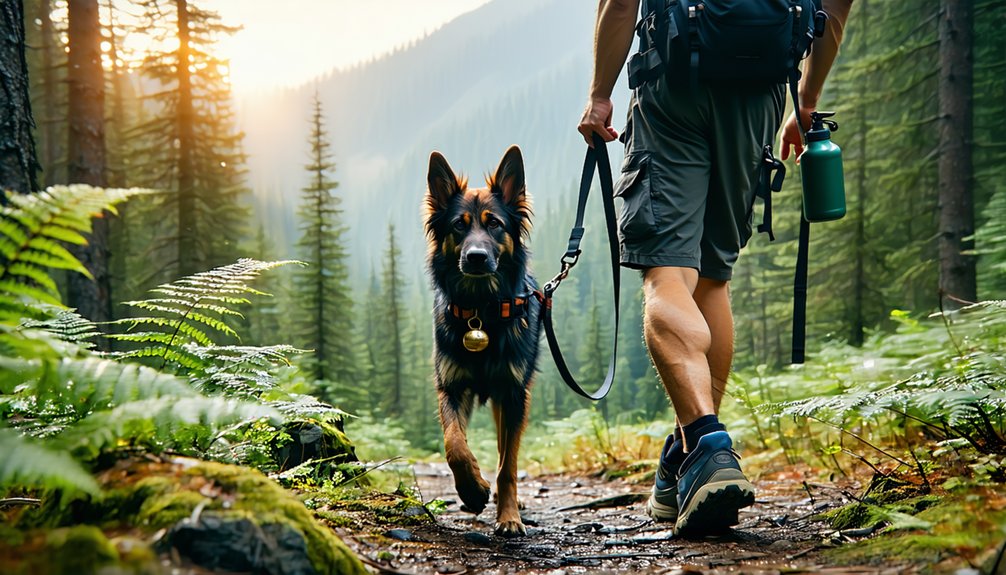
When you bring a dog into bear country, you change the safety equation entirely. Off-leash dogs run ahead, surprise bears at close range, and trigger defensive responses—especially from sows with cubs.
When a startled bear chases your fleeing dog, that dog retreats to you, pulling an agitated bear straight toward your group.
Bears perceive dogs as canid threats, much like wolves, so they escalate faster, with bluff charges, huffing, and jaw-popping.
This dog-induced escalation undermines standard human-only avoidance protocols.
Don’t count on your pet for protection either; studies suggest about 80% of dogs fail to defend owners during an attack.
That’s why bear-safety groups treat dogs and bears as a high-risk combination, making leash enforcement the foundation of every responsible handler’s approach.
Train Your Dog’s Recall Before You Hit the Trail
Because a leash can fail and a bear can appear without warning, you need a recall that works every time—not just in the backyard. Start your trail recall planning with a single cue—one word or whistle—spoken once in a clear, happy voice.
Pair it with high-value rewards like chicken, steak, or a favorite toy, and use reward driven reinforcement the moment your dog commits to coming, not just on arrival.
Begin a foot away in low-distraction spaces, then add distance in controlled steps using a 20–50 foot long line.
Never reel your dog in; voluntary movement is the goal.
Once you’ve succeeded indoors, generalize to busier places and try round-robin recalls with friends.
Keep sessions short and upbeat, always ending on a win.
Master Leash Discipline in Bear Country
A reliable recall is your backup, but your leash is your frontline defense in bear country. Choose a short, non-retractable leash—a leash length of 6 to 10 feet keeps your dog close and your reaction time sharp.
Retractable leashes let dogs range ahead into dense brush, sparking surprise encounters, so skip them.
Keep your dog at your side or slightly behind, never out front where wildlife gets surprised first.
Practice slack control through berry patches and low-visibility terrain, minimizing slack to prevent darting into cover.
Position your dog between you and the trail edge.
If you spot a bear, take in all slack, turn around calmly, and retreat.
Never unclip—releasing your dog invites a chase that redirects an agitated bear toward you.
Do Bear Bells Actually Work?
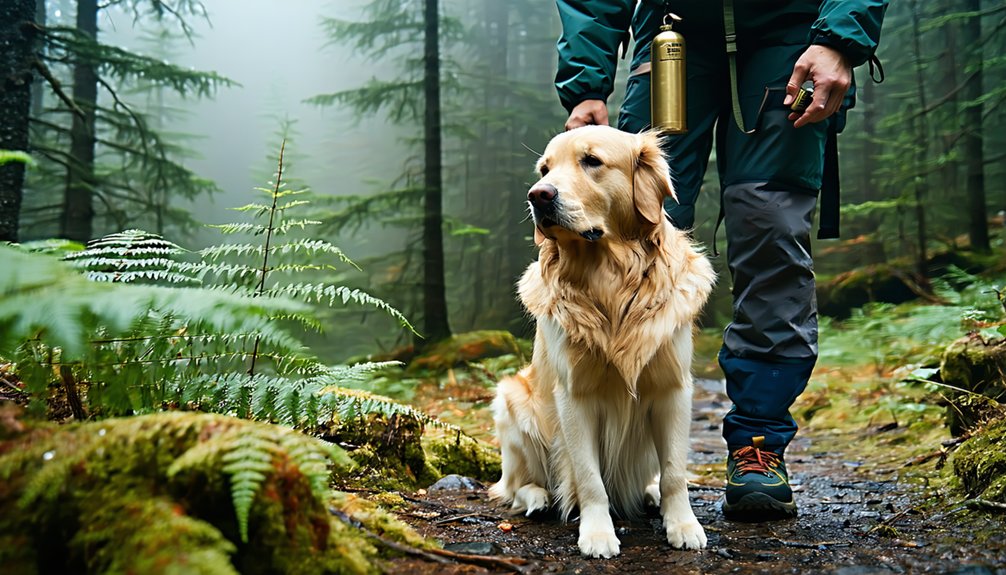
Though bear bells jingle from countless packs across every trailhead, they’re not the reliable deterrent their popularity suggests. The National Park Service warns they don’t effectively alert bears, who often won’t hear that faint tinkling until you’re dangerously close. When you evaluate bell limits, consider that rivers, wind, and dense brush easily mask the sound.
Here’s what the evidence tells us about when to use them:
- Treat bells as a supplemental early-alert tool, never your primary safety measure.
- Rely on alternatives like voices—loud, human-like calls trigger stronger avoidance.
- Prioritize spray readiness, keeping bear spray accessible and ready to deploy.
Join the hikers who pack smart: you’ll lean on proven tactics, not jingling habits, to stay safe alongside your dog.
Smarter Noise-Making to Alert Bears Early
Beyond bells, your voice is the single most effective tool for alerting bears early. Talking, singing, or calling “hey bear” gives bears the clear, human signal they need to move off before you ever meet.
The goal isn’t to scare them—it’s to avoid surprise encounters. A consistent voice at steady intervals of 30 to 60 seconds works best, and you’ll want to call out more often in high-risk spots: berry patches, salmon streams, dense brush, and blind corners.
Crank up the volume near rivers, waterfalls, and wind, where ambient noise masks your approach. Clap your hands or tap your trekking poles before cresting hills or entering thick cover.
Save whistles and air horns for hazing—not constant use. Travel in groups and keep talking.
How to Carry, Aim, and Range Your Bear Spray
- Draw from the holster in under two seconds.
- Pull the safety clip straight off only when a charge looms.
- Grip firmly, canister upright, nozzle pointed away from your face.
Check wind direction before you fire, angling slightly downwind to avoid blowback.
For spray control, aim 8–10 feet ahead, then raise into the bear’s face with short 1–2 second bursts, building a protective cloud.
Read Fresh Bear Sign Before You Walk In
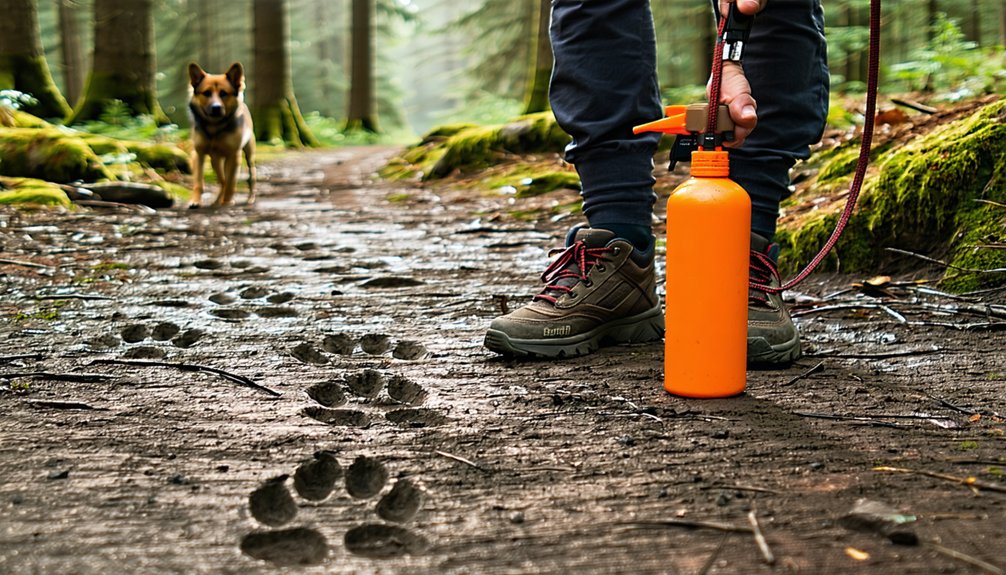
Before you and your dog step into the brush, read the ground for what’s already there.
Track recency tells you everything: sharp, unweathered edges with damp soil mean a bear passed within hours.
Check scat moisture by flipping it with a stick—soft, glossy droppings over green grass signal fresh feeding nearby.
Watch for vegetation disturbance: freshly broken saplings, bent berry bushes, and trampled clusters mark active travel routes.
Trust your nose, too.
Odor cues like carrion, decomposing flesh, or a musky, wet-dog scent warn you a bear’s close.
When multiple fresh signs cluster together, you’re in an actively used area, and your encounter odds climb.
We don’t walk in blind here—we read first, then decide whether to detour or turn back.
What to Do the Moment You Spot a Bear
When you first spot a bear, freeze and hold still for a moment—don’t run, scream, or make sudden moves that could trigger a chase or defensive reaction.
This calm assessment buys you time to read the bear’s behavior, the wind, and your escape routes before acting.
Keep your eyes on the bear without hard, predatory staring, and start talking in a low, steady voice so it knows you’re human.
As you work through escape planning, gather your group close:
- Pull children and companions to one side, moving as a single unit.
- Leash your dog tightly to stop barking or lunging.
- Back away slowly along your entry route, keeping a clear exit for the bear.
Stay together, stay deliberate.
Handling a Dog-Bear Encounter Without Getting Hurt
Because a dog can turn a routine sighting into a dangerous confrontation, your first job is keeping it under absolute control. Safe Leashwork starts with a non-retractable leash kept short, preventing your dog from lunging, circling, or charging.
Issue a strong Emergency Recall to bring your dog close, never allowing chasing, barking, or harassing.
Position your dog behind or beside you, never between you and the bear, so you can move together calmly.
For your Distance Retreat, stand tall, stay calm, and slowly back away without sudden movements that trigger pursuit.
If you’ve got a small dog, scoop it up with one arm, keeping your dominant hand free for bear spray.
Stay controlled, stay together, and you’ll exit safely—just like every prepared handler does.
Black Bear or Grizzly? How to Respond
How do you tell a grizzly from a black bear in the field? Don’t trust fur color—both species range from blond to black. Instead, read the body, head, and tracks like the seasoned hikers around you do:
- Shoulder hump and face profile: Grizzlies show a prominent muscular shoulder hump and a concave, dished face. Black bears lack that hump and have a straighter or slightly convex profile.
- Ear shape and head size: Black bears sport taller, pointed ears and smaller heads; grizzlies have short, rounded ears and large heads.
- Track accuracy: Grizzly front tracks line toes nearly straight with long 2–4 inch claws. Black bear toes curve, claws shorter.
Match behavior to species, then respond accordingly.
Bear-Proof Your Yard With a Dog
Although your dog can sense bears before you do, don’t mistake that instinct for a security system. Wildlife agencies are clear: attractant control, not your pet, is your primary defense.
Start by eliminating yard attractants—feed your dog indoors, store kibble inside, and clear spilled food and dirty bowls from decks. Secure garbage in bear-resistant cans, skip bird feeders in bear season, and keep grills and compost off-limits.
Next, invest in dog fencing at least six feet high with gates you keep closed. Trim dense shrubs near runs for visibility, and add motion-activated lights for nighttime warning.
Let your dog patrol for tracks and scat, but recall it immediately when barking escalates. Together, these layered steps keep your dog—and your community—safer in bear country.
Keep Your Dog Safe at Camp
When you choose your campsite, you’ve already made your first safety decision for your dog. Pick low bear-use areas away from salmon streams, berry patches, and game trails, and join other adults—groups face lower attack risk than solo parties.
Set up your camp with deliberate spacing:
- Keep your tent, cooking area, and food storage at least 200 feet apart.
- Camp 200 feet from water sources and trails to avoid bear travel corridors.
- Use established sites with bear boxes, food poles, or lockers.
Maintain zero scent near your dog’s rest zone—no food bowls, treat pouches, or scented toys. Store everything in bear proof storage.
At night, keep your dog inside your tent or hard-sided shelter, never tied out unattended.
Frequently Asked Questions
Does Bear Spray Expire, and How Often Should I Replace It?
Yes, bear spray expires. Bear Spray Shelf life runs 3–4 years from manufacture, so you’ll want to replace yours before the printed date. Make Expiration Checks part of your seasonal routine, keeping fellow hikers safe.
Are Certain Dog Breeds Riskier to Bring Into Bear Country?
It’s less about Bear Breed Temperament than behavior. High-prey-drive or bold dogs raise risk, but your Training Prior Preparedness matters most. With solid recall and leash discipline, you’ll keep your pack safer together.
Can I Legally Use Bear Spray in All Parks and Regions?
No, you can’t use bear spray everywhere. Yosemite, Sequoia, Kings Canyon, and Lassen ban it. Local legality varies, call regulations; State park policies differ, check signage. We want you safe, so verify before you go.
What First Aid Helps if My Dog Is Injured by a Bear?
First aid basics: make certain the bear’s gone, then check your dog head-to-tail. Stop bleeding with firm, direct pressure using clean cloth—layer more if it soaks through. Keep your buddy warm, minimize movement, and reach a vet urgently.
What Time of Day Are Bear Encounters Most Likely?
You’ll face the highest risk at morning, dusk, and crepuscular hours. Watch behavior cues at trail junctions and wildlife hotspots, where bears concentrate. Though most attacks happen in daylight, we’d all stay sharp during low-light periods together.
Conclusion
Bringing your dog into bear country means you’re responsible for two lives, not one. Train solid recall, keep that leash short, and trade unreliable bells for your own voice and deliberate noise. Carry bear spray and know when to deploy it. Learn the difference between black bear and grizzly responses, secure your yard, and lock down your campsite. Do the work now, and you’ll both come home safe. That’s the whole protocol.
References
- https://dam.assets.ohio.gov/image/upload/ohiodnr.gov/documents/wildlife/wildlife-management/bearwise/Ohio_BearWise_Poster_Dogs-Bears-Trouble_2024.pdf
- https://www.petvetonpatton.com/blog/keeping-your-dog-safe-in-bear-country
- https://portal.ct.gov/-/media/deep/wildlife/pdf_files/outreach/bearwise-outdoors-dogs-bears.pdf?rev=143195991eec494c832b94d941b5b734&hash=06DBFEB34C5D3750F8D08DC04B3DDC05
- https://unitedridersofcumberland.com/wild-life-information/bear-tips-and-recommendations/
- https://www.albertaparks.ca/albertaparks-ca/advisories-and-public-safety/outdoor-safety/visiting-bear-country/
- https://publications.gc.ca/collections/collection_2012/pc/R64-405-2011-eng.pdf
- https://www.facebook.com/groups/9003421258/posts/10161074805276259/
- https://www.ktoo.org/2026/05/05/qa-the-dos-and-donts-of-staying-safe-in-bear-country/
- https://www.thatmutt.com/hiking-with-dogs-in-bear-country/
- https://bearvault.com/blogs/articles/what-to-do-if-you-encounter-a-bear-with-your-dog