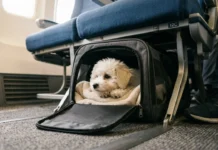
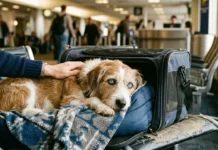
Start 8–12 weeks before your flight, or at least 4–6 weeks for intensive conditioning. Play long terminal-audio tracks at home below your dog’s startle threshold, providing high-value treats while the noise plays. Teach calm cues like settle on a mat, then generalize to busy parks and pre-security airport areas during off-peak hours. Watch for panting, drooling, or pinned ears, and slow down when stress appears. Here’s how to build lasting calm.
TLDR Key Takeaways
- Start conditioning 8–12 weeks before travel, allowing a minimum 4–6 week intensive timeline with buffer for setbacks.
- Play long terminal-audio tracks at home below your dog’s startle threshold, varying sounds for broader generalization.
- Pair airport noises with high-value treats delivered during playback, building a sound-to-good-outcomes link.
- Teach calm cues like settle on a mat, then generalize to busy public spaces at sub-reactive distances.
- Monitor stress signals (panting, drooling, pinned ears) and end sessions early, advancing only after multiple relaxed sessions.
Why Airport Noise Overwhelms Dogs
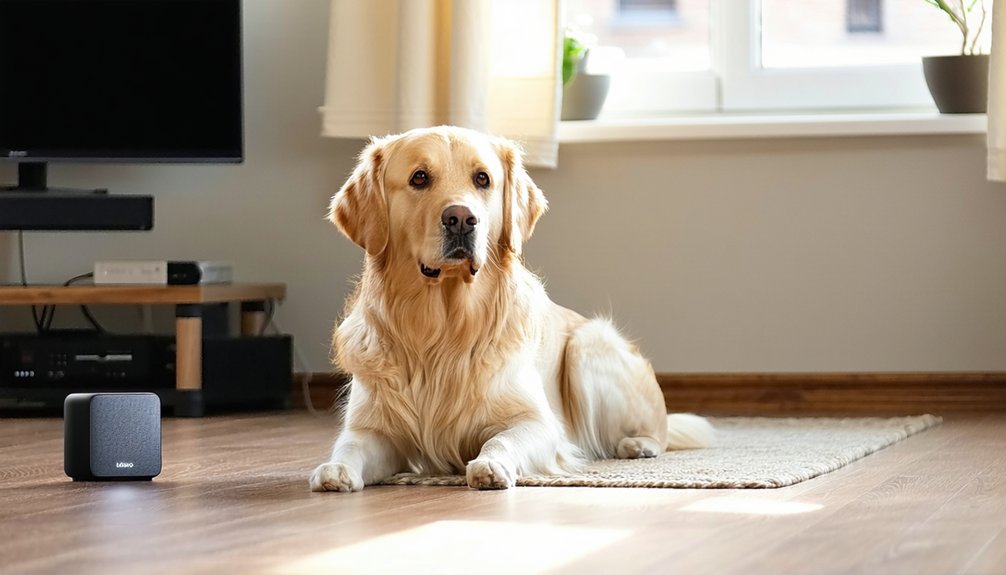
Your dog hears the airport in ways you simply can’t. Their hearing range extends from 40 Hz up to 45–60 kHz, far beyond your 20 kHz ceiling, so high frequency detection of jet engines and machinery hits them hard.
With thresholds as low as 0–20 dB, they perceive terminal noise as more intense than you ever will.
That’s just the beginning. Rapid, high-intensity sounds—takeoff thrust, reverse thrust, baggage drops—trigger startle fear responses they can’t suppress.
The dense soundscape of engine roar, PA systems, trolleys, and crowds overwhelms their auditory processing.
Worst of all, intermittent unpredictable peaks prevent habituation, keeping your companion locked in vigilance and arousal.
Understanding this shared challenge helps you support every dog facing travel day together.
How Early Should You Start Airport Noise Training?
Once your flights are confirmed, you should start airport-noise work immediately—ideally 8 to 12 weeks before travel, which aligns with standard pet-flight preparation timelines that begin several months out.
At minimum, give yourself 4 to 6 weeks for intensive conditioning, building in buffer time for setbacks.
Timing depends on your dog. Puppy readiness peaks during the socialization window (about 3 to 16 weeks), when brains absorb novel sounds best through gradual exposure paired with rewards.
An adult transition takes longer, since dogs with no noise history need slower progressions.
If your dog already shows noise anxiety, involve a veterinarian or behaviorist early and lengthen your timeline.
Seniors and medically compromised dogs need extra lead time.
Throughout, honor stress pacing—increase volume only as your dog stays calm.
Start With Recorded Airport Sounds at Home
Because the home gives you complete control over volume, timing, and your dog’s stress level, it’s the ideal place to begin desensitization before you ever set foot in a terminal. Choose long ambience tracks (20–60 minutes) of real terminal audio, and include variety—engine rumble, scanner beeps, and crowd noise—for broader generalization. Control playback volume below any startle threshold, then track stress cues like panting or pinned ears to guide each step.
| Element | Action | Goal |
|---|---|---|
| Volume | Start very low | Reinforce baseline calm |
| Distance | Begin far away | Focus safe distance |
| Duration | Keep sessions short | Reduce fatigue |
| Location | Rotate training rooms | Prevent context learning |
Join countless owners who’ve prepared their dogs this way—patient, structured home sessions build the confidence your companion needs.
Pair Airport Sounds With Treats and Play
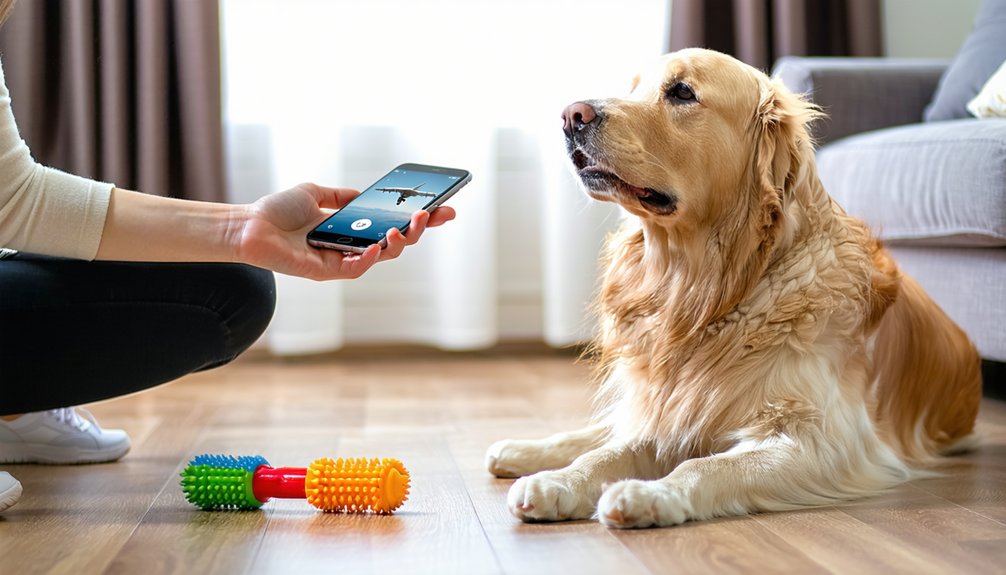
Pairing airport sounds with rewards converts a potential trigger into a predictor of good things. Reach for high-value treats—meat or cheese reserved only for these sessions—and deliver them while the noise plays, not after it stops. Reward timing matters: feeding during the sound builds the link, while feeding after it ends simply relieves fear. Keep treat frequency high, around 5–10 small pieces per minute, to maintain continuous positive pairing during early exposure.
Fold noise cues into play, too. Run airport audio during 3–5 minute fetch, tug, or puzzle-feeder sessions, and try scent games that shift focus toward searching. Nail your enrichment timing by introducing treats or play before any stress signs appear, so the sound reliably predicts fun rather than relief from worry.
Teach Calm Behavior Before Adding Noise
Before you ever play a single airport sound, your dog needs a reliable set of calm-behavior cues to fall back on under pressure. Teach and proof settle, wait, touch, leave it, and drop in quiet rooms, aiming for 95% reliability at 10 feet with no distractions.
Train a formal settle on a mat so relaxation becomes an on-cue behavior, just like nail conditioning builds tolerance through repetition.
Sharpen your reward timing, providing high-value treats—chicken, cheese, tripe paste—before stress appears.
Mind your session pacing, keeping each one short enough that arousal stays low.
Watch your dog’s stress threshold closely; panting, salivation, or tension means you’ve pushed too far, so end immediately.
Practice across multiple calm locations, and you’ll build the steady foundation every confident dog deserves.
Use Mat Training for Relaxation Under Sound
When you give your dog a defined mat to settle on, you hand them a clear job and a predictable resting spot that cuts arousal in chaotic places like airports.
Build value first: reinforce any mat interaction, then shape sits, downs, and truly relaxed postures like hip rolls or chin on paws.
Deliver treats directly on the mat to anchor stillness, and pair relaxed cueing phrases like “settle” with slow breathing to deepen calm.
Once your dog rests comfortably, layer in low-volume airport recordings—PA announcements, rolling luggage, beeps—only while they’re already settled.
Apply counterconditioning basics: feed before any tension appears, so each sound predicts good outcomes.
Raise volume in small increments, dropping back if you spot scanning or startle.
Practice at home first, then generalize elsewhere.
Build Noise Tolerance in Busy Public Places
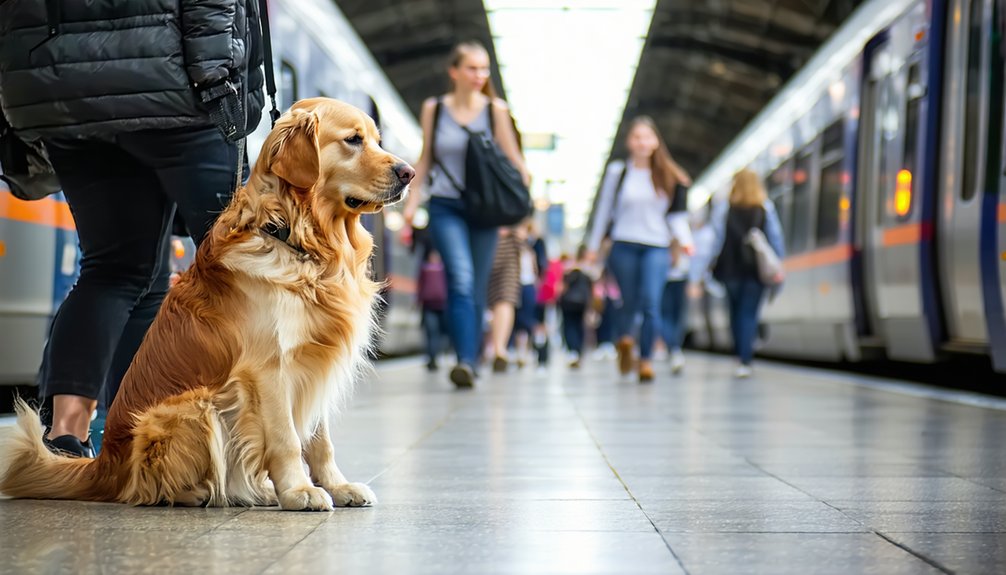
Take your dog’s noise training into the real world by starting in moderately busy, open public spaces like a spacious park near traffic or an outdoor shopping area. Keep ample distance from roads, entrances, and bus stops so your dog stays aware but not reacting—threshold work at sub-reactive distance is core best practice.
Schedule short 5–15 minute visits during off-peak hours, building a gradual exposure ladder from quiet sidewalks to busier corners. Advance only when you see loose posture and normal respiration; signs like panting or scanning mean you should retreat a step.
Use positive reinforcement—high-value food, play, or sniffing time—so ambient noise predicts reward. Visit several times weekly, and never flood your dog with loud crowds, which worsens phobias and sensitization.
Get Your Dog Comfortable With Rolling Luggage
Rolling luggage is one of the airport’s most unavoidable triggers, and your dog will encounter dozens of wheeled bags clattering across hard floors the moment you enter a terminal. Start with stationary suitcases at home, then progress to slow rolling while maintaining distance markers that keep stress signs minimal. Pair every calm glance with high-value food rewards, using strategic treat placement that scatters progressively closer to moving luggage. Watch for tail relaxation and loose posture before increasing speed, duration, or proximity.
| Training Element | Purpose |
|---|---|
| Mat pairing | Anchors calm settling near rolling bags |
| Distance markers | Prevents looming-object fear |
| Treat placement | Encourages voluntary investigation |
| Tail relaxation | Confirms readiness to advance |
Practice across tile, hardwood, and carpet, generalizing comfort so suitcase noise never feels situation-specific.
Visit the Airport Before Travel Day
Before travel day arrives, you’ll want to bring your dog to the airport itself, where veterinary and training experts agree that early exposure dramatically reduces flight-day stress.
Many airports permit pets in pre-security, public areas, so contact airport services to confirm pet access rules and understand security access limits.
Start with off peak planning—early mornings or late evenings—when the noise level stays manageable, then progress toward busier windows for stepwise desensitization.
Practice in ticketing halls and baggage claim, where conveyor noise, crowds, and announcements mirror flight-day conditions.
Try crate placement in quiet terminal corners, letting your dog settle inside for 30–60 minutes amid ambient sound.
Watch for stress signals like panting, drooling, or pinned ears, and end sessions early when they appear.
Exercise and Routine That Lower Travel Stress
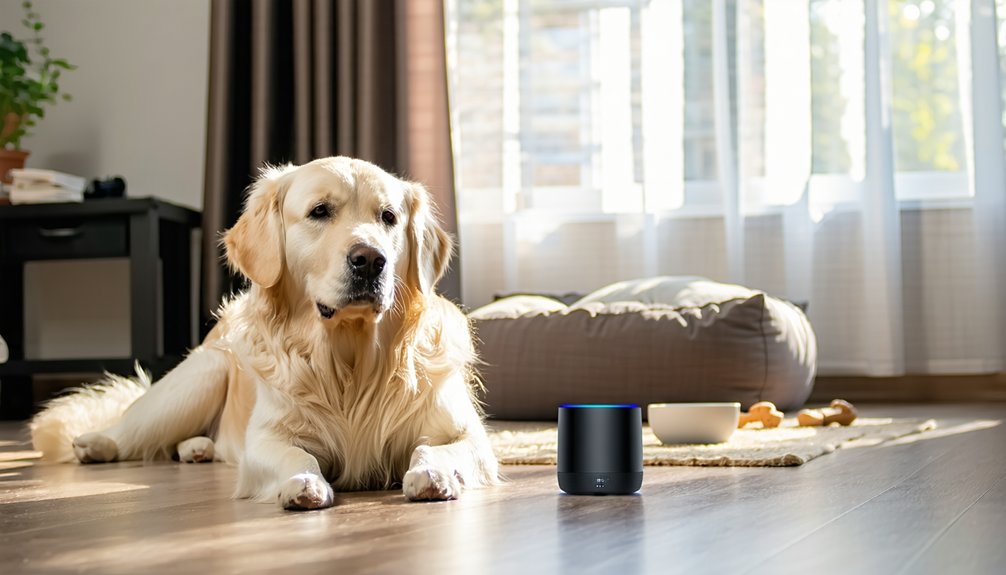
Familiarizing your dog with the airport handles the environment, but you’ll also want to manage your dog’s internal state through exercise and routine. Give your dog 30–60 minutes of vigorous activity before departure—a brisk walk, fetch, Herding Games, or Water Play—to promote calmer behavior and resting during transit. Keep it moderate, though; over-exertion increases dehydration and discomfort on travel day.
| Exercise Type | Benefit |
|---|---|
| Green exercise (parks, trails) | Stronger calming effect than indoor activity |
| Scent games + obedience | More complete fatigue than exercise alone |
Pair physical activity with 5–15 minute reward-based training sessions, which deliver mental fatigue comparable to longer workouts. Then follow a consistent wind-down: cool-down, light snack, quiet time. Sticking to familiar feeding, walking, and sleep schedules keeps everyone grounded together.
When to Use Calming Aids or Call Your Vet
While exercise and routine handle most travel nerves, some dogs need more support—and knowing when to call your vet matters.
Schedule a vet preflight conversation if your dog shows persistent anxiety at home, panics during thunderstorms or fireworks, or reacts badly to past travel with vomiting, escape attempts, or crate refusal.
Pre-existing conditions—heart or respiratory disease, glaucoma, seizures, advanced age, or brachycephalic breeds—demand professional review before any aid.
For mild nerves, you can start with pheromones like Adaptil, calming chews, or a ThunderShirt, introduced gradually.
Prescription anti-anxiety meds require dosage planning, an in-person exam, and side effect checks through a home trial on a quiet day.
True sedatives carry safety risks, so let your vet guide every decision you make.
Spot Stress Signals and Adjust Your Pace
Calming aids and vet support help, but your dog’s body language tells you when training is working and when it’s pushing too hard. Watch for mild signs—an occasional lip lick or brief ear flick—signaling you’re near your dog’s Behavioral Thresholds, so hold steady.
When moderate signs emerge, like persistent panting, frequent scanning, or refused treats, lower the volume, shorten sessions, or reduce difficulty.
Strong signals—fleeing, continuous vocalizing, trembling, or freezing—demand an immediate switch to an easier scenario.
Your Calming Criteria for moving forward: a loose body, normal breathing, and willing engagement with food or toys.
Trust gradual progress over single successes, advancing only after multiple relaxed sessions.
Consistent stress tracking keeps you connected to your dog and confident you’re doing right by them.
Frequently Asked Questions
Are Some Dog Breeds Naturally Better Suited for Airport Travel?
Yes, some breeds suit air travel readiness better—small, calm companions like Cavaliers tolerate confinement well. But temperament vs stress resilience matters more than breed, so you’ll find your individual dog’s stability outweighs any label.
What Documents Are Required to Fly With My Dog?
You’ll need a rabies certificate, government-endorsed health certificate (CVI), and ISO microchip documentation. Check passport requirements—like the EU Pet Passport—plus import permits and airline-specific rules. Many destinations also require parasite treatments and rabies titer tests.
Can Puppies and Senior Dogs Handle Airport Noise Training Equally?
No, they can’t equally. Puppies adapt faster through gentle desensitization during their socialization window, while seniors—facing hearing sensitivity, pain, and cognitive changes—need slower progression. You’ll find your dog thrives when you match training to their age.
Should I Sedate My Dog During the Actual Flight?
No, you shouldn’t—the AVMA advises against sedation due to serious cardiorespiratory risks at altitude. Join countless pet parents who choose sound desensitization and crate comfort instead, keeping your dog calm, coordinated, and safely monitored throughout.
How Do I Choose Between Cabin and Cargo Travel?
Start your travel options comparison with size limits overview: dogs under 8–10kg fit cabin, larger ones need cargo. For cabin vs cargo comfort tradeoffs, experts like the Humane Society recommend cabin—you’ll provide safer, calmer oversight together.
Conclusion
You’ve got the tools to prepare your dog for airport chaos, but success hinges on starting early and reading your dog’s signals. Don’t rush the process—gradual exposure, paired with treats and rewarded calm behavior, builds lasting confidence. If you spot persistent stress, consult your veterinarian about calming aids well before travel day. Consistent routine and exercise matter just as much as sound training. Put in the work now, and you’ll fly with a calmer, happier companion.
References
- https://dogpacking.com/behaviour-tips-for-air-travel-with-your-dog/
- https://www.alibaba.com/product-insights/how-to-train-your-dog-to-handle-airport-security-lines-calmly-and-confidently.html
- https://forum.greytalk.com/topic/319676-living-close-to-an-airport-with-a-sound-sensitive-hound/
- https://www.signaturepettransport.com/blog/how-to-prepare-your-dog-for-a-flight-in-cabin-the-complete-guide-to-stress-free-air-travel
- https://www.youtube.com/watch?v=IR9QYWV4KrU
- https://usaservicedogregistration.com/training-your-service-dog-for-air-travel-and-airport-navigation/
- https://www.youtube.com/watch?v=pjRcPc-3AlY
- https://www.psychdogpartners.org/resources/training/service-dog-training-for-flying
- https://www.reddit.com/r/dogs/comments/3dz86k/help_dog_scared_of_overhead_airplane_noises/
- https://www.reddit.com/r/service_dogs/comments/18ixij8/how_do_you_practice_for_airports/