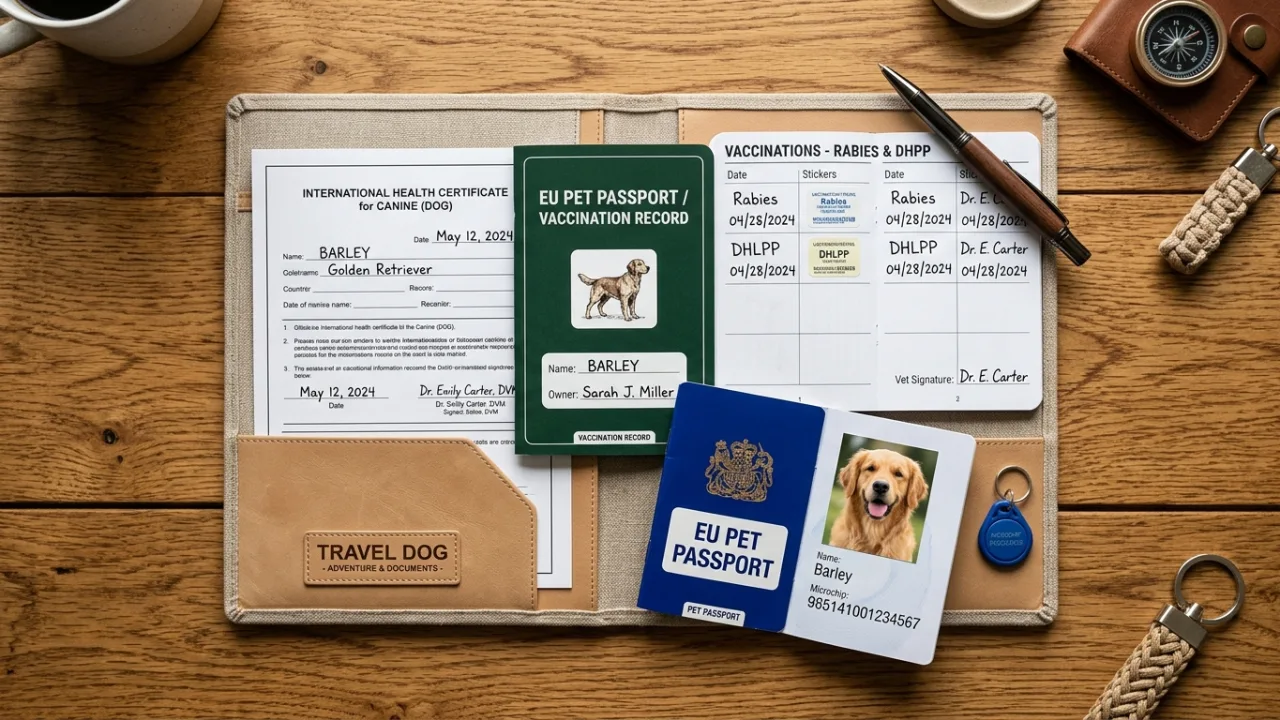
Picture this: your dog has just finished a whirlwind few months bouncing between Portugal, Morocco, and Thailand with you, and now it’s time to head home. You assume the hardest part is over — the flights, the new smells, the strange hotel beds. Then a border agent asks for a document you’ve never heard of, and suddenly your dog is standing in a holding area while you scramble to find a vet who can fax paperwork on a Sunday.
This scenario plays out more often than most traveling pet owners expect, and it almost always comes down to the same root cause: nobody explained that visiting multiple countries doesn’t just multiply your dog’s stamps — it multiplies the rules that apply to your dog’s re-entry.
- Every country your dog visits can add its own layer of health, vaccination, or quarantine requirements — and the strictest country in the chain usually determines what you need for re-entry.
- Rabies risk classification matters more than travel order — a single stop in a high-risk country can trigger titer tests or extended waiting periods, even if you only passed through briefly.
- Health certificates typically expire in 10 days to a few weeks, which means a 3+ country itinerary often requires multiple certificates, not one.
- Microchip and vaccination timelines must line up in the exact order regulators expect (chip first, then rabies vaccine, then any titer test) — reversing the order can invalidate everything.
- Keep a physical and digital travel folder for every country visited, including entry stamps, since customs officers may ask for proof of your dog’s full route, not just the last stop.
- When in doubt, contact the destination country’s official agriculture or animal health authority directly — rules change frequently and vary depending on your dog’s passport-holding country.
Why Multi-Country Dog Travel Complicates Re-Entry

Most pet travel guides are written for a simple round trip: home country to destination, then back again. That’s a manageable, well-documented process. But once your dog has visited three, four, or more countries, the paperwork trail stops being linear and starts looking more like a web.
Here’s the part that catches people off guard: re-entry requirements aren’t just based on where you’re flying in from. They’re often based on every country your dog has set foot in within a certain lookback period — sometimes the last six months, sometimes longer. Border and agriculture officials care about disease exposure risk, and a dog that’s been to a rabies-endemic region three stops ago can still be flagged, even if the most recent country was low-risk.
This is where a lot of well-meaning, careful pet owners get tripped up. They do everything right for country two and three, but forget that country one’s status is still technically “on the record.”
The Core Concepts Every Multi-Country Traveler Needs to Understand

1. Rabies Risk Categorization
Most countries divide the world into two rough buckets for pet travel purposes: rabies-controlled/low-risk countries and high-risk (sometimes called “unlisted” or “non-qualifying”) countries. The exact list varies by destination, but the general logic is consistent — if your dog has been anywhere considered high-risk for rabies, expect extra scrutiny, regardless of how briefly you were there.
Practical example: a dog that flew from the US (low-risk) to the UK (low-risk) to Egypt (typically classified as higher-risk) and now wants to re-enter the EU may need a rabies antibody titer test completed well in advance, plus a mandatory waiting period after that test, even though the EU is usually straightforward for US or UK-origin pets.
2. It’s Not Just About the Last Country You Left
Many owners assume customs only cares about the country they’re flying in from. In reality, most health declarations ask you to list everywhere the animal has traveled over a recent period — often the last 30, 90, or 180 days depending on the jurisdiction. Lying or omitting stops isn’t just risky; it can trigger mandatory quarantine if discovered, since officials treat undisclosed high-risk exposure as a genuine public health concern.
3. Titer Tests and Waiting Periods
A rabies antibody titer test (often called the FAVN test) measures whether your dog’s vaccine actually produced enough antibodies. Many countries require this test if your dog has been in or is arriving from a higher-risk rabies country (see: rabies titer testing timing), and most require the blood draw to happen a set number of months before travel — commonly around three months — with results sent to an approved laboratory. If your itinerary added an unplanned high-risk stop late in the trip, you may not have enough runway left to meet this window, which can mean an unplanned quarantine stay on re-entry.
How Re-Entry Rules Shift Once You’ve Hit 3+ Countries
Document Stacking
A single-destination trip usually needs one health certificate and one set of vaccination records. A 3+ country trip often needs a fresh health certificate for each new border crossing, because most certificates are only valid for a short window — commonly somewhere between 10 days and a few weeks from the exam date. If your itinerary spans months, you’ll likely need to find licensed veterinarians in each country who can issue a new certificate before each leg.
Health Certificate Validity Windows
This is one of the most common trip-ending mistakes. A certificate issued in country one is often expired by the time you’re ready to leave country three. Airlines and border agents will check the issue date, not just whether you have “a” certificate. Build vet visits into your itinerary the same way you’d plan flights or hotels.
Microchip and Vaccine Timeline Conflicts
Regulators are strict about sequencing: the microchip generally must be implanted before or on the same day as the rabies vaccination that will be used for travel purposes. If your dog was vaccinated before the chip was implanted, many countries won’t accept that vaccination record at all — meaning you may need to restart the entire rabies vaccination and waiting-period clock from a later country in your trip, which can derail your return timeline significantly.
Country-by-Country Snapshot: Common Re-Entry Frameworks
Rules change, and you should always confirm details with the official government agency before traveling. (see: country-by-country dog import rules) That said, here’s a general comparison of how different regions typically structure pet re-entry:
| Region/Authority | Typical Health Certificate Validity | Titer Test Required From High-Risk Countries? | Quarantine Risk |
|---|---|---|---|
| United States (USDA APHIS) | Often around 10 days before arrival | Sometimes, depending on origin country classification | Low for most, higher for unvaccinated or undocumented dogs |
| European Union (Pet Travel Scheme) | Certificate/passport valid for the trip duration once issued correctly | Yes, if arriving from a non-listed/high-risk country | Possible if titer test or waiting period wasn’t met |
| United Kingdom (DEFRA) | Health certificate typically valid for a limited window per entry | Yes, for non-qualifying countries | Quarantine possible for undocumented rabies exposure |
| Australia | Extensive pre-approval process, not a simple certificate | Yes, mandatory titer test plus extended waiting period | Mandatory quarantine period is common practice |
Notice the pattern: the more rabies-cautious a destination is, the more likely they are to ask about your dog’s entire recent travel history, not just the immediate departure point.
A Realistic Multi-Country Scenario
Let’s walk through a composite example based on common traveler experiences. A dog named Biscuit travels with their owner from Canada to Spain, then to Morocco for three weeks, then back to Spain, and finally home to Canada.
- Canada to Spain: Standard EU entry requirements apply — microchip, valid rabies vaccination, and an EU health certificate issued within the accepted pre-travel window.
- Spain to Morocco: Morocco has its own import requirements, and depending on current classification, may require additional paperwork or health checks on arrival.
- Morocco back to Spain: Because Morocco may be classified differently for rabies risk, re-entering the EU after this stop could require a fresh veterinary exam, updated health certificate, and possibly closer scrutiny of vaccination timing.
- Spain to Canada: Canada’s requirements for dogs re-entering focus heavily on proof of rabies vaccination and, depending on the dog’s recent country history, may ask for documentation covering the entire trip, not just the most recent leg.
By the time Biscuit gets home, the owner has needed at least two separate health certificates, needs to keep proof of vaccination dates handy for three different border checks, and has had to double-check whether Morocco’s classification triggered any additional titer testing requirement for the Spain-to-Canada leg. This is exactly the kind of compounding complexity that trips up experienced pet travelers, not just beginners.
Step-by-Step: Preparing for Complex Re-Entry
- Map the entire itinerary before you book anything. List every country in order, including layovers where your dog will clear customs (see: layover country transit permit) (not just connecting flights where the dog stays airside).
- Check the rabies risk classification for each country against the requirements of every subsequent country on your route, not just the final destination.
- Confirm microchip and vaccination order is correct before you leave your home country — this is nearly impossible to fix retroactively once you’re abroad.
- Book veterinary appointments in advance for each country where you’ll need a new health certificate. Many countries require government-endorsed or officially accredited vets, not just any local clinic.
- Schedule titer tests early if any country on your route is classified as higher-risk. Waiting periods can be several months, and lab processing adds more time on top of that.
- Keep both physical and digital copies of every certificate, vaccination record, and entry/exit stamp. Cloud storage plus a printed folder is the safest combination.
- Call ahead to the destination country’s animal or agriculture authority a few weeks before each leg to confirm nothing has changed. Regulations are updated more often than most travelers expect.
Common Mistakes Multi-Country Pet Travelers Make
Assuming the Rules Only Apply to the Last Country
This is the single biggest and most costly assumption. Many border agencies specifically ask about travel history, and undisclosed stops in higher-risk regions can lead to on-the-spot quarantine holds.
Letting Health Certificates Expire Mid-Trip
A certificate that was perfectly valid when you left home may be well past its expiration by the time you’re ready to fly home three countries later. Set calendar reminders tied to each certificate’s issue date.
Vaccinating Before Microchipping
If the rabies vaccine was given before the microchip, most countries won’t count that vaccination for travel purposes. This single sequencing error is one of the most common reasons pets get held at customs.
Underestimating Titer Test Lead Time
Owners often discover the titer test requirement only after they’ve already added a high-risk country to their route, leaving no time to complete the test and required waiting period before their planned return date.
Not Confirming Accredited Vet Status
Not every veterinarian is authorized to issue internationally recognized health certificates. Some countries require certificates to be countersigned or endorsed by a specific government agency after the vet issues it — skipping this step can invalidate the whole document.
Pros and Cons of Multi-Country Dog Travel
| Pros | Cons |
|---|---|
| Your dog gets to experience enriching new environments alongside you | Paperwork complexity increases with every additional border crossing |
| You avoid the stress and cost of long-term pet boarding at home | Higher risk of unexpected quarantine if documentation lapses |
| Many airlines and hotels are increasingly pet-accommodating for frequent travelers | Veterinary costs multiply with each required health certificate |
| Builds a flexible, adaptable travel companion over time | Titer test waiting periods can force you to change your itinerary |
When Quarantine Becomes a Real Risk
Quarantine isn’t the default outcome for most well-prepared multi-country trips, but it becomes a genuine risk in a few specific situations: missing or expired rabies vaccination records, undisclosed travel through a high-risk rabies country, incomplete titer testing when required, or arriving without the correct government-endorsed paperwork. Some countries, like Australia, build a quarantine period into their process by default for most international arrivals, regardless of how well-documented the pet is — so it’s worth checking whether quarantine is a baseline requirement rather than a penalty for a mistake.
If your dog does get flagged, ask calmly for the specific regulation being cited and the exact document needed to resolve it. Border and customs staff generally want a resolution just as much as you do — panicking rarely speeds things up, but having your full document folder ready usually does.
Expert-Level Tips for Frequent Travelers With Pets
- Keep a simple spreadsheet logging every country, entry date, exit date, and which certificate covered that leg. This becomes invaluable if an officer questions your dog’s travel history.
- Photograph your dog’s passport or certificate pages after every stamp, in case the physical document is lost or damaged mid-trip.
- Build a buffer of at least a few extra days into your itinerary before any leg requiring a new health certificate, in case a vet appointment needs to be rescheduled.
- Research whether your dog’s home country passport (if issued, such as an EU pet passport) remains valid throughout the trip or needs periodic renewal.
- Join online communities of expats or long-term pet travelers for country-specific, up-to-date firsthand experiences — regulations often lag behind real-world enforcement practices, and recent travelers often know the current on-the-ground reality faster than official websites are updated.
The Bottom Line
Traveling internationally with your dog through three or more countries is absolutely doable, and plenty of pet owners do it successfully every year. The key difference between a smooth trip and a stressful border delay almost always comes down to preparation: understanding that every country’s requirements can stack on top of each other, keeping documentation current for each leg, and never assuming that just because you cleared one border, the next one will be simple. Treat your dog’s paperwork with the same seriousness you’d give your own passport and visas, and re-entry becomes a manageable checklist rather than a source of dread.
If you’re planning a multi-country trip with your dog, start your research early, contact each destination’s official animal health authority directly, and build your veterinary appointments into your itinerary from day one. Your dog will thank you with a much smoother, calmer journey home.
Frequently Asked Questions
Do re-entry rules depend on every country my dog has visited, or just the last one?
Many countries ask for your dog's recent travel history, not just the most recent stop, especially if any country visited is considered a higher rabies risk. Always disclose the full route on customs declarations, since undisclosed stops in higher-risk regions can trigger mandatory quarantine if discovered later.
How long is a pet health certificate valid for international travel?
Validity windows vary by country, but many health certificates are only accepted for about 10 days to a few weeks from the exam date. On a multi-country trip, you'll typically need a fresh certificate before each new border crossing rather than relying on one certificate for the entire journey.
What is a rabies titer test and when is it required?
A rabies titer test (often called a FAVN test) measures the antibody levels in your dog's blood to confirm the rabies vaccine was effective. It's commonly required when traveling from or through countries classified as higher-risk for rabies, and it usually needs to be completed several months before travel, with a required waiting period afterward.
Does it matter if my dog was microchipped after their rabies vaccination?
Yes, this is a critical detail. Most countries require the microchip to be implanted before or on the same day as the rabies vaccination used for travel. If the vaccine was given first, many authorities won't accept that vaccination record, which can mean restarting the vaccination and waiting-period process.
Can my dog be quarantined even if I have all the paperwork?
It's uncommon if your documentation is fully correct, but some countries, such as Australia, build a quarantine period into their standard import process regardless of how complete your paperwork is. Always check whether your destination treats quarantine as a routine step rather than a penalty for missing documents.
How do I know if a country is considered high-risk for rabies?
Each country's official agriculture or animal health authority publishes its own list of low-risk and high-risk countries for rabies purposes, and these lists can change. Check the specific requirements page for your destination country rather than relying on general assumptions, since classifications differ between regions.
What should I do if my dog's health certificate expires mid-trip?
Book a veterinary appointment in your current country before the certificate expires and before your next border crossing. Look for a vet who is officially accredited to issue international health certificates, since not every clinic has this authorization, and confirm whether the certificate needs a government endorsement stamp afterward.
Is it better to use a pet passport or a health certificate for multi-country travel?
It depends on where you're traveling. EU pet passports can simplify travel within the EU once issued correctly, but health certificates are usually required for travel to or from countries outside that system. Many multi-country travelers end up using a combination of both, depending on their route.