You can keep your dog calm on a long-haul flight without sedation, and vets strongly recommend you do. Sedatives suppress breathing and impair balance at altitude, raising hypoxia risk. Instead, schedule a pre-flight vet exam, choose an IATA-approved crate, and start crate training four weeks ahead. Desensitize your dog to airport sounds, use DAP pheromones, pack familiar scents, and time meals and potty breaks carefully. There’s much more that’ll make your dog’s trip safer.
TLDR Key Takeaways
- Avoid sedatives, as altitude lowers oxygen and they suppress breathing, raising hypoxia risk—especially dangerous for brachycephalic breeds.
- Begin crate conditioning at least four weeks ahead, feeding meals inside and rewarding voluntary entry with high-value treats.
- Use non-sedating calming aids like dog-appeasing pheromones (DAP) and calming chews as adjuncts to consistent routines.
- Pack familiar scents such as unwashed bedding or a worn T-shirt, and keep crate lighting dim to reduce stimulation.
- Stay calm yourself, move slowly, speak softly, and use a trained “settle” cue, since dogs mirror handler stress.
Why Vets Warn Against Sedating Dogs for Air Travel
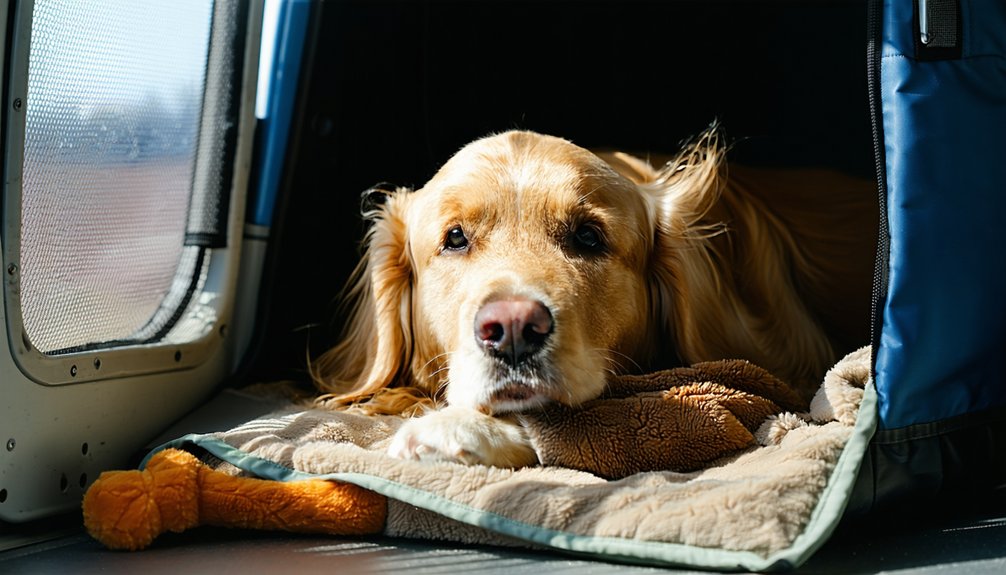
Although sedation might seem like a kind way to spare your dog the stress of a long flight, the American Veterinary Medical Association warns against it for good reason.
Altitude physiology changes everything: reduced cabin pressure and lower oxygen levels amplify the way sedatives suppress your dog’s breathing and heart rate, creating a serious hypoxia risk.
That’s why sedation avoidance has become a cornerstone of responsible airline safety.
You should also know that sedatives impair balance and thermoregulation, leaving your dog vulnerable to falls, overheating, or chilling in the cargo hold.
Brachycephalic breeds face even greater danger.
Because every dog metabolizes drugs differently, a “safe” ground dose can turn dangerous airborne.
Like countless caring owners, you’ll protect your companion best by choosing drug-free calming methods.
Get a Pre-Flight Vet Exam and Health Certificate
Now that you’ve ruled out sedation, your next move is making sure your dog is genuinely fit to fly. A pre-flight exam confirms your dog has no fever, vomiting, or respiratory distress, and helps catch underlying issues that make air travel unsafe. Book early—ideally a month ahead—so there’s time for lab work, vaccine updates, and USDA endorsement. Bring complete vaccination records and microchip details to secure your pet health clearance.
Certificate timing rules vary, so verify them every time you travel:
| Requirement | Typical Window |
|---|---|
| Standard health certificate | Within 10 days of departure |
| Strict routes/carriers | 48–72 hours before departure |
| USDA endorsement | Adds processing time |
| Booking the exam | At least one month ahead |
Confirm your destination’s rules before booking.
Choose an Airline-Approved Crate That Fits Right
Once your dog’s cleared to fly, the crate becomes your most important purchase—and the wrong one can get you turned away at check-in.
Start with crate material: pick rigid plastic or fiberglass with a secure metal-bar door—never soft-sided or collapsible structures.
Verify hardware compliance by confirming the top and bottom fasten with metal nuts and bolts, not plastic clips or slide latches, which fail inspection.
Check door security and ventilation requirements—you’ll need openings on multiple sides, with at least 16% of wall area ventilated on two opposite walls.
Size it right using IATA’s formula: length equals A plus half B, width equals C times two, height equals D plus headroom.
Choose “just large enough” so your dog can stand, turn, and stretch comfortably—and brace during turbulence.
Crate-Train Your Dog in the Weeks Before the Flight
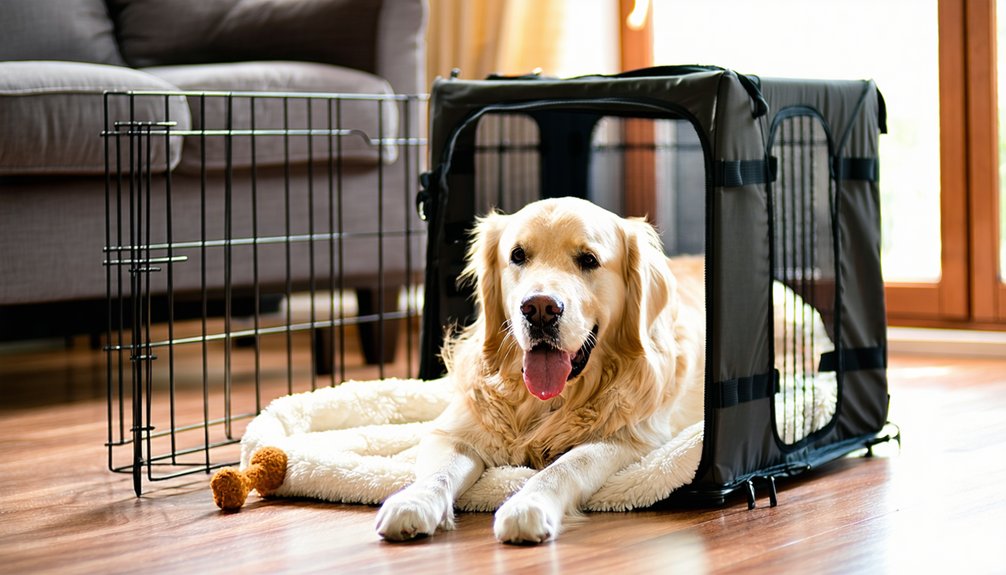
With the right crate in hand, you’ve got the tool—but a crate alone won’t keep your dog calm at 35,000 feet.
Start conditioning at least four weeks out.
Keep the crate in a calm, commonly used room, leave the door open, and add a familiar blanket or owner-scented item so voluntary entry becomes the norm.
Feed meals inside and reward every approach with high-value treats, building positive associations that ease Airline Anxiety.
Close the door only after entry feels reliable, then extend time gradually—seconds, minutes, then supervised naps.
Never let whining open the door.
Practice alone time and short departures, then progress to flight-like drills using crated car rides.
Securing the crate during driving reinforces Crate Safety and teaches your dog to stay settled.
Desensitize Your Dog to Airport Sounds and Motion
Because a crate-trained dog still panics at the first roar of a jet engine, you’ll need to tackle sound and motion separately before flight day.
Start by playing airport recordings—takeoffs, boarding announcements, baggage carts—at barely audible levels, pairing each with high-value treats.
Raise the volume only when your dog stays loose and relaxed.
- Sound desensitization: Vary speaker location and direction so calm responses generalize across rooms.
- Motion acclimation: Introduce stationary luggage, then slow rolling, rewarding neutral behavior on different floor surfaces.
- Real-world practice: Visit terminals during off-peak hours, retreating if stress signs appear.
Reinforce calm crate positioning throughout, and practice emergency exit readiness so you can retreat quickly.
Join countless owners who’ve built confidence this way—your dog belongs by your side.
Build a Calm Relaxation Routine on a Mat
Although your dog now tolerates airport sounds and motion, you still need a portable “off switch” that triggers calm anywhere—and a dedicated relaxation mat delivers exactly that.
Choose a non-slip, padded mat large enough for a full-body stretch, and place it in a quiet area first.
Build a positive association by dropping high-value treats on it, reserving the mat for calm behaviors only.
Lure a down, then feed a slow stream of treats between the front paws, shaping relaxed postures like hip rolls and resting heads.
Add a “settle” cue once your dog reliably lies down.
Follow mat consistency rules and clear treat timing cues to reinforce stillness, gradually increasing duration, distance, and distractions.
Finally, pair the mat with carriers and pre-flight routines, generalizing calm into travel.
Pack Familiar Scents to Keep Your Dog Calm
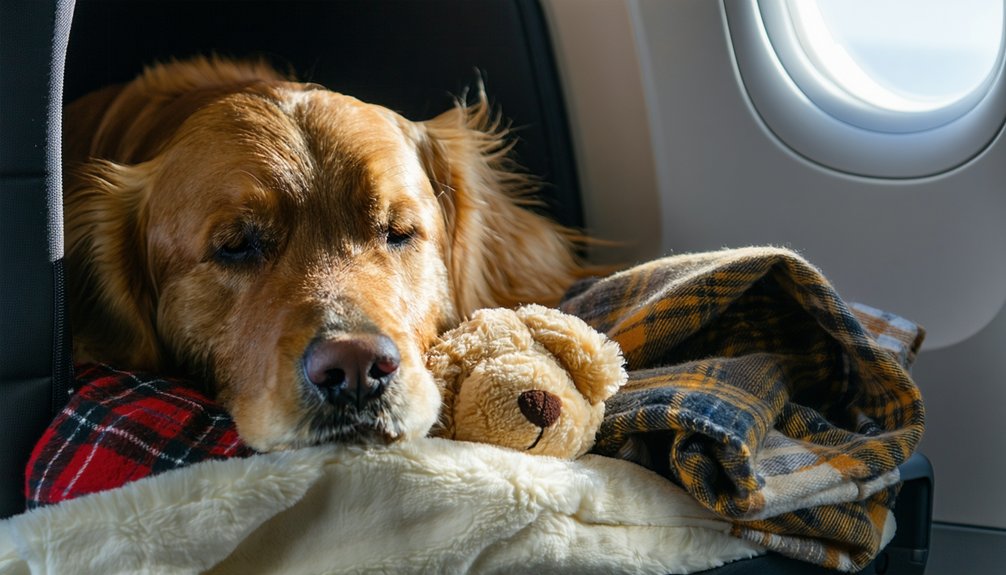
Build your scent kit with three sources:
- Unwashed bedding from your dog’s regular sleeping area for olfactory continuity.
- A worn T-shirt or pillowcase, secured under padding so he can’t shred or ingest it.
- One familiar toy or chew, clean of food but rich with home scent.
Do Pheromones and Calming Chews Actually Help?
When you’re trying to avoid sedation, pheromones and calming chews look like appealing alternatives—but you should set your expectations carefully.
Dog-appeasing pheromone (DAP) comes as collars, diffusers, or sprays, and it’s low-risk and non-sedating.
The evidence strength variability matters: moderate evidence supports DAP for thunderstorm fear, but weaker evidence covers general stress in dogs over six months.
Expect modest calming outcomes, often most noticeable during exposure, with some dogs responding little.
Calming chews typically contain L-theanine, chamomile, valerian, passionflower, or melatonin, and they’re best suited to mild anxiety targets.
Keep adjunct only expectations in mind—these are supportive tools for conditioning and routine, not standalone fixes.
Used alongside a multimodal plan, they can help your dog feel safer and more settled.
When Are Trazodone or Gabapentin Worth Considering?
If pheromones and chews haven’t taken the edge off your dog’s travel anxiety, it’s worth talking to your vet about trazodone or gabapentin.
Both target situational stress, but they fit different dogs. Trazodone shines for short-term, flight-day calming without heavy sedation, typically given 1 to 2 hours before departure.
Gabapentin suits dogs whose anxiety pairs with pain, like arthritis or nerve discomfort.
Consider these points before you decide:
- Veterinary dosing matters—your vet chooses the drug based on your dog’s health, stress level, and current medications.
- A home trial lets you spot unexpected sedation or agitation before flight day.
- Not every dog needs medication; many fly well without it.
You’re not alone—plenty of caring owners weigh these options thoughtfully.
Time Exercise, Meals, and Potty Breaks Before Takeoff
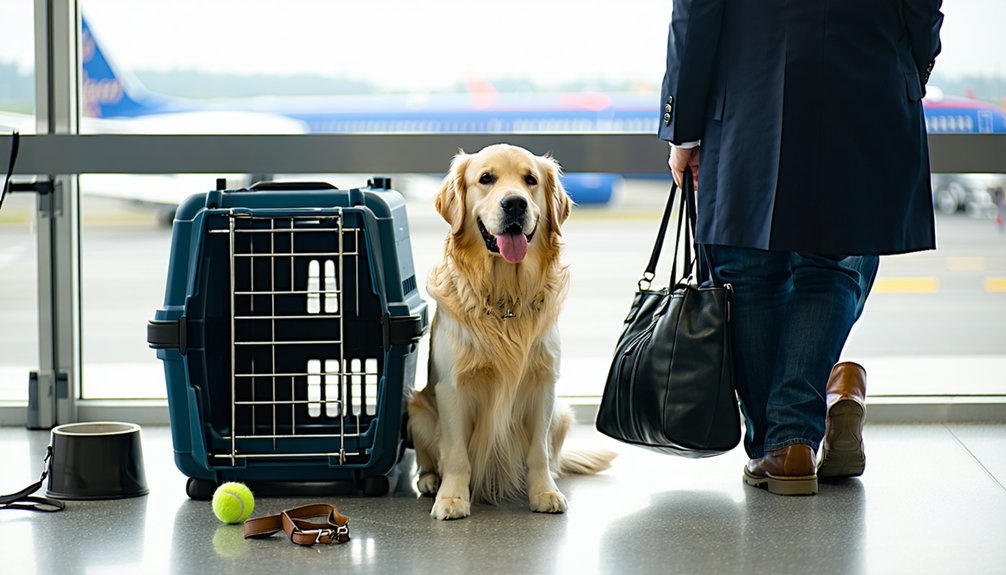
Hours before you leave for the airport, you can set your dog up to rest calmly through the flight by sequencing three things: exercise, meals, and potty breaks. Start with at least 45 minutes of heart-pumping activity—a vigorous walk or fetch 3–4 hours before check-in—so a fatigued dog rests during travel.
Feed lightly or skip the meal entirely; a light meal 4–6 hours out, or no breakfast, reduces vomiting risk. Avoiding Car Sickness matters too, so plan that intense exercise before the airport rush, not during it. Measuring Water Timing helps as well: many sources advise withholding water for several hours before departure.
Then give one final potty break right before boarding, emptying both bowels and bladder. This routine helps your dog settle alongside you.
How to Keep Your Dog Calm During the Flight
Once you’ve timed exercise, meals, and potty breaks, your focus shifts to managing the flight itself. You’re not alone in wanting your dog to feel safe—small, evidence-based choices make the difference. Start with the micro-environment, then layer in calming sensory cues.
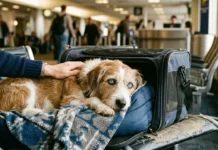
- Set up the crate: Use non slip bedding for stable posture, prioritize familiar scent packing (a worn T-shirt) for comfort, and maintain dim carrier lighting to lower visual stimulation.
- Offer calm sensory support: Your calm handler presence matters—dogs mirror your stress, so move slowly, speak softly, and use a trained “settle” cue.
- Provide safe distraction: Give a favorite chew or quiet food puzzle to encourage self-soothing.
Together, these steps signal safety and keep your companion relaxed throughout.
Spot Stress Signals and Get Behavior Help Early
Because dogs can’t tell you they’re overwhelmed, you’ve got to read their body language and catch stress early. Watch for obvious signals like excessive panting, drooling, trembling, pacing, and repeated escape attempts.
But don’t stop there—identify micro stress signs too: repetitive yawning, fast tongue flicks, whale eye, lip licking, sudden itching, or shaking off when dry.
Freezing or refusing to move toward the carrier isn’t stubbornness; it’s fear.
As you practice, track worsening escalation.
If your dog can’t take treats, can’t settle, or grows more distressed with each exposure, that’s your cue to act.
Persistent panic, self-injury in the crate, or vomiting on practice rides are red flags.
Reach out to a veterinary behaviorist early—you and your dog deserve support.
Frequently Asked Questions
How Much Does It Cost to Fly a Dog Internationally?
You’ll typically spend $1,000–$5,000+ flying your dog internationally, depending on size and route. Join savvy pet parents by budgeting hidden fees—vet work, paperwork, crates—and respecting airport check-in timelines, so you’re never caught off guard.
Can My Dog Fly in the Cabin or Only Cargo?
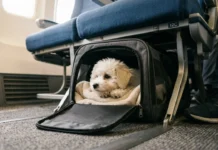
Your dog’s in-cabin eligibility depends on size—small dogs fitting under-seat carriers join you inside, while larger ones travel cargo. Check airline policies, crate sizing, and carrier rules early, since we’re all steering through these limits together.
What Documents Are Required for International Pet Travel?
You’ll need microchip documentation, vaccination records (especially rabies), health certificates with government endorsement, and import permits where required. Joining countless prepared pet parents, you’ll gather these essentials early—your destination’s rules dictate exact requirements, so verify them beforehand.
Are Certain Dog Breeds Banned From Flying Altogether?
No single universal ban exists, but airline policies vary widely. You’ll find brachycephalic breeds and certain “dangerous” types facing temperament restrictions or cargo bans. Always recheck your airline’s rules before booking—we’re all manoeuvring this together.
What Happens if My Dog Has an Emergency Mid-Flight?
Crew handles in-flight panic with basic comfort measures, then requests priority landing for serious emergencies. You’ll feel prepared when you create a calming plan, follow veterinary advice, and pack an emergency checklist—joining countless owners who’ve flown safely together.
Conclusion
You’ve got the tools to fly with your dog safely—no sedation required. Start early: book that vet exam, choose the right crate, and commit to weeks of crate-training and desensitization. Time exercise, meals, and potty breaks wisely, and watch closely for stress signals throughout the trip. If anxiety runs high, talk to your vet about trazodone or gabapentin. Prepare thoroughly, stay attentive, and you’ll give your dog the calmest flight possible.
References
- https://travelreadypets.com/how-to-calm-dog-or-cat-for-flying/
- https://passportforpets.co.uk/blog/preparing-pets-for-long-haul-flights
- https://www.youtube.com/watch?v=ElFOah0oH18
- https://tailwindglobalpet.com/blog/dog-sedatives-for-travel/
- https://www.petholidayclub.com/blog/dog-travel-anxiety-what-a-brand-new-study-found-and-what-actually-helps
- https://www.petholidayclub.com/blog/how-to-keep-your-pet-calm-during-a-long-international-flight/
- https://nelsonsequestrian.co.uk/is-flying-traumatic-for-dogs-risks-stress-signs-and-how-to-make-air-travel-safer-2025-guide
- https://www.petcargo.com/en/blog/is-it-safe-to-sedate-dog-for-flight
- https://www.petmd.com/dog/slideshows/7-ways-comfort-your-dog-while-flying
- https://moxietrail.com/traveling-with-pets-on-international-flights-what-three-vet-approved-sedatives-actually-do-and-why-airlines-ban-most-of-them-2/