Airlines don’t universally require muzzles, but carriers like LATAM, Binter Canarias, and Condor mandate them for dogs over 12-20 kg, including some ESAs. You’ll also find gate agents can deny boarding on the spot for uncontrolled pets, regardless of prior approval. Sedation isn’t a safer alternative—AVMA and IATA guidance warns altitude intensifies drug effects, disrupts thermoregulation, and depresses breathing. Keep going, and you’ll see exactly how these rules apply to your pet’s size and breed.
TLDR Key Takeaways
- Muzzle rules vary by airline, often required for large or restricted breeds over specific weight limits.
- Airlines like Binter Canarias, Condor, and LATAM enforce muzzle requirements for dogs over 12-20 kg.
- Airlines prefer physical containment like muzzles over sedation to manage unpredictable pet behavior safely.
- Sedation is risky since altitude and stress intensify drug effects, depressing the central nervous system.
- Sedated pets face heightened risks like heatstroke, hypothermia, and loss of righting reflex during flights.
Do Airlines Require Muzzles for Pets and Service Animals?

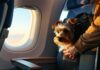
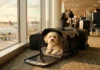
A muzzle isn’t the default rule for pets flying in the cabin. You’ll find that airline rules focus on an approved carrier that fits under the seat, not muzzling. Pet policies from the FAA and carriers like Delta emphasize kennel size, placement, and age limits instead.
Service animals follow the same logic: Singapore Airlines doesn’t require a muzzle unless your dog is a restricted breed, though one should be available just in case. Restricted breeds may need behavior documentation, a muzzle, restraint, and leash for the entire flight. Some airlines require muzzles for large dogs over 20 kg or breeds labeled “dangerous,” but these rules aren’t universal—they’re airline-specific, so you’ll want to check before you fly. For example, Binter Canarias and Condor both require a muzzle specifically for dogs weighing over 20 kg when transported in the cargo hold or cabin. Muzzle requirements can also extend to emotional support animals, since LATAM Airlines requires a muzzle for ESA dogs over 12 kg. Unlike pets, service animals are considered working animals and are not required to be confined in a container or cage, which is why muzzle policies for them differ so much from standard pet carrier rules.
Why Airlines Enforce Muzzle Rules in the Cabin
Because a pressurized cabin counts as a confined high-risk space, airlines treat muzzle rules as frontline safety tools rather than arbitrary restrictions. You’re sharing a narrow aisle—often just 3-4 meters wide—with limited escape routes, so unpredictable animal behavior becomes a genuine cabin safety concern. Crew members need clear passage to reach safety equipment, exits, and medical kits without obstruction. Aviation authorities classify aggressive or unpredictable behavior as an operational hazard requiring mitigation, and muzzles serve that exact purpose. This mirrors how the Sterile Cabin Rule restricts non-essential activity below 10,000 feet to keep crew focused during critical phases of flight.
| Concern | Risk | Muzzle Benefit |
|---|---|---|
| Confined space | No escape room | Reduces bite risk |
| Crew access | Blocked aisles | Keeps paths clear |
| Liability | Legal exposure | Shows due diligence |
| Regulation | Safety scrutiny | Demonstrates compliance |
You still fly with your dog—just safely, and within reason.
Can Airlines Set Their Own Pet Containment Rules?
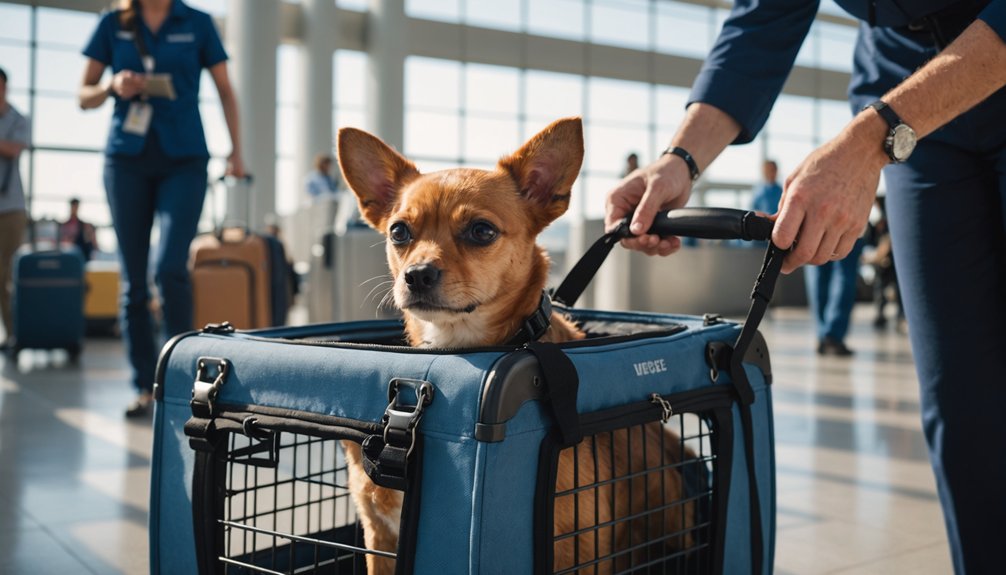
Since federal law only sets the outer boundaries, airlines fill in the rest with their own containment rules.
FAA regulations require a pet container to fit under the seat and stay stowed during taxi, takeoff, and landing—but that’s where federal authority stops.
DOT confirms size and weight limits fall entirely to each carrier, meaning airline policies dictate your real-world options.
You’ll see this discretion play out through:
- Carrier limits – American Airlines caps carriers at 18 x 11 x 11 in and 20 lbs total.
- Behavioral demands – pets must stay harmless, odorless, and contained the whole flight.
- Documentation rules – some carriers require a recent veterinary health certificate, and this certificate must typically be issued within 10 days of travel. Fees for these containment and travel requirements typically range from $35–$150 per pet, per flight, depending on the airline.
Know each airline’s pet regulations before booking—your freedom to travel with your pet depends on it.
Small Pets vs. Large Dogs: Muzzle Rules Compared
Once you know how airlines set their own containment specs, you’ll notice size does most of the work in deciding whether muzzle rules even apply to your pet. Small pets stay zipped inside under-seat carriers, so crews rarely demand muzzles—your cat or small dog is already contained. Large dogs don’t get that pass. If they’re not fully enclosed in cargo-approved crates, muzzling expectations rise fast, especially around public safety concerns. Small dogs can typically be hand-carried through security instead of walked on a leash.
| Pet Type | Muzzle Likelihood |
|---|---|
| Small pet in carrier | Rare |
| Large dog outside crate | High |
| Large dog in cargo crate | Situational |
| Brachycephalic large dog | Often Restricted |
Pet policies vary by carrier, but airline restrictions consistently favor smaller, fully-contained animals—know this before you book your freedom to fly. Airlines like American Airlines require original signed health certificates for large dogs traveling via cargo, adding another layer of preparation beyond muzzle compliance.
Service Animals and the “Direct Threat” Standard
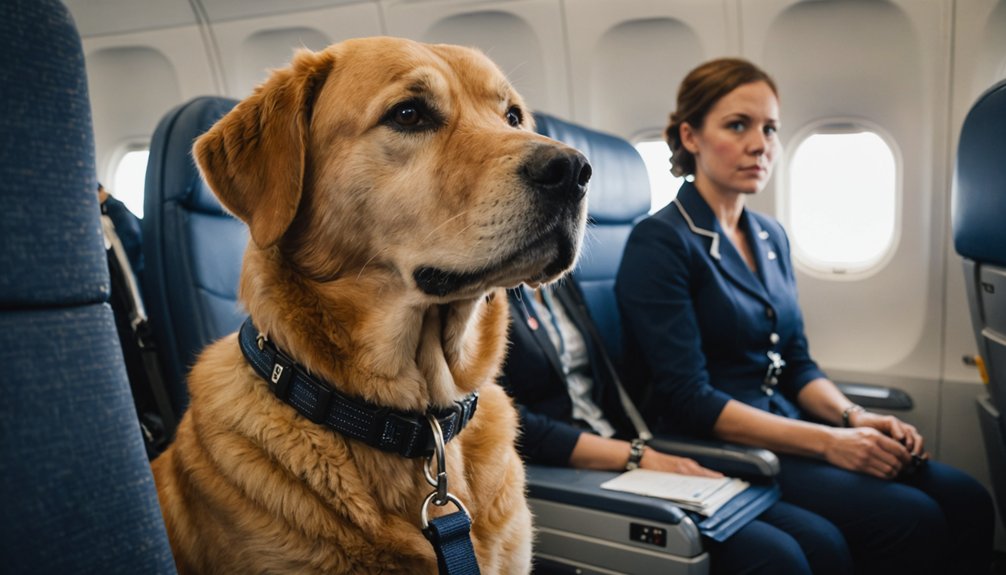
A proper threat assessment considers:
- Nature and severity of risk—is the behavior genuinely dangerous?
- Probability of harm—how likely is an incident to occur?
- Available mitigations—can reasonable accommodations neutralize the risk?
Your disability rights remain intact; airlines can’t invoke blanket bans.
They must evaluate your specific animal’s conduct, not generalized fears, before denying boarding. Staff may only remove an animal from the premises if it is out of control and the handler fails to take effective action. Covered entities under the ADA are permitted to request credible verbal assurance of a person’s disability and the service the animal performs, rather than demanding documentation or certification. There is no national or state registry, certification, or licensing requirement, and owner-training is fully permitted for service dogs.
Muzzle Rules on International Flights and Public Transit
International travel throws a curveball at handlers: many carriers require pet dogs to be muzzled and leashed while in the cabin, and that’s before you factor in the general “direct threat” protections service animal handlers otherwise enjoy domestically.
Larger dogs face the strictest scrutiny—airport staff often handle them through crowded terminals, boarding queues, and transfers, so muzzles reduce bite risk during unpredictable moments.
Rules aren’t uniform: each airline sets its own travel guidelines, and destination countries add their own layers, from health certificates to behavioral documentation. A health certificate confirms your dog is fit to fly and current on required vaccinations, and it’s often mandatory before international carriers will even process your booking.
If your dog exceeds cabin size limits, hold transport kicks in, and ground crews may require muzzling during handling. Airlines also typically require entry permits and other documents for the countries you’ll be entering or transiting through, adding another layer of preparation before departure.
Bottom line: pet safety standards abroad don’t mirror U.S. domestic norms, so you need to check every carrier’s conditions of carriage before you fly.
What Happens If Your Pet Isn’t Muzzled at the Gate?
Show up at the gate with an unmuzzled dog roaming loose, and you’re gambling with your travel plans.
Gate procedures give agents full authority to deny boarding on the spot—no exceptions for prior check-in approval.
Pet safety concerns drive this: an uncontrolled mouth reads as a liability risk in crowded boarding areas, and staff won’t take that gamble.
Here’s what typically unfolds:
- Immediate containment demand — you’re told to muzzle or carrier your pet before boarding continues.
- Scramble for gear — if you lack compliant equipment, you may need to buy it fast, racing the door-closure clock.
- Rebooking fallout — miss the window, and you’re bumped to a later flight, often with fees attached.
Freedom to fly with your pet depends on playing by these rules.
Muzzles vs. Sedation: Which Do Airlines Actually Prefer?
Once you’ve sorted out the muzzle situation at the gate, don’t assume sedation offers a safer backup plan—it doesn’t.
Airline policies consistently favor physical containment over chemical control.
A crate and, when required, a muzzle are treated as behavioral tools; sedation is treated as a medical risk.
Altitude and stress can intensify drug effects, worsening respiratory and cardiac strain, especially in flat-faced breeds.
That’s why AVMA and IATA-linked guidance discourage routine tranquilization, reserving it for medically necessary cases under veterinary supervision.
Some carriers even deny boarding to visibly sedated pets or require disclosure of medication use. In one recent case, a dog given gabapentin and trazodone before a flight was denied boarding after the owner disclosed the sedation at the check-in desk.
If you want your travel freedom protected, respect pet preferences and stick to non-drug solutions—crate training, exercise, and calm handling beat sedatives every time. Vets instead recommend crate acclimatization to reduce travel stress without relying on medication.
Why Sedating Pets Before Flights Is Risky
Because sedatives depress the central nervous system, your pet’s response to stress and environmental change drops sharply during flight, and that’s exactly when they need it most.
Veterinary documentation confirms real pet risks: breathing slows, blood pressure drops, and undiagnosed heart conditions become dangerous liabilities at altitude.
Sedation doesn’t just dull awareness—it strips your pet’s physical defenses at the worst possible moment.
Three mechanisms compound the danger:
- Thermoregulation fails—reduced panting and muscle tone leave pets vulnerable to heatstroke or hypothermia in cargo holds.
- Righting reflex disappears—your pet can’t reposition during turbulence, loading, or landing, risking injury.
- Cardiovascular strain increases—altitude pressure combined with sedatives strains an already-suppressed system.
You value your pet’s freedom and safety—true animal welfare means rejecting sedation as a shortcut and choosing methods that keep their body’s natural defenses intact.
How Altitude and Cabin Pressure Affect Sedated Pets
When your flight climbs to cruising altitude, cabin pressure settles at an equivalent of 6,000–8,000 feet, and at 8,000 feet barometric pressure drops roughly 26% compared to sea level.
Oxygen concentration stays at 21%, but its partial pressure falls, putting your pet into mild hypoxia.
Healthy animals compensate through faster, deeper breathing—the hypoxic ventilatory response.
Sedation blocks this defense.
Altitude effects hit harder when a sedative’s already slowing respiration and dropping blood pressure, stacking cardiovascular strain on top of hypobaric stress.
Cabin pressure alone rarely threatens a healthy, alert animal—air holds continuously renew oxygen supply.
The danger emerges when sedation blunts your pet’s natural compensatory response, leaving them unable to adjust to reduced oxygen availability at altitude.
How Airlines Assess Temperament Instead of Sedating Pets
Airlines favor eyes over drugs. Instead of masking behavior with sedatives, staff rely on direct pet assessment—watching how your animal reacts in real time.
This temperament evaluation happens at check-in, boarding, and cargo loading, giving handlers a clear read on whether your pet is fit to fly without chemical interference.
Airlines use a simple three-point standard:
- Calm control – no snarling, lunging, or excessive barking.
- Physical composure – alert, responsive, not overly lethargic or stressed.
- Manageable restraint – proper restraint system or leash signaling training and stability.
This model mirrors service-animal rules, where disruption or aggression means exclusion. You keep your freedom to travel by proving your pet’s stability—not by dulling its senses.
How to Prepare Your Pet for Flying Without Sedation
Since sedatives are off the table, preparation becomes your real tool for a stress-free flight. Start crate training weeks in advance, using positive reinforcement so carrier familiarity builds naturally. Establish an exercise routine—substantial activity the day before, plus a walk before entering the airport—to burn off anxious energy. Nail down feeding timing: skip meals 4-6 hours pre-departure, offer water freely, and consult your vet on specifics.
Don’t skip health checks—confirm fitness to fly and gather travel paperwork, including a health certificate within 10 days of departure. Add comfort measures like a familiar blanket or toy inside the crate.
This combination—crate training, routine, timing, and paperwork—is real flight preparation. It’s how you protect pet safety without drugs, and it’s the smartest travel tip you’ll follow.
Frequently Asked Questions
Can I Bring My Own Muzzle or Must It Be Airline-Approved?
You can bring your own muzzle—airlines don’t mandate “approved” brands. Muzzle rules under airline policies just require humane, secure, well-fitting designs that let your dog pant freely. Choose confidently; you’re not locked into buying anything specific.
Are There Natural Calming Alternatives Vets Recommend Instead of Sedatives?
Yes—you’ve got options. Try calming treats with chamomile, L-theanine, or valerian root, or use pet therapy tools like DAP pheromones and compression wraps. Vets favor these low-risk, drug-free choices for keeping your dog’s freedom and comfort intact.
Will My Vet Need to Sign off on My Pet’s Fitness to Fly?
Yes, you’ll need vet approval. Airlines require health certificates issued within 10 days of departure, confirming you’re fit to fly per IATA and AVMA standards—giving you documented freedom to travel confidently with your pet.
Can Airlines Refuse Boarding if My Pet Shows Anxiety Symptoms?
Yes, airlines can refuse boarding if your pet’s behavior signals distress. Per airline contracts of carriage, staff assess pet behavior for animal welfare and safety—continuous panting, frantic escape attempts, or vocalization can trigger denial.
Does Travel Insurance Cover Incidents Involving Unmuzzled or Sedated Pets?
No—your pet insurance won’t cover unmuzzled biting incidents or sedation reactions if you’ve skipped carrier rules or ignored known behavioral issues. Standard travel policies exclude pets entirely, so you’ll need explicit pet riders for any real protection.
Conclusion
You don’t need sedatives to fly with your pet—you need preparation. Airlines enforce muzzle and containment rules to protect everyone in the cabin, and the FAA and ASPCA both warn that sedation raises serious risks at altitude. Instead, focus on crate training, temperament conditioning, and following your airline’s specific policies. When you prepare your pet properly, you’ll meet safety standards without gambling on your animal’s health mid-flight.
References
- https://www.facebook.com/groups/1180884898968404/posts/2508731082850439/
- https://www.travelnuity.com/dog-muzzle-for-travel/
- https://www.transportation.gov/briefing-room/us-department-transportation-issues-final-statement-enforcement-priorities-regarding
- https://www.reddit.com/r/unpopularopinion/comments/18ymz13/animals_flying_in_passenger_seats_should_be/
- https://zastavaarmsusa.com/flying-with-a-suppressor-tsa-rules-airline-policies-and-case-checklist/
- https://redlandbaysidenews.com.au/sealink-dog-muzzle-policy/
- https://www.tsa.gov/news/press/factsheets/firearms-and-ammunition
- https://www.aa.com/web/i18n/travel-info/baggage/firearms-and-ammunition.html
- https://www.business-standard.com/article/companies/formulate-policy-on-carrying-pets-on-flights-display-it-on-websites-dgca-123011701406_1.html
- https://www.delta.com/us/en/pet-travel/overview